
Initial Detainee Facility Challenges in Somalia
The doctrinal plan for establishing detainee holding areas in Somalia was functionally impossible. U.S. forces, deploying in December 1992 as part of the Unified Task Force (UNITAF), arrived to a complete absence of the secure, pre-positioned infrastructure that tactical manuals presumed would be available. A review of operational logs from units like the 1st Marine Division and the Army's 10th Mountain Division indicates that sites designated for detainee collection were open tracts of land. There were no buildings, no fences, and no functioning utilities. The city of Mogadishu was a ruin. Public buildings had been systematically looted and destroyed, with no functional sanitation systems or law enforcement. This forced an immediate pivot from occupation to large-scale construction under duress. The expectation, as outlined in U.S. military publications, was to secure and modify existing structures like warehouses or schools. In Somalia, no such structures existed in a usable state, invalidating the foundational assumptions of the mission’s detention plan before the first captive was taken.
This infrastructure void was compounded by a scarcity of both construction materials and specialized personnel. The initial landings of Operation RESTORE HOPE brought some engineering equipment aboard maritime prepositioning ships, but these were intended to rebuild port facilities, not to construct prison camps. Archival evidence from UNITAF after-action reports shows a scramble for basic engineering supplies. Concertina wire, lumber, sandbags, and nails were in short supply. The few combat engineer and Navy Seabee detachments in theater were stretched thin, tasked with road repair, airfield maintenance, and the fortification of their own bases. They lacked the manpower and dedicated material stockpiles to rapidly erect detainee compounds capable of holding hundreds. Planners had estimated the overall UN mission would require a five-brigade force supported by 8,000 logistics personnel but acknowledged shortfalls in engineer forces from the outset. Local procurement was not a viable alternative; the local economy had collapsed, and attempting to purchase materials in a city ruled by rival warlords was a hazardous undertaking.
The operational environment itself presented a persistent threat to establishing and maintaining any facility. The extreme heat, often soaring above 100 degrees Fahrenheit, placed immense physical stress on both guards and detainees. Without climate-controlled structures, dehydration and heat-related illnesses were a constant danger. This was made worse by the lack of functioning sanitation systems. In a landscape devoid of modern plumbing, the disposal of human waste for a concentrated population became a major health risk. Makeshift latrines quickly became breeding grounds for disease. Medical intelligence reports from the period highlighted the high risk of communicable diseases like cholera and dysentery spreading rapidly through any camp. Providing adequate clean drinking water was a logistical nightmare, requiring constant purification and distribution in a water-scarce region. The combination of intense heat, rudimentary shelter, and inadequate sanitation created conditions for a public health disaster, turning any holding pen into a potential epicenter for an outbreak.
Doctrine Versus Somali Ground Conditions
The entire legal framework for managing captured persons, as understood by Western armies, was built for a conflict that did not exist in Somalia. U.S. military doctrine was founded upon the protocols of the Geneva Conventions, which presupposed a conflict between nation-states employing uniformed armed forces under a responsible chain of command. The Conventions conferred Prisoner of War (POW) status upon individuals who met specific criteria: belonging to a party to the conflict, having a fixed distinctive sign, carrying arms openly, and conducting operations in accordance with the laws of war. The clan militiamen of Mogadishu met none of these requirements. They were non-state combatants, loyal to warlords like Mohamed Farrah Aidid rather than a signatory government, wore no uniforms, and blended with the civilian population. A review of after-action reports from both UNITAF and UNOSOM II reveals this was a fundamental breakdown of the system’s core premise. U.S. forces could not legally grant POW status to captured Somali fighters, which immediately invalidated the established doctrinal procedures for their handling and disposition.
This absence of a clear legal category for captured individuals created administrative ambiguity that cascaded from high-level command down to tactical units. With POW status inapplicable and the local Somali justice system nonexistent, captured fighters occupied a gray zone. They were not criminals in a traditional sense, as there was no functioning civilian judiciary to process them, yet they were not protected POWs. Operational logs from the 10th Mountain Division and Task Force Ranger show a confusing array of ad-hoc terminology, with captured persons logged as "detainees" or "local nationals," labels that carried no defined legal pathway. This ambiguity was paralyzing. Unit commanders on the ground received no clear guidance on critical questions. How long could a detainee be held? What were the rules for interrogation? What was the ultimate disposition for these individuals? They could not be transferred to a local authority that did not exist, and indefinite detention by U.S. forces created its own set of legal and logistical problems, turning makeshift holding pens into administrative black holes.
The problem was compounded by the rapid and violent operational tempo of urban combat, which precluded any opportunity to implement formal POW processing. The doctrinal ideal, as outlined in field manuals, involved a multi-step process at the point of capture. This included searching the individual, tagging them with a DD Form 2745 (Enemy Prisoner of War Capture Tag), and documenting the circumstances of their capture. A soldier was expected to record the capturing unit, time, and location, creating a paper trail. In the chaotic street battles of Mogadishu, this was not feasible. During raids conducted by units like Task Force Ranger, the interval between insertion and first contact was often measured in seconds. The priority for assault teams was overwhelming the objective, securing high-value targets, and surviving the counter-attack. A soldier pausing to fill out a multi-part form while under fire was a liability. Detainees were often subdued with flex-cuffs, minimally searched for immediate threats, and moved toward extraction points with extreme haste. The paper trail required by doctrine was shredded by the pace and violence of the fighting.
Makeshift Detainment Camp Fortifications
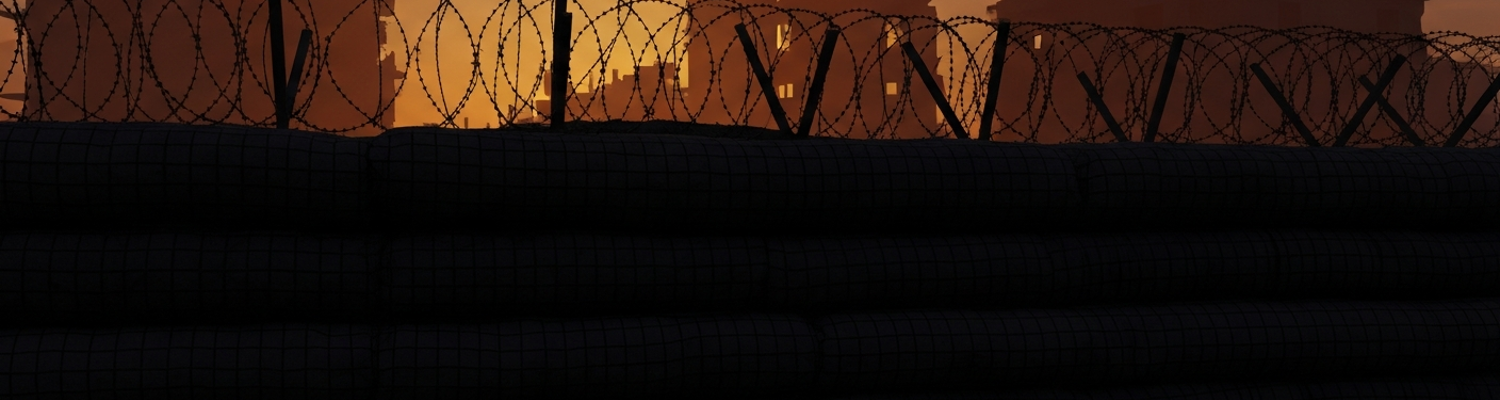
A review of operational logs from engineer and infantry units, such as those from the 10th Mountain Division during Operation Restore Hope, shows that the construction of detainee holding areas was an exercise in improvisation. The foundational element of any perimeter was triple-strand concertina wire, a non-doctrinal but universally available material. Teams of soldiers, working in punishing heat, would deploy thousands of feet of this wire, stretching it between metal pickets driven into the hard-packed Somali earth. These barriers were layered, often three or four deep and stacked vertically to create a tangled, impassable wall of barbs. The wire alone was insufficient. It provided a visual deterrent and a cutting hazard but lacked mass and could be breached with simple tools or crushed by a vehicle. To add substance, units embarked on the physical task of filling and stacking hundreds of thousands of sandbags. This was grueling, manual labor that consumed immense man-hours and exposed troops to the elements and potential sniper fire. The process was further complicated by the scarcity of quality fill material; soldiers often resorted to using rubble, debris, and poor-quality sand, which compromised the structural integrity of the sandbag walls. To compensate, units scavenged the urban landscape, dragging pieces of scrap metal, destroyed vehicle chassis, and concrete rubble into the defensive line to create a crude but more formidable barrier.
Where available, standard-issue engineering assets were adapted for purposes far beyond their intended design. The HESCO bastion, a collapsible wire-mesh container lined with heavy-duty fabric, was a prized commodity. Designed for creating robust blast walls on major operating bases, their allocation for a temporary detainee facility was a significant command decision. Engineer support teams with front-end loaders would fill these large containers with sand, rapidly creating thick, bullet-resistant walls that were far superior to sandbags alone. However, HESCO barriers were in short supply and high demand for fortifying critical infrastructure like the main airfield and command posts. Their use at detainee sites was limited, often reserved for entry control points or critical corners of the compound. Similarly, concrete vehicle barriers, commonly known as Jersey barriers, were commandeered. Designed for traffic control, these heavy, pre-cast structures were laboriously moved into place to form an unyielding lower wall, often topped with layers of concertina wire to increase their height and deterrent effect.
The absence of purpose-built infrastructure necessitated the creation of improvised surveillance and observation systems. Lacking dedicated lighting towers, units would position tactical vehicles like HMMWVs along the perimeter, using their headlights to illuminate the wire at night. This created predictable patterns of light and shadow, consumed fuel, and drained vehicle batteries, but it was the only available option. Observation posts were jury-rigged affairs, often consisting of little more than a sandbagged position built on top of a standard shipping container or a hastily constructed wooden platform. These elevated positions gave guards a better vantage point but also made them prominent and exposed targets. Surveillance was an analog affair, relying on soldiers equipped with binoculars and early-generation night vision goggles scanning their sectors. To provide early warnings, crude tripflares and noise-makers fabricated from empty cans and wire were sometimes strung in the dead space between concertina wire fences, a field-expedient solution to a technologically barren environment.
Improvised Captive Movement Protocols
The supply chain for detainee operations in Somalia was unprepared for the mission, a failure that manifested in the most basic tools of control. Doctrinal procedure called for the use of standard-issue metallic handcuffs, but a review of supply manifests and after-action reports from units like the 10th Mountain Division and Task Force Ranger shows these items were not available in sufficient quantity. The mission was not initially envisioned to require mass detentions. In their place, soldiers relied on personal restraints, primarily plastic zip ties and lengths of rope. This was a necessity born from a logistical shortfall. While effective for short-term control in a secure environment, these improvised methods were inadequate for moving non-compliant or wounded individuals through a hostile city. Plastic zip ties, lacking the double-locking mechanism of law enforcement-grade restraints, could be cinched tighter during a struggle, cutting off circulation and causing tissue damage. They were also susceptible to being cut or broken. Rope was an even poorer substitute, difficult to apply securely under pressure and more likely to inflict injury. The use of these field-expedient items represented a disconnect between the assumed availability of specialized equipment and what was actually present in the cargo containers unloaded in Mogadishu.
Moving captured individuals from the point of capture to a holding area was one of the most hazardous tasks a unit could undertake. Convoys are vulnerable, and in the tight, debris-choked streets of Mogadishu, this vulnerability was amplified. A quick reaction force report from October 1993 noted that convoys were more susceptible to attack than ground maneuver forces and needed to be planned with the same level of detail as a direct assault. Analysis of operations conducted by Task Force Ranger during Operation GOTHIC SERPENT reveals the tactical dilemma. The primary method of exfiltration after a raid was by ground convoy, as landing helicopters in the dense urban landscape was deemed too hazardous. These convoys, often consisting of HMMWVs and 5-ton trucks, were unarmored and presented slow-moving, high-profile targets. The decision to transport captives required diverting combat assets, infantry squads to act as escorts and gun trucks to provide fire support, to protect a column that was difficult to defend. The routes were predictable, and ambushes were a constant threat from armed militia who could fire from alleyways and rooftops and then melt back into the civilian population. A single disabled vehicle could halt the entire convoy, turning a transport run into a protracted firefight in a pre-selected kill zone.
The medical support system for detainees during transport was nonexistent. Doctrinal planning assumes a structured evacuation chain for all casualties, but in Somalia, this system was reserved exclusively for U.S. and UN forces. There was no dedicated medical transport, no designated medical personnel, and no specific facility for treating injured Somali captives. A captured fighter wounded in a firefight was another body to be loaded onto a truck. This created a cascade of tactical and humanitarian problems. Soldiers providing convoy security were not equipped or trained to render aid to wounded captives, who may have been suffering from gunshot wounds or other severe trauma. Placing a wounded, potentially contagious, and hostile individual in the back of a truck alongside other detainees and their guards created a dangerous and unsanitary environment. A detainee dying en route from untreated wounds was a common possibility, creating a new set of legal and operational challenges for the capturing unit. This absence of planning is evident in operational logs, which contain no specific protocols for the triage, treatment, or transport of injured enemy personnel, forcing soldiers on the ground to improvise solutions under the most dangerous conditions.
Soldier Burden and Detainee Management
The responsibility for detainee management placed an unanticipated strain on the tactical units assigned to the mission. Combat soldiers from infantry outfits like the 10th Mountain Division, trained for high-intensity maneuver warfare, found themselves relegated to the monotonous duty of guarding hastily constructed perimeters. This was not a passive role. Guards stood for hours in extreme heat, staring at wire and sand, exposed to sniper fire and the threat of coordinated attacks. After-action reports detail a state of high alert that was psychologically exhausting to maintain over prolonged periods. The environment bred a combination of boredom and fear. This was compounded by the physical misery of the conditions, with the risk of diseases like cholera and dysentery spreading from the detainee population to the guards. The psychological toll manifested as burnout, heightened irritability, and desensitization to the grim surroundings. The stress was made worse by the nature of the detainees themselves, a mix of hardened militia fighters, common criminals, and civilians swept up in raids, none of whom had a clear legal status, creating an atmosphere of ambiguity and latent hostility that permeated every interaction across the wire.
Every soldier assigned to guard a detainee compound was a rifleman removed from a front-line combat mission. A review of operational logs reveals that commanders were forced to divert entire platoons and even companies from their primary objectives of patrolling, securing key infrastructure, and conducting offensive operations. This diversion of personnel was a drain on units already stretched thin. The 10th Mountain Division had to allocate significant manpower not only to direct guard shifts but also to the physical labor of constructing and maintaining the facilities. The man-hours consumed by filling sandbags, stringing concertina wire, and building improvised watchtowers were hours not spent on mission rehearsals or tactical training. The equipment followed the personnel. HMMWVs needed for patrols were used as static guard posts or to illuminate the perimeter at night, consuming fuel and draining batteries. Communications equipment essential for coordinating combat patrols was instead tied into the command net for the holding area. This diversion represented a direct degradation of a unit’s ability to project force and respond to threats, forcing commanders to make choices between force protection at the compounds and mission execution in the streets.
The doctrinal void surrounding detainee status created a profound ethical problem for soldiers on the ground. With captives falling outside the protections of the Geneva Conventions, U.S. troops received no clear guidance on interrogation or long-term treatment. This ambiguity was not an abstract legal problem; it forced young soldiers and junior leaders to make command-level ethical decisions in a tactical vacuum. The pressure to gather intelligence on warlord activities, especially after the ambush of Pakistani forces in June 1993 and subsequent attacks on U.S. personnel, was extreme. This created a direct conflict with the principle of humane treatment, particularly under the harsh field conditions where resources were scarce. Providing adequate food, water, and medical care to detainees often meant stretching a logistical chain that was already failing to fully supply U.S. troops. Reports from the period indicate that UNOSOM detained dozens, and in some cases hundreds, of individuals without charge or trial, holding them for interrogation in special facilities. Soldiers faced the dilemma of enforcing a detention regime that had no defined legal endpoint while being expected to adhere to Western humanitarian standards in an environment that made doing so nearly impossible. The lack of a functioning Somali judicial system meant there was no authority to transfer detainees to, turning U.S. units into indefinite jailers.