
Forging the Amphibious Armada
With North Africa secured, Allied strategic planners turned their attention to Sicily. The invasion, Operation Husky, was a necessary step to open the Mediterranean and begin the assault on continental Europe. General Dwight D. Eisenhower, the Supreme Allied Commander, oversaw the operation from Algiers. His principal naval commander, Admiral Sir Andrew Cunningham, directed the immense fleet from Malta. This command structure, with land, sea, and air chiefs operating from separate headquarters, created communication delays and friction that would manifest throughout the campaign. The naval forces were divided into two massive fleets. The Eastern Naval Task Force, under British Admiral Bertram Ramsay, would land the British Eighth Army. The Western Naval Task Force, commanded by American Admiral Henry Kent Hewitt, would land the U.S. Seventh Army.
The scale of the operation was without precedent. It required assembling nearly 3,000 vessels to transport and support an initial assault wave of 160,000 troops. Ports from Tunis to Oran became hives of frantic activity. The principle of combat loading, where equipment needed first was loaded last, governed every action. This meant tanks, artillery, and ammunition were crammed onto ships in a precise reverse order of their intended use, a complex logistical puzzle under immense time pressure. For the soldiers packed into the transports, the journey was a brutal trial. On July 9, 1943, a severe gale swept the Mediterranean. The winds churned the sea, turning the troop holds into pitching, foul-smelling chambers of misery. Widespread seasickness weakened the men before they even saw the enemy. The storm, however, provided an unexpected advantage. Axis defenders, believing no landing possible in such weather, relaxed their guard, granting the invasion a crucial element of surprise.
Coordinating this armada was a supreme navigational challenge. Dozens of convoys, sailing from different ports at different speeds, had to converge on a 100-mile stretch of hostile coastline at precisely the right moment. Royal Navy submarines like HMS Seraph and HMS Shakespeare acted as submerged navigation beacons, surfacing at prearranged times to guide the lead ships to their designated sectors. Despite the gale and the fragmented command system, the vast majority of the fleet arrived on station during the night of July 9-10. The sight of thousands of ships appearing out of the darkness off the Sicilian coast shocked the Italian and German defenders.
The Littoral Steel Tide
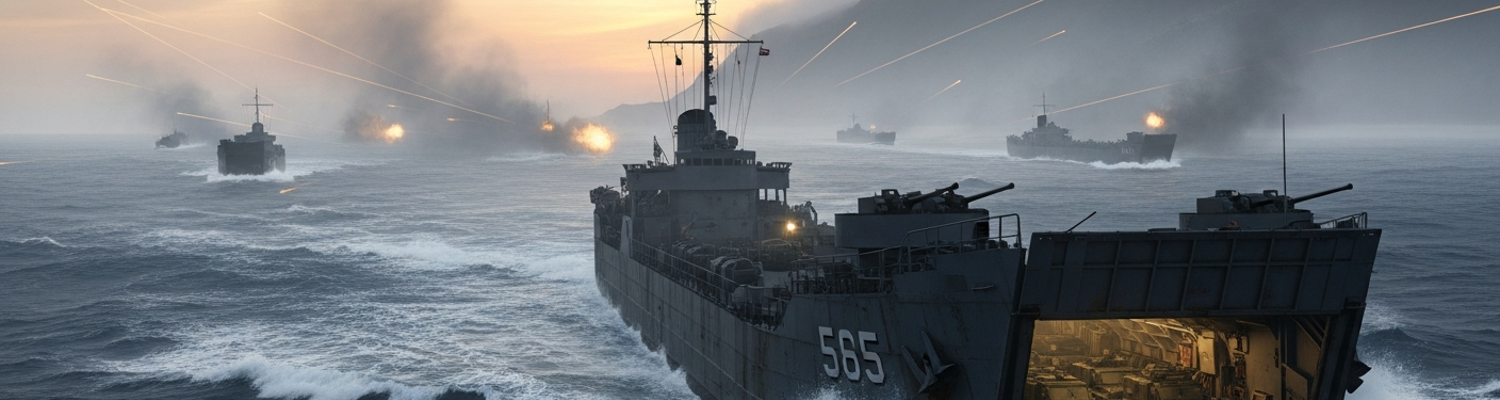
The invasion's success depended entirely on the Allies' ability to project power from the sea onto the land. Husky became the proving ground for amphibious technologies and tactics refined since the earlier landings in North Africa. The operation saw the first large-scale deployment of several new and vital craft. The Landing Ship, Tank, or LST, was a 328-foot, flat-bottomed vessel designed to run aground and disgorge its cargo of tanks and vehicles directly onto a beach through large bow doors. Though slow and vulnerable, earning the nickname "Large Slow Target" from its crews, the LST's ability was transformative. On July 11, LSTs delivered Sherman tanks of the U.S. 2nd Armored Division directly into the fight near Gela, helping to blunt a dangerous counterattack by the Hermann Göring Panzer Division.
Smaller craft played their parts. The Landing Craft, Infantry (LCI) carried around 200 soldiers each, deploying them down narrow ramps on either side of the bow. Landing Craft, Tank (LCTs) brought ashore lighter armor, artillery, and engineering equipment. Perhaps the most versatile vehicle was the GMC DUKW, an amphibious 2.5-ton truck making its combat debut. While the rough surf swamped and damaged many conventional landing craft, the DUKWs navigated the waves with ease. They shuttled ammunition and supplies from ships to shore, ferried wounded men back to hospital ships, and, most importantly, could drive directly off the beach to inland supply dumps, bypassing the chaotic bottlenecks at the water's edge. Admiral Alan Kirk, a senior American naval commander, would later state the DUKW was one of the most valuable pieces of equipment used in the operation.
Naval Gunfire Support (NGFS) had also matured into a precise and deadly art. During Operation Torch, fire support had been reactive and sometimes hesitant. For Husky, detailed fire plans were integrated into every landing. Cruisers and destroyers were assigned sectors, their guns tasked with neutralizing coastal batteries and breaking up enemy formations. The light cruiser USS Boise engaged in a direct fire duel with German Panzer IV tanks threatening the Gela beachhead, its 6-inch guns proving devastatingly effective. The veteran British battleship HMS Warspite lent the weight of its 15-inch shells to the fight around Catania. This fire was directed by spotters in the air and on the ground. Slow, unarmored floatplanes like the Vought OS2U Kingfisher, launched from cruisers, circled low over enemy territory to call in adjustments. These missions were exceptionally dangerous, with pilots exposed to both anti-aircraft fire and Luftwaffe fighters. On the beaches, specially trained Shore Fire Control Parties, consisting of a few men with a radio and a map, advanced with the first waves. These teams directed the fire of offshore destroyers with pinpoint accuracy, saving numerous infantry units from being overrun.
Vertical Envelopment from the Night Sky
A massive and complex airborne assault was designed to precede the seaborne landings. The plan involved the U.S. 82nd Airborne and British 1st Airborne Divisions, tasked with seizing key bridges and road junctions to disrupt Axis movements. The execution was fraught with peril and tragedy. The British 1st Airlanding Brigade, part of Operation Ladbroke, was tasked with a glider assault to capture the Ponte Grande bridge south of Syracuse. The American and British pilots towing the flimsy Waco and Horsa gliders were inexperienced in large-scale night operations. Buffeted by the same high winds that afflicted the fleet, many became disoriented. They released their gliders too early. Of 144 gliders that took off from Tunisia, 65 crashed into the sea, drowning an estimated 252 soldiers.
A small force of about 87 men from the 2nd Battalion, South Staffordshire Regiment, reached the objective. They stormed the Ponte Grande bridge, cut the demolition wires, and held it against repeated Italian attacks. They fought until their ammunition was gone and they were overwhelmed. The bridge was recaptured by advancing British ground forces a short time later. The glider troops' sacrifice had successfully delayed and confused the local defenders. The American airborne drop was even more chaotic. Colonel James Gavin's 505th Parachute Infantry Regiment was scattered across hundreds of square miles. Gavin himself landed nearly 20 miles from his intended drop zone. He began walking toward the sound of the fighting, gathering a small, mixed group of paratroopers. Though dispersed, the paratroopers acted in small bands, ambushing patrols and cutting communication lines. They created the impression of a much larger force, tying down enemy reserves. Gavin's ad-hoc unit eventually grew and led a successful attack on Biazza Ridge, a critical piece of high ground overlooking the American beaches.
The human cost of the airborne plan was compounded by a catastrophic friendly fire incident. On the night of July 11, C-47 transport planes carrying Colonel Reuben Tucker's 504th Parachute Infantry Regiment flew in as reinforcements. The Allied fleet and shore batteries below were on high alert after a day of German air raids. As the C-47s flew over the fleet on a similar approach path used by the Luftwaffe, nervous gunners opened fire. In a cascade of panic, nearly every anti-aircraft gun in the sector joined in. Twenty-three American transports were shot down, and many more were severely damaged. One aircraft that managed to limp back to its base in North Africa was found to have over one thousand bullet holes. The incident killed 81 men and wounded hundreds more. The airborne operations in Sicily, while achieving some of their goals through the sheer determination of the soldiers on the ground, became a painful study in the deadly complexities of joint operations.