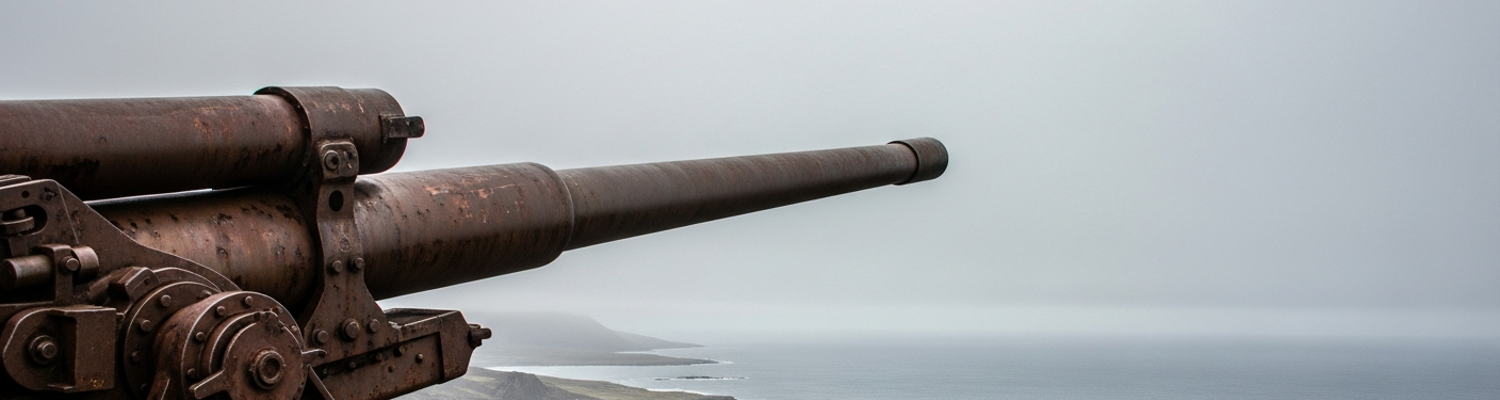

The ordnance manifest for Operation Cottage was a testament to industrial might. Pre-invasion plans allocated hundreds of tons of naval shells. Battleships like the USS Idaho and USS Pennsylvania were prepared to fire their main batteries. Eleventh Air Force B-24s were tasked with delivering over 400 tons of bombs onto Japanese positions throughout July 1943. The ground component, a combined force of over 34,000 American and Canadian troops, carried standard infantry weapons, mortars, and pack howitzers. For the island’s post-invasion fortification, planners allocated heavy coastal artillery, including batteries of the 155mm M1 gun, the “Long Tom.” Each gun weighed 30,434 pounds, required a crew of fourteen, and could fire a 100-pound projectile over fourteen miles. This arsenal was assembled to annihilate the island’s defenders and transform the volcanic rock into an unsinkable fortress.
The order to deploy these defensive guns came hastily, but not as anticipated. On August 15, 1943, assault waves landed to an eerie silence broken only by the Aleutian wind. The Japanese were gone.
Occupation descended into a lethal exercise against a phantom. In the disorienting fog, friendly fire incidents erupted between American and Canadian units. The final count was 32 dead and 50 wounded. Another four were killed by booby traps left by the departed garrison. The destroyer USS Abner Read struck a sea mine, resulting in 71 fatalities. Amidst the confusion, a new directive arrived: fortify the island immediately. The mission shifted from assault to garrison. Army engineers and artillerymen, including elements of the 602nd Field Artillery Battalion, now faced the task of wrestling their heavy equipment onto an island with no prepared docks or roads. They had to move 14-ton guns across miles of mushy, volcanic tundra using ropes and improvised sleds in the perpetually cold, rainy conditions.
This fortification effort was a direct consequence of a significant intelligence miscalculation. For weeks, Allied planners, conditioned by the brutal fight to retake Attu island in May, had prepared for a fanatical defense. They amassed a huge invasion fleet and subjected Kiska to a relentless three-week preliminary bombardment. They remained entirely unaware that on the night of July 28, 1943, Japanese Vice Admiral Masatomi Kimura had executed Operation Ke-Go with flawless precision. Taking advantage of an exceptionally dense fog bank and a temporary gap in the Allied naval blockade, Kimura’s task force of cruisers and destroyers slipped into Kiska Harbor. In just 55 minutes, they evacuated the entire 5,183-man garrison. The task force then melted back into the mist, completely undetected. The American and Canadian soldiers who stormed the beaches three weeks later were invading an empty battlefield. Command refused to accept this fact for several days. The coastal artillery pieces were therefore being laboriously dragged ashore to defend against an enemy that had already orchestrated a perfect escape.
The primary mission of the new Kiska Island Garrison and Little Kiska Harbor Defense Site was defense against a Japanese re-invasion. From a strategic viewpoint, the threat seemed plausible. The Japanese still occupied the nearby Kuril Islands and might try to reclaim their lost North American territory. The plan was to establish interlocking fields of fire covering Kiska Harbor, Gertrude Cove, and other potential landing beaches. This required hauling the 155mm Long Tom guns to commanding heights on places like North Head, a physically demanding engineering task in the unforgiving terrain. Emplacements had to be built. Ammunition had to be stored. Fire-control positions had to be established. The U.S. Army set up six in-water firing ranges to zero the new batteries. For months, these powerful guns stood ready, their crews peering out into the perpetual fog, guarding against an attack that would never come. The guns and their garrisons remained on Kiska through the end of the war, a massive investment of manpower and material against a threat that had evaporated in a single night. The Kiska Naval Auxiliary Air Facility was decommissioned in September 1944. The Army garrison itself was placed on inactive status in December 1945.
Imperial Japanese Navy logs reveal the specifics of Operation Ke-Go. On the night of July 28, 1943, a task force under Vice Admiral Masatomi Kimura exploited a characteristic Aleutian fog to slip past the Allied naval blockade. His force, including the light cruisers Abukuma and Kiso along with several destroyers, entered Kiska Harbor without being detected. The evacuation was a model of discipline. In under an hour, the entire 5,183-man garrison was brought aboard the ships. They left behind booby-trapped equipment, timed explosives, and a handful of stray dogs. The operation’s success was aided by an Allied error. Days earlier, American warships had expended significant fuel and ammunition firing at phantom radar pips, forcing them to temporarily withdraw from the blockade to resupply. This created the exact gap Kimura needed.
The psychological conditioning from the battle for Attu in May 1943 heavily influenced the thinking of Admiral Thomas C. Kinkaid and Lieutenant General John L. DeWitt. They expected a brutal, prolonged fight against what they believed was a large, well-fortified garrison. When initial assault waves on August 15 found only abandoned positions, the assumption was not that the enemy was gone. The command staff believed the Japanese had withdrawn to the island’s rugged interior to mount a defense from prepared positions, mirroring their tactics on Attu. This belief, coupled with the disorienting fog, led directly to the friendly fire incidents. The operational priority became securing the island not against a phantom garrison in the hills, but against a plausible Japanese amphibious counter-invasion. The order was given to fortify the island with extreme urgency.
Even after patrols confirmed the island was deserted, the possibility of a Japanese naval action to retake their lost territory seemed strategically sound. Archival evidence (NARA Record Group 338) shows that for weeks after the August landing, the garrison remained on high alert. Inconclusive reconnaissance flights, often hampered by the fog, and ambiguous radar contacts were interpreted as potential threats. The discovery of abandoned Japanese equipment and numerous booby traps was seen by some not as evidence of a final withdrawal, but of a hasty retreat intended to be temporary. Army engineers and artillerymen, including elements of the 7th Infantry Division, were tasked with emplacing the 155mm guns on commanding heights overlooking Kiska Harbor. For months, these gun batteries stood ready, their crews scanning the empty, fog-shrouded sea.
The Aleutian weather was a primary operational constraint. The region is defined by some of the most consistently severe weather on the planet. Soldiers faced impenetrable fog, violent storms, and hurricane-force winds. The fog, a near-constant feature, could reduce visibility to less than ten feet, grounding air missions for days at a time and making naval navigation a lethal gamble. It was not uncommon for half of all bombing sorties launched against Kiska to return to base without ever sighting a target. The Aleutians are also infamous for williwaws, sudden, unpredictable squalls of extreme violence that could descend from the mountains with speeds exceeding 100 miles per hour. These winds could destroy landing craft, wreck aircraft on the ground, and make any form of outdoor construction or crane operation physically impossible. Freezing rain and persistent dampness saturated everything, accelerating mechanical wear and shorting out radio equipment.
Maritime operations, the lifeline of the entire Aleutian campaign, descended into chaos. Shipping schedules became hypothetical documents, rendered meaningless by storms that kept vessels confined to port or unable to approach Kiska’s rocky shores. Kiska Harbor and Gertrude Cove lacked developed port facilities. All supplies, from ammunition to the 14-ton components of 155mm guns, had to be ferried from transport ships to the shore on smaller lighters and barges. This process was perilous even in calm weather. During the frequent storms and high seas, it was often impossible. Landing craft were swamped and destroyed. Transport vessels sometimes ran aground. The dense fog, while occasionally offering cover, more often served to cripple the Allied blockade, allowing Japanese supply submarines and eventually their evacuation fleet to slip through undetected. A sudden williwaw could snap crane lines or capsize a barge laden with critical artillery parts, delaying the establishment of coastal batteries for weeks.
The constant disruption to shipping meant that the timely delivery of supplies was never guaranteed. While major shortages of ammunition for the coastal guns were a persistent threat, the bottleneck affected every class of supply. Spare parts for the bulldozers and trucks needed to haul the guns into position were frequently unavailable, forcing engineer units to cannibalize vehicles. Construction materials for gun emplacements, bunkers, and barracks arrived sporadically, leaving troops exposed to the elements for extended periods. The weather also crippled personnel rotations. Men slated to serve for six months found themselves stranded on the island for much longer. Mail from home, a critical component of morale, was often delayed for months, deepening the sense of abandonment felt by the troops guarding an empty island.
Post-evacuation, the underwater threat in the Aleutians continued. The Imperial Japanese Navy, having lost the surface battle, shifted its remaining submarine assets to a campaign of commerce raiding. After the Battle of the Komandorski Islands in March 1943, Japan had already abandoned attempts to resupply its forces with surface ships, relying solely on submarines. This strategic pivot meant that even with Kiska secured, the long, vulnerable sea lanes connecting Dutch Harbor to the new American garrisons on Adak, Amchitka, and Kiska remained active hunting grounds. The threat was one of persistent, low-level activity by long-range I-class submarines. These vessels, often operating alone, would patrol the great circle routes and the narrow straits between islands, forcing the U.S. Navy to maintain a constant state of anti-submarine vigilance.
This threat was aimed squarely at the logistical convoys. Every transport ship laden with artillery shells, bulldozer parts, winter clothing, and mail was a potential target. A single successful torpedo attack could erase weeks of logistical progress. The perpetually poor weather and challenging hydrographic conditions of the Aleutians, with unpredictable currents and a highly variable sea floor, made sonar (ASDIC) operations exceptionally difficult. A submarine could use the ambient noise of storms or hide amidst the echoes of underwater canyons to mask its presence. The sinking of the SS William Williams by the submarine I-19 in May 1943, though occurring south of the Aleutians, exemplified the reach and capability of these submarines. U.S. anti-submarine warfare efforts, led by destroyers and destroyer escorts, were a constant feature of convoy operations, but the vastness of the area made a truly secure cordon impossible.
The operational consequence was a severe degradation of logistical efficiency. Supply transit times increased substantially. Convoys were forced to adopt evasive, time-consuming zigzag patterns. To counter the threat, ships were often held in port at Dutch Harbor or in the continental U.S. for weeks, waiting for a sufficient number of ASW escort vessels to become available. This created a backlog at the very source of the supply chain. The speed of the entire convoy was dictated by the speed of its slowest vessel. These delays rippled through the Aleutian theater. A two-week delay in the arrival of a transport carrying specialized engineering equipment could halt the emplacement of a 155mm coastal gun battery on Kiska for a month, leaving a critical gap in the island’s theoretical defenses.
Quartermaster and ordnance logs for the Kiska garrison reveal a persistent discrepancy between the firepower on hand and the ability to sustain it. The 155mm Long Tom gun batteries were particularly vulnerable. Their combat effectiveness was entirely dependent on a fragile supply chain delivering three distinct components for every shot. The ammunition was separate-loading. The 100-pound projectile, the variable powder bag charges, and the sensitive percussion primers were shipped and stored as individual items. A failure to deliver any one of these three elements in the correct quantity rendered the gun an inert piece of steel. The constant Aleutian dampness was a perpetual enemy of the powder charges, which were susceptible to moisture contamination that could lead to inconsistent shell velocities or misfires. The supply of primers was another point of failure, as was the availability of specialized fire-control system parts like vacuum tubes and generator components.
This logistical breakdown extended directly to the health of the more than 34,000 occupying troops. Archival medical records from the Aleutian Campaign paint a grim picture. The fight for the nearby island of Attu had already provided a clear warning, where non-battle casualties from disease and exposure numbered nearly double the soldiers wounded in combat. On Kiska, garrison life became a battle against trench foot, frostbite, pneumonia, and debilitating skin infections fostered by the cold, wet, and unsanitary conditions. Field hospitals and aid stations found themselves critically short of the specific supplies needed to combat this threat. Stocks of sulfa drugs, morphine for the casualties from friendly fire and booby traps, and even basic sterile bandages were inconsistent. The supply chain could not reliably deliver the medical materiel needed to care for a large force suffering from chronic environmental attrition.
The most fundamental element of the supply chain, food, became a weapon against the garrison’s own morale. Analysis of the garrison’s diet shows an almost complete reliance on preserved B-Ration and individual C-Ration and K-Ration meal units. The long and unpredictable sea voyage made the delivery of fresh food and produce, classified as A-Rations, a logistical fantasy. Troops subsisted for months on a monotonous and nutritionally incomplete diet of canned meats, powdered eggs, and hard biscuits. While providing sufficient calories, this diet was severely deficient in essential vitamins. As a result, dietary deficiency diseases began to appear. Incidents of scurvy, caused by a lack of Vitamin C (ascorbic acid), and beriberi, from a deficiency of thiamine (Vitamin B1), were recorded by medical officers. These conditions led to lethargy, weakness, gum disease, and nerve issues, degrading the physical readiness of the force. The K-Ration, designed as a lightweight assault ration for a maximum of fifteen meals, was often the only food available for weeks on end.
Post-operational reports from Operation Cottage reveal that the primary casualty of the Kiska landing was the garrison's morale. The discovery that the island was completely deserted did not bring relief, but a deep sense of futility. This anticlimax was immediately compounded by lethal confusion in the fog. Nervous and conditioned to expect a fanatical defense, American and Canadian patrols mistook one another for the enemy. These men were casualties of an enemy that existed only in the minds of their commanders. The psychological strain of having survived a massive amphibious landing only to be shot by one’s own allies began a rapid decay in unit cohesion.
Archival medical records for the Kiska garrison document a sharp increase in preventable environmental illnesses. Soldiers were forced to operate and live in trenches and makeshift shelters that were perpetually filled with near-freezing water, leading to an epidemic of trench foot. Official tallies confirm that 130 men were incapacitated by this condition alone during the initial occupation period. This was a direct result of inadequate footwear and the impossibility of keeping dry. Medical units like the 28th Field Hospital were overwhelmed, not by combat wounds, but by cases of frostbite, pneumonia, and severe skin infections. Records show that basic medical supplies like plaster and linen bandages were often ruined by mildew and dampness in storage before they could be used.
This combination of physical hardship and psychological disillusionment created a distinct condition known among the troops as the “Aleutian stare.” It was a vacant, dissociated look common among soldiers worn down by the isolation, the miserable weather, and the perceived pointlessness of their mission. They were tasked with guarding a barren, fog-shrouded rock against a counter-invasion that would never come. The Canadian brigade assigned to the occupation endured this state for over three months before being withdrawn in January 1944. For the thousands of American troops left behind, the sense of abandonment was total. The daily reality was an endless grind against cold, damp, and disease.
Strategic directives from the Joint Chiefs of Staff in late 1943 and early 1944 reveal a decisive shift in focus away from the northern Pacific. Once Kiska was secured, the island and the entire Aleutian theater were downgraded in strategic importance. The primary engine of the Pacific War was Admiral Nimitz’s island-hopping campaign through the Central Pacific and General MacArthur’s drive through the Southwest Pacific. These efforts demanded a concentration of shipping, landing craft, aviation assets, and manpower that left little for what was now considered a quiet rear area. The initial justification for seizing the Aleutians had become largely moot. While some long-range bombing missions were flown from the Aleutians against the Kuril Islands, they were secondary efforts. The main event was thousands of miles to the south. Kiska was relegated to the status of a strategic backwater.
This decline in strategic value was magnified by a convoluted and unresponsive supply bureaucracy. A soldier on Kiska needing a replacement part for a coastal gun’s fire-control system was at the mercy of a paperwork chain stretching thousands of miles. A requisition would originate with the Kiska garrison, travel to the Alaskan Department headquarters at Fort Richardson, and then be transmitted to the Western Defense Command at the Presidio of San Francisco. From there, it entered the procurement system of the Army Service Forces. At each step, the request competed with higher-priority requisitions from active combat zones. Archival evidence shows a system where requests from the Aleutians were systematically de-prioritized. The theater had no single, powerful commander to advocate for its needs directly to Washington. Authority was split between Army and Navy commands that often had conflicting interests and reported to different headquarters. This bifurcated command structure, a known source of friction during the active campaign, became a logistical quagmire in the garrison phase.
The tangible result of this strategic sidelining and bureaucratic paralysis was a state of chronic, debilitating shortage. The stockpiles of material brought for the invasion were not designed for long-term sustainment. The trickle of replacements was wholly inadequate. Quartermaster logs document the effects of this neglect. Engineer units tasked with completing fortifications were forced to cannibalize their bulldozers and trucks for spare parts, leaving a graveyard of inoperable heavy equipment. The 155mm gun batteries were often non-operational due to a lack of specific maintenance items like generator components or replacement vacuum tubes for their targeting systems. The garrison was left to subsist on preserved rations, as shipping space for fresh food was allocated elsewhere. This institutional neglect transformed the occupation of Kiska from a military assignment into an exercise in endurance against administrative apathy. The powerful coastal guns were left to rust in the fog, guarding an empty ocean.