
The October 1944 Garrison Reduction Records
Radio transmitters fell silent during the morning transmission to regional command in October 1944, forcing the frontline unit on Aitutaki to rely entirely on its own initiative. A fragmentary coded order received just before the equipment lost contact had directed the abrupt reduction of Cook Islands base personnel to a token garrison of two officers and ten enlisted men. Transport planes had departed the island only an hour earlier, carrying away hundreds of mechanics, heavy equipment operators, and administrative clerks toward active combat theaters further north and west. Those departures left twelve isolated soldiers standing on a coral apron that had recently bustled with continuous air traffic, cargo staging, and around the clock aircraft maintenance. The senior officer on the ground pocketed his radio log, turned his back on the darkened communications hut, and ordered the remaining men to secure the base before tropical weather and equipment decay took hold.
Padlocks snapped shut across the sprawling installation as the two officers initiated immediate post departure administrative audits documenting abandoned infrastructure across Aitutaki and Penrhyn Atoll. The inspection team walked the empty perimeter roads, systematically inventorying barracks blocks, empty mess halls, water distillation units, and dark aircraft hangars built to sustain an entire staging wing. Runways constructed of crushed coral at Amuri Field on Aitutaki and the distant motu at Penrhyn stretched out under the tropical glare, completely cleared of transport aircraft but surrounded by unmonitored equipment yards. The officers checked heavy chains on ordnance bunkers, surveyed leaking drums of aviation gasoline left in open dispersal bays, and noted structural wear on dozens of vacant wooden tropical quarters. Every logged entry confirmed that twelve men now held legal and operational responsibility for millions of dollars worth of unattended military installations scattered across hundreds of miles of open ocean.
Notebook pages preserved raw field notes recording the sudden transition from active air depot to stripped emergency staging post. Enlisted clerks and mechanics scribbled continuous records detailing the shutdown of fuel distribution valves, the drainage of hydraulic servicing carts, and the mothballing of runway illumination units. The caretakers noted with growing alarm that without daily maintenance crews and regular generator power, salt air and sea spray attacked critical metal fittings within twelve hours of base deactivation. Auditing soldiers identified which communication antennas to pull down to avoid storm damage, while listing the precise minimum stocks of high octane fuel and oil required to support an unscheduled emergency landing. The post commander gathered these field entries into a single master ledger and locked the document inside a waterproof steel storage locker.
Wrenches turned against seized bolts as the ten enlisted men stripped unnecessary electrical gear and packed essential navigation tools into dry storage lockers. The garrison commander divided the remaining force into rotating inspection watches to patrol the landing strip, guard against fuel theft, and keep runaway vegetation from overtaking the crushed coral surface. Two soldiers drove a light truck along the cleared runway edges, loading loose tools, discarded canvas covers, and abandoned ground equipment into a central storage shed. The mechanics aligned their remaining hand pumps and basic repair gear next to the runway apron so a skeleton crew could refuel any stray aircraft in darkness without relying on the dead base power plant. The post commander signed the final completed audit roster at the edge of the flight line, locked the master supply crate, and pocketed the brass padlock key.
Task Force 8408 Reef Lighterage Logistics
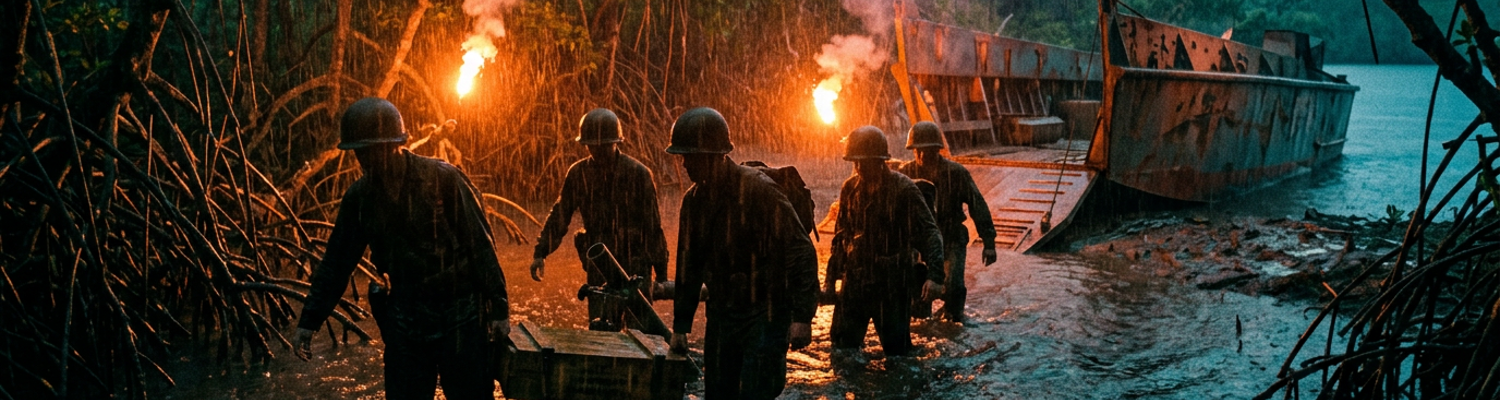
Machinery listed on that final audit sheet traced its survival back to the arrival of Task Force 8408 and the 10th Airways Detachment aboard the motor vessel Kota Agoeng off the western coast of Aitutaki. Rolling ocean swells had battered the Dutch transport ship as civilian freighters anchored outside the barrier reef, leaving soldiers with no deepwater harbor facilities and no protected anchorage. Crews confronted the immediate aftermath of forcing over 1,100 tons of heavy equipment and fuel drums across the shallow coral shelf on flat bottomed wooden barges and makeshift pontoon rafts. Stunned work details stood knee deep in the churning surf along the reef rim, watching sea spray soak uncrated aviation engines while ocean breakers smashed against iron skids. Soldiers scrambled across wet coral heads to retrieve floating timber and severed towlines before the falling tide stranded their remaining barges on dry stone.
Barges wedged against jagged coral heads demanded immediate surf damage assessments as officers clambered over splintered hulls to record their initial lighterage losses. Inspectors cataloged crushed rudders, flooded outboard motors, and cracked deck planking where incoming waves had flipped two supply craft directly into the breaker line. Mechanics dropped their tools into shallow tide pools to secure ruptured fuel barrels, smelling raw aviation gasoline wash across the reef flat as punctured drums leaked into the lagoon. Working parties used hand winches and steel cables to haul swamped tractors onto firmer ground before salt water ruined their electrical systems. Officers scribbled emergency loss tallies on water soaked clipboards, noting that nearly a third of their primary lighterage craft had suffered structural failures during the first tide cycle.
Engineers reacted to the mounting vessel losses by dragging damaged craft above the high water mark and stripping usable timbers to reinforce the remaining lighters. Soldiers manning the offshore transfer lines anchored motor launches beyond the outer breakers, passing heavy towing hawsers across the surf to keep supply rafts from broaching sideways against the coral. Crane operators balanced heavy road graders and steel airfield matting on paired pontoon assemblies, timing each reef transit to the crest of incoming swells to clear the jagged underwater ledges. Labor crews formed bucket lines in the waist deep water of the lagoon to manhandle five hundred pound gasoline drums across the shallows, rolling the metal barrels onto the sand before saltwater corrosion ate through their seams. Drivers backed six wheel drive trucks into the shallows at the concrete jetty, winching each dripping cargo crate onto cargo beds to clear the shoreline for the next inbound wave.
Trucks ground through the damp coastal sand toward the inland clearings, delivering the salvaged gear to dispersal points where supply clerks waited with fresh property books. Maintenance sergeants tore open sodden packing envelopes to verify which replacement parts had survived the reef crossing and which crates had vanished into the deep water outside the breaker line. Supply officers entered these raw field tallies into permanent operational records, noting that future island air depot landings required specialized ramp equipped amphibious vessels rather than open wooden lighters. Personnel from the 10th Airways Detachment carried their surviving radio transmitters into a temporary canvas shelter, setting up the island weather observation post while mechanics flushed sea water out of the lone operational bulldozer fuel lines.
Pulverized Coral Damage to Heavy Earthmovers
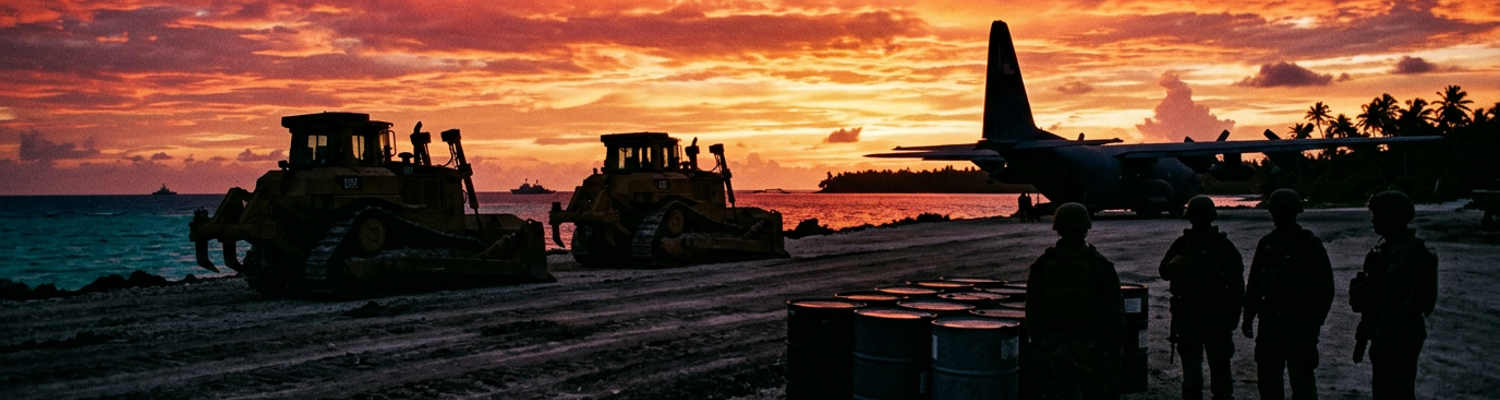
Bulldozer engines roared to life the moment clean diesel cleared the injectors, sending the heavy machines straight into the thick coastal scrub to carve out the Amuri landing strip. Operators lowered heavy steel blades into the jagged limestone shelf, crushing calcified rock into powdery white fragments that blew across the work area in thick clouds. Pervasive infiltration of fine pulverized coral dust into diesel bulldozer air intakes and cylinder assemblies began within the first few hours of continuous operation. The abrasive powder bypassed standard oil bath air cleaners, mixing directly with lubricating oil inside the crankcases to form a gritty paste that chewed into cylinder walls and piston rings. Exhaust stacks coughed dark smoke and sputtered erratically as internal compression dropped across the entire earthmoving pool, forcing maintenance crews to rush forward with hand tools to inspect each faltering machine. Drivers killed their throttles along the rough runway boundary, listening to internal metal components scrape and rattle under the heavy mechanical strain.
Crankshafts locked as systemic mechanical seizures of earthmoving machinery during runway crushing and leveling operations brought base construction to a sudden halt across the coral flat. Pistons welded tight to the scored cylinder liners before operators could disengage their master clutches, leaving heavy crawler tractors immobilized along the unfinished runway centerline. Road rollers, towed sheepsfoot compactors, and ditch digging graders ground to an immediate stop behind the dead bulldozers, congesting the single transit lane cleared through the coconut palms. Enlisted mechanics stripped off their protective gloves and unbolted boiling engine cowlings right on the sunbaked rock, shining hand torches into stripped gearboxes and jammed valve trains. Officers supervising the earthmoving teams stood beside the silent machines, recalculating their runway completion timetables as vital equipment sat crippled on the coral grade.
Mechanics compiled field maintenance entries detailing rapid abrasive scoring on hydraulic rams, bearings, and track pins as recovery crews hauled the seized machines into staging yards. High pressure hydraulic rams that lifted the heavy dozer blades developed deep vertical grooves along their polished chrome surfaces, permitting hydraulic fluid to blow past worn packing glands and spill across the limestone foundation. Grease fittings packed with coral grit ground away the steel track pins, gouging deep trenches into the metal and stretching the heavy crawler tracks off their guide wheels. Track pins wore down to half their original diameter, slackening the steel belts until track shoes jumped the drive sprockets and threw heavy tracks into the ditch. Mechanics wiped powdered coral off stripped steering clutches and recorded the precise metal loss in pocket notebooks before dragging the broken track segments back to the repair tents.
Machinists stripped abandoned barges and disabled support trucks for usable metal, gathering spare parts to rebuild the essential grading equipment. Work details built improvised fabric air shrouds out of salvaged parachute nylon and clamped extra oil filters onto the intake manifolds to trap the airborne limestone dust before it reached the engine blocks. Repair teams ground down grooved hydraulic shafts on manual bench lathes, packing the cylinder glands with greased canvas strips to maintain hydraulic pressure on the remaining operational blades. Construction sergeants reassigned half the heavy equipment operators to manual pick and shovel crews, wetting down the runway surface with seawater from tank trucks to suppress the dust clouds before the next grading pass. Officers gathered the completed maintenance reports to file urgent supply requisitions for heavy duty pre cleaners and hardened replacement tracks, preparing to submit their findings whenever long range radio contact with headquarters was finally restored.
Aviation Gasoline System Failures and Contamination
Folders containing those maintenance reports stacked up along the workbench as mechanics smelled raw high octane fumes leaking from the main airfield fueling lines near the edge of the scrub. Constant ocean salt spray and tropical humidity had heavily corroded the aviation gasoline supply valves and distribution piping running from the lagoon storage tanks. Flakes of red iron rust and crusty green verdigris froze the cast metal gate valves in place, snapping threaded valve stems whenever wrench crews attempted to clear the lines. Leaks widened around underground pipe couplings where salty groundwater and constant dampness ate away the protective thread sealant, allowing pressurized fuel to soak into the porous coral sand. Inspectors unbolted the corroded pipeline junctions and discovered that the entire fixed distribution network was unsafe to operate, forcing ground crews to rely completely on stockpiles of packaged fuel barrels scattered along the runway perimeter.
Steel drums rolled out of those perimeter storage dumps revealed an even more dangerous hazard inside the packaged fuel reserves. Soldiers cracked open the threaded bungs on the barrels and drew test samples into clear glass jars, uncovering thick layers of rust flakes, rainwater, and brown sediment settling beneath the gasoline. Heavy tropical rains and damp sea air had seeped past swollen rubber gaskets during months of outdoor storage, creating widespread sediment fouling in 55 gallon drums supporting transpacific B-24 Liberator and C-87 flights. Official fuel contamination reports recorded that four engine C-87 transports and B-24 Liberators risked total engine failure over open ocean if these floating rust flakes reached their carburetor jets. Ground crews pushed their cloudy sample jars across the inspection tables and halted all direct fueling from the drum line until they could assemble an effective physical barrier against the floating debris.
Technicians devised emergency fuel straining protocols on the spot to trap that floating debris and keep staging transports airworthy. Working parties stripped tight weave chamois leathers and fine brass wire mesh from aircraft maintenance toolboxes to build multi stage filtering cones inside standard refueling funnels. Hand pump operators rolled each 55 gallon drum onto wooden blocks at an angle, letting water droplets and heavy flakes settle into the lowest edge of the barrel for half an hour before dropping in a suction hose. Crews then worked hand wobble pumps to force the gasoline through layers of washed cotton cloth and damp chamois skins into clean five gallon carry cans. Flashlight beams held over the open cans confirmed whether the fuel ran crystal clear or still carried microscopic flecks of tank scale that demanded a second pass through the filters. Flight line officers signed off on every cleared batch of gasoline before loading details carried the strained cans out to the waiting transports parked on the coral apron.
Soldiers hoisted those heavy fuel cans up wooden ladders to reach the wing tanks of an idling C-87 transport bound for the southern supply line. Fueling details poured the purified gasoline through secondary felt strainers set into the wing openings, checking the suction screens on the aircraft pumps after every hundred gallons. Flight engineers watched the cockpit fuel pressure gauges while four radial engines turned against their chocks, looking for any drop in flow that might indicate a clogged carburetor screen. Ground officers updated their daily fuel logs by hand, entering tallies of condemned barrels alongside records of the extra man hours required for the manual straining process. Mechanics rolled twenty barrels of rejected gasoline into a pit at the runway edge to use for road oiling and dust control on the crushed coral strip. Crew chiefs locked the safety wire on the transport wing caps, signaled the ground crew to pull the wheel chocks, and cleared the plane to begin its takeoff roll.
Immediate Lessons from Radio Station WVJD
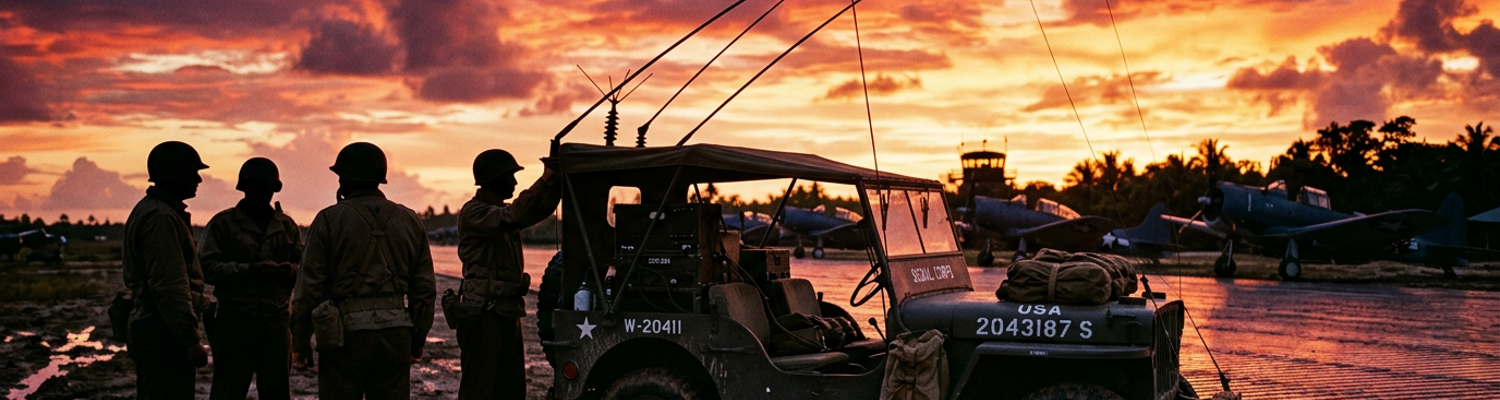
Propeller wash churned up blinding clouds of pulverized coral dust along the runway verge as the departing transport lifted off into the overcast sky. The sudden hush that settled over the Amuri flight line left the remaining ground crew standing in eerie silence, surrounded by miles of empty reef and abandoned administrative tents. Inside the low wooden communications shack near the runway turnoff, Army Airways Communications System operations logged under callsign WVJD at the Aitutaki airfield immediately took over monitoring the flight. Vacuum tubes inside the tall receiver racks glowed dull orange in the dim room, radiating dry heat that fought against the heavy ocean moisture creeping through the screened windows. Two enlisted radiomen sat shoulder to shoulder on wooden crates, monitoring the faint crackle of high frequency audio while the outbound plane shrank to a distant speck above the southern horizon. The duty operator wiped damp ocean mist from his microphone and jotted the aircraft departing coordinates into the master station ledger.
Ink smeared across that master station ledger as operators worked through the quiet afternoon to track flights scattered across thousands of miles of open water. Crucial navigational intercept logs maintaining directional guidance along the remote South Pacific ferry route demanded continuous vigilance from the lone man at the receiver dials. Aircraft ferrying between Hawaii, Canton Island, Fiji, and Australia depended on WVJD to provide accurate bearings, weather updates, and homing signals over vast oceanic gaps where a navigation error of five degrees meant running out of fuel over open water. Static crashes from distant tropical squalls regularly drowned out aircraft voices, forcing the radioman to strain through his headphones and pick out faint Morse code chirps among the electrical noise. Pencil leads snapped against the rough grid paper under the pressure of plotting rapid course corrections for aircrews drifting off their navigation tracks.
Pencils rolled across the plotting boards as the radiomen struggled under the alarming operational strain placed on the skeleton crew. Urgent technical dispatches recording the vulnerability of isolated radio stations following mass personnel drawdowns piled up beside the radio logbook. The radical reduction of the airfield garrison to a mere twelve men had stripped the communications facility of its dedicated maintenance specialists, relief operators, and generator mechanics. A single radioman now had to monitor emergency frequencies, manually haul five gallon diesel cans to fuel the outdoor motor generator, and troubleshoot complex transmitters without backup. Any sudden component breakdown, power failure, or physical collapse of an exhausted soldier threatened to extinguish the radio beacon entirely and leave passing transport planes flying blind in the dark. Technicians gathered burnt vacuum tubes and frayed copper leads from the transmitter rack to draft a detailed casualty report on their failing spare parts cache.
Typewriters clicked against damp carbon paper as the station officer typed up those raw casualty findings for regional command headquarters. The finished dispatches documented how tropical fungus ate through wire insulation, how salt corrosion jammed the transmitter tuning capacitors, and how solitary watchstanders risked falling asleep at the dials during twenty four hour shifts. The officer folded the typed pages into moisture proof rubber envelopes and stamped them for delivery on the next northbound courier plane that touched down on the coral runway. Darkness crept across the stripped atoll as the sun dipped below the ocean rim, leaving only the dim clearance bulbs along the transmitter shack roof to illuminate the flight line. The relief operator clamped his steel headphones tightly over his ears, advanced the transmitter output dial to maximum power, and tapped the brass Morse key into the night.
Power Generator Corrosion and Improvised Salvage
Sparks died inside the transmitter panel as the outdoor power unit choked and stalled in the darkness. Constant salt fog rolling over the barrier reef had triggered rapid galvanic corrosion and moisture breakdown inside radio generator assemblies exposed to marine air. Salty ocean dampness crept past the louvers of the outdoor generator shelter, reacting with the mismatched metals inside the machine and coating the brass contact points and steel armature screws with thick deposits of green and white oxide. Water droplets formed directly across the high voltage windings of the magneto, causing internal electrical shorts that killed the ignition current before it could fire the spark plugs. The lone mechanic on duty stripped off the generator side covers with a wrench, finding the internal wiring brittle, the distributor points pitted, and the cylinder head fouled with sea moisture. Mechanics hurried out from the living quarters with flashlights and canvas tool rolls to strip down the dead machine before the radio station battery bank completely discharged.
Flashlight beams swept across the dark equipment boneyard as the repair crew hunted for replacement parts among discarded machinery. Mechanics began the systematic cannibalization of derelict vehicles and abandoned construction frames to salvage copper wire, spark plugs, and gaskets. Soldiers climbed over rusted two and a half ton cargo trucks and stripped weapons carriers, cutting loose intact bundles of copper ignition wire before corrosion could eat through the rubber insulation. Other men unbolted the cylinder heads of broken water pumps and abandoned grader engines to recover usable spark plugs, scraping the carbon and rust from their electrodes with pocket knives. Wrenches cracked through oxidized iron fasteners on abandoned steel building frames and concrete mixers so technicians could peel away intact sheets of cork and compressed asbestos to fashion replacement gaskets. Repairmen packed their salvaged hardware into wooden crates and rushed the parts back across the runway to the darkened generator shack.
Crates thumped onto the maintenance bench as the mechanics sorted their salvaged components under the beam of an inspection lantern. Soldiers threaded the cleaned spark plugs into the cast iron cylinder heads and spliced the reclaimed automotive copper wire into the magneto circuit. The repair team knew that raw ocean air would ruin the delicate assembly again within hours unless they sealed the machine against the elements. Mechanics carried out improvised weatherproofing attempts utilizing canvas scraps, aviation grease, and salvage compounds to shield the exposed electrical components. Enlisted men smeared heavy amber aviation grease across every bare terminal, spark plug porcelain collar, and exposed bolt thread to repel the encroaching salt mist. Other workers coated hand cut gasket seams with thick marine salvage compound and lashed discarded heavy canvas scraps over the engine housing, leaving only narrow bottom slits for cooling air.
Air rushed through the lower vents as the mechanic yanked the recoil starter cord with both hands. The refurbished engine backfired twice, blew a cloud of dark exhaust through the canvas shroud, and settled into a rhythmic, steady roar. Voltmeter needles inside the generator control cabinet climbed past one hundred and ten volts, holding firm as the greased ignition wiring prevented electrical leakage across the metal chassis. Radiomen inside the communications station watched the amber indicator lights on their transmitter racks flicker back to life as full electrical current flowed through the floor cables. The station officer signed off on the improvised repair entry in the emergency machinery log, noting that the station was operating entirely on scavenged automotive parts and salvage sealant. The relief operator switched the main transmitter back onto the primary South Pacific ferry channel, tapped his brass key, and broadcast the station identification signal out across the ocean.
Strategic Reorientation of Transpacific Air Corridors
Headphones clamped over the radioman ears caught only empty ocean hiss instead of incoming aircraft check ins, revealing the immediate operational impact as primary Air Transport Command routes shifted north toward the Marianas and Marshall Islands. Strategic planners in Washington and Hawaii had redirected the flow of transpacific military traffic along a newly established central corridor running through Kwajalein and Eniwetok directly toward Saipan and Guam. This shorter northern route bypassed the vast south central Pacific expanse, cutting hundreds of flight miles and dozens of flying hours from the supply pipeline feeding the Philippine campaign. Heavy transport planes and combat bombers that had once sustained the southern air bridge through the Cook Islands moved north by entire squadrons, taking their logistical priorities with them. The radical change left the crushed coral airstrips on Aitutaki and Penrhyn marooned in an empty ocean sector where air activity vanished almost overnight. Enlisted men stepping out of the communications shack looked up at clear skies that had roared with multi engine aircraft engines only weeks before.
Dispatches delivered by a rare northern courier flight confirmed the formal downgrading of the Cook Islands atolls from primary transit hubs to secondary emergency diversion airfields. Base directives stripped the island stations of their status as vital stepping stones between Hawaii, Fiji, and Australia. Theater planners instructed the small garrisons to reduce active facilities to the bare minimum needed to land distressed aircraft experiencing engine failure or fuel exhaustion. High capacity transient barracks, large mess halls, and aircraft maintenance shops were locked down and abandoned to the damp air, leaving only basic medical supplies and emergency shelter ready for unexpected arrivals. Ground personnel shifted their focus entirely from rapid cargo handling to routine runway preservation, clearing fallen brush and checking drainage ditches to prevent tropical rain washouts. Soldiers maintained the Amuri strip as a backup landing site, keeping the coral surface packed hard so that any stray crew reaching the atoll could set down without crashing.
Flight clearance data entered on daily station ledgers documented the steep drop in scheduled B-24 and C-87 transits through Penrhyn and Aitutaki. Transit sheets that had regularly recorded dozens of B-24 Liberator bombers and C-87 cargo transports each week showed entries falling to zero across whole seven day periods. The constant stream of four engine planes carrying aircraft engines, blood plasma, and mail to south Pacific garrisons had evaporated as Air Transport Command routed every available long range transport toward the Central Pacific. Station dispatchers who once spent hours logging takeoff times, gross weights, and navigation fixes now entered only blank lines across consecutive ledger pages. Flight clearances across both atolls shrank to occasional administrative hops by twin engine utility planes or single engine reconnaissance aircraft checking island outposts. Dispatch clerks noted in the log margins that fuel consumption tallies had plummeted in direct parallel with the vanishing transport flights, leaving high octane stores untouched in their corroding metal drums.
Soldiers inspected those untouched fuel drums along the runway revetments, marking off full containers on their emergency inventory sheets. Ground personnel placed heavy wooden chocks against the remaining tractor wheels and secured the portable airfield lighting kits inside dry supply sheds. The base commander filed the completed clearance logs alongside the fuel inspection audits, establishing formal procedures to keep the diversion strip functional with the twelve remaining men. Maintenance crews greased the surviving radio antennas, locked the spare generator housing, and retreated to the operations building to wait for emergency distress calls on the transpacific frequencies. The duty officer sealed the day record envelope with red wax, laid it in the outbound courier pouch, and closed the dispatch office door against the blowing ocean rain.
Austere Operating Doctrines for Token Garrisons
Rainwater pooled outside the locked dispatch door as the twelve isolated caretakers began logging surreal day to day accounts of managing thousands of acres of vacated airstrip facilities. Duty clerks recorded bizarre observations of migratory seabirds nesting inside cavernous abandoned maintenance hangars and wild island pigs rooting across parking aprons where four engine bombers had stood only weeks before. Soldiers walked solitary security rounds past endless rows of empty canvas tents, noting in the station ledger that the only sound breaking the silence was ocean surf crashing against the barrier reef. Sentries tasked with guarding miles of crushed coral runways jotted down the deep psychological strangeness of standing night watch over dead taxiways, describing an eerie stillness where wind rattled through abandoned mess halls and open supply sheds. Mechanics logged minor daily routines like scraping sea crabs out of generator intake ducts, inventorying leftover hand tools, and searching empty barracks for spare light bulbs. Base officers collected these strange journal entries by lantern light every evening, compiling raw tallies of locked buildings, decaying fences, and quiet hours into the official station record.
Fungus spread across the damp paper of those official records overnight, prompting the garrison commander to institute strict emergency maintenance schedules to keep the coral runways clear using minimal equipment and fuel. Sergeants restricted the lone operational tractor to thirty minutes of engine time each morning, strictly rationing remaining diesel stocks so the base would not run dry before an unscheduled cargo vessel arrived. Soldiers hitched an improvised drag harrow constructed from salvage iron pipes, crosscut timber, and discarded steel fencing behind the machine to crush encroaching coastal scrub and smooth out rain ruts along the main runway. Enlisted men walked the remainder of the five thousand foot strip on foot, carrying rakes, shovels, and canvas sacks to clear loose coral stones, fallen coconut fronds, and storm gravel by hand. Mechanics immediately drained the tractor fuel bowls and wiped its cooling fins with oily rags after each brief grading run, sealing the carburetor intake to block pulverized coral dust and salt spray. Work crews marked cleared runway sections on a wooden flight line status board, preserving a single hard landing lane for distressed aircraft while tropical vines rapidly swallowed the surrounding taxiways and parking revetments.
Vines creeping across the abandoned revetments provided immediate physical evidence for Army Air Forces doctrinal reports evaluating the long term feasibility of skeleton crew airfield preservation. Theater planners reviewing the incoming Cook Islands maintenance data calculated that twelve soldiers could keep a bare coral runway open for emergency landings, but could never arrest the general decay of a sprawling base complex. Technical evaluations documented how ocean salt, high humidity, and unchecked vegetation destroyed buried fuel pipes, warped timber structures, and seized motor vehicles unless dedicated engineer and maintenance companies remained on station. Logistics officers balanced the tactical benefit of keeping empty diversion strips operational against the continuous loss of machinery, spare parts, and the fuel required to support isolated caretakers by sea. Couriers loaded these finished reports aboard an outbound transport plane alongside the Aitutaki station logs, delivering the operational assessments directly to regional air headquarters in Honolulu.