
Santa Fe Railhead Bottlenecks in Las Animas County
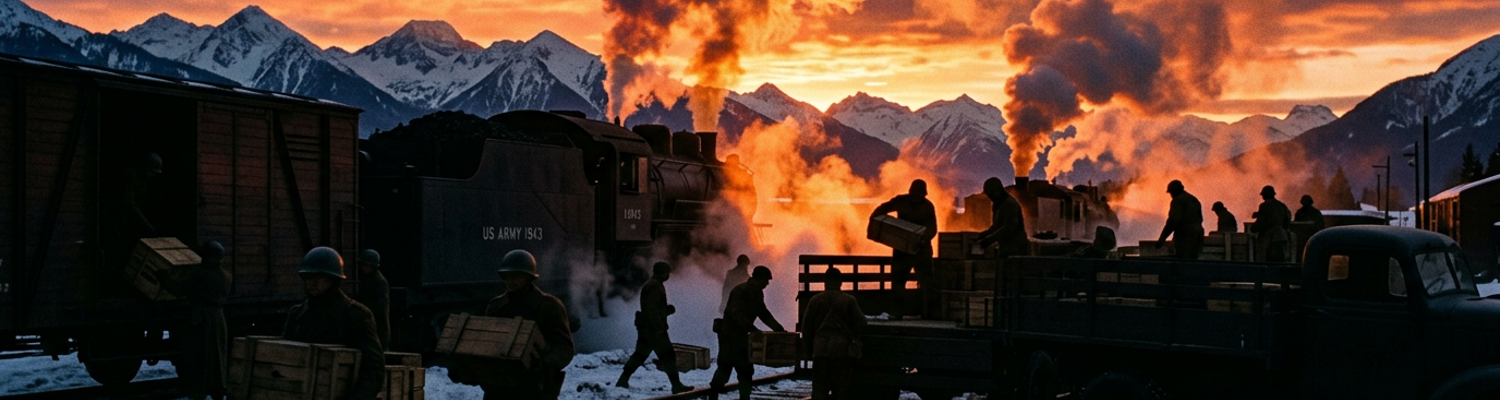
Boxcars packed to their rooflines with canned rations, flour, and construction lumber jammed the single-track Atchison, Topeka and Santa Fe Railway spurs serving southern Colorado throughout late 1942 and early 1943. Camp Trinidad was expanding rapidly to house thousands of German prisoners of war, but the railroad infrastructure running through Las Animas County was never built to handle an industrial military supply line. Steep mountain grades approaching Raton Pass already restricted train lengths, forcing the railway to divide heavy freight movements into smaller, staggered sections that occupied the region limited passing sidings. Mainline rail traffic slowed to a crawl as inbound military shipments competed directly with civilian coal trains moving out of local mining camps along the Purgatoire River valley. Heavy steam locomotives frequently waited for hours on the main line while switchmen struggled to route incoming cars into crowded transfer tracks. Station masters at the Trinidad rail depot ran out of usable track space entirely, shunting trainloads of vital Quartermaster subsistence stores onto remote bypass tracks where the cars sat stranded under winter snowfall.
Trucks required to haul those stranded food stocks from the railhead to the cantonment six miles east of town were almost impossible to secure. Quartermaster officers found that regional cartage companies possessed neither the vehicle fleets nor the spare parts to maintain a continuous drayage shuttle over unpaved county roads. Civilian transfer laborers were just as scarce, because high wages in Denver war plants and the military draft had drawn workers away from Las Animas County. Local coal mines competed fiercely for any remaining laborers, leaving the Army with only a handful of elderly workers and inexperienced local hires at the depot platforms. These small crews relied on basic two-wheeled hand trucks and wooden ramps to manually offload hundred-pound bags of flour, sacks of potatoes, and crates of tinned beef from high boxcar doors. Mud, slush, and icy ruts repeatedly stalled civilian delivery flatbeds in the transfer yard, causing offloaded crates to pile up in exposed mounds alongside the tracks while unemptied train cars continued to clog the sidings.
Railway officials assessed punishing demurrage penalties against the Quartermaster Corps for every twenty-four-hour period those unemptied cars occupied track space beyond the standard unloading deadline. These financial penalties rapidly accumulated into thousands of dollars of unauthorized operational debt, generating sharp reprimands from Seventh Service Command headquarters in Omaha. National logistics coordinators in the War Department added further pressure, warning the post commander that holding scarce rolling stock on southern Colorado sidings disrupted the nationwide movement of railcars needed for transcontinental weapons shipments. Camp quartermasters had no surplus funds to pay the mounting bills and no administrative authority to halt inbound supply trains that were already rolling toward Trinidad from Midwest distribution depots. Quartermaster officers finally resolved the depot congestion by pulling military personnel directly from facility security details and camp utility units to form emergency unloading shifts. Soldiers worked through subzero nighttime temperatures alongside the civilian drayage drivers, manually shifting cargo into convoy trucks and clearing the depot platforms so the railway could haul the empty cars back out to the main line.
Bituminous Coal Deficits and Winter Fuel Rationing
Cargo crates offloaded from those cleared depot platforms arrived at a facility facing an immediate heating crisis. Acute shortfalls of regional bituminous coal deliveries crippled Camp Trinidad as sustained sub-zero temperatures gripped southern Colorado throughout the winter of 1943 to 1944. Regional mines along the nearby Purgatoire River valley struggled with equipment breakdowns, freezing tipples, and manpower shortages, while national war boards diverted primary regional yields to defense plants and steel mills in Pueblo. Railroad dispatchers repeatedly bypassed military supply requisitions, leaving camp coal storage bins sitting empty while blizzard winds pushed temperatures across Las Animas County down to fifteen degrees below zero. Utility crews watched the camp reserve stockpiles drop to critical levels within days, since inbound freight trains delivered barely enough low-grade coal to keep the main water pumping plant and central hospital functional. Soldiers detailed to camp utility yards had to break through frozen crusts on the surviving outdoor coal mounds with picks and sledgehammers, shoveling brittle lumps into trucks just to keep barracks stoves from going dark.
Barracks across the cantonment consumed those hand-shoveled coal lumps at unsustainable rates because emergency construction crews had erected the timber-frame mobilization buildings without interior insulation. High mountain winds drove freezing drafts directly through gaps in the exterior drop siding and thin asphalt building paper that lined each exterior wall. Cast-iron heating stoves situated in the center of each long barracks bay burned red-hot around the clock, yet excessive heat loss through uninsulated timber roofs and drafty floorboards left wall corners cold enough to freeze water inside soldier canteens. Mobilization buildings consumed nearly twice the fuel tonnage estimated in standard Army Quartermaster manuals, creating runaway fuel consumption that no supply schedule could satisfy. Metal grates and stovepipes repeatedly warped under the strain of continuous forced firing, causing soot fires in exhaust flues and threatening to burn down the dry pine barracks entirely. Maintenance crews scrambled between buildings with replacement sheet-metal patches, but every mechanical repair only highlighted the fact that the post was burning through its winter coal reserves twice as fast as regional supply trains could dump fresh loads into the storage bins.
Quartermaster officers confronted this impending fuel collapse by issuing strict conservation orders that dictated fuel triage between administrative offices, military police barracks, and internment compounds. Headquarters staff suffered the sharpest daytime reductions, as camp directives prohibited clerks from lighting office stoves until an hour after morning roll call and ordered all administrative fires extinguished promptly at four o clock in the afternoon. Military police barracks and elevated perimeter guard towers received the highest fuel priority, allowing armed sentries to rotate through warm quarters and survive freezing twelve-hour guard shifts along the barbed-wire fences. Internment compounds housing thousands of German prisoners of war received strictly measured coal allowances that fell far below baseline comfort standards. Prisoners tore apart shipping crates for kindling, stuffed newspapers into bunk mattresses for added warmth, and used flour paste to glue scrap cardboard over drafty wall seams. Supply sergeants weighed daily coal rations down to the pound on platform scales at every compound gate, padlocked the fuel bins against theft, and logged every bucket into strict balance sheets before releasing sentries back into the freezing night.
Geneva Convention Rations and Commissary Accounting Hurdles
Ledger books in the camp commissary demanded the same unrelenting precision when supply clerks shifted their attention from tracking coal piles to calculating prisoner meal allowances. Under Article 11 of the 1929 Geneva Convention, the United States Army was legally obligated to provide captive personnel with food rations equal in quantity and quality to those consumed by American troops in regular garrison billets. This international standard required camp quartermasters to issue thousands of German prisoners nearly four thousand calories per day, including generous daily allocations of fresh beef cuts, whole milk, butter, sugar, and white wheat flour. At the exact same time, the Office of Price Administration forced surrounding Colorado communities and the civilian home front into strict domestic food rationing, severely limiting everyday families to small coupon allowances for meat, canned goods, and cooking oils. Local ranchers and townspeople in Las Animas County grew outraged whenever railroad shipments brought tons of prime butcher beef directly to the internment camp while nearby grocery meat counters stood empty. Commissary officers faced constant administrative friction trying to bridge the gap between civilian rationing quotas and strict treaty terms, spending hours cross-referencing ledger entries and stacking physical receipts to prove that the military was matching exact international treaty weights.
Requisition slips created immediate logistical friction inside compound mess halls because German cooks flatly rejected key components of the standard American garrison diet. Prisoners refused to touch sweet corn, hominy grits, pumpkin, and peanut butter, demanding instead heavy root vegetables, dark rye flour, and cheap pork cuts that they could grind into traditional sausage. Quartermaster clerks had to execute complex bookkeeping conversions, balancing out rejected cornmeal and canned vegetables with equivalent monetary values of cabbage, potatoes, and pork scrap without violating garrison cost baselines. Strict inspection visits by neutral Swiss diplomats and International Committee of the Red Cross representatives placed every kitchen under immediate scrutiny. Foreign delegates inspected food preparation lines unannounced, pulling daily mess logs and checking kitchen scale readouts to confirm that daily meals matched Geneva caloric minimums. Mess sergeants worked late into the night adjusting paperwork and logging food swaps into specialized Quartermaster Corps ledger sheets to ensure every replacement cabbage head or pork scrap satisfied rigid Army accounting rules.
Ammonia compressors inside the post subsistence depot broke down repeatedly under the dry southern Colorado heat, wrecking those carefully balanced dietary calculations. Unreliable walk-in cold-storage rooms suffered frequent electrical blowouts and refrigerant leaks, allowing temperatures inside the meat lockers to shoot up into the seventies. Quarters of freshly dressed beef spoiled and turned gray within forty-eight hours, while crates of eggs, fresh dairy cans, and tubs of lard rotted into foul sludge before supply drivers could haul them to the mess halls. Post veterinary officers and sanitary inspectors walked through the sweltering storerooms condemning whole boxcar shipments, marking hundreds of pounds of meat as totally unfit for human consumption. Supply crews shoveled the rancid foodstuffs into open-bed dump trucks, driving the spoiled cargo out to perimeter burial trenches where utility details drenched the waste with fuel oil and set it ablaze. Quartermaster officers immediately telegraphed regional distribution centers in Omaha and Denver to requisition emergency crates of canned Vienna sausages and dried navy beans, racing to stack replacement supplies inside the mess halls before morning roll call triggered another inspection crisis.
Detainee Footwear Conversion and Work Clothing Scarcity
Telegraph lines carried simultaneous demands for basic detainee work clothing, because those same morning roll calls exposed hundreds of newly arrived prisoners shivering in threadbare desert uniforms. Most German troops transferred to southern Colorado had surrendered in North Africa, arriving at the cantonment in lightweight shorts, open-collar shirts, and thin cotton drill tunics that offered zero defense against Rocky Mountain blizzards. Quartermaster workshops inside the camp ran into paralyzing production bottlenecks while attempting to convert surplus American military stocks and captured Axis garments into regulation prison attire. Work details labored at long wooden benches, using shears to rip out domestic army buttons, national insignia, and service patches from worn American khaki trousers and olive wool overcoats. Enlisted men and prisoner tailors then pressed carved wooden blocks and zinc stencils into trays of thick black oil paint, stamping indelible prisoner of war markings across the backs of jackets, the seats of trousers, and the right thighs of work pants to meet mandatory security rules before anyone could join labor crews. Paint fumes saturated the crowded alteration sheds while damp garments hung from every ceiling rafter, creating a processing backlog that stalled the release of hundreds of warm winter uniforms.
Uniforms drying on those rafters could not solve the deepest supply crisis facing the cantonment, because outdoor work detachments completely lacked durable cold-weather work shoes suitable for rigorous manual labor. Hundreds of prisoners had arrived at Camp Trinidad wearing flimsy canvas tropical boots, torn dress shoes, or cardboard-lined footwear that disintegrated after a single morning in snow and freezing mud. Regional farm bureaus and railroad operators pressured the post commander to dispatch captive work crews to harvest sugar beets, clear irrigation canals, and chop firewood across Las Animas County, but men walking into frozen ditches in ruined shoes quickly suffered debilitating trench foot and frostbite. Quartermaster supply depots in Denver and Kansas City routinely rejected requisitions for new footwear, reserving standard leather combat boots exclusively for active United States Army divisions preparing for overseas combat. Camp quartermasters received only occasional shipments of thin civilian work shoes that tore across the jagged shale soil and offered no insulation against sub-zero mountain temperatures. Medical officers soon filled convalescent barracks with limping detainees whose feet were lacerated by frozen gravel, forcing labor supervisors to cancel work dispatches and pull crews back inside the barbed wire.
Leather hides salvaged from discarded military saddles and condemned cargo straps provided the raw material for an emergency camp resoling program designed to get those grounded labor crews back to work. Article 12 of the Geneva Convention required the United States Army to provide all captive workers with footwear equal in durability to standard military field shoes, exposing the command to severe diplomatic penalties if neutral Swiss inspectors found prisoners working barefoot or in rags. Camp engineers converted an empty barracks building into a centralized cobbler shop, outfitting the space with foot-treadle stitching machines, iron anvils, and rotary leather knives. Quartermaster sergeants recruited experienced shoemakers and tanners from among the German prisoners, putting twenty craftsmen on round-the-clock shifts to salvage condemned footwear. Detainee cobblers cut thick outsoles from reclaimed War Department leather stocks, cemented and stitched the heavy slabs onto usable shoe uppers, and drove steel hobnails into the heels to resist the abrasive Colorado shale. Convoy trucks loaded crates of rebuilt, weatherproof work shoes from the shop platform each evening, delivering the reinforced footwear directly to the compound gates so labor details could return to regional timber and agricultural projects the following morning.
Auxiliary Guard Integration on Regional Farm Details
Quartermaster dispatchers struggled to muster enough operational trucks each morning to haul those newly equipped prisoner detachments out to regional work sites across the Arkansas River Valley. The camp motor pool faced crippling vehicle allocation shortages, possessing only a fraction of the two-and-a-half-ton cargo trucks required to move hundreds of captive laborers across Las Animas and Otero counties every day. Mechanics worked through the night stripping usable driveshafts, spark plugs, and tires from disabled vehicles just to keep a baseline fleet of flatbeds and canvas-topped transports rolling. Farm bureaus in towns such as Rocky Ford and La Junta demanded immediate labor deliveries to save their ripening crops, but regional fuel quotas and War Department transport limits forced supply officers to stagger dispatches and combine multiple farm crews into overcrowded flatbeds. Drivers packed thirty to forty men into open truck beds lined with wooden bench slats, forcing armed sentries to perch on tailgates while convoys bounced over rutted dirt access roads. These transport deficits frequently stranded dozens of authorized field hands inside the cantonment compound, delaying daily departure times and reducing the total tonnage of sugar beets harvested along the river basin.
Military police escorts accompanying these overloaded convoys clashed almost immediately with inexperienced Colorado State Guard auxiliaries assigned to secure the perimeter lines at rural drop-off points. Regular Army soldiers had completed formal tactical training and held firm instructions to enforce Geneva Convention security regulations without using unnecessary violence or creating public disturbances. Colorado State Guard units, assembled rapidly from local volunteers who were either too young or too old for overseas combat, possessed little practical understanding of military prisoner handling or formal sentry procedures. Auxiliaries frequently abandoned assigned boundary posts to sit in shaded irrigation ditches, shouted conflicting instructions at German-speaking work gangs, and challenged the authority of Army noncommissioned officers who had far more operational experience. Seasoned military police officers had to step between nervous state guardsmen and compliant detainees during rest periods to prevent accidental shootings caused by language barriers and improper firearm handling. This persistent operational friction repeatedly interrupted farm work, as military escorts spent substantial portions of their shifts physically separating nervous state guardsmen from compliant detainees rather than watching the captive laborers.
Civilian watchmen hired by local growers to reinforce those thin security cordons created an even deeper logistical crisis across commercial sugar beet fields. Vast agricultural tracts spanning hundreds of unfenced acres offered numerous concealment routes through dense crop rows, demanding dozens of armed sentries that the Army could not provide from regular garrison rosters. Local farmers hired private field hands, retired county deputies, and night watchmen who arrived at agricultural check-in posts carrying an uncoordinated assortment of personal hunting rifles, lever-action carbines, and commercial revolvers. Quartermaster supply officers had no stock of civilian ammunition calibers, leaving the post unable to replenish expended rounds or verify field ordnance reliability. Untrained civilian guards routinely ignored basic muzzle safety protocols, wandered away from designated sectors, and lacked knowledge of military rules of engagement when detainees walked toward drainage canals to retrieve irrigation shovels. Military police commanders ultimately ordered all non-standard civilian armaments locked inside convoy truck cabs and established rigid perimeter checkpoints where private watchmen were restricted to unarmed observation roles along main access roads.
Wastewater Infrastructure Strain and Federal Grant Allotments
Trucks rolling back through those access roads returned thousands of captive field hands to a cantonment whose underground plumbing was already failing under catastrophic strain. Detainee populations surged past three thousand men during the summer and autumn of 1943, swamping a camp sewage collection network originally designed to handle only half that load. Vitrified clay sewer pipes cracked under the ground as soil shifted, while heavy grease and solids accumulated inside the undersized collection network. Gravity-fed lines clogged with thick sludge, causing black wastewater to back up through floor drains into barracks latrines and spill across open compound ditches. Camp maintenance details used hand augers, flexible steel cables, and high-pressure water hoses to force obstructions through the narrow eight-inch mains, but constant flushes from overcrowded washrooms overwhelmed the lift stations within hours. Submersible pump impellers burned out repeatedly as sand, rags, and coarse debris jammed the collection sumps, forcing utility crews to hoist smoking electric motors out of the pits by hand to replace fractured bronze gears.
Bronze replacement parts offered only a temporary fix for the overwhelmed collection grid, driving Army logistics officers to petition the Federal Works Agency for Lanham Act War Public Works emergency allotments to expand the municipal processing plant. Federal reviewers in Washington questioned the exact detainee population projections and delayed the release of construction funds, demanding that the nearby city of Trinidad absorb a major portion of the capital improvement costs. Municipal leaders in Las Animas County vigorously resisted these federal demands, pointing out that local tax revenues were already depleted and could not subsidize a massive utility expansion triggered entirely by the War Department. Bureaucratic auditors in Washington held up the emergency grant applications for months while arguing over technical blueprints, municipal matching requirements, and pipeline right-of-way easements. War Department evaluators exchanged heated memos with civilian engineers over sewer main diameters and cost-sharing percentages, stalling all federal funding authorizations throughout the dry summer months. Unfiltered camp effluent continued to bypass the choked municipal treatment beds entirely, discharging thousands of gallons of foul wastewater each day into drainage ditches that emptied straight toward the Purgatoire River.
River water samples collected by Colorado public health inspectors downstream from those drainage ditches revealed dangerous bacterial counts, triggering a fierce administrative confrontation with military authorities. State sanitation officials threatened to shut down regional irrigation intakes and file formal complaints with federal authorities if the post failed to halt the contamination of agricultural waterways. Post surgeons sided with the civilian inspectors, issuing urgent warnings to camp headquarters that pooling sewage around the perimeter fences created an intolerable breeding ground for flies and raised immediate risks of dysentery or typhoid outbreaks among both garrison troops and detainees. Regional Army engineers from the Seventh Service Command pushed back against these medical demands, arguing that national steel conservation orders and wartime copper quotas prohibited the installation of new chlorination machinery or expanded concrete settling tanks without War Production Board clearances. Engineers instead ordered Quartermaster utility crews to dig hasty earth-berm settling basins and dump barrels of unslaked lime and powdered calcium hypochlorite directly into open ditches, using temporary chemical treatments to mask the odors and suppress bacteria until stalled federal construction crews finally arrived to pour new concrete settling tanks.