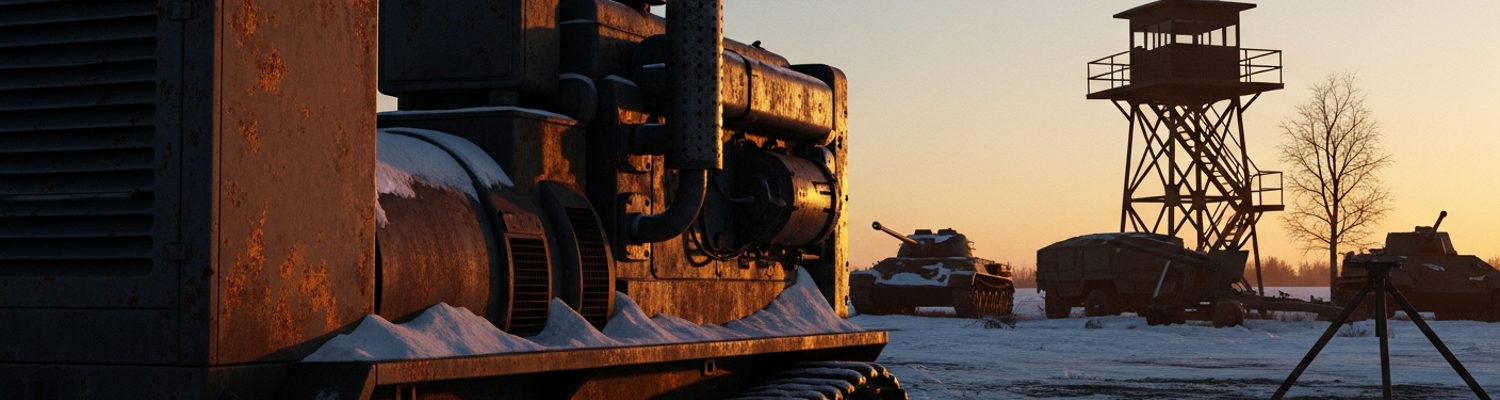

Peace was not quiet for US Army logisticians after World War II. It was a frantic pivot. A new kind of conflict demanded a new kind of footprint. Across the rubble of occupied Germany, Austria, and the Korean peninsula, a sprawling network of semi-permanent camps, observation posts, and headquarters materialized. The existing inventory of purpose-built military generators, battered from years of continuous wartime operation, was wholly insufficient for this new static, long-term mission. A different kind of power was needed. Archival evidence from US Army Europe (USAREUR) shows procurement officers, under pressure to power this new Cold War infrastructure, initiated a massive, hurried acquisition of commercial, off-the-shelf diesel generator sets. There was no single standard. The primary driver was immediate availability. Army depots filled with a chaotic assortment of civilian units from manufacturers like Caterpillar, Cummins, and Detroit Diesel. Models such as the Caterpillar D311 and the Cummins Model H, designed for predictable industrial or agricultural use, were suddenly federalized and shipped to unforgiving field environments. This procurement strategy, born of necessity, sidestepped the lengthy research and development process typical for military hardware, but in doing so, it sowed the seeds of future maintenance and operational failures.
These were not machines of war.
The arrival of these commercial generators at frontline camps, particularly along the tense Inner German Border, immediately exposed their profound unsuitability for military life. A close review of operational logs from units like the 11th Armored Cavalry Regiment, tasked with patrolling the Fulda Gap, details a litany of failures and the desperate, ad-hoc modifications required to keep the lights on. A stock Caterpillar D311, for example, was built with a sheet-metal enclosure designed to protect it from rain on a construction site, not the freezing mud and constant concussive shock of an active armored cantonment. Its commercial-grade air and fuel filters, expecting clean diesel and relatively clear air, would quickly choke on the low-quality fuel and the dense dust kicked up by M48 tanks and M113 personnel carriers. Motor pool mechanics became masters of improvisation. They welded scavenged steel plates to generator housings for ballistic and weather protection. They fabricated crude but effective sandbag revetments that unfortunately restricted airflow and led to chronic overheating. They cannibalized air filtration systems from wrecked vehicles to replace the inadequate civilian parts. Vibration was a constant enemy; the commercial mounting brackets, designed for stable concrete pads, would fracture on uneven, muddy ground, causing fuel lines to crack and high-voltage wiring to chafe. This created significant fire hazards noted in numerous after-action reports. The absence of standardization devolved into a supply disaster, forcing units to unofficially dedicate specific generators as parts sources to keep the rest of the mismatched fleet operational.
Power was a tactical imperative.
This cobbled-together electrical grid served two functions of the highest priority: perimeter security and command communications. For the hundreds of observation posts and camps facing Warsaw Pact forces, continuous illumination was a non-negotiable element of defense. The sheer load of powering hundreds of high-wattage floodlights around a battalion-sized perimeter placed a colossal and constant strain on the already-struggling civilian generators. These machines were often run at near-maximum output for twelve hours or more every night, dramatically accelerating engine wear and leading to predictable failures. The second, and more essential, power consumer was the communications shelter. High-powered radio sets like the AN/GRC-26, the nerve center for division and corps-level command, required exceptionally stable, or clean, 115-volt, 60-cycle power to function. The slightest voltage drop or frequency fluctuation from a laboring generator could corrupt a teletype transmission or damage the radio’s sensitive vacuum tube components. This sensitivity forced a system of electrical triage. Commanders would identify their single most reliable generator and designate it exclusively for the communications hub. This commo bird was placed off-limits for any other use, while the less dependable generators were left to power the lights, mess halls, and everything else, ensuring that even if the camp went dark, command and control would endure.
The mission of these commercial generators rapidly expanded beyond supporting frontline combat units. It extended into the sprawling network of detainee and displaced persons (DP) camps established across occupied Europe and Asia. Following the collapse of the Axis powers, millions of uprooted individuals were gathered into temporary facilities that were anything but. Camps like the Föhrenwald DP facility in Bavaria or the massive internment centers for former Axis soldiers required a foundational electrical infrastructure where none existed. Into this void, logistics officers pushed the same mismatched fleets of Caterpillar, Cummins, and Detroit Diesel generators. Archival evidence (NARA Record Group 338) shows that Military Police and Civil Affairs units commanding these facilities were suddenly tasked with becoming small-scale utility managers. Their primary mission was humanitarian and administrative. Yet, this could not happen without power. Generators were needed for camp administration buildings, for the kitchens preparing thousands of meals, and for the provisional hospitals treating thousands of malnourished and sick individuals. The very act of registering and tracking hundreds of thousands of people, a core task of the United Nations Relief and Rehabilitation Administration (UNRRA) and the military, depended on lighted administrative centers that could function after dark.
This power was the backbone of camp security. The perimeters of these vast enclosures, often measuring miles in circumference, had to be secured and illuminated. A close review of Military Police operational doctrine from the period underscores a constant concern for control and order within these volatile environments. High-wattage floodlights, often mounted on crude wooden poles, became the primary tool for this task. These lighting systems placed an enormous and continuous load on the unreliable commercial generators. A single large camp could require a dozen or more generator sets in tandem just to power the perimeter lights, a function that was non-negotiable from dusk until dawn. The failure of a single generator could plunge a whole section of the fence line into darkness, creating an immediate security crisis. In response, camp commandants designated specific generators as lighting birds, dedicating their most reliable units exclusively to the perimeter grid. The light was directed outward from the perimeter, illuminating the approaches and making it difficult for anyone outside the wire to see in, a standard security practice that turned the camps into isolated islands of harsh, artificial light in the postwar darkness.
The generators faced these new demands in wildly diverse and unforgiving environments. In the ruins of Germany and Austria, the primary antagonist was the cold. During the winters of the late 1940s, maintenance logs detail a litany of cold-weather failures. Diesel fuel would turn to gel in the tanks and fuel lines of generators like the Caterpillar D311, starving the engines. Standard lubricants congealed, increasing engine strain and leading to seized components. Batteries, already weak from inconsistent maintenance, would lose a significant portion of their cranking power in the sub-zero temperatures. Daily starts became a monumental effort. Soldiers resorted to lighting fires under the engine blocks, a dangerous but often necessary field expedient, just to warm the oil enough for the machine to turn over. Conversely, in the humid, dusty conditions of occupied Japan and later in Korea, the challenges were different but no less severe. The fine dust choked the commercial-grade air filters. This would lead to rapid engine wear and overheating. The constant high humidity and frequent rain in Asian climates accelerated corrosion on unprotected electrical contacts and control panels, causing short circuits and fires. These environmental extremes proved that a generator’s reliability was entirely dependent on a climate it was never designed to survive.
A close review of operational logs from the U.S. Constabulary in occupied Germany during the 1947 winter details a near-constant state of mechanical crisis. For the junior engineers and motor pool sergeants of the 2nd Constabulary Regiment, the newly-arrived commercial generators were not assets, but antagonists. These men, many of them trained on robust, simplified military-issue hardware, were now confronted with a chaotic array of unfamiliar civilian machines. The units were mechanically temperamental. Their governors, designed for the predictable loads of a farm or factory, would hunt and surge under the fluctuating power demands of a military camp, causing lights to flicker and sensitive radio tubes to blow. The constant, ground-shaking vibration of nearby armored car patrols and tank movements, for which the generators’ thin sheet-metal housings and commercial mounting bolts were never designed, caused hairline fractures in fuel injector lines and coolant hoses. Maintenance teams found themselves performing triage in the freezing mud, often at night, with little more than hand tools and flashlights, trying to diagnose problems far outside their training manuals. Failure of the automatic shutdown systems, which should have protected the engine from low oil pressure or overheating, was a frequent and catastrophic event, often leading to thrown rods or seized pistons that rendered the entire unit useless.
The machines were starving.
This mechanical battle was compounded by a logistical problem of severe shortages. The rapid, disorganized procurement process that federalized these civilian generators paid no attention to creating a corresponding supply chain for spare parts. A maintenance team in one camp might have three different models of generator from three different manufacturers, none of which shared common parts. An entire battalion might be brought to its knees by the lack of a specific gasket for a Cummins water pump or a starter motor for a Detroit Diesel. Archival evidence shows that units resorted to a desperate, unofficial system of barter, trading jerrycans of gasoline for a needed fan belt or a set of filters. More often, they were forced to designate one of their precious few generators as a parts source, stripping it piece by piece to keep the others running. Fuel itself was a constant problem. The diesel fuel available in post-war Europe was of inconsistent quality, often contaminated with water or debris that would quickly foul the sensitive injectors on the commercial engines. Wartime stocks of high-quality fuel were depleted, and what remained was often prioritized for tactical vehicles, leaving the generators to run on whatever low-grade substitute could be found.
The human element introduced an even more dangerous set of variables. Beyond the struggles of well-meaning but ill-equipped engineers, the generators were subject to simple neglect and outright sabotage. In the context of a demobilizing army, many of the soldiers assigned to guard and refuel the generators were not dedicated technicians but draftees counting the days until they could go home. A forgotten oil check or the failure to monitor the temperature gauge during a long winter night could easily lead to a destroyed engine. More sinister threats came from the environment of the occupation itself. Counter Intelligence Corps (CIC) field reports from the U.S. Zone document multiple investigations into suspected sabotage. Disgruntled local laborers, hired for non-sensitive tasks around the camps, had easy access to the loud, isolated generator positions. A handful of sand in a fuel tank, a quietly severed fan belt, or a loosened battery terminal was all it took to disable a camp’s power supply. For an isolated border outpost along the Czechoslovakian frontier, the sudden loss of perimeter lighting could be a prelude to an infiltration or a probe by opposing forces, turning a maintenance problem into a high-stakes security failure.
A close examination of US Army Europe (USAREUR) logistical doctrine from the 1950s and 1960s reveals a command wrestling with a fundamental contradiction. At the highest levels, the Quartermaster Corps issued stringent directives demanding strict spare parts accountability, conservation of existing generator stock, and a reliance on slow, depot-level repair cycles to preserve the overall equipment pool. This bureaucratic approach, designed for a peacetime army, clashed violently with the needs of frontline units. Field commanders, particularly those in the V and VII Corps responsible for defending against a potential Soviet thrust, operated under opposing orders that prioritized constant operational readiness above all else. Local commanders were authorized, and unofficially encouraged, to use any means necessary to keep power flowing to their command posts and defensive positions. This created an impossible dilemma for battalion S4s and maintenance officers. They were forced to choose between violating a high-level logistical directive or failing an operational requirement. The result was a shadow supply system. Maintenance logs from units along the Inner German Border show a pervasive pattern of cannibalizing designated parts-source generators for fuel injectors, starter motors, and voltage regulators. These components were perpetually on backorder through official channels. This practice was a direct violation of Quartermaster Corps policy but was the only way to meet the readiness targets set by tactical commanders.
The problem was a command decision.
This internal conflict was magnified by the complex and often disjointed nature of the Allied command structure. While Supreme Headquarters Allied Powers Europe (SHAPE) coordinated overall defense strategy, the logistics supporting national contingents remained largely sovereign. An American armored cavalry regiment and a West German Panzergrenadier brigade stationed side-by-side in the Fulda Gap might as well have been on different continents logistically. They used different generators, different parts, and different supply request forms, preventing any meaningful pooling of resources in a crisis. Within the American structure, a clear hierarchy of generator allocation emerged. Asset distribution was dictated by a unit’s proximity to the front line of the Iron Curtain. The 11th Armored Cavalry Regiment, tasked with being the tripwire in the Fulda Gap, received the lion’s share of the newest and most reliable generator sets, along with priority access to the scarce supply of spare parts. A review of V Corps maintenance records indicates that units like the 11th ACR had significantly lower generator downtime compared to those in the rear. Support units located west of the Rhine were consistently issued the oldest, most problematic generators and were last in line for parts. This created a dangerous disparity in capability, where the very support infrastructure depended upon by the frontline combat units was itself powered by the least reliable equipment in the inventory.
The consequences of this systemic mismanagement became apparent during major training exercises. During the annual REFORGER exercises, the massive influx of stateside units and the simulated 24/7 combat operations pushed the generator fleets across West Germany to their absolute limit. After-action reports from a REFORGER exercise in the mid-1970s document a failure within the 8th Infantry Division’s sector. As the division’s command post was tracking a simulated main attack by Warsaw Pact armored forces, its primary power grid collapsed. Two aging, chronically-overloaded commercial generators failed within minutes of each other; one suffered a catastrophic fuel pump seizure while the other, its commercial air filters long since choked with field dust, simply overheated and shut down. For nearly three hours, the divisional headquarters was effectively blind, its AN/GRC-26 radio links silent. A frantic search for a replacement generator from a neighboring engineering battalion was delayed by incompatible power connectors and the sheer difficulty of moving a multi-ton asset over muddy, congested field roads in blackout conditions.
The chaotic period of mismatched, cannibalized commercial generators could not last. A detailed 1967 Department of Defense study confirmed what field commanders already knew: the lack of a standardized, reliable power source was a systemic failure. The document triggered a complete reversal in procurement strategy. No longer would the Army rely on adapting civilian hardware. A new family of military-specific generators would be designed from the ground up. This was the birth of the Mobile Electric Power (MEP) program, a joint-service effort established on July 1, 1967, to create a family of purpose-built machines.
Standardization was the new mandate.
The design requirements for the first generation of MEP generators, such as the Tactical Quiet Generator (TQG) family, were a direct reflection of the failures of their commercial predecessors. A close review of the specifications shows an obsession with logistical simplicity and ruggedness. Where before a single battalion might contend with three different brands, the new system used standardized engines, filters, control panels, and connectors across its entire model range, from small 3kW units to large 60kW sets. A mechanic could service any generator in the inventory with a common set of parts and training. The requirement for durability was absolute. New military standards, like MIL-STD-810, demanded that these machines could start in sub-zero temperatures and operate in sandstorms. Procurement for these new tactical generator sets began in earnest in 1969, with the goal of fielding them by 1972, a clear effort to correct the deficiencies exposed in Vietnam.
The logistical lessons of the early Cold War were paid for with broken equipment and failed missions. The MEP program represented a fundamental shift in military thinking, from focusing on the initial purchase price of a generator to its total lifecycle cost. This new doctrine acknowledged that the true expense of a piece of hardware included the training of its operators, the complexity of its maintenance, and the logistical burden of its spare parts pipeline. The family concept was the core of this new efficiency. By designing a series of generators that shared a high degree of parts commonality, the Army dramatically shrank its required inventory of spare fuel injectors, water pumps, and electrical components. This approach also simplified the work of depot-level technicians and the curriculum at engineering schools. The parts catalog became as important as the engine itself. This logistical foresight ensured that the mountains of mismatched and useless parts that clogged the supply depots in Germany and Vietnam would not be repeated.
The MEP family of generators became the reliable power backbone of the late Cold War U.S. Army. It was a quiet enabler of the Big Five modernization programs: the M1 Abrams tank, M2 Bradley Fighting Vehicle, AH-64 Apache helicopter, UH-60 Black Hawk helicopter, and the Patriot missile system. These new, sophisticated weapons platforms were dependent on digital fire control systems and networked communications that required stable, continuous power. Yet, the very technological advance that the MEP generators were built to support would eventually render them obsolete. The proliferation of microprocessor-based systems and sensitive digital communications gear across the battlefield in the 1980s and 1990s demanded electrical power of a quality that the aging MEP diesel generators could not always provide. Voltage fluctuations from a mechanically governed diesel engine could corrupt data transmissions or damage delicate circuit boards. The tactical environment itself was changing. The noise and significant infrared heat signature of a standard diesel generator became an unacceptable liability on a battlefield populated with advanced acoustic and thermal sensors, turning each generator into a potential target. This forced the development of the next generation of military power sources: the Advanced Medium Mobile Power Sources (AMMPS).