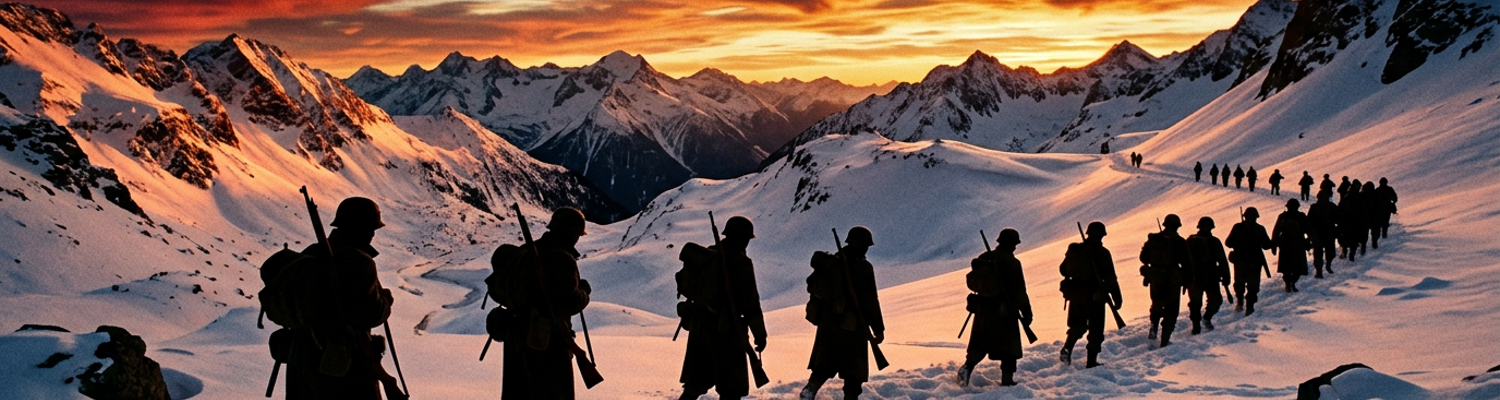

Airborne Infiltration and Drop Zone Azure
Rifle crates slammed into the mud at our Brindisi staging depot as Operational Group Tacoma rushed to beat a sudden forty-eight-hour departure deadline. Command staff gave us no time to test our loads, forcing sergeants and mechanics to work straight through the night using kerosene rags to wipe heavy packing grease off our weapons before the lubricants could freeze solid in northern mountain air. Supply personnel shoved cold-weather field rations, radio batteries, and demolition blocks into cylindrical metal containers while jumpmasters inspected our static lines under flickering hangar lamps. Exhaustion settled deep into the muscles of our six-man team before we even hauled our gear up the metal boarding ladder of a British Halifax bomber on the evening of December 26, 1944. Four massive engines roared for hours as the aircraft climbed across the Adriatic Sea into freezing northern turbulence until the dispatch officer finally pulled open the floor hatch above Drop Zone Azure near the mountain village of Valmorel. Static lines snapped taut against the overhead anchor cables as all six of us dropped straight through the belly opening into the black sky, immediately watching our heavy parachute containers tumble out of the bomb bay behind us.
Heavy parachute containers vanished into the darkness as snowdrifts five feet deep caught our falling bodies and buried the cargo bundles, scattering our six-man team across hundreds of yards of pitch-black mountain slope. Sub-zero Alpine temperatures froze our sweat inside waterlogged woolen uniforms within minutes, stiffening the fabric and chilling our bodies while we dug ourselves out of the powdery drifts. High winds had pushed the cargo parachutes far away from the intended drop markers, driving containers into rocky gullies and burying critical ammunition supplies under deep layers of snow. Numb fingers fumbled with shielded flashlights while we crawled through the darkness on hands and knees, searching for missing carbines and trying to locate the radio canister before the intense frost cracked its glass vacuum tubes. Weapon mechanisms jammed solid as soon as men worked their charging handles because standard gun oil applied at the airbase had congealed into thick, useless paste in the sub-zero chill. Soldiers spent hours clearing packed ice from their gun barrels with steel cleaning rods, pocketing what loose ammunition they could find and whistling low recognition signals into the freezing wind to locate the rest of the scattered team.
Scattered team members finally converged when Italian partisan fighters stepped out from the dark pine timber to meet us, guiding our group away from the exposed drop zone before enemy search patrols could spot our tracks in the fresh snow. These local fighters helped haul our few recovered equipment bundles up the mountain, sharing the weight as we climbed along narrow, icy paths that wound toward the timberline. Malga Montegal, a sturdy stone dairy farm redoubt built high on the mountain ridges above Valmorel, became our operational rallying point where we could unpack our surviving gear out of the wind. Partisan sentries took up defensive positions along the rocky approaches outside while our supply sergeant placed the damp radio batteries next to the central stone hearth to thaw out their frozen chemical paste. Tactical leaders from both groups immediately began distributing the salvaged ammunition and establishing overlapping fields of fire to protect the redoubt by setting up machine gun tripods.
Recovered Supply Canisters and Equipment Damage
Machine gun tripods settled into the dirt floor as Browning machine gun bolts seized up the moment gunners pulled back the steel cocking handles, exposing the immediate failure of our hurried weapon preparation back in Brindisi. Rushed ordnance crews at the airbase had only wiped the outer metal, leaving factory cosmoline and heavy mineral oil deep inside the bolt tracks, firing pin springs, and trigger groups. Alpine frost turned that thick protective packing grease into solid, unyielding blocks within minutes of hitting the mountain air, locking mechanical parts together completely. Soldiers dropped to their knees over dirty canvas sheets by lantern light, using bayonet tips, wire brushes, and scrap metal to scrape hardened grease out of every receiver groove and slide assembly. Mechanics soaked dirty rags in gasoline drawn from a generator can to wash the stripped metal clean before friction could wear down internal parts or cause feeding failures during an attack. Reassembled weapons were test-cocked dry without standard oil, and our men stacked the cleaned carbines against the stable wall while making space on the floor for the communications containers.
Communications containers hauled across the stable floor yielded an even worse operational crisis as soon as our specialist pried open their dented steel lids. Rough terrain and parachute failures had slammed the equipment crates into granite ledges at high speed, completely crushing the rubber shock mounts protecting our SSTR-1 clandestine radio sets. Catastrophic impact damage combined with sub-zero thermal shock had cracked the glass envelopes of nearly every vacuum tube inside the transmitter and receiver chassis, snapping internal tungsten filaments and rendering the circuits dead. Battery boxes fared no better on the cold stone floor, where fractured lead-acid casings and split dry-cell packs leaked frozen chemical paste over spare coils and frequency crystals. Technicians sorted through the wreckage by the warmth of the hearth, hoping to salvage an intact tube or scrape enough clean chemical residue to power an emergency broadcast back to base stations in southern Italy. Not one transmitter unit survived with enough voltage or signal stability to produce an audible carrier wave, cutting our isolated unit off before we could transmit our arrival code to Allied high command.
Allied high command remained completely ignorant of our situation while snowbanks along the upper gullies of Drop Zone Azure held the rest of our equipment bundles buried beneath six to ten feet of wind-packed powder. Partisan search parties spent hours probing the drifts with pine poles without striking the metal shells of our missing parachute canisters. Those lost bundles contained our entire reserve of concentrated alpine rations, along with winter mountain parkas, heavy wool sweaters, trigger-finger mittens, and dry felt boot liners meant to protect six men from freezing weather. Deep snowdrifts covered the white cargo chutes entirely, leaving our team with only the soaked woolen uniforms on our backs and zero high-calorie food packs to sustain physical labor on the mountain ridges. Men shivered violently as wet uniform trousers froze rigid in the drafty barn, forcing our supply sergeant to ask the local partisan commander for dry rags and scrap wool to wrap around freezing toes. Italian fighters could only spare thin cornmeal polenta, dry chestnuts, and small scraps of salt pork from their own small winter food stores, giving our soldiers barely enough calories to stay on their feet.
Soldiers stayed on their feet only through sheer willpower as ordnance sergeants gathered our six exhausted Americans around the lantern to establish strict emergency rationing for every remaining cartridge, dry match, and scrap of clean canvas. Team leaders assigned two men to scrape carbon off salvaged cleaning rods and build wooden sledges for hauling the functional machine guns across high ridges if German mountain troops assaulted the farm. Partisan lookouts took positions behind stone boundary walls overlooking the valley approaches, carrying hand-drawn trail maps and written runner messages since dead radio batteries ruled out electronic early warning. Soldiers stacked the stripped, grease-free carbines within arm reach of the barn door and checked their loaded magazines in total silence as the temperature plummeted toward midnight.
Small Arms Failures and Mismatched Calibers
Loaded magazines sat useless as ammunition crates dragged across the stable floor brought our supply work to an immediate halt when crowbars split open the pine lids. Supply packers back in Brindisi had filled the containers with heavy bandoliers and wooden cases of .30-06 rifle ammunition, completely ignoring the real equipment needs of the mountain underground. The Italian partisan detachments gathered inside our stone redoubt carried short Model 1891 Carcano carbines built for 6.5mm cartridges, alongside captured Beretta Model 38 submachine guns that fired 9mm Parabellum rounds. Not a single partisan firearm in the redoubt could chamber the long, heavy American .30-06 cartridges, leaving hundreds of pounds of useless brass stacked across the barn floor. Partisans cursed the southern depot staff and shoved the unopened ammunition cases into the corner of the stable, leaving their squads with half-empty magazine pouches. Italian commanders demanded that we inspect the crates of American automatic weapons instead, hoping modern submachine guns would offset their severe shortage of rifle ammunition.
Modern submachine guns offered no immediate relief when M3 grease guns distributed to the partisan squad leaders failed on their very first mechanical tests. Sub-zero mountain air turned the light factory oil and residual cleaning solvent inside the tubular receivers into a waxy paste that glued the heavy steel bolts to their internal guide rods. Worse still, the severe frost made the dual recoil springs brittle, causing the tempered steel wire to lose its spring tension or snap into fragments after only two or three manual cycles. Men dropped down on canvas tarps to strip the stamped metal receivers down to bare parts, using kerosene rags to wash the springs, bolts, and guide rods clean of all moisture and grease. Even with the internal mechanisms wiped bone dry, the sluggish bolts still bound inside the sheet-metal housings, failing to strip dummy rounds forward into the chamber. Team mechanics had to set the grease guns aside as combat liabilities, shifting all attention to the crates of commercial submachine guns stacked near the hearth.
Commercial submachine guns unpacked from the remaining supply containers offered an immediate tactical advantage because their United Defense M42 barrels matched the partisans existing stocks of 9mm Parabellum ammunition. That advantage disappeared as soon as our ordnance sergeant sorted through the canvas accessory pouches and discovered that Brindisi personnel had packed the weapons without functional spare magazines. Each M42 submachine gun arrived with only the single twenty-round box magazine inserted directly into its receiver, leaving gunners with no spare clips to carry in their combat web gear for sustained firefights. Partisan armorers attempted to modify Italian Beretta Model 38 magazines to fit the American feed ports using hand files and pliers, but the mismatched feed lips jammed cartridges against the chamber face on every cycle. Our supply sergeant solved the crisis by pairing each automatic gunner with a loader who carried loose 9mm ammunition in canvas pockets and a wooden loading tool. Fighters snapped their single twenty-round magazines into the receivers, racked the charging handles, and moved into defensive firing positions along the snow-covered perimeter walls.
Field Expedient Armory Modifications
Defensive firing positions required reliable rifles, and piles of damaged German weapons stacked against the stable walls demanded our immediate mechanical intervention. Italian fighters had dragged dozens of captured Karabiner 98k bolt-action rifles back from road ambushes over the previous months, but severe operational wear and bitter cold had rendered half of them completely useless. Ordnance specialists dragged a heavy iron farm anvil and two sections of scrap railroad track beside the stone fireplace to create an improvised armory workbench. Mechanics clamped stripped Kar98k bolt assemblies into crude bench vises and used hand files to reshape worn extractor pins that were slipping off cartridge rims inside frozen chambers. Metal chips accumulated in the snow under our boots as we manually machined chipped extractor claws down to clean ninety-degree contact angles, compensating for the lack of factory replacement parts with slow, precise hand pressure. Armorers tapped each reworked extractor collar back onto its bolt body with brass punches and ran empty steel cartridge cases through the receivers to confirm that the bolt faces locked and extracted smoothly.
Steel cartridge cases ejecting cleanly onto the straw proved that the extractors functioned, but stripped firing pins inside the bolt assemblies presented a far more difficult manufacturing problem. Sub-zero mountain conditions had shattered brittle German firing pins across multiple rifles, while weeks of damp storage in alpine hideouts had rusted internal springs until they collapsed under compression. Enlisted ordnance specialists salvaged round steel stock from broken farm machinery and abandoned truck axles, chucking the metal rods into a portable hand-cranked lathe to turn out substitute firing pins by eye. Hand files and fine abrasive stones ground each substitute striker tip down to the exact curvature required to pass cleanly through the bolt face without piercing primer cups. Specialists then wrapped high-tensile steel wire salvaged from vehicle brake lines and downed field telephone cables around iron mandrels to wind fresh coils for the striker mechanisms. Armorers heated these fabricated spring coils directly in the glowing wood coals of the central hearth until the steel turned dull red, immediately plunging the hot metal into cans of discarded motor oil to temper the springs against future stress fractures.
Discarded motor oil hissed against the cold stone floor as technicians pulled the hardened springs from the dark fluid and dried them with canvas scraps for final assembly. Reconditioned Kar98k rifles, rebuilt Carcano carbines, and repaired German submachine guns were test-fired into a deep dirt trench dug beneath the stable floorboards to verify lockup and primer ignition before any weapon left the shop. Garibaldi and Mazzini partisan brigades operating throughout the Belluno valley sent armed runners through the mountain snowdrifts every night to collect these refurbished Axis small arms and carry them back to isolated camps. This continuous reconditioning of captured Axis weapons enabled both the communist Garibaldi detachments and the republican Mazzini units to maintain aggressive resistance against German convoys along the Piave River transit corridor. Partisan squad leaders wrapped the rebuilt Mausers into canvas bundles, loaded their pouches with salvaged 7.92mm ammunition, and set out across the ridges under cover of the falling snow.
Gestapo Encirclement and Mission Eagle Loss
Falling snow covered the tracks left by those departing partisan squads within hours, but terrible news traveled back down the freezing trails before our supply grease had even dried. Couriers from the northern valleys reached our redoubt at Malga Montegal with word that German security forces had captured Captain Roderick Stephen Hall on January 7, 1945, during a solo demolition attempt against a vital transit route. Hall was the daring commander of OSS Mission Eagle, tasked with severing the critical rail and road choke points running through the Alps toward the Brenner Pass. Operating deep in enemy territory with little direct support, Hall had set out on skis with a heavy rucksack of plastic explosives to blow a high mountain bridge near Cortina d Ampezzo. Deep snow, sub-zero cold, and severe frostbite in his feet slowed his movement until enemy spotters identified his tracks in the alpine brush. German ski troops surrounded his temporary shelter, disarmed him after a brief struggle, and hauled the injured officer down into the valley along with his mission gear and field documents.
Field documents and mission gear fell into the hands of Gestapo agents who took control of Captain Hall at Bolzano transit camp, immediately placing him in solitary confinement for aggressive interrogation. German counterintelligence officers interrogated Hall for weeks, attempting to extract the cipher keys, drop zone coordinates, and partisan contacts that held the regional resistance network together. Hall endured severe physical torture in the damp concrete cells of the camp, refusing to disclose operational details about our group or the local Italian units defending the ridges. Realizing that the American captain would not break or sign false confessions, the SS camp authorities decided to murder him rather than treat him as a lawful prisoner of war. German personnel led Hall into the camp washhouse in February 1945, placed a rope around his neck, and executed him by hanging from the ceiling pipes. Executioners falsified camp medical records to make the killing look like an ordinary suicide, subsequently burying his body in an unmarked grave outside the perimeter fence.
Unmarked graves awaited anyone caught in the dragnet as German counterintelligence squads immediately exploited the intelligence materials and route records recovered from Mission Eagle to execute coordinated sweeps across the upper Cadore region. Fascist militia and Gestapo units raided civilian safe houses, rail depots, and mountain hideouts that served as the primary courier pipeline between our redoubt and the northern frontier. Informants and local sympathizers broke under mass arrests, compromising the clandestine intelligence networks that monitored troop movements along the Piave River valley. These sweeping raids slammed the northern escape routes shut, cutting off the designated overland corridors that led toward the Austrian border and neutral Swiss territory. Mountain passes that our team had mapped as emergency extraction corridors became death traps crawling with armed border guards, tracking dogs, and alpine vehicle checkpoints.
Alpine vehicle checkpoints and fortified patrol bases sprang up along every road winding through the valley floor, completely isolating Operational Group Tacoma in the frozen wilderness of the Venetian Alps. Tacoma team leader Captain Howard W. Chappell and our ordnance personnel recognized that no reinforcements or overland relief columns could push through the enemy blockade to assist us. Supply stockpiles in our stone barn dwindled down to whatever damaged ammunition and frozen rations we could protect from moisture and vermin. Partisan brigades operating alongside us lost contact with their regional commanders, forcing both American soldiers and local fighters to rely entirely on hand-carried runner messages through waist-deep snow. Tactical commanders halted all planned offensive sabotage missions along the railway line to pull our scattered outposts into tight defensive perimeters around Malga Montegal. Gunners dragged water-cooled machine guns into stone outbuildings, dug secondary firing trenches into the frozen mud, and waited for German alpine battalions to launch their inevitable assault against our mountain stronghold.
Alpine Counterguerrilla Sweeps and Encirclement
German alpine battalions and Waffen-SS infantry launched their winter rastrellamento encirclement across the Belluno sector before our machine gun crews could even finish sandbagging those stone farm walls. Truck convoys packed with Fascist militia sealed off every secondary road along the Piave River valley, setting up interlocking machine gun cordons at the base of the ridges while German mountain troops pushed upward through the pine forests in coordinated sweep lines. Heavy mortar rounds tore into the snowy slopes outside Malga Montegal as forward spotters zeroed in on our stone redoubt, chewing up our outer rifle pits and throwing frozen mud across the barn roof. Captain Chappell ordered an immediate tactical withdrawal because our six Americans and thirty local partisans had no heavy artillery to counter an entire motorized security regiment closing the perimeter from three sides. Soldiers loaded the surviving submachine guns, stripped the firing pins out of any damaged weapons we had to leave behind, and moved out into the blinding whiteout of a mountain blizzard to slip past the tightening Axis encirclement.
Mountain blizzards whipped gale-force snow directly across the high passes, masking our footsteps while German ski patrols swept the ridge lines just a few hundred yards behind our trailing rear guard. Men took turns breaking trail through waist-deep drifts along narrow mountain shelves, tethering themselves together with parachute cord so that exhausted fighters would not slip over the icy precipices in the darkness. Carbine barrels and receiver groups iced over completely as the temperature plunged well below zero, forcing our ordnance specialists to carry spare weapons underneath their heavy woolen coats to keep body heat from letting the mechanisms freeze shut. Partisan scouts steered our column away from the glow of vehicle headlights along the valley floor, where German motorized cordons maintained continuous perimeter patrols with armored cars and heavy halftracks. Teams bypassed those enemy roadblocks by scrambling over jagged limestone cols at eight thousand feet, leaving the valley floor behind as the storm buried our tracks.
Buried tracks provided our only safety while smoke plumes rising from the lower timberline confirmed that German search detachments and Black Brigade squads were methodically burning every partisan safehouse and dairy barn across the valley. Enemy demolition teams systematically blew up stone barns, set fire to haylofts that concealed our hidden ammunition dumps, and shot any civilian mountain farmers suspected of sheltering underground resistance couriers. Exploding supply caches echoed through the ravines as months of hoarded flour, dried beans, canned meat, and medical bandages burned inside the destroyed timber outposts, eliminating our entire stockpile of food and medicine in a single afternoon. Deprived of these permanent shelters and baseline rations, our team had no choice but to dig into exposed high-altitude bivouacs on the windswept rock faces above the timberline.
Windswept rock faces offered no warmth as canvas tarpaulins stretched over shallow crevices provided our only defense against sub-zero winds while men huddled together in waterlogged wool uniforms to stave off hypothermia. Sentry details rotated every twenty minutes because bare hands holding frozen steel gun receivers lost all circulation and turned white with frostbite almost instantly. Ordnance specialists used dull bayonets to chip away at blocks of frozen mule meat and melted pocketfuls of snow over match flames, sharing tiny sips of water to keep fighters functional. Patrol leaders posted two-man listening posts along the sheer scree fields below the crags, chambering dry rounds into their submachine guns and scanning the foggy slopes for any sign of German ski scouts climbing the peak.
Railway Interdiction and Brenner Pass Sabotage
German ski scouts turned back down the mountain slope before noon, giving our detachment the chance to shoulder our remaining demolition gear and slip down into the Piave River valley. Captain Howard W. Chappell led our six-man team and fifteen selected Italian partisans through deep drifts along drainage gullies to reach the vital rail networks channeling Axis supplies toward the Brenner Pass. Axis logistics depended heavily on these secondary Alpine lines and masonry viaducts to feed war materiel south from Austria into northern Italy. Our clandestine sabotage raids targeted critical rail junctions, stone culverts, and mountain bridges spanning narrow river ravines where repairs would be slowest and most dangerous for enemy engineers. Partisan sentries established blocking positions on the parallel valley highways to watch for German armored cars while our demolition men crawled through the frozen ballast rocks directly onto the railway bed.
Railway beds offered no cover as blocks of composition C-2 plastic explosive had hardened into solid, unyielding chunks in the freezing mountain air, forcing our ordnance team to warm the dense compound inside our woolen jackets before it would stick to the steel rails. Soldiers packed the softened C-2 into the inner curves of the rail joints and wrapped heavy charges around masonry bridge piers using loops of olive-drab primacord detonators. Moisture inside our supply packs complicated every step of the setup because water had penetrated the brass sleeves of our British time-pencil delay fuses, ruining the chemical acid ampoules and causing premature failures or duds. Frozen friction igniters created another severe hazard when sub-zero cold locked their internal striker mechanisms, snapping the pull wires cleanly in half whenever gunners tried to arm the charges. Ordnance sergeants worked around the damaged gear by cutting off the bad fuses, scraping water from the primacord ends with pocketknives, and wiring manual percussion caps directly to dry length-measured safety fuses that we struck by hand.
Hand strikes flared matches under cupped canvas mittens to ignite the trimmed safety fuses, sending smoke sizzling along the detonating cords as our teams scrambled back into the hillside pine timber. Explosions shattered the valley silence moments later, tearing thirty-foot sections of steel track out of the railbed and collapsing the stone culverts into the creek beds below. The blast severed the main feeder lines linking the Belluno sector to the Brenner corridor, halting rail traffic immediately. Partisan lookouts confirmed that the damaged tracks directly disrupted German military freight convoys carrying vital reinforcement materiel, including tank tracks, replacement engines, and artillery shells destined for Axis units holding the Gothic Line. Stranded freight trains backed up for miles along the northern sidings, leaving dozens of heavily loaded cargo cars completely immobilized on open tracks where Allied tactical fighter-bombers could spot and destroy them.
Immobilized cargo cars drew immediate attention as German garrison commanders dispatched motorized security squads and engineering repair trains into the sector within hours of the blasts, but our partisan scouts triggered secondary fragmentation mines along the service roads to delay their arrival. Rail mechanics had to haul wooden replacement ties and steel repair rails on foot across blown culverts under the constant threat of partisan sniper fire from the surrounding ridge lines. Captain Chappell verified the destruction of the bridge supports through his field binoculars, noting that the enemy could not restore train service through the corridor for at least five days. Demolition teams gathered their remaining rolls of primacord, packed their empty canvas haversacks, and began the grueling trek back up the snowy mountain ridges to prepare their next strike against Axis road convoys.
Physiological Collapse and Tactical Isolation
Snowy mountain ridges punished our bodies as snowdrifts along those upper elevations soaked directly through our leather combat boots and wool trousers while we hauled our packs toward the timberline. Standard military woolen field uniforms suffered complete thermal collapse under continuous exposure to freezing wet snow. Coarse government-issue wool absorbed pounds of melted water, turning our trousers and field jackets into heavy, waterlogged armor that pulled heat directly out of our chests instead of insulating us. Men tried drying their outer layers over tiny wood fires inside shallow limestone caves, but the wet cloth stayed damp for days and froze into stiff boards whenever guards stepped back out into the wind. Moisture trapped against our skin dropped core temperatures into dangerous territory, leaving every soldier in the detachment shivering uncontrollably as we checked our weapon actions and scraped ice from our carbines.
Ice scraped from carbines fell onto the cave floor as boots stripped off swollen feet revealed the severe damage caused by weeks of uninterrupted damp and sub-zero air. Trench foot and frostbite spread through our six-man team and the surrounding partisan detachments with devastating speed. Toes and soles turned waxy white before decaying into purple, blistered flesh that cracked and bled whenever men forced their feet back into frozen leather. Chronic caloric deficits accelerated the physical breakdown because our daily rations had dwindled to small tin cups of boiled cornmeal polenta and scraps of rancid lard. Carrying heavy machine guns and explosive canisters across vertical rock faces burned thousands of calories each day, and living on less than a third of that energy caused severe muscle wasting. Soldiers lost twenty to thirty pounds by late winter, leaving gaunt men with hollow eyes and visible ribs who struggled to hoist their ammunition haversacks without leaning against the rock walls for support.
Rock walls provided the only support as soldiers forced their crippled legs back onto the mountain trails when Captain Howard W. Chappell ordered continuous sabotage strikes against the lower transit corridors. Relentless German counter-guerrilla sweeps and the constant risk of local informers meant our teams could never sleep more than two hours at a time without moving camp. Cumulative psychological strain and exhaustion ground down our minds through the freezing nights of February and March, breeding paranoia over every cracking pine branch and keeping men awake with thoughts of the Gestapo executing captured agents such as Captain Hall. Nerves frayed to the breaking point under the constant threat of encirclement, yet our detachment kept laying explosive charges, severing communication lines, and ambushing enemy truck columns across the Belluno sector. Guerrilla warfare continued without pause until the final Axis capitulation in northern Italy on May 2, 1945, broke the German garrison command in the Piave River valley. Partisan fighters and our surviving American sergeants marched down the melting mountain trails into Belluno, disarming hundreds of German soldiers and stacking their Mauser rifles in piles along the town square.