
A close review of operational logs for the Southwest Pacific Area in mid-1944 reveals the growing importance of a small, elliptical island in Geelvink Bay. Noemfoor, positioned between the embattled island of Biak and the Japanese stronghold at Manokwari, had transitioned from a geographic footnote to a high-priority objective. The reason was airpower. The island-hopping campaign toward the Philippines demanded forward air bases for fighter cover and bomber staging. The ongoing, bloody fight for Biak meant its airfields were not yet available, forcing planners to look elsewhere. Noemfoor offered a seemingly perfect solution: three Japanese-built airfields, Kamiri, Namber, and the unfinished Kornasoren, that could be seized and quickly made operational. From these strips, Allied aircraft could support the next westward advance to the Vogelkop Peninsula and project power toward the Philippines, effectively neutralizing Japanese air and naval bases in the Manokwari area. The principal mission of the CYCLONE Task Force was explicitly to capture these airdrome sites for rapid development.
The plan was built on a foundation of deeply flawed intelligence.
Allied command, specifically the ALAMO Force G-2 Section, operated on a dangerously optimistic assessment of the Japanese presence. Pre-invasion estimates suggested a token enemy force. The most generous reports placed the total Japanese garrison at approximately 2,000 men, with some intelligence suggesting a combat strength of less than a single battalion. These figures were derived from aerial reconnaissance and assumptions about Japanese capabilities, indicating that the enemy was using Noemfoor primarily as a staging point to reinforce Biak, not as a fortress. The belief was that the Japanese command, under Colonel Suesada Shimazu, possessed a force composed mainly of the 219th and 222nd Infantry Regiments, supplemented by service troops. This underestimation was profound. Archival evidence shows the actual number of Japanese personnel on the island was closer to 5,000, including combat troops and a large contingent of conscripted laborers. The initial intelligence miscalculation was off by more than 100 percent.
This gross misreading of enemy strength directly fostered a widespread belief that Operation Cyclone would be a simple affair. The entire operational plan was predicated on a swift, lightly opposed seizure. The perceived weakness of the Japanese garrison was a key reason MacArthur selected Noemfoor; it promised the prize of three airfields without a large-scale, costly amphibious operation. The assault force, centered on the 158th Regimental Combat Team, was considered more than sufficient to handle a garrison believed to be less than one battalion in fighting strength. This confidence in a quick victory shaped every aspect of the initial landings, from the allocation of combat troops to the timetables for airfield construction. The expectation was not for a fight for survival but a rapid engineering operation.
The order committing the 503rd Parachute Infantry Regiment to Noemfoor was a reaction to this flawed intelligence. General Edwin D. Patrick, commanding the CYCLONE Task Force, had received prisoner interrogations suggesting that 3,000 Japanese reinforcements had landed on the island just a week prior to the initial D-Day amphibious assault. This new estimate, which pushed the total garrison strength to a potential 5,000 men, was a shocking escalation. In response, the 503rd PIR, held in reserve at Hollandia, was activated. The 1st and 3rd Battalions were tasked with jumping onto the island on July 3rd and 4th, 1944, to reinforce the 158th Regimental Combat Team. The objective was to seize the island’s three airfields, with the immediate drop zone being the area around Kamiri Drome. On the morning of July 3rd, thirty-eight C-47s of the 54th Troop Carrier Wing lifted off from Cyclops Drome, carrying Colonel George M. Jones, his regimental staff, and the 1st Battalion.
The plan immediately unraveled.
A catastrophic pilot error sent the first wave of paratroopers out of their aircraft at a dangerously low altitude. The lead C-47 pilot had reportedly failed to adjust his altimeter for the island’s elevation; when his instrument read 300 feet, the aircraft was actually only 150 feet above the drop zone. For men exiting at the rear of the plane, the altitude was even lower. Their chutes had barely a moment to deploy before they slammed into the ground. The drop zone itself was unprepared. Instead of a clear field, the paratroopers of the 1st Battalion descended directly onto the Kamiri airstrip, which had not been cleared of vehicles and equipment from the initial amphibious landing. Men landed on bulldozers, trucks, supply dumps, and jagged piles of wrecked Japanese aircraft. The hard-packed coral surface of the runway was unforgiving, and the low-altitude jump meant there was no time to avoid the obstacles below. The 1st Battalion’s jump resulted in 72 casualties before a single shot was fired in organized resistance, a high number of broken ankles, legs, and other impact injuries.
The physical shock of the landing was met instantly with enemy violence. The pre-invasion intelligence suggesting the Japanese were concentrated at the airfields was accurate, but the assessment of their will to fight was not. While the main Japanese force under Colonel Suesada Shimazu had begun a tactical withdrawal eastward, they had left behind determined pockets of resistance. As the paratroopers struggled to shed their harnesses and locate their equipment amidst the wreckage, they were engaged by concealed Japanese positions. Small arms and machine-gun fire erupted from the jungle fringes and prepared defensive caves surrounding the airfield. The dazed and injured Americans, scattered across the hazardous terrain, found themselves in a desperate fight from the moment they touched down. The coordinated assault envisioned by planners devolved into dozens of small, isolated firefights. The initial amphibious force of the 158th RCT had met little organized resistance on D-Day, as the preliminary naval bombardment had stunned the Japanese defenders near the beachhead. The paratroopers of the 503rd received no such advantage.
The discrepancy between the intelligence picture and the situation on the ground was total. Planners had believed the main Japanese combat power resided in the 3rd Battalion of the 219th Infantry. The reality was a much larger and more complex force. The revised estimate of 5,000 Japanese personnel, prompted by the prisoner interrogation, was far closer to the truth. On the morning of July 5th, this miscalculation was driven home when two companies of the Japanese 219th Infantry, bolstered by around 150 armed Formosan laborers, launched a determined counterattack against the American positions at Kamiri, specifically targeting Hill 201. The attack was ultimately repelled, costing the Japanese around 200 killed, but it demonstrated a level of organization and offensive capability that ALAMO Force intelligence had failed to predict. The paratroopers of the 503rd, who were supposed to be reinforcing a simple seizure, instead found themselves locked in a close-quarters fight against an enemy whose numbers and tenacity had been dangerously underestimated. The second airborne drop, carrying the 3rd Battalion on July 4th, suffered another 56 jump-related casualties, leading to the cancellation of the planned third jump. The 2nd Battalion was brought ashore by LCI instead.
The pre-invasion intelligence failure extended beyond enemy manpower. It completely missed the nature and extent of the Japanese defensive network. Allied planners had assumed the Japanese were using Noemfoor as a staging point, not a bastion. A post-battle analysis of the island reveals this was a grave error. The island’s geography, composed of coral and limestone terraces, was ideal for the construction of subterranean defenses. Japanese engineers, along with conscripted Javanese and Formosan laborers, had spent months transforming the terrain around the key airfields into a fortress. They excavated an extensive system of caves, many of which were improved with concrete and coral rock, rendering them nearly impervious to preliminary air and naval bombardments. These positions were not isolated dugouts; they were interconnected fighting positions with overlapping fields of fire, concealed by the dense jungle canopy and natural rock formations. The approaches to Kamiri and Kornasoren dromes were dotted with these hidden emplacements, housing machine-gun nests and riflemen.
This was not a passive defense.
The defensive doctrine of the Imperial Japanese Army had, by 1944, shifted to a strategy of attrition centered on fanatical resistance. Colonel Suesada Shimazu, the garrison commander, organized his forces into strongpoints designed to inflict maximum casualties. His troops, primarily from the 219th Infantry Regiment, were expected to fight to the last man. This was demonstrated on July 5th, when two companies of the 219th, supported by armed Formosan laborers, launched a determined counterattack against the American perimeter at Kamiri. Even after being repelled with heavy losses, the surviving Japanese did not surrender or retreat. They fell back into their network of caves and pillboxes to continue the fight. Throughout the campaign, American units encountered isolated pockets of Japanese soldiers who would launch last-man offensive charges or defend their positions until they were killed. The concept of taking prisoners was almost nonexistent; of the original Japanese garrison of nearly 5,000, only 186 were captured alive by the end of August. Every Japanese position had to be physically destroyed and its occupants annihilated.
Neutralizing these positions became a slow, costly process. The interlocking and concealed nature of the caves and pillboxes made them difficult to locate and engage with heavy weapons. A single position, invisible until it opened fire, could pin down an entire platoon. Standard infantry tactics proved insufficient. A close review of operational logs from the 158th and 503rd shows a rapid adoption of specialized reduction techniques. The primary tools became M1 portable flamethrowers and satchel demolition charges. A typical assault involved a squad providing suppressing fire while a two- or three-man team, a flamethrower operator and riflemen for cover, crawled as close as possible to the emplacement’s aperture. A burst of flaming napalm would consume the oxygen within the confined space and eliminate the occupants. If the position was too deep, demolition teams would follow, throwing satchel charges into the opening to collapse the structure. This was high-risk work, and flamethrower operators suffered a high casualty rate. Clearing the jungle and hills around the airfields devolved into a series of intimate and vicious small-unit actions, where progress was measured not in miles, but by the number of fortified positions destroyed.
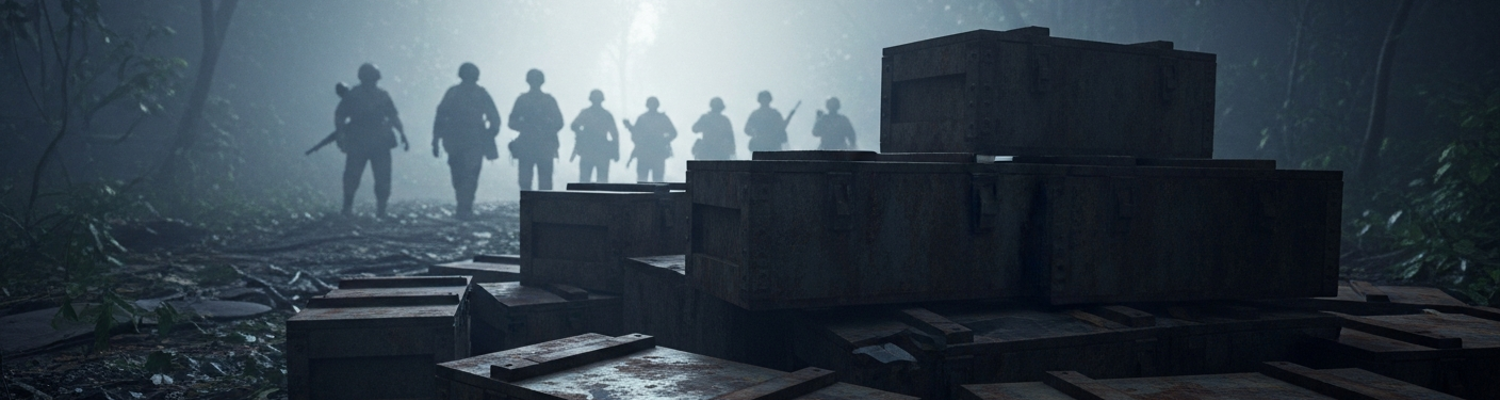
The physical environment of Noemfoor was an enemy as formidable as the Japanese garrison. Operations took place in a climate of relentless heat and near-constant 90-percent humidity. Metal surfaces left in the sun became too hot to touch, while torrential downpours turned the ground into a quagmire of mud and coral slush. For the paratroopers of the 503rd PIR and the infantry of the 158th RCT, this environment was a constant physical and psychological drain. A far more insidious problem emerged from the extreme conditions: the rapid and widespread degradation of their ammunition. The tools of war were being systematically dismantled by the air and water. Standard ammunition crates, designed for temperate European climates, offered little protection. Moisture wicked its way past seals and into the packaging, initiating a destructive chemical process.
Ordnance began to fail.
This was a systemic crisis that threatened to cripple combat effectiveness. A review of ordnance reports from the Pacific theater reveals a consistent pattern of failure directly attributable to moisture. The most immediate problem affected small arms ammunition, specifically the .30-caliber tracer rounds used in M1 Garands, Browning Automatic Rifles, and M1919 machine guns. The hygroscopic nature of the pyrotechnic compound in the base of a tracer bullet meant it readily absorbed atmospheric moisture. Once compromised, the tracer element would fail to ignite upon firing, or would light with a dim glow that extinguished almost immediately. For squad and platoon leaders, this was a severe blow. Tracer fire was the primary method for directing the fire of a unit in the chaotic jungle environment. A stream of glowing red was used to mark enemy positions and designate targets for machine gunners. With a significant portion of tracer rounds failing, this command and control function broke down.
The problem was worse for heavy ordnance.
While tracer failures caused confusion, the degradation of high-explosive mortar shells created a direct threat to the American forces. The 60mm M49 and 81mm M43A1 mortar shells were essential for providing immediate, high-angle fire support against the Japanese cave defenses. The paratroopers relied heavily on their organic mortar sections to suppress machine-gun nests and break up enemy counterattacks. On Noemfoor, reports of duds became alarmingly frequent. The propellant increments, cloth bags of powder known as "cheese charges" that were attached to the shell’s fins to adjust range, absorbed moisture, leading to inconsistent ignition and erratic shell trajectories. More dangerously, the sensitive fuzes and the main explosive filler of the shells themselves were compromised. A mortar crew could drop a round down the tube only to have it fall dead, resulting in a dud that failed to explode on impact. This not only wasted precious ammunition but also left the assaulting infantry without the fire support they needed to approach fortified positions. The failure of these support weapons forced rifle companies into costly frontal assaults against Japanese caves.
A detailed analysis of U.S. Army Ordnance Department logistics during the Pacific War reveals a systemic flaw in its ammunition supply chain. The standard packaging protocols, developed with a temperate European climate in mind, were inadequate for the extreme humidity of the Southwest Pacific. Ammunition arrived from stateside factories packed predominantly in non-waterproofed cardboard cartons, which were then placed inside wooden crates like the M1917 box. These containers offered physical protection but provided almost no defense against moisture infiltration. The relentless dampness penetrated the fiberboard and wood, saturating the cardboard packaging within and initiating a corrosive process on the ammunition itself. Reports from ordnance personnel throughout the theater noted that rubber gaskets intended to provide a watertight seal on some metal containers failed, losing their elasticity in the tropical heat.
The issue was a failure of institutional learning.
This widespread ammunition degradation, known colloquially in the theater as 'Ammudamp', was a known issue long before the 503rd PIR jumped onto Noemfoor. Earlier operations in New Guinea and the Solomons had produced numerous after-action reports detailing the exact same failures. The problem was so pervasive that it was estimated that 40% of all rations shipped to the Southwest Pacific spoiled due to similar packaging failures. The Ordnance Department was aware of the shortcomings, yet the logistical pipeline was slow to adapt. Production and shipping schedules were vast and difficult to alter, meaning that despite the known deficiencies, units on the front lines continued to receive ammunition in the same susceptible packaging. For the men on Noemfoor, this meant that crates of needed ordnance, delivered at great risk, were often found to be compromised before they could even be issued.
The direct consequence of this bureaucratic inertia was a tangible impairment of combat effectiveness. The primary casualty was indirect fire support. The 60mm and 81mm mortars, essential for suppressing Japanese cave defenses from a safe distance, became perilously unreliable. Propellant increments absorbed so much moisture that they would often fail to ignite properly, causing rounds to fall short or with unpredictable trajectories. Even worse, the fuzes and main explosive fillers of the mortar shells themselves were being compromised. A review of combat logs (NARA Record Group 407) shows an alarming frequency of duds, where mortar teams would fire a shell only to have it fail to detonate on impact. This left attacking infantry without the covering fire needed to cross open areas and approach the heavily fortified cave mouths.
This failure of ordnance forced a tactical shift to far more costly methods of attack. With mortars rendered ineffective, the task of destroying Japanese positions fell to individual soldiers armed with M1 portable flamethrowers and satchel demolition charges. Instead of suppressing a cave with a mortar barrage, a two or three-man team had to physically crawl under fire to within yards of the target aperture to deliver a burst of napalm or throw a charge. This was exceptionally hazardous work, and flamethrower operators in particular suffered a high casualty rate. The inability to rely on ammunition right out of the crate meant that every assault on a Japanese position was more hazardous, more costly in American lives, and slower than it needed to be, directly extending the campaign of annihilation on Noemfoor.
The invasion plan for Noemfoor was built on the expectation of a swift action lasting only a few days. Archival evidence shows that planners, underestimating Japanese strength, believed the island’s three airfields could be secured rapidly. The reality was a grinding, two-month campaign of extermination that officially spanned from July 2nd to August 31st, 1944. Organized resistance from Colonel Suesada Shimizu’s main force was largely broken by mid-July, but this marked a transition, not an end. The fighting devolved from set-piece battles for the airfields into an island-wide hunt for an enemy that refused to surrender. For the men of the 503rd Parachute Infantry Regiment and the 158th Regimental Combat Team, the last six weeks of the campaign became an exhausting series of patrols pushing deep into the island’s unmapped interior, seeking out the shattered remnants of the 219th and 222nd Infantry Regiments. The term 'mopping up' fails to capture the lethal nature of this work, where isolated Japanese units, starving but still armed, would set deadly ambushes or fight to the last man from hidden positions. The campaign was not over until the last pockets of resistance were physically annihilated, a process that dragged the formal conclusion of the operation to the final day of August.
This was a war of intimate violence.
The defining feature of the Noemfoor campaign after the seizure of the airfields was the close-quarters combat required to clear Japanese fortifications. Colonel Shimizu had organized his defenses into fourteen dispersed strongpoints, many based around the island’s natural cave systems. These were not simple holes; they were fortified positions, often interconnected, with overlapping fields of fire designed for a war of attrition. A review of after-action reports from both the 503rd and 158th reveals that engaging these positions was a slow, methodical task. A single, well-concealed machine-gun nest could pin down an entire company. With mortar fire often proving unreliable due to ammunition degradation, the job of destroying these caves fell to small assault teams. The standard tactic involved a base of fire to suppress the cave opening while a two-or-three-man team, typically armed with an M1 flamethrower and satchel charges, crawled into position. The flamethrower operator would project a stream of ignited napalm into the aperture, consuming the oxygen and killing the occupants, followed by demolition charges to collapse the structure.
The cost of underestimation and prolonged combat was paid in American casualties. The final tally for the CYCLONE Task Force by August 31st was 66 killed or missing and 343 wounded. While these numbers may seem low compared to other Pacific battles, they are significantly higher than anticipated for an operation expected to be lightly opposed. A substantial portion of these losses occurred after the main objectives were secured. The 503rd PIR, tasked with much of the pursuit into the island’s interior, suffered heavily during its clashes with the remnants of the Japanese garrison. Beyond combat losses, the casualty lists were inflated by non-battle injuries, most notably the 128 jump-related casualties sustained by the 1st and 3rd Battalions of the 503rd during their drops on Kamiri Drome. The unforgiving coral runway and faulty jump altitudes shattered ankles and legs before the men even entered the fight. In contrast, the Japanese garrison was effectively annihilated. Approximately 1,730 Japanese soldiers were killed, with only 186 taken prisoner.
Post-war accounts of the Noemfoor campaign often frame the operation as a model of efficiency, a swift victory secured by bold paratroopers. This portrayal is a significant distortion of the historical record. The plan for Operation Cyclone was indeed predicated on a rapid seizure of the island’s three airfields, an action planners believed would conclude in days.
This was a fiction.
A close review of operational logs shows the campaign officially lasted two full months. The initial landings by the 158th RCT and the subsequent airborne drops by the 503rd PIR did succeed in capturing the primary objectives, the airfields at Kamiri, Namber, and Kornasoren, within the first week. This did not end the fighting. It marked a transition from conventional battle to a protracted war of annihilation. For the next seven weeks, American forces engaged in an exhausting series of platoon-level patrols deep into the jungle interior. This sanitized a lethal reality where starving but determined Japanese soldiers fought to the death from hidden caves and ambushed American patrols, prolonging the conflict until the last pockets of resistance were physically exterminated.
The root cause of this protracted bloodshed was a systemic failure of intelligence and matériel. The popular narrative of a daring airborne assault conveniently omits that the decision to commit the 503rd PIR was itself a panicked reaction to faulty intelligence. Initial Allied estimates dangerously suggested a token Japanese force of less than a single effective battalion. The real number was closer to 5,000 troops. This gross underestimation shaped an operational plan unsuited for the enemy’s actual strength. Archival evidence shows that planners were also entirely unaware of the extensive network of fortified caves and interlocking pillboxes the Japanese had constructed. These defenses, nearly impervious to preliminary bombardment, turned the island into a fortress and ensured any fight would be a grinding, close-quarters affair. This intelligence failure was compounded by a critical matériel crisis. Ammunition, improperly packaged for the tropics, degraded rapidly in the extreme humidity. Propellant charges for 60mm and 81mm mortars absorbed moisture, causing erratic trajectories and frequent duds. The inability to rely on mortar support to suppress Japanese strongpoints forced a tactical shift to far deadlier methods, requiring infantry teams to crawl under fire to destroy cave openings with flamethrowers and satchel charges.
Any honest assessment of the Noemfoor operation must reject post-war accounts of seamless efficiency. The facts point instead to a campaign plagued by foreseeable and embarrassing errors that directly increased American casualties. The airborne assault itself, often romanticized, began with a disaster. Due to pilot error and an unprepared drop zone littered with vehicles and debris, the 1st and 3rd Battalions of the 503rd PIR suffered a combined 128 jump-related casualties. Men were put out of action with broken limbs before a single shot was fired in organized combat. These losses were so severe that the planned jump for the 2nd Battalion was cancelled entirely; the unit was brought ashore via landing craft instead.