
Strategic Origins of Operation Starvation
Steel trailers rolled across the coral aprons of the Mariana Islands, carrying two thousand pound Mark 25 and one thousand pound Mark 26 naval mines coated in protective grease. Navy ordnance specialists worked inside open sided quonset huts, bolting delicate magnetic search coils, hydrophone acoustic pickups, and water pressure sensors into the tail cavities of each steel shell. Ground crews then fitted heavy canvas parachute packs to the tail rings, setting the static cords that would pull the chutes open the moment the weapons cleared the aircraft. Flight line mechanics modified the bomb bays of the Boeing B-29 Superfortress bombers parked nearby, wiring electrical release solenoids and bolting specialized sway braces to hold the blunt naval ordnance steady. Hydraulic dollies hoisted the assembled mines into the dark bellies of the aircraft, where armorers locked each weapon into the suspension shackles until the bays held twelve full weapons. Ground handlers checked the arming wires one last time before locking the bomb bay doors shut, securing the heavy cargo for long flights over the ocean.
Ocean transit routes became the primary target for Chester Nimitz and his Navy planners, who had spent months demanding these heavy bombers for an aerial blockade. Navy leadership pressured Major General Curtis LeMay to allocate the B-29 Superfortresses to sever Japan from its overseas supply routes, arguing that the Japanese home islands depended completely on imported food, oil, and raw materials shipped across the Inland Sea and through the Shimonoseki Strait. LeMay resisted this pressure because he believed that pulling his heavy bombers away from the urban firebombing campaign would dilute their destructive power and delay the end of the war. Navy planners countered by showing that American submarines could not penetrate the shallow coastal channels, leaving aerial mining as the only practical weapon capable of choking off enemy merchant shipping. Orders from the Joint Chiefs of Staff eventually forced the two services into an operational compromise that required XXI Bomber Command to support maritime interdiction. LeMay yielded to this high level command decision, agreeing to designate an entire combat wing to seal the Japanese home waters.
Combat wing assignments fell to the 313th Bombardment Wing based on Tinian, tasked to execute low altitude nocturnal minelaying missions across the vital choke points of the Inland Sea. Brigadier General John H. Davies commanded the wing from North Field on Tinian, where his aircrews had to retrain immediately from high altitude daytime formation bombing to solo night navigation at five thousand to eight thousand feet. Navy mine specialists arrived on the island to run intensive classroom courses, teaching Army pilots and navigators how water depth, tides, and aircraft airspeed altered mine trajectories. Aircrews flew repeated night practice runs over the open ocean, learning to steer strictly by their AN/APQ-13 radar displays and release weapons without visual landmarks. Flight engineers recalculated engine power settings to manage the heavy fuel consumption caused by flying thick, low altitude air over long distances. Bombardiers calibrated their radar scopes to release individual weapons into narrow navigable channels, knowing that misplaced mines dropped on land or in deep water would leave enemy sea lanes completely open.
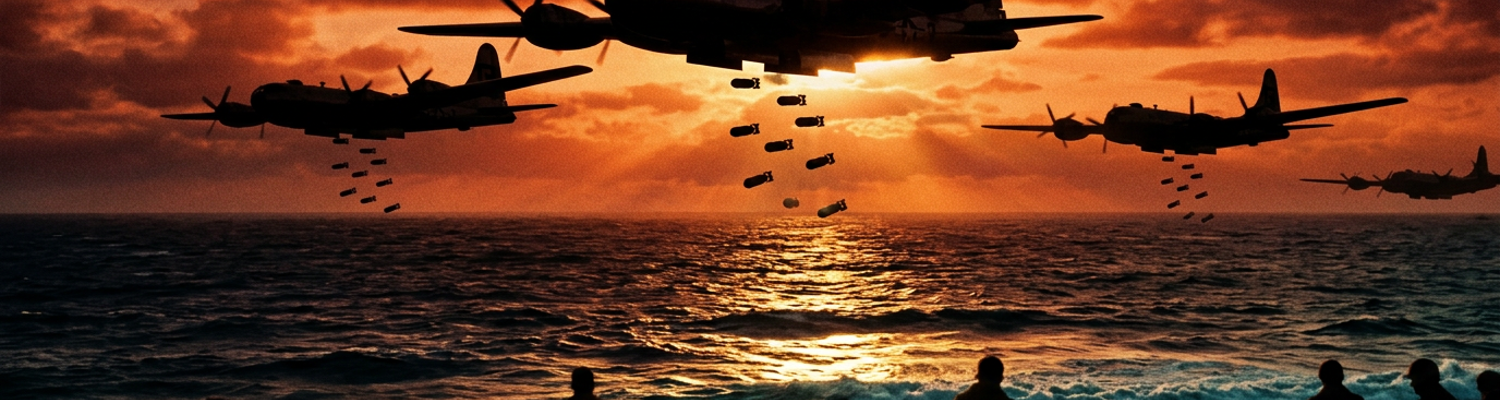
Sea lanes narrowed as pilots in the 313th Bombardment Wing guided their bombers down to eight thousand feet over the pitch black waters of the Shimonoseki Strait, tracking shoreline echoes on their radar scopes to find the narrow channels. Japanese searchlight beams swept the night sky while coastal antiaircraft batteries threw up dense walls of flak to break up the incoming flight paths. Flight crews held the four engine planes steady against turbulence and shrapnel, opening the bomb bay doors directly over the marked shipping lanes. Canvas parachutes blossomed in the dark as the mines tumbled free, slowing their descent so the impact would not crack the delicate acoustic and magnetic fuzes on the surface of the water. Each mine plunged into the channel and settled into the seafloor mud, arming its internal clockwork mechanisms to detect the steel hulls and propeller vibrations of passing cargo ships. Ground crews at North Field on Tinian met the returning bombers on the taxiways with tractors and hydraulic hoists, preparing another batch of magnetic mines for the following night.
Aerial Minelaying Tactics in the Shimonoseki Strait
Armorers bolted these new magnetic mines onto the bomb bay shackles within hours of touchdown, sending refreshed B-29 crews back into the sky for repeat strikes against the Shimonoseki Strait. Navigators seated behind the cockpit relied on the green glowing screens of their AN/APQ-13 radar sets to track the twisting shorelines of Honshu and Kyushu through dense cloud decks and total darkness. Radar operators tuned their receivers to pick up the sharp contrast between black water and rocky bluffs, giving pilots precise heading corrections to line up with channels less than a thousand yards wide. The use of AN/APQ-13 radar navigation by B-29 crews to achieve precise mine distribution across narrow waterways became standard procedure, allowing navigators to calculate drift and tide speeds so individual weapons fell along the exact center of the shipping lanes rather than burying themselves uselessly in coastal mudflats. Flight crews held their bombers level at altitudes between five thousand and eight thousand feet during the final run, listening over the intercom as the radar operator counted down the remaining seconds to the release point.
Bombardiers tripped the electrical switches the instant the countdown hit zero, dropping strings of heavy ordnance into the slipstream at four second intervals. Canvas parachutes yanked free from the tail packs and snapped open, keeping the weapons nose down so the impact with the water would not shatter the delicate firing mechanisms inside. Sustained operations by the 313th Bombardment Wing achieved the emplacement of over 12,000 Mark 25 and Mark 26 acoustic and magnetic sea mines between March and August 1945, blanketing the Shimonoseki Strait and the surrounding approaches to the Inland Sea. Pilots flew these runs individually rather than in formations to prevent midair collisions in the dark, dodging Japanese searchlight batteries that locked onto their aluminum fuselages from the surrounding hills. Antiaircraft fire burst in tight clusters around the bombers as coastal gunners tracked the engine roar, but the scattered flight paths allowed most aircraft to escape back out over the open ocean after dropping their loads.
Steel mine casings settled deep into the silt beneath the shipping channels, arming internal clockwork fuses that waited for target vessels to pass overhead. Technicians in the Mariana Islands had programmed the two thousand pound Mark 25 and one thousand pound Mark 26 mines with varied sensitivity settings, mixing magnetic triggers that detected steel hulls with acoustic hydrophones that picked up the churn of bronze propellers. Ordnance specialists also installed ship count mechanisms inside the mine casings, allowing several vessels or wooden minesweepers to pass safely before the firing circuit detonated under a loaded freighter. Japanese sweepers dragged wire cables and noise making gear through the channels during daylight, but the unpredictable fuzing combinations blew the minesweepers apart and made reliable clearance impossible. Commercial shipping companies halted traffic through the Shimonoseki Strait as blast columns threw damaged freighters onto sandbars, trapping dozens of coal barges and cargo ships inside regional ports.
Harbor masters ordered desperate merchant crews to attempt alternative passages along the coastline, but waiting B-29s systematically seeded those secondary escape routes with fresh minefields. Port authorities at Moji and Shimonoseki watched maritime cargo volume through the strait fall by more than eighty percent within weeks of the initial drops. Raw materials from Korea and northern China piled up on Asian docks because transport ships could no longer reach industrial factories on the Japanese mainland. American air commanders analyzed aerial reconnaissance photographs of the bottlenecked harbors, assigning additional B-29 squadrons to replenish the mine barriers whenever sweepers managed to blast open a temporary path.
Economic Strangulation of the Inland Sea
Superfortress crews dropped fresh mines directly into the churned wakes of Japanese sweepers, sealing the narrow exits from the Inland Sea and trapping merchant vessels at their loading berths. Port captains in Kobe, Osaka, and Kure watched loaded freighters accumulate along stone quays because harbor channels remained infested with hidden explosives. The rapid expansion of these aerial minefields severed the critical maritime transit routes linking the industrial factories of Honshu to essential Hokkaido coal mines and rich Kyushu grain reserves. Steamships attempting to transport coking coal from the northern ports of Muroran and Otaru ran into mine barriers laid across the Tsugaru Strait, leaving thousands of tons of fuel stranded on northern docks. Bulk carriers hauling barley and rice from southern agricultural valleys found their routes northward through the Bungo and Kii channels blocked by acoustic and pressure weapons that detonated without warning.
Detonations sent shockwaves ripping through the steel hulls of cargo vessels whose captains gambled on running the seeded waterways. Water pressure caved in rusted hull plates and collapsed interior bulkheads, sending dozens of converted freighters, colliers, and wooden motor vessels to the shallow seabed with their cargo holds intact. Japanese naval authorities organized emergency salvage units and dispatched wooden tugs to tow crippled hulls out of the main fairways, but repeated explosions along coastal shallows overwhelmed their repair facilities. The steady attrition of these strikes resulted in the sinking or damaging of over 1.25 million tons of merchant shipping across the home islands, gutting the national merchant marine that kept the archipelago functioning. Shipyard workers in dry docks along Tokyo Bay and the Inland Sea abandoned long term maintenance projects because blast damage from mines continuously filled every available slipway with twisted metal and flooded engine rooms.
Shipyard bottlenecks accumulated so rapidly that Japanese domestic waterborne trade ground to a virtual halt by the middle of summer. Freight volume moving through home island coastal waters plunged by more than eighty five percent, cutting off the heavy raw materials needed to keep weapon foundries and aircraft assembly lines operating. Blast furnaces across the Osaka and Yawata industrial districts cooled and stopped operating because the severed sea routes could no longer deliver the thousands of tons of bituminous coal required each day. Ministry of Transportation officials attempted to divert essential shipments onto the national railway network, but narrow gauge tracks and mountain tunnels lacked the rolling stock and freight capacity to replace deep draft cargo ships. Coal piles sat untouched in open air rail yards while regional train managers canceled civilian passenger schedules to prioritize the few remaining carloads of military ammunition and food.
Food supplies dwindled as grain reserves spoiled inside waterfront warehouses across Kyushu because no cargo vessels could safely navigate the mined approaches toward the hungry cities of Osaka, Nagoya, and Tokyo. Civilian diet allotments dropped to less than sixteen hundred calories per day, forcing urban factory workers to spend hours searching rural hillsides for wild grasses and edible roots instead of assembling weapons. Imperial General Headquarters realized that the aerial minefields had effectively split the Japanese nation into four isolated geographical pockets, preventing army units from shifting ammunition and provisions between the islands. Coastal defense commanders attempted to bypass the dead waterways by lashing together small wooden fishing trawlers and motorized sampans to slip over shallow minefields during high tide, but acoustic sensors hidden in the mud detonated beneath the light wooden keels and drove the remaining crews ashore.
The Postwar USSBS Economic Inquest
Crews ashore watched as Paul Nitze led a large delegation of civilian and military investigators into the ruined commercial ports of the Japanese home islands in autumn 1945 to examine the shattered remnants of the coastal merchant fleet. Working as vice chairman of the United States Strategic Bombing Survey, Nitze deployed field teams of economists, industrial specialists, and uniformed technical officers into the battered waterfronts of Tokyo, Yokohama, Kobe, and Osaka. These investigation units walked along quiet stone wharves where cranes stood idle and inspected hundreds of sunken freighters resting in the harbor mud. Nitze instructed his field teams to look past the superficial burn scars left by incendiary air raids and uncover the precise mechanisms that strangled regional commerce. Field researchers established mobile headquarters in municipal administrative buildings, dispatching bilingual intelligence teams to track down harbor masters, warehouse supervisors, and local shipping executives who witnessed the rapid collapse of waterborne transport.
Investigators seized administrative offices across every major port district, initiating the systematic confiscation and translation of Imperial Japanese Navy mine countermeasure records and civilian shipping ledgers. Navy specialists impounded wooden filing cabinets from maritime headquarters in Kure and Yokosuka, hauling crates of classified patrol logs and acoustic sweeping charts back to survey workrooms. Military linguists worked through stacks of handwritten records that documented the desperate, failed attempts of Japanese sweepers to neutralize American magnetic and pressure mines. Civilian shipping ledgers provided an unbroken paper trail of lost tonnage, showing cargo manifests, route cancellations, and grain stockpiles stranded at regional depots. These seized documents revealed that mining operations disrupted coastal traffic far more quickly and thoroughly than senior Allied planners had projected during the war.
War planners faced new data as economists within the survey cross referenced the confiscated harbor manifests against domestic railway tallies and factory production curves. Their statistical graphs demonstrated that the aerial blockade severed fuel and food distributions months before urban firebombing destroyed inland manufacturing centers. Japanese industrial output plummeted because raw bauxite, iron ore, and coking coal remained pinned in outer ports, starving heavy industry while factory machinery sat undamaged. Nitze confronted captured officials from the Ministry of Munitions, who confirmed that lack of maritime transit alone would have halted arms production and triggered nationwide starvation by autumn 1945. These hard figures showed that a joint blockade using aerial minelaying and submarines had already achieved decisive economic strangulation without requiring the scheduled amphibious invasion of the home islands.
Nitze circulated preliminary survey drafts among senior staff members in Tokyo, igniting bitter disputes over which service branch deserved credit for paralyzing the Japanese empire. Air force commanders argued that the B-29 Superfortress was the decisive weapon of victory, pointing to the aerial delivery of thousands of mines as proof of independent air power. Naval officers countered that the aerial mining offensive was fundamentally a naval operation that used navy designed ordnance and tactical doctrine to complete an encirclement begun by submarines. Nitze resisted military pressure to alter the economic conclusions, packing the verified shipping statistics and captured naval logs into courier pouches bound for Washington. Couriers delivered the completed draft chapters directly to the Pentagon and the White House, forcing Truman administration officials to schedule contentious hearings on armed forces unification.
Interrogations of Japanese Military and Civilian Leadership
Unification hearings required solid evidence, prompting investigators to gather sworn testimony in Tokyo to back up the draft chapters before these contentious Washington meetings took place. Survey teams summoned Imperial Japanese Navy commanders to face formal depositions, where stenographers recorded senior officers, including Captain Kyuzo Tamura, the chief of navy minesweeping operations, explaining how the underwater ordnance paralyzed maritime defense networks. Tamura testified that although American submarines had successfully severed outer ocean supply lines earlier in the war, the aerial mining campaign struck directly at the vital home waterways and inflicted the decisive operational damage on Japanese shipping. Minesweepers lacked the technical equipment to clear acoustic and pressure fuzes fast enough to match the rate of new B-29 drops in the Shimonoseki Strait and Inland Sea channels. Imperial Japanese Navy depositions revealed that merchant captains refused to leave port because the invisible mine barriers created total operational paralysis that conventional warships could not break. Coastal convoys halted completely along the home islands, leaving surviving freighters and naval escorts pinned at their docks.
Docks remained crowded with trapped freighters while Survey interrogators shifted their questioning to civilian officials from the Ministry of Transportation. Transportation officials arrived at the inquest rooms with stacks of harbor logs and rail manifests, detailing how the sudden shipping collapse caused catastrophic factory shutdowns across the mainland by mid 1945. Bureaucrats explained that essential raw materials, such as coking coal, iron ore, and bauxite, piled up on distant docks in Hokkaido and northern Honshu because no maritime transports could carry them into the industrial belt. Steel mills, chemical plants, and aircraft assembly lines in Osaka and Yawata exhausted their existing stockpiles within weeks, forcing plant managers to extinguish blast furnaces and shut down machinery. Ministry representatives testified that domestic industrial output collapsed not because air raids destroyed factory buildings, but because vital materials sat stranded on distant wharves with no way to reach inland production centers. Railways could not make up for the lost sea routes, because narrow tracks and limited boxcars carried only a fraction of the heavy bulk freight that factories needed to stay open.
Steam locomotives broke down on steep mountain grades under the desperate effort to haul coal and iron, confirming to American interviewers that inland transportation could not handle the diverted cargo volume. Transportation planners described how aircraft factories and ammunition plants stood silent by July of 1945, with workers sitting beside idle assembly jigs while unworked metals remained hundreds of miles away. Survey economists confronted captured industrial leaders with wartime shipping charts, matching the exact dates of minefield drops to the sudden drop in aircraft engine and weapons output. Civilian administrators conceded under oath that national war production would have ended by late summer entirely because of raw material shortages, even if high explosive and incendiary bombing had never occurred. Intelligence linguists compiled every confession into official records, verifying that the combined sea blockade and aerial mining offensive had disarmed the empire before Allied armies set foot on the beaches.
Beaches remained uninvaded as Paul Nitze packed these translated interrogation records alongside captured shipping ledgers into secure leather pouches for immediate transport to Washington. Survey leaders intended to use the Japanese testimony to counter aggressive claims from senior air commanders who credited the victory solely to high altitude firebombing. Naval strategists and air generals studied the interrogation transcripts closely, seizing on different statements by enemy officers to claim primary responsibility for the collapse of Japanese shipping. Administration officials distributed copies of the sworn Japanese depositions to members of the armed services committees, preparing for contentious debates over whether the Navy or the Air Force held the primary role in forcing the surrender. Congressional hearing rooms filled with senior military witnesses who argued over the Japanese confessions, using the testimony of captured admirals and ministers to battle for control of the postwar defense budget.
The Capitulation Without Invasion Thesis
Defense budget battles intensified when Paul Nitze laid mimeographed copies of the Survey summary draft across committee tables, fueling these clashes with an explosive historical judgment. The draft document concluded that conventional aerial interdiction and the naval blockade would have compelled the Japanese government to surrender unconditionally prior to November 1, 1945. Survey analysts based this claim on the complete economic paralysis of the home islands, pointing out that factory output had stopped and food supplies had plummeted once shipping channels closed. This formal finding asserted that Japan would have yielded by late autumn even if Allied forces had not dropped the atomic bombs and even if the Soviet Union had never declared war in Manchuria. Military strategists in the Pentagon read these preliminary pages with deep alarm, recognizing that the text challenged the foundational justifications for the final months of the Pacific War.
Pacific War justifications faced immediate pushback as Army planners challenged the Survey conclusions because the findings directly minimized the military necessity of Operation Downfall, the planned amphibious invasion of Kyushu scheduled for November 1. General George Marshall and Joint Chiefs staff members had prepared to deploy hundreds of thousands of combat troops onto southern beaches, anticipating catastrophic casualties in prolonged ground fighting against fortified imperial divisions. The draft Survey report undercut those casualty projections by insisting that sea mines, submarines, and land based bomber sweeps had already destroyed the enemy capacity to sustain organized military resistance. Ground warfare advocates argued that naval and aerial blockades alone had never forced a determined imperial army to lay down its arms, maintaining that only the physical presence of landing craft and infantry could have guaranteed absolute victory. Staff officers filed formal memorandums questioning the statistical methods of the civilian economists, accusing the Survey leadership of relying too heavily on post surrender rationalizations from captured Japanese officials.
Japanese officials were not the only source of controversy, as Manhattan Project leaders joined the counterattack after Survey drafts minimized the operational impact of the atomic bombings on Hiroshima and Nagasaki. Scientists and cabinet officials insisted that the dual nuclear strikes had provided the overwhelming psychological shock required to break the political deadlock inside the imperial palace and force Emperor Hirohito to intervene. The Survey draft treated the atomic detonations as secondary events that merely accelerated an inevitable collapse, arguing that the true collapse had already occurred along mined sea lanes and burned railyards. Defenders of President Harry Truman pointed out that discounting the atomic bomb threatened to undermine public confidence in the administration wartime decision to use the new weapon. Civilian analysts stood by their economic curves, reiterating that the destruction of maritime transit had already doomed Japan to winter starvation and military helplessness regardless of special weapons.
Government editors marked draft passages in red ink, demanding qualifying phrases to blunt the political fallout before the Government Printing Office produced final copies. Paul Nitze agreed to minor textual adjustments, but he preserved the core judgment that conventional blockade and aerial interdiction would have forced capitulation before the November invasion date. Naval planners seized on the printed chapters to demand greater funding for carrier aviation, mine warfare, and submarine construction, while newly minted Air Force generals cited the same pages to claim that independent strategic aviation made traditional ground armies obsolete. Couriers carried the finished volumes into White House offices and Pentagon briefcases, delivering thousands of bound copies to service chiefs who immediately retooled their postwar procurement requests.
Postwar Inter-Service Warfare and Doctrinal Debates
Procurement requests sparked immediate conflict as admirals highlighted passages across the thick survey volumes to challenge the rising influence of Army air commanders in postwar budget hearings. Senior naval officers mounted fierce pushback against the survey findings, arguing that American submarine warfare had served as the primary driver of the Japanese maritime collapse rather than late war Army Air Forces minelaying. Fleet planners stacked four years of torpedo logs, patrol reports, and sinking charts onto congressional hearing tables to prove that fleet submarines had already eliminated the bulk of merchant shipping before B-29 bombers dropped a single naval mine into the Inland Sea. Submarine commanders pointed out that their crews had sunk over four million tons of Japanese merchant shipping, starving the home islands of raw petroleum and isolating the southern empire long before Operation Starvation began. Naval leadership insisted that air dropped mines simply inflicted the final losses against an empire whose vital sealanes had already been closed by undersea patrols.
General Carl Spaatz and the Army Air Forces command countered these naval arguments by using the survey conclusions to validate independent strategic airpower as the decisive instrument of modern warfare. Air generals argued that long range bombers possessed the speed, range, and destructive payload to destroy enemy industries, seal coastlines, and force national surrender without bloody amphibious landings or costly naval blockades. Staff officers in the Pentagon compiled excerpts from the bombing survey into legislative briefing packets, circulating them among sympathetic congressmen who were drafting military reorganization bills. Aviators maintained that the aerial mining campaign proved the heavy bomber could execute classic naval blockade missions far more rapidly and cheaply than surface fleets or submarine squadrons. Air commanders used these operational claims to demand a separate, co-equal United States Air Force and the largest share of future procurement funds for long range bombers.
Secretary of the Navy James Forrestal challenged these airpower claims in executive meetings with President Truman, warning that overreliance on strategic bombers would weaken traditional fleet readiness. Naval strategists warned that reducing carrier aviation and submarine programs in favor of land based bombers would surrender control of the open oceans. Budget analysts calculated that the immense costs of building and maintaining intercontinental bomber wings would consume the funds needed to protect commercial sealanes and amphibious fleets. Naval officers emphasized that Operation Starvation had relied entirely on navy designed acoustic and magnetic mines and navy technical doctrine, demonstrating that aircrews were merely dropping naval weapons under fleet guidance. These clashing service perspectives hardened into bitter jurisdictional fights over which branch would control maritime aviation, antisubmarine warfare, and future atomic delivery systems.
President Harry Truman confronted these bitter jurisdictional fights by pushing military unification bills through Congress to end public bickering among his service chiefs. Congressional committees incorporated the conflicting survey arguments into marathon hearings on the National Security Act of 1947, balancing naval warnings about sea control against airpower claims of decisive strategic reach. General Curtis LeMay and Strategic Air Command planners utilized their wartime mining and bombing data to secure top priority for long range bomber squadrons within the newly created Department of the Air Force. Naval aviators and submarine designers salvaged their own core missions by securing statutory protections for carrier aviation and marine amphibious forces within a reorganized Department of the Navy. Budget directors signed off on divided appropriations that funded new B-36 strategic bombers for the Air Force while preserving construction funds for submarine hulls and aircraft carriers under naval command.
The National Security Act of 1947
Congressmen examined these split funding balances while opening formal committee hearings on military unification in the spring of 1947. Committee members called upon civilian analysts and uniformed officers to substantiate their budget requests with hard operational data from the recent conflict in the Pacific. Paul Nitze and survey investigators delivered hundreds of pages of field reports directly to Capitol Hill, ensuring the complete integration of USSBS operational data into Congressional hearings regarding the unification of the armed services. Air commanders pointed to survey statistics on collapsed coal shipments and blocked harbors to claim that land based heavy bombers could starve an island nation without the need for massive surface fleets or costly amphibious landings. Naval leaders countered with captured shipping registers and minefield clearance reports from the survey, insisting that aerial mining had functioned purely as an auxiliary naval tactic reliant on Navy designed ordnance and tactical doctrine. Dueling witnesses covered committee tables with charts and translated Japanese interrogation transcripts, turning the legislative review into an intense dispute over which service had inflicted the decisive operational damage on Japanese merchant shipping.
Japanese merchant shipping debates threatened to derail the defense reorganization program, prompting President Harry Truman to urge congressional leaders to forge a decisive statutory settlement. Lawmakers responded by drafting the National Security Act of 1947, creating a unified National Military Establishment presided over by a civilian Secretary of Defense. The landmark statute formally authorized the establishment of an independent United States Air Force shaped by the bureaucratic fallout of the Pacific blockade inquest. Strategic bombing advocates secured co-equal status with the Army and the Navy, using the survey conclusions to validate an autonomous military department dedicated to long range aerial operations. Truman signed the reorganization act aboard his presidential transport plane, permanently ending the status of the Army Air Forces as a subordinate branch within the Department of War.
Department of War subordination ended, but admirals responded to the signing of the act by securing rigid legal boundaries to protect fleet aviation from total Air Force consolidation. Navy leaders remembered the bitter debates over Operation Starvation, arguing that an independent air branch focused exclusively on strategic bombing would neglect the vital requirements of maritime defense. Congressmen addressed these fleet concerns by embedding explicit statutory safeguards within the law to preserve the integrity of carrier aviation and Marine amphibious units under the Department of the Navy. Drafters barred the new air service from absorbing naval aircraft, preventing air generals from taking control over maritime reconnaissance, carrier strike wings, or coastal patrols. These legislative provisions protected the separate identity of the sea service but left basic questions regarding operational jurisdiction over maritime airspace and aerial minelaying unresolved.
Secretary of Defense James Forrestal convened a summit of the Joint Chiefs of Staff at Key West to settle these persistent jurisdictional disputes. Service chiefs spent four days in closed door sessions debating the official functions paper that would define peacetime military roles and missions. Air Force generals claimed primary jurisdiction over all land based aircraft capable of deep water interdiction, citing their wartime minelaying runs over the Shimonoseki Strait as operational precedent. Forrestal broke the inter-service deadlock by confirming that the Navy maintained primary authority over maritime warfare, naval reconnaissance, and sea mining operations. The resulting Key West Agreement relegated the Air Force to a collateral, secondary role for aerial minelaying and anti-submarine support in cooperation with naval task forces. Service chiefs signed the compromise document and distributed the finalized mission directives across the Pentagon, ordering operational commanders to adjust their peacetime training and procurement schedules accordingly.