
I Corps Infiltration: March 1967
Operation Prairie II concluded on March 18, 1967. Over forty-seven days of fighting, the United States Marine Corps recorded 93 killed and 483 wounded. The casualty logs told a grim story. Nearly one-third of the dead and two-thirds of the wounded were victims of enemy mortar fire. This was a clear indicator of a well-supplied adversary operating with near impunity just south of the Demilitarized Zone (DMZ).
A close review of operational logs from the 4th Marine Regiment’s S-2 intelligence section (Record Group 127, NARA) reveals an intense effort to assemble a coherent picture of this enemy. Intelligence officers worked to piece together a mosaic from fragmented reports. Long-range reconnaissance patrols, prisoner of war interrogations, captured documents, and radio intercepts all contributed. The primary antagonist materializing from this data was the North Vietnamese Army’s 324B Division. S-2 summaries from this period consistently identified elements of this division, specifically its 812th Regiment, as the main force engaging Marine units and shelling their positions. Intelligence suggested the 324B’s mission was the complete control of Quang Tri Province. Yet, the intelligence was reactive, a portrait of an enemy that had already struck. For every confirmed sighting, countless other moments saw enemy forces moving undetected. The reports paint a frustrating picture of an enemy dictating the terms of engagement, initiating contact before melting back into the terrain.
The NVA’s elusiveness was a function of the landscape in eastern Quang Tri Province. They did not move in large formations along conventional roads. Instead, they utilized a complex, shifting network of jungle trails and footpaths crisscrossing the region south of the Ben Hai River and west from the Laotian border. These infiltration corridors, often obscured by a triple-canopy jungle that rendered aerial observation almost useless, allowed for the steady movement of troops, equipment, and the ammunition for the mortars inflicting so many casualties. Movement was primarily nocturnal. Small groups of soldiers and porters traversed these paths, resting in pre-established, camouflaged base areas during the day. The sheer number of available routes made a comprehensive blockade impossible. Sealing one trail only forced the NVA to cut a new one a few hundred meters away. The enemy’s logistical chain was not a highway but a capillary system, resilient and difficult to disrupt.
This operational reality confronted the 3rd Marine Division. The strategic imperative was clear: infiltration had to be stopped. The constant flow of NVA regulars into I Corps threatened to overwhelm scattered Marine bases and disrupt all pacification efforts. The resources available to the division commander were finite. The 3rd Marine Division was responsible for the entirety of Quang Tri Province, a massive area of operations stretching from the coast to the mountains. There were not enough infantry battalions to establish a physical presence along every potential infiltration route. With only a few battalions available for mobile operations at any given time, the rest were tied down defending major combat bases like Dong Ha, Gio Linh, and Camp Carroll. Marine commanders sought an alternative. They needed an economy-of-force measure, a way to deny the enemy freedom of movement without committing thousands of troops to static guard duty. This requirement for a wide-area interdiction capability, born from a scarcity of conventional assets, became the direct catalyst for the engineering improvisations that followed.
Aerial Minelaying System Challenges
The initial attempt to choke NVA infiltration routes from the air relied on the Family of Scatterable Mines, or FASCAM. This new approach to warfare theoretically allowed commanders to emplace minefields rapidly in enemy-held territory using aircraft. The concept was to blanket suspected trails and choke points without committing ground troops. A review of S-2 intelligence summaries and after-action reports from the 3rd Marine Division in 1967 reveals a consistent pattern of failure. Initial deployments, often conducted by helicopters like the UH-1E Huey or CH-46 Sea Knight, were plagued with problems. Reports documented mines failing to arm, scattering in unpredictable patterns, or landing far from their intended drop zones. One documented issue was the inaccuracy of the delivery systems, which were only as precise as the conventional munitions of the era. S-2 logs from units operating south of the DMZ noted with frustration that reconnaissance patrols would find NVA movement continuing unabated through areas supposedly mined just hours before.
One cause of these failed deployments was the rudimentary state of navigational technology. In 1967, precision GPS-guided strikes were decades away. Marine pilots navigated over the monotonous green expanse of Quang Tri Province using map-and-compass techniques, dead reckoning, and unreliable radio beacons. Some larger aircraft were equipped with systems like LORAN-A, but these were designed for strategic navigation, not for the pinpoint accuracy needed to drop a string of mines onto a three-meter-wide trail hidden under jungle. The tolerance for error could be over a nautical mile per hour of flight. For a helicopter or A-4 Skyhawk flying low and fast over disorienting terrain, identifying the exact drop point was nearly impossible. Pilots attempted to find specific coordinates based on terrain features that appeared identical for miles in every direction. The result, as intelligence reports confirmed, was minefields sown into empty jungle, sometimes kilometers away from targeted infiltration routes.
Even when a pilot managed to release a dispenser directly over a targeted trail, the jungle itself formed the final obstacle. The dense, multi-layered canopy that concealed NVA movement proved just as effective at defeating the mines. Early scatterable munitions, like the gravel mine or the small, lightweight XM41 "Dragontooth," were designed to be dispersed in large numbers. As these mines fell, they were frequently snagged by the thick web of leaves and vines hundreds of feet above the ground.
A significant percentage never reached the forest floor to arm.
They remained dangling uselessly in the trees, their positions often given away by the very parachutes or winglets meant to stabilize their descent. NVA soldiers could simply spot and avoid or easily clear them. For the mines that did penetrate the upper layers, their trajectory was so deflected by vegetation that any concept of a planned minefield pattern was rendered meaningless. Instead of creating a dense barrier across a trail, the mines were scattered randomly over a wide area, reducing their tactical effectiveness to near zero.
Command Confusion and Ground Hazards
The operational maps within the 4th Marine Regiment’s command posts south of the DMZ were becoming works of fiction. A review of after-action reports from early 1967 reveals a dangerous cycle tied to the FASCAM program. A mission would be requested to seal a suspected NVA infiltration route. A flight of A-4 Skyhawks or CH-46 helicopters would be dispatched, release their dispensers, and report mission completion. Within the regimental Combat Operations Center, an S-3 Operations officer would dutifully draw the symbol for a minefield onto the acetate overlay covering the operational map. Planners for future patrols and artillery fire missions would then treat this marking as fact. The problem was the disparity between the plotted minefield and the actual location of the munitions on the ground. Reports from 3rd Reconnaissance Battalion patrols frequently noted a complete lack of evidence of mining in designated zones. Other units would report unexplained detonations in areas believed to be clear. This created a crisis of confidence in the operational picture. The maps showed a battlefield that did not exist.
This command-level disconnect translated into lethal hazards for the infantry patrols of the 4th Marines. A squad leader preparing for a patrol would be briefed on the location of the new, friendly minefield, a red-boxed area on his map to be avoided. The patrol would then step off, navigating through the dense terrain of Quang Tri Province with the belief that their maps were accurate. Because of the gross inaccuracies of the aerial drops, the actual minefield might be scattered hundreds of meters away from its plotted location. A patrol, believing they were giving a wide berth to a known danger zone, could walk directly into the unmapped minefield. The lightweight nature of the mines, particularly the XM41, created another insidious threat. Many failed to reach the ground, snagged by the triple-canopy jungle. They remained there, armed and hidden in the foliage, until a gust of wind or the vibration from a passing helicopter dislodged them onto the unsuspecting Marines below.
These issues were compounded by a fragmented command structure. Directives for interdiction flowed down from the 3rd Marine Division headquarters, which was focused on the broad problem of NVA infiltration. These orders were then interpreted by the 4th Marine Regiment, which tasked its battalions and requested air support from the 1st Marine Aircraft Wing. A critical gap existed in the feedback loop. There was no effective, real-time system for a pilot to report navigation error or for a ground unit to immediately update the master operational maps for all adjacent units. An order from Division could lead to a mine drop whose errant placement created a new, undeclared threat for a battalion from a different regiment operating nearby. One unit’s supposed solution became another’s deadly problem.
Combat Engineers' Improvised Obstacles
The failure of aerial mining shifted the burden of interdiction onto the ground units of the 4th Marine Regiment. The command imperative was unchanged. The flow of NVA personnel and materiel through the territory south of the DMZ had to be stopped. With high-technology solutions proving ineffective, responsibility devolved to the Marines on the ground and, specifically, to the combat engineers attached to the infantry battalions. A review of operational logs from the 3rd Engineer Battalion, whose companies were parceled out in support of the infantry, shows a rapid pivot toward ground-based obstacle construction. The engineers were ordered to achieve by hand what aircraft had failed to do from the sky.
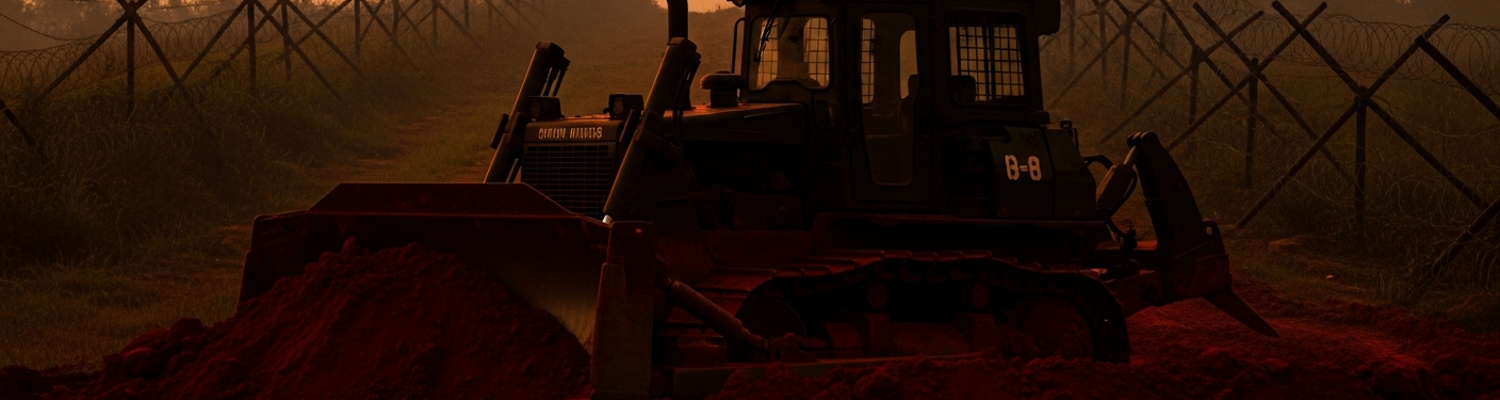
This effort was a localized, desperate precursor to the larger, formalized "Strong Point Obstacle System" (SPOS), which would later be known as the McNamara Line. While high-level command debated the grand strategy of a province-wide barrier, the engineers of the 4th Marines were already at work. They were driven by the immediate tactical need to protect their firebases and cut the infiltration trails being actively used by the NVA. Their work began on a strip of land between Gio Linh and Con Thien, designated for clearing and fortification. The plan, known as Project Dye Marker, called for bulldozing a trace several hundred meters wide, then lining it with a dense web of obstacles. Elements of the 3rd Engineer Battalion, supported by Navy Seabees, began the arduous task of clearing the vegetation. The process immediately drew heavy artillery and mortar fire from NVA positions inside the DMZ.
Their primary tools were concertina wire, manually emplaced anti-personnel mines, and improvised explosive devices. Records detail the construction of immense triple-strand concertina fences, a physically demanding task requiring thousands of man-hours. Teams of engineers and infantrymen detailed to support them spent weeks pounding pickets into the hard, dry earth and stretching endless spools of barbed wire, all while under constant threat.
The effort was defined by improvisation born from scarcity. The Marine engineer battalions in Vietnam were organized for amphibious operations of short duration, not a protracted land war defined by construction. After-action reports from 1967 consistently document shortages of specialized engineering equipment, from earth-moving machinery to basic items like generators and pneumatic tools. The 11th Engineer Battalion, committed to clearing the trace for the barrier, started with a mandate to clear a strip 200 meters wide and over 10 kilometers long. Lacking sufficient bulldozers, much of this had to be done by hand or with explosives.
When standard-issue mines were unavailable, they fabricated their own. A particularly effective improvised weapon was the flame fougasse, a battlefield expedient made from 55-gallon drums filled with a mixture of gasoline and diesel fuel, detonated by a block of C-4 explosive. Engineers would bury these devices along likely avenues of approach. Command logs from units like the 3rd Antitank Battalion also document the extensive use of Claymore mines, with dozens being wired together around a perimeter to provide a cohesive defense controlled from a central firing position. Every aspect of the obstacle belt was a creation of what could be requisitioned, salvaged, or fabricated on site.
Direct Fire and Resource Scarcity
The work of clearing the trace fell to the 11th Engineer Battalion. Their operational logs from 1967 reveal a task conducted under severe duress. The planned 200-meter-wide firebreak stretching between Gio Linh and Con Thien was under direct observation from NVA artillery positions within the DMZ. These were not harassing attacks. They were systematic, daily bombardments intended to halt construction. NVA gunners used 130mm field guns, whose range allowed them to fire with impunity, alongside mortars and recoilless rifles. For the engineers working in the open, there was no place to hide. Every time a bulldozer from the 11th Engineers began to clear the jungle, it drew immediate fire. The work became a lethal routine: clear a section, take fire, seek cover, treat casualties, and begin again. Unit diaries document a steady drain of men and machines. A bulldozer blade could be stopped by a detonated explosive, injuring the operator and halting work for hours.
This was a construction project on a static, pre-sighted battlefield.
Engineers innovated to survive. They learned to work in short bursts, timed between predictable artillery salvos. They dug shallow fighting positions and revetments along the trace as they worked. But the threat was constant. Snipers targeted equipment operators. Mortar rounds could land without warning anywhere along the line. The casualty rates for the engineers working this strip were consistently high.
An analysis of equipment manifests for Marine engineer battalions in I Corps during this period shows a force structured for expeditionary assault, not large-scale construction. The 3rd and 11th Engineer Battalions possessed some heavy equipment, like D-8 bulldozers, but not in the quantity required for a project of this magnitude. The original plan was a task for a fully-outfitted army construction corps, not a few Marine companies. Compounding the shortage was the difficulty of maintenance. The abrasive red dust, the humidity, and the enemy fire took a heavy toll on machinery. A February 1967 report from the 11th Engineer Battalion noted the completion of new maintenance pads at Dong Ha as a significant step, an indicator of how basic facilities were. The few bulldozers they had were mission-critical assets. Losing one to enemy action or mechanical failure had an outsized impact on the entire operation.
Lack of specialized equipment forced a reversion to manual labor under combat conditions. Where a fleet of bulldozers was needed, teams of Marines with explosives and hand tools had to suffice. The physical process of building the obstacle belt was a low-technology affair. The dominant sound was not of heavy machinery but of metal on metal and metal on earth. It was the clang of sledgehammers driving steel pickets into the hard-packed soil for the triple-strand concertina fences. It was the scrape of shovels digging weapons pits. Above all, it was the grating of thousands of feet of concertina wire being stretched taut by hand, its barbs snagging on gloves and uniforms. This auditory signature of intense labor was punctuated by the crack of sniper fire and the crump of incoming 82mm mortar rounds. Teams worked in rotation, one group pounding pickets while another provided covering fire, all of them exposed on the open ground they had just cleared.
Desperate Coordination Amidst Static
A review of after-action logs from the engineer and infantry battalions operating along the trace in 1967 reveals a battlespace dominated by auditory chaos. The primary tool for small-unit coordination, the AN/PRC-25 man-portable radio, was failing them. Its effectiveness was severely degraded along the DMZ. The rolling hills and dense jungle created dead zones where line-of-sight VHF signals could not penetrate. During the monsoon season, thick, moisture-laden air and torrential downpours further scattered transmissions. A platoon leader from the 11th Engineer Battalion, attempting to coordinate with his security element from the 4th Marines only a few hundred meters away, would often get nothing but a roar of white noise. The handset itself was notoriously vulnerable to moisture, a critical flaw in a region defined by extreme humidity. Radio Telephone Operators resorted to wrapping the handsets in the plastic bags from spare battery packs, a field improvisation against an environment as hostile as the enemy.
This communications breakdown isolated the small teams of engineers and their infantry support. It forced a reliance on raw improvisation. When a D-8 bulldozer struck a buried enemy explosive and ground to a halt, the operator could not simply call back to the maintenance section at Dong Ha for guidance. The NVA, observing the stalled machine, would begin walking mortar rounds in on the location. Under this incoming fire, the troubleshooting effort was desperate. A close study of maintenance reports from the 11th Engineers shows a constant struggle against equipment failure caused by both combat damage and the harsh conditions. A ruptured hydraulic line on a bulldozer’s blade was not a simple repair. It was a potential death sentence. Mechanics and operators, covered in grease and red dust, would have to crawl under the heavy machine, using scavenged parts or fabricating patches from rubber and wire to stop the leak. They worked with the knowledge that the sound of their tools could draw sniper fire. Every repair was a race against time and dwindling luck, a focused effort to get a vital piece of machinery moving before it was destroyed completely.
The mission to build the obstacle belt had the highest national priority. The engineers of the 3rd and 11th Battalions, supported by Seabees, were the agents of this strategy. They refused to be halted. Unit diaries document how, after a mortar barrage lifted, Marines would emerge from their shallow fighting holes and immediately return to their work. The rhythmic pounding of sledgehammers driving pickets for triple-strand concertina wire would resume, a defiant sound of construction in a landscape of destruction. They continued stretching the wire and laying out minefields even as they treated their wounded and called for medevacs that struggled to find them through the static. They were building a barrier, meter by meter, under direct fire, with failing equipment and fractured communications.