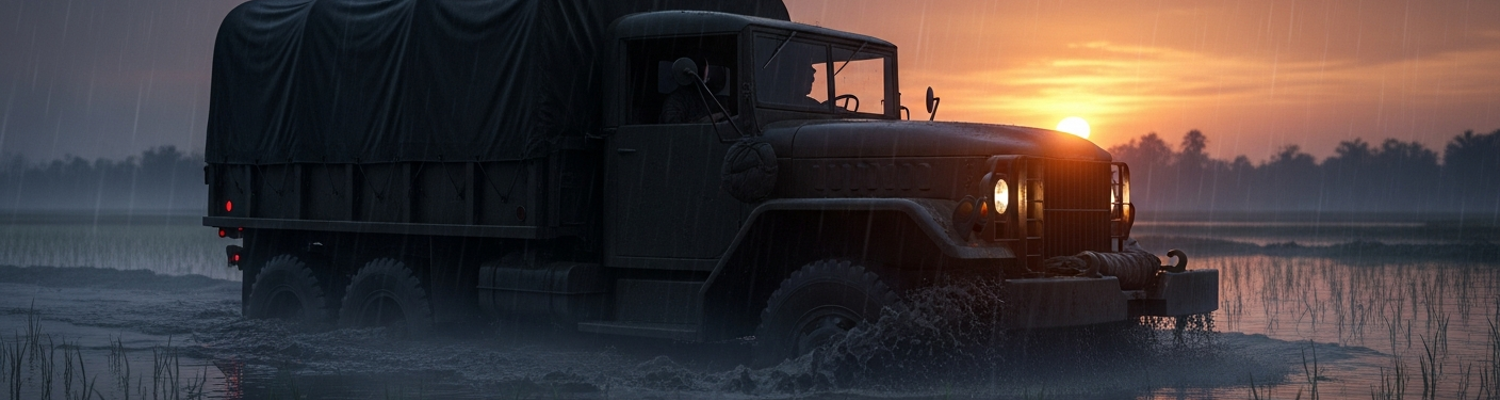

1st MAW Logistical Vulnerability 1972
A close review of operational logs from early 1972 reveals a precarious dependency. The 1st Marine Aircraft Wing’s high-tempo operational capacity in Military Region 1 was wholly reliant on a fragile and predictable system of ground-based resupply. The Wing’s squadrons, fielding F-4 Phantom IIs, A-4 Skyhawks, and a vast array of helicopters including the CH-46 Sea Knight and AH-1 Cobra, consumed aviation fuel, ordnance, and spare parts at a ferocious rate.
This entire air effort was tethered to the ground by convoys of M54 5-ton trucks.
These vehicles, often filled with drums of JP-4 jet fuel, pallets of Mk 82 500-pound bombs, Zuni rockets, and 20mm cannon ammunition, formed a slow-moving, high-value target for any hostile force. While some critical supplies could be moved by C-130 Hercules transport aircraft, the sheer volume required to sustain daily combat sorties necessitated the use of road transport. This created a direct, linear relationship between the security of key roadways and the 1st MAW’s ability to put aircraft in the sky. The lifeline was National Route 1.
On March 30, 1972, the North Vietnamese Army (NVA) launched the Nguyen Hue Offensive, known in the West as the Easter Offensive. This was not a guerrilla action; it was a full-scale conventional invasion. Approximately 30,000 NVA soldiers from the 304th and 308th Divisions, supported by T-54 tanks and massive concentrations of heavy artillery, poured across the Demilitarized Zone (DMZ) into Quang Tri Province. Their objective was the seizure of provincial capitals and the shattering of the Army of the Republic of Vietnam (ARVN). The offensive’s design showed a sophisticated understanding of modern warfare, immediately targeting the command, control, and logistical structures of the ARVN and their American advisors. Key logistical hubs like Dong Ha and the Ai Tu Combat Base were directly threatened or overrun. The primary north-south artery, Route 1, became a contested front line. For the 1st MAW, this meant their forward arming and refueling points (FARPs), pushed forward to decrease aircraft turnaround time, were suddenly in danger of being completely cut off.
The NVA and local Viet Cong cadres systematically exploited the inherent vulnerabilities of road-bound supply. The terrain of Quang Tri Province, with its narrow coastal plain flanked by dense vegetation and low hills, offered countless opportunities for ambush. NVA doctrine prioritized the interdiction of enemy supply lines. Long-range 130mm M-46 field guns, positioned miles away and expertly camouflaged, could shell stretches of Route 1, halting traffic and creating chaos. This would be the prelude to a direct fire ambush. From concealed positions, teams armed with RPG-7s and recoilless rifles would target the lead and rear vehicles of a convoy, trapping the column in a pre-sighted kill zone. Mortars would rain down on the stationary trucks while machine gunners swept the road to cut down any personnel who dismounted. The destruction of a single fuel tanker or ammunition truck could create a fiery blockade, stopping the entire column and making it a static target for hours.
Deviations From Standard Logistical Doctrine
The North Vietnamese Army’s offensive rendered the 1st Marine Aircraft Wing’s logistical protocols immediately obsolete. Pre-offensive planning relied entirely on predictable, large-scale convoy operations moving north from Da Nang and Phu Bai along the paved artery of Route 1. This was a system built on an assumption of secured roadways. A review of operational logs from the period shows a rigid structure: M54 5-ton trucks would be loaded with JP-4 fuel, ordnance, and parts at sprawling depots and dispatched in long columns at scheduled intervals. Security was the domain of distinct Military Police outriders. The system was centralized, methodical, and entirely dependent on the integrity of a single road. With the NVA’s conventional invasion, this protocol was not merely disrupted; it was severed. NVA 130mm long-range artillery began to systematically interdict key sections of Route 1, particularly the stretches approaching the besieged city of Quang Tri. The destruction of the Dong Ha bridge and the constant shelling of any movement south of the city transformed the highway into a kill zone. Established convoy procedures, which called for columns to halt and fight back when ambushed, proved disastrous, turning the tightly packed trucks into stationary targets for NVA mortar and RPG teams. The doctrinal supply chain had simply ceased to exist.
This complete breakdown of established transit corridors forced an immediate and desperate shift to improvised routing and ad-hoc security measures. With Route 1 impassable, convoy commanders and their ARVN counterparts began diverting supply runs onto a network of unpaved secondary roads, coastal sand flats, and rough tracks never intended for heavy vehicle traffic. M54 and M35 series trucks, designed for highway loads, were now forced over punishing terrain that led to constant mechanical failure. After-action reports (ref: FMFPac Logistical Review Q2-1972) detail a litany of snapped axles, blown tires, and overheated engines as drivers tried to navigate these unreconnoitered paths. Security became a matter of immediate necessity, not formal assignment. With dedicated MP units stretched thin, security detachments were cobbled together from any available personnel. It became common for aircraft armorers, mechanics, and administrative clerks from Marine Air Base Squadron 11 or H&MS-15 to be handed M16s and tasked with riding shotgun on a single fuel truck making a high-stakes dash. Instead of organized security platoons, a detachment might consist of a single jeep mounting an M60 machine gun leading a pair of trucks. These were not trained convoy escorts; they were simply extra guns.
The extreme vulnerability of any ground movement necessitated the adoption of unconventional resupply tactics to keep the vital FARPs operational. The risk of losing entire columns of trucks, along with their irreplaceable cargoes, was too great. Planners began to favor speed and dispersion over the defensive firepower of a large convoy. Single trucks or small packets of two or three vehicles were dispatched at irregular, unpredictable intervals, gambling that a smaller, faster-moving target would be harder for NVA artillery or ambush teams to acquire. A more significant tactical shift involved leveraging the 1st MAW’s own air assets. Heavy-lift helicopters, primarily the CH-53 Sea Stallions of HMH-463, were retasked from troop transport to carrying critical supplies. Archival records show these helicopters executing perilous external-lift missions, flying low with pallets of 500-pound bombs, Zuni rocket pods, or massive rubber fuel blivets dangling beneath them. These flights directly into active combat zones like the area around Quang Tri City were exceptionally dangerous, exposing the high-value aircraft to enemy SA-7 missiles and heavy anti-aircraft machine gun fire. Aircrews developed terrain-masked, short-hop tactics between relatively secure zones to move supplies incrementally closer to the front. It was an inefficient and hazardous process, but the alternative was allowing the forward-deployed AH-1 Cobras and A-4 Skyhawks to run out of ammunition and fuel.
Ambush Encounter Convoy Decision Point
Operational logs from late April 1972 show the dispatch of a small, ad-hoc supply column, designated Task Unit 7, from the relative security of the My Chanh Line northward into the contested zone of Quang Tri Province. The unit consisted of just four M54 5-ton trucks, their beds laden with pallets of 105mm artillery shells and rubber fuel blivets for a beleaguered ARVN fire support base. Its security element was minimal: a single M151 jeep carrying a lieutenant from the 3rd Force Service Support Group and mounting one M60 machine gun, and a lone M35 gun truck with hastily welded steel plates and two .50 caliber machine guns bringing up the rear. Their route was a tertiary laterite road, a thin red line cutting through a landscape of flooded rice paddies and dense treelines that offered unlimited concealment. The air itself, heavy with the smell of diesel and wet earth, seemed to press in on the small group of Marines.
The attack came without warning. As the small convoy rounded a sharp bend flanked by a steep embankment on one side and a waterlogged paddy on the other, the distinct thump-whoosh of an RPG launch split the air. The rocket, fired from a concealed spider hole just 50 meters away, struck the engine block of the lead M54, which erupted in a shower of sparks and black smoke, lurching to a halt and blocking the narrow road completely. Almost simultaneously, a second RPG team targeted the rear gun truck, shredding its tires and wounding the driver, effectively sealing the kill zone. From the embankment, the treeline, and previously unseen positions in the paddy, a storm of automatic weapons fire erupted from at least three NVA machine gun nests, their interlocking fields of fire sweeping the trapped vehicles. The metallic clang of rounds impacting the thin-skinned trucks mixed with the deafening chatter of the enemy’s RPDs and the heavier, slower rhythm of a 12.7mm heavy machine gun.
The doctrinal response was to form a perimeter and fight.
For the young lieutenant in the lead jeep, standard operating procedure was a death sentence. A quick assessment, captured in the frantic seconds of the initial onslaught, revealed a well-planned, L-shaped ambush utilizing at least a platoon-sized NVA element. His men were pinned down, caught in a perfectly executed trap with no viable cover. Pushing through was impossible; the lead truck was a burning, immovable obstacle. Attempting to fight from their current positions would mean being systematically cut apart by the superior enemy force firing from fortified positions. His eyes scanned the terrain, desperate for an alternative. To his left was the elevated embankment where the bulk of the enemy fire originated. To his right, across a shallow ditch, lay the flooded rice paddy, a treacherous, unreconnoitered expanse of mud and water. The map showed a small village track on the far side of the paddy, over a kilometer away, but there was no telling if it was mined, watched by other NVA units, or even accessible to the heavy 5-ton trucks.
He had seconds to decide.
In a decision that defied every line of the field manual, the lieutenant chose the unknown over certain destruction. He keyed his radio handset, his voice cutting through the cacophony of battle. Instead of ordering his men to dismount and establish a base of fire, he commanded the remaining two M54 drivers to execute an immediate right turn, crashing through the ditch and directly into the rice paddy. The M60 gunner in his jeep pivoted, laying down a stream of suppressive fire on the nearest NVA machine gun nest to cover the movement. The M35 gun truck in the rear, despite its damage, began firing its .50 caliber guns into the treeline, adding to the desperate attempt to break contact. The heavy trucks, their engines screaming in protest, plunged off the roadbed, their tires sinking into the mud as they used their own bulk as mobile shields, churning through the water and away from the established kill zone.
Unorthodox Field Command Improvisation
The lieutenant’s order defied standard operating procedure completely. Marine Corps ambush doctrine was clear: upon contact, establish a base of fire, suppress the enemy, and assault through the kill zone. For a trapped convoy, the SOP dictated that vehicles and personnel should form a 360-degree perimeter and fight back, using the trucks as cover while waiting for air support or a reaction force. But a review of the tactical situation showed that following this procedure would have been suicidal. The NVA had executed a text-book L-shaped ambush, positioning the bulk of their firepower along the embankment to fire down the length of the convoy, while a smaller element blocked the road, catching Task Unit 7 in a perfect crossfire. The unarmored M54 trucks offered no meaningful protection from the heavy 12.7mm machine gun and RPGs. To dismount and form a perimeter in the open on the narrow road would have presented the NVA gunners with static, exposed targets. The lieutenant’s command, screamed over the radio, was for the two remaining drivers to turn ninety degrees right and drive their 10-ton trucks directly off the road, through a ditch, and into the waterlogged rice paddy. The order gambled on the M54’s rated off-road capability, pushing the vehicle far beyond its designed purpose. Engines strained and transmissions groaned as the heavy cargo trucks, laden with artillery shells and fuel, crashed into the knee-deep water and mud, using their own bulk as a moving wall of steel to screen the crews from the fusillade of fire coming from the embankment.
A close analysis of after-action reports and the photographer’s contact sheets reveals a critical decision-making window of no more than five minutes, from the initial RPG impact to the moment the last truck cleared the kill zone. The first ninety seconds were chaos. The destruction of the lead truck and the disabling of the rear gun truck sealed the trap. The air filled with the distinctive sound of AK-47 fire, the slower, heavier thud of the 12.7mm, and the constant clang of rounds hitting the vehicles. The lieutenant, pinned down in his jeep, had to process an overwhelming amount of information under lethal pressure. His training screamed at him to fight. The terrain told him that to fight was to die. The embankment to his left was a wall of enemy fire. The road ahead was blocked by a burning wreck. Behind him, the gun truck was crippled. The only remaining axis was the open, unknown terrain of the rice paddy to his right. It was an impossible choice: certain annihilation versus a high-risk, unreconnoitered path that could be mined or lead to a secondary ambush.
This pivotal moment of battlefield improvisation was preserved not by an official log entry, but by the lens of an attached combat photographer. A sergeant with the MOS 4641 from a 1st MAW Combat Camera unit, his mission was to document operations for intelligence and historical purposes. While the Marines of the security element returned fire, the photographer operated his Nikon F camera, loaded with Kodak Tri-X film, changing lenses and framing shots amidst the incoming rounds. His preserved images provide a granular detail that operational reports lack. One frame captures the lieutenant, face taut with adrenaline, shouting into his radio handset, his finger jabbing decisively not towards the enemy, but towards the rice paddy. Another series of shots documents the result of that order: a massive M54 truck, its front wheels lifting off the ground for a split second as it smashes through the roadside ditch before plunging into the water, throwing up a great wave of muddy spray. A third key image shows the M60 gunner on the lieutenant’s jeep, brass casings ejecting in a blur as he lays down suppressive fire on the NVA positions to cover the trucks’ desperate maneuver. These photographs transform an abstract tactical decision into a visceral, human event. They provide incontrovertible proof of a junior officer deliberately breaking with established doctrine to save his command.
Triumph of Improvised Mission Success
The violent lurch of the M54 trucks as they plunged into the rice paddy immediately broke the geometry of the NVA’s kill zone. What had been a perfect, linear ambush was now a chaotic, multi-directional engagement. The thick, muddy water of the paddy, while a massive obstacle for the vehicles, also served to extinguish an RPG-initiated fire on the second truck. A detailed review of after-action reports from the 3rd Force Service Support Group indicates that this unorthodox maneuver was the single most effective countermeasure. It presented the NVA gunners with a radically different tactical problem. Instead of stationary targets on a predictable road, they now faced moving targets at varying ranges in open terrain, partially obscured by the water and their own vehicle’s bulk. Suppressive fire from the lieutenant’s jeep and the damaged rear gun truck was instrumental in this phase. The M60 and .50 caliber machine guns forced the NVA teams to keep their heads down, degrading their ability to aim and shift fire effectively onto the escaping trucks. The NVA platoon, positioned and dug-in for a classic roadside ambush, was unable to effectively reorient its heavy weapons to track the trucks churning through the paddy. Contact was broken.
The cost of survival was one M54 5-ton truck and its entire cargo of 105mm artillery shells, abandoned and burning on the road. The calculus of the lieutenant’s decision, however, reveals its success. The loss of the remaining three trucks, their critical fuel and ammunition, and the lives of their crews was the almost certain alternative. By sacrificing the lead vehicle and breaking contact, he preserved two of the three remaining trucks and their crews.
The subsequent journey across more than a kilometer of flooded paddy was a brutal test of mechanical endurance. The M54’s Continental multi-fuel engine was pushed to its limits, threatening to overheat as the ten-ton vehicles fought against the resistance of mud and water. Drivers had to skillfully navigate the unseen terrain, avoiding deeper channels that could bog down and trap the vehicles completely. Yet, the two remaining cargo trucks, their beds laden with fuel blivets and artillery shells, successfully reached the far side and located the village track. Hours later, battered but functional, they arrived at the ARVN firebase. The delivery of this partial resupply had a direct and measurable battlefield effect, allowing the ARVN artillery to continue its fire missions in support of friendly infantry, blunting a local NVA probe later that day.