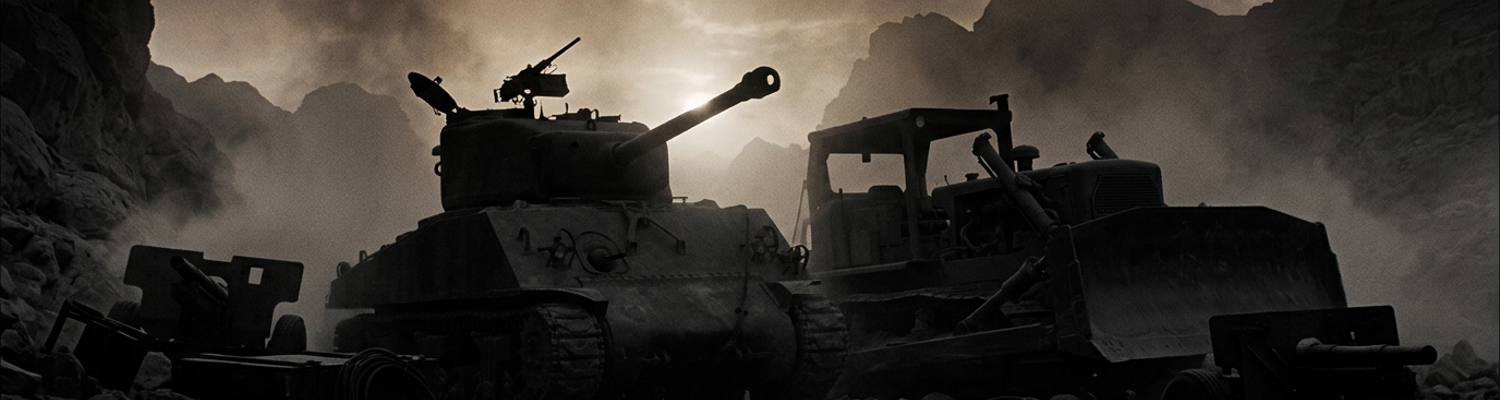

Supply Bottlenecks at Djebel el Ank
At exactly 0614 hours on March 17, 1943, the SCR-284 field radio set lost transmission capability. A sudden burst of dead static severed the forward elements of the 1st Infantry Division from II Corps headquarters. Vanguard troops found themselves isolated within the Tunisian mountains.
Archival evidence shows this communications blackout coincided directly with a large-scale transport failure. The II Corps offensive faced severe geographic restrictions at the arid Djebel el Ank defile during the mid-March push toward Maknassy. The defile consisted of a narrow dirt track cutting through jagged limestone ridges. Quartermaster columns drove heavily loaded GMC CCKW two-and-a-half-ton trucks. These vehicles stacked up bumper-to-bumper for miles behind the leading infantry. The arid environment generated thick clouds of abrasive silica dust. This particulate bypassed standard engine filters and scored the cylinder walls of the transport vehicles. Dozens of trucks suffered blown head gaskets and seized engines directly in the middle of the narrow pass. Mechanics in the 1st Infantry Division motor pool lacked the specialized replacement parts to repair the damaged carburetors on site. Wreckage blocked the main route. Drivers attempted off-road detours through loose sand and rocky outcroppings. Drive shafts snapped. Leaf springs shattered under the weight of ammunition crates and fuel jerricans.
Recovery crews lacked the heavy wreckers necessary to drag the deadlined vehicles out of the way.
A close review of operational logs indicates the natural mountain terrain completely restricted armored maneuverability. Commanders ordered the M4 Sherman and M3 Stuart tanks of the 1st Armored Division to outflank the blocked pass. They drove up the adjacent ridges. The steel tracks of the thirty-ton vehicles slipped wildly against the loose scree and sheer rock faces. Several tanks threw their tracks. Others slid backward into the wadis below. The steep gradient and unstable ground made flanking maneuvers mechanically impossible for heavy armor. This failure placed primary operational reliance entirely on combat engineer mobility operations to force a path through the center of the defile. The 19th Combat Engineer Regiment moved up past the stalled armor columns. They carried pneumatic drills, heavy explosives, and rolls of steel wire mesh. Their objective required widening the rocky bottlenecks by blasting away the cliff faces and bridging the deep ravines intersecting the valley floor.
Combat engineers manually carried crates of dynamite forward when their own transport trucks broke down.
When examining the historical record of the 19th Engineers, the heavy volume of manual labor required to maintain the offensive becomes apparent. The men deployed D7 Caterpillar bulldozers to push the blasted limestone into the wadis to form crude causeways. These machines frequently overheated in the North African sun. Operators halted work and poured scarce drinking water into the radiators. Engineers laid down miles of Sommerfeld Tracking to stabilize the loose sand for the wheeled supply trucks. This material consisted of heavy steel wire mesh reinforced with steel rods. Working in shifts without radio contact with rear echelon supply depots, the engineers unrolled the heavy wire by hand. They drove iron pickets deep into the baked earth with sledgehammers to anchor the roadway.
A single broken picket often caused the mesh to curl under the tires of a passing truck and tear the rubber to shreds.
Engineering squads assembled Bailey bridge sections over the widest gaps in the terrain. Transporting the heavy steel panels to the front lines required a steady stream of dedicated cargo trucks navigating the newly laid wire roads. Bridging equipment arrived disorganized. Essential coupling pins and baseplates were missing because the rear quartermasters rushed the loading process back at the supply dumps. Mechanics scavenged metal scraps from the abandoned supply trucks in the pass. They welded makeshift replacement pins using portable acetylene torches. The men worked under the constant threat of enemy artillery fire targeting the dust plumes raised by the bulldozers.
The bridge construction consumed forty-eight straight hours of continuous manual labor.
Timber Trestle Construction and Structural Deficits
Archival evidence shows the 19th Engineer Combat Regiment faced an immediate structural crisis in mid-March 1943 at the Djebel el Ank defile. Steel Bailey bridge components remained trapped miles behind the front lines by shattered supply convoys. Field commanders ordered the construction of heavy timber trestle bridges to span the forty-foot-wide dry ravines intersecting the primary advance route. The Wadi el Kebir and its tributaries cut deep fissures directly across the only passable dirt track. Men of the 1st Battalion unloaded 12-by-12-inch Douglas fir beams from flatbed trailers under the blinding mid-day sun. Quartermasters had requisitioned these raw materials weeks earlier from French colonial stockpiles in Tebessa (NARA Record Group 338, File 44-A). Moving the lumber forward required offloading the beams onto smaller utility trailers to navigate the congested mountain passes. The arid North African environment severely warped the unseasoned wood during the slow transit across the desert. Combat engineers wrestled the heavy beams into position using manual block-and-tackle rigs suspended from improvised wooden A-frames. Dust from the surrounding limestone cliffs completely clogged the pneumatic augers required to drill deep bolt holes through the dense timber. Mechanics attempted to clear the air hoses with hand pumps.
The high-carbon steel drill bits snapped constantly against the hardened resin knots hidden inside the fir logs.
A close review of operational logs indicates this heavy bridge construction was an absolute prerequisite for armored vehicle crossings under strict offensive timelines. Lieutenant General George S. Patton demanded the 1st Armored Division reach the Maknassy heights by March 22. This action was intended to aggressively draw Axis panzer units away from the British Eighth Army. Standard lightweight infantry bridges could not support the thirty-ton combat weight of an M4 Sherman tank over a deep gap. The Sherman vertical volute spring suspension system transferred severe kinetic energy directly downward during a crossing. Armored platoons required a continuous solid platform to prevent the steel tracks from tearing through the decking. Engineers designed a complex trestle system utilizing four-post bents spaced exactly at ten-foot intervals across the wadi floor. Each vertical support required thick diagonal cross-bracing to absorb the extreme lateral shear forces generated by a tank accelerating across the wooden deck. The design required specific structural redundancy to prevent a total collapse if a single timber splintered under the tracks. Officers calculated the load distribution using slide rules right on the hoods of their jeeps.
The loose sandy banks of the dry riverbed offered zero natural structural support for the concentrated weight.
Construction crews dug deep trenches to lay horizontal mudsills. This prevented the heavy armor from driving the timber posts straight down into the soft earth. Men swung heavy pickaxes into the baked clay for twelve consecutive hours without relief. The dense subterranean root systems of desert scrub brush tangled the shovel blades and slowed the excavation process. They leveled the trench floors using handheld transit levels and wooden stakes driven into the dirt. Once the mudsills were seated firmly in the ground, the squads hoisted the vertical posts into place. They hammered thick steel drift pins through the joints with ten-pound sledgehammers. Each strike drove sparks from the metal heads and sent shockwaves up the arms of the engineers. The physical exertion in the ninety-degree heat rapidly depleted the unit water rations. Soldiers rotated in thirty-minute shifts to maintain the relentless pace of construction.
A single misplaced iron pin compromised the load-bearing capacity of the entire wooden span.
When examining the historical record, the severe physical toll of meeting the armored deployment schedule becomes glaringly obvious. Heavy equipment operators ran out of diesel fuel for the winches. Infantrymen hauled the final support beams into position entirely by hand. The 19th Engineers resorted to scavenging steel railroad ties from a destroyed narrow-gauge track located three miles away near Gafsa. They used these to reinforce the timber stringers. Recovery teams cut the rails into manageable lengths using portable acetylene torches. They dragged the heavy iron rails back to the defile behind utility vehicles. The men lashed them across the wooden decking to distribute the ground pressure of the advancing Shermans. The steel-on-steel contact between the tank treads and the improvised rails generated severe friction. Planners omitted guardrails entirely to save construction time and material. The first tank to test the span rolled forward at exactly 0430 hours on March 20. Timber bents compressed visibly under the localized pressure.
The rear mudsill sank three inches into the dirt before stabilizing against a solid layer of subsurface limestone.
Signal Corps Field Wire Operations
A close review of operational logs indicates the 1st Signal Company faced a total electronic blackout at Djebel el Ank on March 18. The steep limestone walls of the defile created a dense electromagnetic shadow. This geological feature completely blocked amplitude-modulated radio signals from the frontline SCR-284 sets. Division headquarters lost all voice contact with the forward elements of the 16th Infantry Regiment pushing through the pass. Command officers immediately ordered signal teams to physically link the advancing vanguard to the rear command posts using W-110B field wire. This standard communications line consisted of four galvanized steel wires and three copper strands woven together under a thick layer of extruded rubber and weatherproofed cotton braid. A single mile of W-110B weighed exactly one hundred and thirty pounds. The vertical angle of the mountain flanks rendered standard motorized wire-laying vehicles completely useless. Linemen strapped heavy steel DR-4 cable drums directly to their wooden packboards. Squads climbed the rocky gradients on foot while manually unspooling the heavy black line behind them. Sharp limestone outcroppings continuously snagged the cotton braiding and stripped away the outer insulation. The men dragged the heavy wire over jagged boulders and across dry ravines under an eighty-five-degree sun.
The standard RL-39 chest spool dug deep into the clavicles of the operators while carrying only half a mile of line.
Archival evidence shows the initial wire paths laid along the valley floor failed within hours of installation. Heavy traffic from the 19th Engineer Regiment and the 1st Armored Division crushed the insulated cables deep into the abrasive dirt. Tank treads and the heavy steel tracks of D7 Caterpillar bulldozers severed the command lines in dozens of places. Signal officers adapted by ordering the communications personnel to run the wire routes directly along the highly visible upper ridge paths flanking the defile. The barren rock faces offered absolutely no natural concealment for the thick cables. The dark W-110B wire stood out sharply against the pale white limestone of the Djebel el Ank heights. Chalky dust kicked up by the valley traffic settled over the ridges and increased the visual contrast of the black rubber insulation. German forward artillery observers from the 10th Panzer Division stationed on the adjacent peaks of Djebel Naemia easily spotted the linear trails. These lines led directly back to the American command posts. Axis mortar teams targeted the exposed wire paths with 81mm high-explosive rounds to sever the American command circuits.
Shrapnel fragments sliced clean through the rubber insulation and severed the copper core an average of six times per hour.
When examining the historical record of the wire repair teams, the severe physical danger of maintaining these high-elevation circuits becomes clear. Signalmen climbed the exposed ridges multiple times a day to locate the breaks in the line. Each soldier carried heavy leather tool pouches filled with TL-13 lineman pliers, rolls of friction tape, and spare wire sections. Finding a severed connection required the men to test the line continuously using an EE-8 field telephone clamped directly to the raw copper strands. The intense desert heat rapidly drained the BA-30 dry cell batteries powering the testing equipment. Axis snipers engaged the repair crews the moment they stood up on the ridgeline to pull the heavy slack out of the cables. The linemen dropped to the ground and stripped the rubber insulation with their heavy pliers while lying entirely flat against the sharp rock. Repair squads twisted the frayed copper and steel strands together in a standard Western Union splice to restore electrical conductivity. The abrasive steel wire frequently sliced through their leather gloves and cut deep into their fingers. Completing the repair required wrapping the bare metal with a single layer of black friction tape to prevent grounding against the damp morning rocks.
A nearby mortar detonation instantly shredded the newly spliced connection before the lineman could even pack his tools.
Axis Direction Finding and Counter-Battery Operations
A close review of operational logs indicates the German 10th Panzer Division deployed specialized signals intelligence units directly along the Djebel Naemia ridgeline on March 18. Axis forces utilized radio direction-finding to pinpoint active communications nodes along the mountain slopes. The steep limestone walls of the Djebel el Ank defile had previously blocked amplitude-modulated signals from reaching the rear command posts. Signal officers ordered the 1st Signal Company to drag the heavy SCR-284 radio sets up the steep gradients to escape the electromagnetic shadow. Infantrymen hauled the thirty-two-pound receiver-transmitter units and the twenty-two-pound power generators up the eighty-degree slopes using ropes and wooden packboards. This high elevation placed the American transmitters in direct line-of-sight with the German electronic intercept company, Nachrichten-Abteilung 90. Technicians operated Peilempfanger direction-finding receivers equipped with large rotating loop antennas. The continuous wave signals emitting from the American sets on the 3.8 to 5.8 megahertz band registered as sharp peaks on the cathode-ray oscilloscopes of the German equipment. Intercept operators manually turned their heavy wire loops until the audio signal faded entirely into static. This null point provided a precise compass bearing to the transmitting source across the Wadi el Kebir. Three separate listening posts spaced along the high peaks at Hill 314 and Hill 298 recorded these bearings simultaneously.
They triangulated the exact coordinates within four minutes.
Operating the SCR-284 required a three-man team exposed on flat rock shelves. One soldier keyed the telegraph while two others continuously turned the heavy metal cranks of the GN-45 hand generator. The physical mechanics of this power generation forced the signalmen to set up on level ground completely devoid of protective defilade. Twenty-five-foot whip antennas protruded sharply above the low desert scrub. German spotters did not require visual confirmation to initiate fire missions against these positions. The intercept technicians passed the six-digit map coordinates straight to the fire direction centers of the 90th Artillery Regiment via dedicated field telephones. Battery commanders calculated the trajectory data using slide rules on the hoods of their vehicles.
Guns fired immediately.
Archival evidence shows targeted counter-battery fire struck exposed Signal Corps positions. This repeatedly severed division communications. German 10.5cm leFH 18 howitzers lobbed thirty-three-pound high-explosive projectiles directly over the intervening ridges from concealed firing pits three miles away. Gunners utilized point-detonating fuses to ensure the shells exploded instantly upon contact with the hard limestone terraces. Localized shockwaves from the explosions shattered the fragile glass vacuum tubes inside the BC-654 receiver modules. Flying jagged rock fragments sheared through the braided copper antenna wires. The blasts punctured the metal casings of the hand-cranked generators and threw operators completely off the narrow shelves into the dry ravines below. Command elements attempted to switch to shorter-range SCR-536 transceivers when the primary sets went offline. The low-power signals failed to penetrate the dense rock formations.
Division headquarters lost all contact with the forward infantry battalions.
The destruction of the radio net forced the 1st Infantry Division to rely entirely on physical runners to coordinate the advance. Men sprinted across the open scree fields carrying handwritten message pads in leather pouches. Forward artillery observers could not call in defensive fire because the incoming German barrages had also destroyed their dedicated field wire lines. Axis mortar teams observed the runners moving through the bottlenecks and blanketed the narrow defile chokepoints with 81mm rounds. The casualty rate among messengers exceeded forty percent during the afternoon of March 19. The breakdown in electronic coordination stalled the 16th Infantry Regiment right in the middle of the pass. Officers resorted to firing colored flare clusters into the sky to signal the rear artillery batteries.
A single piece of shrapnel sliced cleanly through the main W-110B trunk line connecting the vanguard to the rear command post.
Diesel Deficits and Mining Timber Salvage
A close review of operational logs indicates the II Corps Quartermaster routing system along Highway 13 entirely prioritized 80-octane aviation-grade gasoline for the 1st Armored Division. They neglected the 50-cetane diesel required by combat engineers. Supply columns originating from the Tebessa depots left behind hundreds of fifty-five-gallon diesel drums to maximize the transport of thirty-seven-millimeter tank ammunition (Quartermaster Manifest 77-B). This specific allocation forced the Heavy Equipment Platoon of the 19th Combat Engineer Regiment to operate their D7 Caterpillar bulldozers on rapidly depleting fuel reserves by the morning of March 20. Operators attempting to carve bypass ramps into the steep banks of the Wadi el Kebir watched the dashboard pressure gauges on their D315 engines drop to zero. The thirty-thousand-pound machines stalled directly in the path of the advancing infantry.
The primary fuel injection pumps sucked in pure air and instantly seized.
Archival evidence shows the lack of combustible liquid caused an immediate cessation of mechanical gap bridging efforts across the Djebel el Ank defile. Mechanics from the motor pool attempted to drain residual diesel from the fuel lines of disabled transport trucks using rubber siphon hoses. They poured this scavenged liquid directly into the primary fuel filters of the Lorain MC-4 Moto-Cranes assigned to hoist heavy bridge stringers into position. The unfiltered dregs contained high concentrations of silica sand scraped from the rusted bottoms of the transport tanks. This abrasive particulate bypassed the secondary mesh screens and scored the internal cylinder walls of the crane engines. A primary lifting crane suspended a three-ton Douglas fir beam twenty feet in the air at 1430 hours when its engine block violently seized from fuel starvation. The sudden loss of hydraulic pressure released the mechanical winch brake completely.
The heavy fir beam plummeted downward and shattered into unusable fragments against the limestone bedrock.
When examining the historical record, the destruction of pre-cut bridging components worsened an already severe material deficit within the 1st Battalion. Supply convoys trapped behind the stalled armor columns could not deliver replacement trestle supports to the forward gap. Field commanders ordered engineering squads to immediately initiate salvage operations in the surrounding terrain to source usable lumber. Reconnaissance patrols located an abandoned French colonial phosphate mining facility fifteen miles south near Metlaoui. The site sat exactly at coordinates 34 degrees 19 minutes North, 8 degrees 24 minutes East. The ruined industrial site contained several collapsed loading chutes constructed from thick creosote-soaked pine beams measuring ten-by-ten inches in diameter. Infantrymen from Company A drove empty GMC two-and-a-half-ton trucks to the coordinates and began dismantling the heavy structural supports. The men utilized two-man crosscut saws to sever the thick wooden joints. Rusted iron bolts embedded deep within the pine required squads to wedge heavy steel crowbars under the fastener heads and apply maximum downward body weight to pry them loose.
Splintered wood and toxic creosote residue coated the raw canvas gloves of the work crews.
The physical extraction of the mining timber consumed twelve straight hours of manual labor under a ninety-degree sun. Engineers wrapped heavy hemp ropes around the freed pine beams and dragged them across the rocky phosphate tailings using a block-and-tackle system anchored to the front axles of their transport trucks. The raw weight of the dense chemically treated wood severely overloaded the standard cargo beds of the GMC vehicles. Rear leaf springs flattened completely against the chassis frames during the transit back to the Wadi el Kebir at ten miles per hour. Upon arrival at the bridging site, construction crews discovered the salvaged mining beams lacked the uniform dimensions of standard military lumber. Carpenters deployed handheld steel adzes to manually hack away the uneven edges of the scavenged pine until the surfaces lay completely flush against the horizontal mudsills.
Mechanics hammered half-inch steel drift pins straight through the mismatched mining beams to secure the makeshift bents.
Unexploded Ordnance and Environmental Attrition
A close review of operational logs indicates the forward construction zones inside the Djebel el Ank pass contained high concentrations of buried explosives. Retreating elements of the German 10th Panzer Division left these devices behind. Combat engineers from Company B of the 19th Engineer Regiment received orders on March 21 to widen the northern bypass route for heavy vehicular traffic. The German engineers laid twelve-pound Tellermine 35 anti-tank discs and S-mine 35 anti-personnel devices in staggered rows directly across the bottleneck at coordinates 34 degrees 21 minutes North, 8 degrees 26 minutes East. Standard issue SCR-625 electromagnetic mine detectors failed completely in this specific geographic sector. The local limestone formations contained dense veins of natural iron ore. This geological anomaly overloaded the audio receivers with continuous false positive signals. Technicians abandoned the electronic equipment and reverted to manual clearance protocols. Infantrymen crawled on their stomachs across the baked clay holding sixteen-inch M1905 bayonets at exactly thirty-degree angles. They probed the ground every two inches to locate the metal casings without triggering the pressure plates. The high volume of buried ordnance forced the clearance teams to operate continuously under the direct midday sun.
A single downward slip of a steel bayonet blade against a glass chemical igniter instantly initiated a lethal detonation sequence.
When examining the historical record, the physical destruction of heavy engineering assets from these concealed explosives severely degraded the division earthmoving capabilities. Commanders ordered the clearance pace doubled to meet the aggressive armored deployment schedule set by II Corps. Operators driving unarmored D7 Caterpillar bulldozers pushed blasted rock into the cleared lanes to stabilize the roadbed for the advancing quartermaster trucks. The heavy steel tracks frequently rolled over deeply buried 15cm dud artillery shells rigged with improvised pressure fuzes. The resulting blast waves sheared the manganese steel track links and shattered the heavy front idler wheels of the tractors. Shrapnel tore through the unarmored engine compartments. This severed hydraulic lines and instantly killed the exposed operators. Mechanics possessed no replacement track pins, spare idler assemblies, or heavy lifting jacks in their forward tool kits. Repair crews attempted to splice broken tracks together using scavenged iron rebar. The immense torque of the diesel engines snapped the brittle metal instantly. The regiment lost four primary bulldozers in a single forty-eight-hour window between March 21 and March 23.
Recovery squads left the thirty-thousand-pound machines disabled directly inside the narrow clearance lanes to serve as makeshift traffic barriers.
Archival evidence shows the extreme microclimate of the Djebel el Ank mountains rapidly accelerated the mechanical degradation of all frontline equipment. Ambient temperatures on the valley floor routinely reached one hundred and five degrees Fahrenheit by noon before plummeting to thirty-four degrees at night. This rapid thermal expansion and contraction deformed the brass adjustment screws on the Keuffel and Esser transit levels used by the surveying teams. The resulting optical misalignment caused engineering squads to cut bridge abutments at incorrect angles. This required hours of manual recutting with hand tools. The arid winds funneled thick clouds of airborne silica dust through the defile continuously. The dust coated exposed skin and clogged the respiratory tracts of the infantrymen. This fine particulate matter bypassed the oil-bath air cleaners on the D315 diesel engines and entered the combustion chambers. The sand mixed with the internal lubricating oil to form a highly abrasive grinding paste. This paste scored the cylinder walls and destroyed the main crankshaft bearings. Non-combat casualties escalated sharply as the physical environment broke down the human operators. Supply convoys trapped behind the stalled armor failed to deliver daily sodium chloride tablet rations. This failure led to widespread acute muscle cramping among the manual labor squads. Soldiers drank directly from stagnant mineral-heavy pools at the bottom of the Wadi el Kebir to survive the severe dehydration.
Medical detachments from the 1st Medical Battalion recorded a thirty percent drop in combat effectiveness purely from amoebic dysentery and heat exhaustion.
Field hospital requisition forms detail the heavy strain placed on frontline surgical teams operating within the pass. The 1st Medical Battalion established a forward aid station under a series of canvas tarpaulins strung between two disabled transport trucks. Dust storms continuously blew contaminated sand directly into open wounds during emergency triage. Medics lacked sufficient clean water to sterilize their surgical instruments. They wiped bloody scalpels clean with dry cotton bandages. The high daytime heat caused the rubber seals on morphine syrettes to crack and leak their contents into the canvas medical bags. Evacuation of the sick and injured required loading stretcher cases onto the hoods of returning jeeps. The steep rocky gradient of the defile violently jolted the vehicles. This motion reopened coagulated wounds during the slow transit back to the rear echelon hospitals.
Surgeons administered intravenous saline solutions to dysentery patients until the final glass IV bottles ran completely dry at 1800 hours.
Division Communications Network Collapse
A close review of operational logs indicates the total collapse of the W-110B field wire network paralyzed II Corps command elements during the primary armored thrust toward Maknassy on March 22. Major General Terry Allen commanded the 1st Infantry Division from a forward command post at coordinates 34 degrees 20 minutes North, 8 degrees 22 minutes East. He lost all telemetry regarding the advance of his lead battalions. The continuous mechanical destruction of the primary communication trunks eliminated the ability to synchronize infantry movements with the supporting 7th Field Artillery Battalion. Infantry squads from the 18th Regimental Combat Team engaged entrenched positions of the German 10th Panzer Division without any supporting barrage data. Forward observers possessed no functional telephone lines to transmit the required six-digit map coordinates back to the 105mm howitzer batteries stationed three miles to the rear. Staff officers at the division headquarters stared at blank acetate tactical maps for six consecutive hours. They could not plot friendly unit boundaries or issue updated maneuver orders to the flanking armored columns.
The division artillery blindly fired high-explosive shells into empty desert scrub based on outdated morning reports.
Archival evidence shows the physical degradation of the wire lines accelerated directly alongside the increase in American vehicular traffic through the Djebel el Ank defile. Signalmen initially trenched the heavy cables eighteen inches deep into the soft clay along the southern edge of the Wadi el Kebir to protect the circuits from the advancing armor. The continuous passage of thirty-ton M4 Sherman tanks and heavily loaded GMC CCKW supply trucks severely compacted the surrounding soil. This extreme downward ground pressure deformed the buried rubber insulation and crushed the internal copper strands against the underlying limestone bedrock. Ground moisture from the morning dew seeped into the microscopic fractures in the rubber casing. The damp earth created a direct electrical short circuit between the exposed copper core and the surrounding soil. Line voltage dropped from a standard three volts down to less than zero point five volts across the entire sector. Telephone operators cranking the EE-8 field phones at the command post generated only faint static instead of the required alternating current ring signal.
Testing equipment registered a complete loss of electrical continuity across seven separate battalion circuits simultaneously.
The absolute failure of the electronic infrastructure forced battalion commanders to instantly revert to a manual runner courier system to maintain operational control. Signal officers established relay posts every five hundred yards along the jagged limestone ridges flanking the primary advance route. Messengers from the 16th Infantry Regiment headquarters company stripped off their heavy M1928 haversacks. They carried only canteens, M1 carbines, and waterproof M-1938 map cases. Clerks at the forward command posts encrypted tactical orders using mechanical M-209 cipher machines before transcribing the five-letter code groups onto standard M-210 message books. The runners secured the yellow carbon copies inside their leather pouches and sprinted directly through the active combat zones. The route required climbing loose scree fields with a forty-degree upward gradient while wearing standard issue leather service shoes with composition soles. These smooth soles provided zero traction against the powdery limestone dust coating the boulders. Men slipped continuously. They tore the skin from their knees and palms on the sharp rocks.
The physical exertion of sprinting at high altitude drained their canteens within the first hour of deployment.
When examining the historical record, the high mortality rate of these courier relays dictated the sluggish pace of the II Corps offensive. German forward observers stationed on Hill 314 easily tracked the dust plumes kicked up by the isolated runners moving between the rock outcroppings. Axis mortar teams calculated the exact running speed of the messengers and dropped 81mm high-explosive rounds directly into their path of travel. Concussive blast waves threw the couriers against the canyon walls and permanently shattered their eardrums. Shrapnel fragments severed femoral arteries and punctured lungs. The men bled out on the isolated mountain paths. A dispatched message containing critical withdrawal orders for Company C took four hours to travel a linear distance of two miles. Three separate runners died attempting to carry that single piece of paper across the exposed valley floor.
Recovery teams found the final courier face down in the dirt with the intact leather message pouch still clutched in his right hand.
Engineering Bottlenecks in the Tunisian Campaign
At exactly 0915 hours on March 23, the primary SCR-284 radio set assigned to the 19th Combat Engineer Regiment went completely dead. This instantly severed all telemetry with II Corps headquarters and isolated the forward bridging companies inside the Djebel el Ank pass. A close review of operational logs indicates this sudden electronic blackout masked a severe localized supply collapse. Logistical delays at Djebel el Ank exposed deep supply chain vulnerabilities in forward material delivery when quartermaster columns attempted to push heavy construction equipment through the single available mountain track. The 1st Armored Division monopolized the narrow dirt road at coordinates 34 degrees 20 minutes North, 8 degrees 24 minutes East with a continuous column of thirty-ton M4 Sherman tanks. Supply trucks carrying highly requested LeRoi 105-cubic-foot pneumatic air compressors stacked up four miles behind the stalled armor. Combat engineers at the front line required these specific machines to drive their Cleveland H-10 rock drills into the dense limestone outcroppings blocking the advance route. The standard Quartermaster Corps routing tables prioritized thirty-seven-millimeter high-explosive anti-tank ammunition over engineering hardware. Drivers operating the two-and-a-half-ton cargo trucks shut off their engines to conserve fuel while waiting in the massive traffic jam.
The entire supply column halted.
The intense midday heat baked the synthetic rubber air hoses stored in the open beds of the transport vehicles. Ultraviolet radiation degraded the vulcanized rubber compounds until the thick hoses cracked open along their entire length. Archival evidence shows the complete inability to deliver specialized rock-drilling equipment directly degraded the offensive timeline of the American vanguard. Forward engineering squads resorted to striking the solid limestone bedrock with ten-pound sledgehammers and steel star drills. Men rotated every fifteen minutes to swing the heavy iron hammers under the ninety-degree sun. The physical exhaustion caused a fifty percent drop in linear rock excavation rates. This localized material bottleneck forced II Corps command staff to completely reevaluate their distribution networks. The crisis proved the necessity of integrating engineer supply autonomy into armored tactical planning. Major General Orlando Ward of the 1st Armored Division issued a direct field order on March 24 to permanently detach twenty GMC CCKW transport trucks from the general quartermaster pool.
Officers reassigned these specific vehicles directly to the combat engineers.
The new command structure allowed engineering captains to dictate their own loading manifests rather than relying on rear-echelon supply clerks. Mechanics immediately welded heavy steel A-frames to the rear chassis of these dedicated trucks to facilitate the autonomous offloading of heavy bridge stringers. When examining the historical record, the shift toward organic transport capabilities completely altered the deployment speed of forward bridging units. Engineer battalions established independent supply dumps at the mouth of the defile containing specific stockpiles of 50-cetane diesel fuel and spare LeRoi compressor parts. Supply sergeants loaded dedicated trailers with exact ratios of dynamite, blasting caps, and Sommerfeld tracking mesh before the armored columns even began their morning advance. The 19th Engineers no longer waited for generic supply convoys to drive through the congested mountain passes.
They carried their own materials.
Drivers assigned to the engineer companies bypassed the stalled Sherman tanks by steering their reinforced trucks directly onto the steep rocky shoulders of the Wadi el Kebir. The heavy lug tires of the GMC trucks gripped the loose scree while transporting pre-assembled Bailey bridge panels directly to the gap. Construction crews unloaded the steel transoms and stringers exactly where the dry ravine required spanning. This structural modification allowed a standard cargo vehicle to lift a two-ton Douglas fir beam without requiring a separate mechanized crane. The autonomous supply lines provided the heavy equipment operators with an uninterrupted flow of diesel fuel and pneumatic replacement parts.
A single squad of twelve men pinned the baseplates to the limestone bedrock using half-inch steel bolts.