
Unrealistic Timetables for the Route 547 Thrust
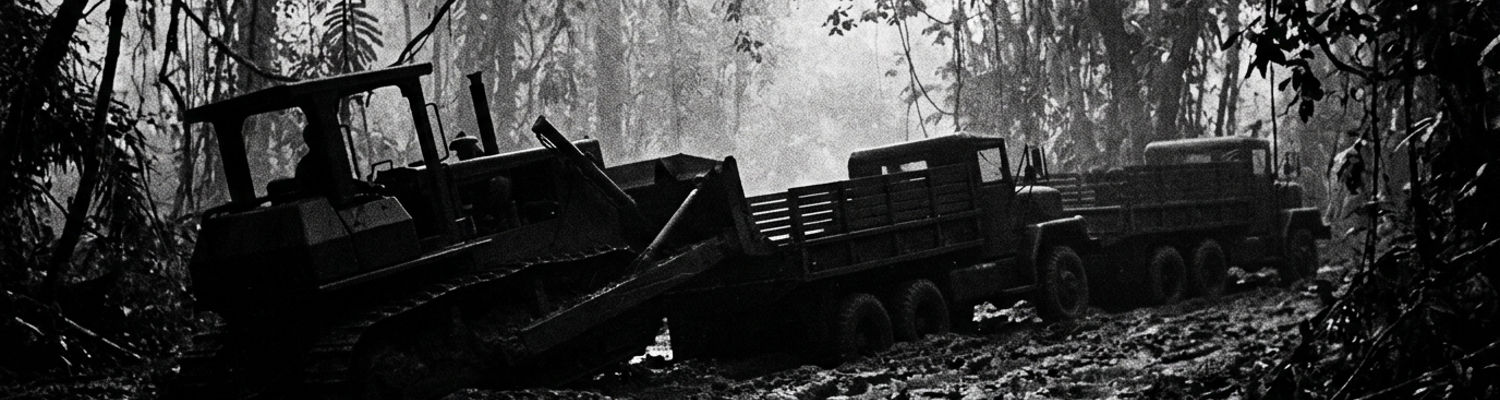
Specialist Fourth Class Thomas Miller wiped graphite grease from the fitting of a Caterpillar D7E bulldozer hydraulic lift cylinder three miles west of Firebase Birmingham.
He used an adjustable spanner to tighten the bleeding valve on the portside track tensioner. Sweat soaked his soiled olive-drab sleeve. Behind him sat the rest of the 59th Land Clearing Company. Their heavy Rome plows mounted on reinforced C-frames idled inside dirt revetments. Division planners had issued field orders directing the 326th Engineer Battalion to cut and grade thirty kilometers of Route 547 into the A Shau Valley.
They had seventy-two hours.
Headquarters framed the operation as a rapid mechanized push to establish ground supply lines before enemy forces could reposition around Firebase Bastogne. Operational logs at XXIV Corps show this three-day target had zero basis in engineering feasibility. Fulfilling the order required thirty-five-ton crawlers to average more than four hundred meters of completed clearing per hour.
The schedule collapsed within six hours of the first dozer blade striking earth.
Archival evidence shows that division staff officers deliberately brushed aside meteorological warnings to preserve their offensive timetable. Weather detachments assigned to the 101st Airborne Division had submitted predictive models (Air Force Weather Agency Report 69-05) indicating that early monsoonal feeder bands from the southwest would strike Thua Thien Province days before the ground push kicked off. Precipitation totals were projected to reach ten inches across a seventy-two-hour window.
Command staff ignored these atmospheric warnings.
Postponing the road build meant delaying the air assaults slated for the high ground flanking the valley. Corps planners prioritized keeping forward infantry battalions on an inflexible assault sequence. They operated on the assumption that mechanical horsepower could overpower tropical weather. When downpours began sheeting across the canopy on the second morning, runoff instantly flooded cut ditches that lacked culverts or revetments.
Silt washed away fresh roadbeds before dozers could even complete rough grading.
Downpours dissolved the forward staging areas into liquid red mud.
A close review of operational logs indicates that initial tactical reconnaissance completely botched its evaluation of the ground structure along the designated trace. Observers flying in OH-6A Cayuse light observation helicopters had examined the abandoned dirt corridor from five hundred feet. They mistook sun-baked surface laterite for load-bearing subsoil. No ground reconnaissance teams ever deployed core penetrometers or hand augers to check sub-surface soil density beneath the canopy.
Below a fragile three-inch crust lay an eight-foot layer of saturated clay.
Soil bearing capacity dropped to near zero once heavy tracks sheared the thin topsoil. When the forty-ton D7E plows moved forward, the surface crust fractured under track pressure. The machines sank past their final drives within seconds. Steel sprockets stranded in the mud. Hydraulic hoses sheared against buried granite boulders.
By dusk, eleven tractors sat immobilized to their belly pans.
Subgrade Failure and M54 Cargo Truck Stranding
Archival evidence shows that the mechanical stripping of the canopy along the ridgeline trace west of coordinates YD620025 immediately triggered catastrophic structural breakdown in the subsoil. The 59th Land Clearing Company cleared three kilometers of dense growth. This stripped away the tangled root systems of bamboo and dipterocarp trees that had stabilized the slope. Exposed directly to the downpour, the underlying saprolite clay lost cohesion within ninety minutes.
Rain gauge stations at Firebase Birmingham recorded four inches of water falling in less than five hours.
Water saturated the micro-fissures in the saprolite. The uncompacted road surface transformed into an unconfined liquid paste with a California Bearing Ratio dropping below one. Standard engineer compaction equipment could not operate on the five-degree incline without sliding sideways down the ravine. Runoff stripped out the crown of the cut before operators could spread laterite gravel or install perforated metal drainage pipes.
Subgrade bearing capacity dropped to zero within three hours of rainfall.
When examining the historical record of the 101st Airborne Division Support Command, thirty-two M54 five-ton six-by-six cargo trucks from the 10th Transportation Battalion rolled directly onto this degrading trace at dawn. Each vehicle carried five tons of palletized 105mm high-explosive artillery shells, steel pierced-plank landing mats, and five-hundred-gallon fuel bladders. Gross vehicle weights approached twenty-eight thousand pounds. This weight rested entirely on standard 11.00-20 non-directional mud tires that lacked adequate flotation.
The front wheels punched through the liquefied clay within forty yards of crossing the cleared perimeter.
Axles sank to their differentials. Transfer cases bottomed out against the subgrade. Because the 326th Engineers had cut the roadway as a bare ten-foot single-lane shelf along steep contour cuts, no bypass routes existed. Stranded trucks immediately choked the primary corridor. Drivers locked their all-wheel drives and engaged low-range transfer cases. Dual rear wheels spun until the vehicle frames settled flush into the mud.
The entire forward supply column was trapped between two sheer earthen cuts.
Dead-weight resistance exceeded the mechanical limits of divisional recovery gear.
A close review of operational logs indicates that recovery crews from the 5th Transportation Battalion deployed two M543A2 five-ton medium wreckers (Federal Stock Number 2320-00-050-8995) to pull the lead ammunition trucks out of the mire. Riggers attached five-eighths-inch steel wire cables to the front tow shackles of the stuck vehicles. The dense saprolite sealed around the axles, generating severe ground suction. Gar Wood twenty-thousand-pound capacity front-mounted winches reached their breaking points within seconds of engagement. Winch shear pins repeatedly failed under dead-weight resistance.
Crews bypassed safety mechanisms with improvised steel bolts.
When operators increased pulling torque using snatch blocks anchored to roadside trees, the tension sheared the grade-eight frame mounting bolts. Rear towing pintles ripped completely free from vehicle crossmembers. Three steel cables snapped under tension. They lashed back across the hoods to shatter the cab sheet metal and punch through radiator cores. By midday, four recovery vehicles were also disabled.
Twenty-six loaded ammunition carriers sat stranded in the open.
Unarmored Caterpillar D7E Bulldozers in Direct Contact
When examining the historical record of the 326th Engineer Battalion, division directives sent Caterpillar D7E bulldozers into the forward clearing trace without factory armor kits or armored cab enclosures. Logistical commands had stockpiles of bolt-on ballistic steel cabs sitting at supply depots in Da Nang. Transport officers deemed the heavy kits too cumbersome for air-lifting across swollen river crossings. Field companies received bare industrial tractors instead.
Operators sat five feet above the ground on open bench seats.
They were shielded only by tubular steel roll-over bars and standard canvas weather tops designed for civilian construction projects. Field records from Company C log that around coordinate YD612015, North Vietnamese snipers positioned along the reverse slope of Hill 372 targeted the exposed upper torsos of these drivers. They used 7.62x39mm fire from ranges under one hundred meters. The three-quarter-inch mild steel of the seat frame offered zero resistance to rifle fire. Operators lacked side plates or bullet-resistant glass to deflect rounds passing above the engine cowling.
Drivers caught in these sudden bursts took direct hits while pinned between the two steering levers.
An exposed engineer at the controls had less cover than an infantryman in an open ditch.
Archival evidence shows that extreme mechanical noise and structural vibration completely prevented operators from detecting incoming hostile fire. The D7E relied on a turbocharged Caterpillar D339 four-cylinder diesel engine. This eight-hundred-cubic-inch power plant produced continuous sound levels exceeding 105 decibels at the driver ear. Steel track grousers grinding over buried granite boulders transmitted severe shocks directly into the operator platform. The vibration numbed the driver feet and hands.
Engineers could not distinguish the crack of incoming small-arms rounds from the clatter of the push arms.
Wearing standard M1 steel pots without noise-attenuating intercom headsets, they drove deaf. Bullets striking the front blade or engine housing produced no audible warning over the roar of the exhaust stack. Flank guards from the 2nd Battalion, 501st Infantry attempted to signal drivers using smoke canisters and hand markers from the perimeter. Dense plumes of diesel exhaust and churned red dust blocked line-of-sight communication. Dozer operators regularly pushed earth dozens of meters deeper into North Vietnamese kill zones before realizing they were taking fire.
A close review of operational logs indicates that civilian-pattern hydraulic hoses failed under indirect fragmentation fire.
The hydraulic assemblies powering the heavy front blades used commercial twin-braided rubber hoses rated at twelve hundred pounds per square inch. These were mounted externally across the lift cylinders and C-frame trunnions without armored sleeves. When North Vietnamese mortar crews walked 82mm rounds across coordinates YD618012, low-angle shrapnel sliced through the synthetic outer jackets. The steel fragments severed the internal wire braids.
Punctured lines immediately sprayed pressurized hydraulic fluid across hot exhaust manifolds.
This created vapor clouds and dumped operating pressure to zero. Without hydraulic fluid holding the cylinders, the four-ton blades dropped directly onto the subgrade under their own weight. The dropped blades dug into the mud, pinning the immobilized crawlers in place. This blocked the narrow shelf cut to all rearward traffic.
By the third day of the push, six abandoned tractors sat wedged into the cut by dropped blades.
North Vietnamese Mortar Fire and Jungle Canopy Ambushes
Archival evidence shows that North Vietnamese forward observers turned the linear road trace into a precise geometric kill zone long before heavy dozers reached the forward trace. Working from concealed observation posts on the upper military crests of Hill 372 and the Dong Den ridgeline, spotters from the 6th NVA Regiment had surveyed deflection angles and propellant charge increments for every bend along the planned route. Cleared vegetation stripped away all overhead foliage. This exposed a ten-meter ribbon of raw yellow saprolite that provided an unmistakable visual reference against the dense jungle.
Stripped earth provided a continuous aiming marker.
Standard Type 53 82mm mortar tubes sat bedded into timber-reinforced pits two kilometers west. Their baseplates were anchored into hard subsoil to eliminate weapon drift during rapid fire. Weapons crews skipped standard registration rounds. Spotters matched physical survey stakes and freshly bulldozed cuts directly against pre-calculated firing tables. Initial barrages landed squarely in the center of the roadbed without prior warning.
When examining the historical record of Company B, 2nd Battalion, 501st Infantry, security detachments stationed sixty meters into the bamboo thickets documented an unnatural, dead calm across the secondary growth minutes before each perimeter attack.
Flank guards watching the clearing lines recorded that bird activity and cicada noise ceased across the draw near coordinates YD615018.
Air hung motionless under heavy humidity beneath the triple canopy. Perimeter squads using AN/PRR-9 receiver units reported zero weapon clicks or wire movement along the defensive perimeter. Silence masked tactical movement. Infiltrating assault elements from the NVA 324B Division had crawled within hand-grenade range of the work trace. They moved across wet forest humus while diesel engine noise drowned out small-arms handling.
Enemy teams hung DH-10 directional fragmentation charges in tree branches.
They sighted B-40 rocket launchers directly at the idling earthmovers.
A close review of operational logs indicates that the sudden fragmentation barrages inflicted severe casualties on road-building personnel working completely unentrenched on the subgrade. Task force commanders had barred engineers from digging protective fighting holes directly into the right-of-way. They argued that slit trenches would compromise subgrade compaction and delay vehicle passage. Operating personnel stayed out in the open, clearing boulders with pry bars or spreading crushed shale with shovels.
Overhead detonations occurred when 82mm mortar shells struck thirty-meter dipterocarp branches above the trace.
This triggered contact fuzes and converted the canopy into high-velocity wooden and steel fragmentation. Shrapnel drove straight down into the unshielded ditch lines. Equipment operators attempting to crawl beneath tractor bellies caught jagged iron splinters that ricocheted off exposed granite bedrock and steel track pads. Forty-two engineers sustained shrapnel wounds across an eight-minute barrage on the morning of May 14. Eight men were killed instantly by upper-body trauma.
Field medics ran out of sterile dressings within twelve minutes.
Silted Fuel Bladders and Quartermaster Supply Breakdown
Archival evidence shows that bulk fuel handling for the forward elements along Route 547 degraded within forty-eight hours of setup. Forward distribution points established by the 23rd Quartermaster Company positioned standard five-hundred-gallon collapsible rubber fuel bladders inside shallow, unlined dirt depressions near coordinate YD628022. Quartermaster personnel lacked gravel for drainage beds or timber matting to elevate the bladders off the raw soil.
Torrential monsoonal downpours turned the depressions into holding basins.
They filled with three feet of standing water and suspended laterite clay. Runoff submerged the brass fill-couplings and breather vent caps. Defective gasket seals on the three-inch Wiggins dry-break nozzles allowed water and fine abrasive silt to bypass tank strainers during gravity feeding. Quartermaster crews pumped muddy sludge directly into five-ton tank trucks and twenty-five-gallon dispensing drums.
Centrifugal separation equipment never arrived from the rear depot at Phu Bai.
Fuel samples pulled from the bottom drain cocks of forward bladders revealed over thirty percent water volume. Dense red abrasive sediment was suspended throughout the diesel fuel.
A close review of operational logs indicates that this contaminated diesel caused catastrophic mechanical failures across the entire fleet of construction equipment. Heavy earthmovers utilized precision Caterpillar fuel injection pumps engineered with tolerances tighter than two ten-thousandths of an inch. Diesel fuel normally provided internal hydrodynamic lubrication for the reciprocating pump plungers and delivery valves. When water-laden diesel reached these assemblies, the fluid barrier broke down instantly.
Mechanical friction between bare steel surfaces generated intense heat.
Piston plungers galled against the hardened steel barrels. They stripped metal shavings into the fuel galleries before seizing completely. Drive shear pins snapped. Governor racks jammed in the fuel-shutoff position, killing engines under load. In six instances, delivery pump drive shafts sheared at the camshaft timing gear, permanently disabling the tractors.
Company maintenance teams had brought only two replacement injection pump assemblies forward.
Seven D7E crawlers sat dead in their tracks while waiting for specialized tools that were trapped on stranded trucks behind the lines.
When examining the historical record of the 101st Airborne Division Support Command, the breakdown of perishable provisions followed a parallel timeline of physical degradation. Forward cargo drops delivered pallets of standard Meal, Combat, Individual rations directly onto the red clay along the road trace at coordinates YD624020. Quartermaster riggers had loaded the wooden pallets without canvas weather covers or protective polyethene tarpaulins.
This exposed the corrugated cardboard cases to continuous downpours.
Cardboard absorbed ambient moisture and dissolved into saturated pulp within twelve hours. Forty-foot ration stacks toppled into stagnant ditches. Canned rations lay submerged in mud contaminated by human waste and petroleum runoff. Tin plating corroded along the rolled seam joints of the cans. This led to bacterial spoilage and botulinum contamination within two days. Field commanders barred troops from consuming swollen tins.
Resupply helicopters were grounded by zero-visibility cloud ceilings.
This cut forward engineer squads from their scheduled daily ration of three meal units down to a single intact can per man. Men burning four thousand calories a day clearing tree trunks subsisted on less than twelve hundred calories of dry crackers and cold peanut butter.
Field Cannibalization and Corduroy Roadbed Reconstruction
Archival evidence shows that by May 17, Company C of the 326th Engineer Battalion had exhausted all forward replacement parts at coordinate YD622019. Depot-level resupply from the 80th General Support Group at Da Nang had ceased after low monsoonal cloud ceilings halted cargo flights. Field maintenance personnel treated abandoned equipment hulls as salvage yards. Mechanics armed with ten-pound sledgehammers and hand-pumped hydraulic jacks scavenged shattered Caterpillar D7E tractors and disabled M54 five-ton dump trucks lining the trace.
Working under intermittent sniper fire, recovery teams drove steel drift punches through damaged track links.
They extracted unbent track pins, which were then hammered into the stretched undercarriages of operational dozers. Crews dismantled hydraulic hoist assemblies from burnt-out dump trucks. They stripped thirty-seven-degree Joint Industry Council flare fittings, copper crush washers, and high-pressure steel-braided lines. These repurposed truck fittings operated at different flow ratings than standard tractor assemblies. This caused high-pressure hydraulic leaks that coated operator footplates in slick petroleum.
Acetylene supplies ran out completely within forty-eight hours.
When examining the historical record of the 101st Airborne Division, forward engineers turned to corduroy road construction after saprolite mud sinks along the valley corridor swallowed entire track assemblies. Between coordinates YD610010 and YD595008, the 326th Engineer Battalion sent two full work companies into the adjacent rain forest to harvest timber by hand. Homelite XL-12 commercial chainsaws issued to the platoons seized within hours. Red laterite grit clogged air filters and stripped plastic pull-start cords.
Engineers fell back on two-man crosscut saws and five-pound felling axes.
They hand-felled three miles of dense jungle growth. Soldiers chopped dense dipterocarp hardwoods and thick bamboo culms into twelve-foot crossbars. They dragged each six-hundred-pound trunk out of the swamp on nylon cargo straps. Working up to their waists in stagnant standing water, infantry security teams and engineers laid cross-axial timber mats directly over deep mud sinks. They chained parallel stringer logs along the margins with half-inch cargo binder chains to form continuous corduroy causeways.
Hand axes replaced motorized tools across the entire clearing trace.
A close review of operational logs indicates that these improvised corduroy structures shifted violently as soon as armored column weight passed over the unanchored wood. Fifty-two-ton M48A3 Patton tanks from the 2nd Battalion, 34th Armor attempted to traverse the log causeway near Firebase Bastogne. Dynamic ground pressure exceeded the load-bearing capacity of the subsoil beneath the timber. Steel track grousers grabbed the unpeeled bark.
This kicked twelve-inch tree trunks out of alignment and snapped cross-bracing cables.
Logs displaced sideways into the mud sinks. Jagged gaps appeared where forty-ton chassis bottomed out directly onto hidden stumps. Displaced saprolite pumped upward under hydrostatic pressure through the shifting timbers. Entire corduroy sections were buried beneath eighteen inches of viscous slurry within twenty minutes of an armored transit.
Field records from Company A detail that engineer platoons rebuilt the exact same six-hundred-meter segment west of Hill 372 four separate times between May 18 and May 21.
Exhausted troops dragged replacement hardwood trunks back onto the shifting beds under persistent 82mm mortar fragmentation. They spiked logs together with fabricated drift pins made from cut reinforcing bar. Bottom timbers sank rapidly beneath the water table. Each rebuild required laying a fresh tier directly atop the drowned wood. By dusk on May 22, the roadway absorbed more than four thousand hand-hewn logs over a single two-mile stretch.
Immersion Foot and Engineer Attrition in the Mud
When examining the historical record of the 326th Engineer Battalion, daily medical rosters logged an exponential surge in warm-water immersion foot among work details west of coordinate YD610010. Soldiers stood for twelve to fourteen consecutive hours in stagnant drainage channels. Surface runoff pooled into three-foot slurry sumps. The standard issue jungle boots (Specification MIL-B-3124) failed completely in suspended saprolite silt.
Fine clay clogged the eyelet mesh screens within minutes.
This trapped water and abrasive grit inside the footbed. Continuous contact with anaerobic water between seventy-five and eighty degrees Fahrenheit broke down the stratum corneum of the plantar surface. Keratin softened into white, folded pulp. Deep fissures cut across the ball of the foot and between toes. This exposed subcutaneous tissues to micro-tears during heavy hauling.
Company commanders refused to authorize boot removal during daylight work shifts due to immediate tactical alert postures.
Soldiers walked on macerated footpads that peeled away inside cotton socks when boots were finally pried off at night. By May 19, Battalion aid stations logged forty-seven personnel from Company B completely non-ambulatory from neurovascular damage and secondary swelling. They physically could not lace their footwear.
Mud consumed the skin before weapons could find the body.
Archival evidence shows that waist-deep mud along the river draws harbored massive concentrations of parasitic leeches and aggressive bacterial pathogens. Ground crews wrestling felled dipterocarp trunks into corduroy patterns worked submerged to their belts in stagnant, brown water. This water was contaminated by decaying organic brush and upstream diesel runoff. Terrestrial and aquatic leeches penetrated through trouser flies, eyelet vents, and sock tops. They latched onto groin folds and ankles.
Anticoagulant enzymes secreted by the parasites caused puncture sites to bleed freely into wet fatigues for hours after removal.
Soldiers burned the parasites off with lit cigarettes or doused them with insect repellent. This created open chemical and thermal burns that instantly turned septic in the humid canopy air. Streptococcal bacteria and Staphylococcus aureus invaded the lesions. This generated extensive tropical ulcers across the shins and thighs. These necrotic craters spread rapidly across subcutaneous fat layers, weeping yellow fluid and producing severe tissue pain.
Field medics ran out of tetracycline ointment and gentian violet dye on the fourth morning of road clearance.
They resorted to washing ulcerated limbs with unboiled canteen water before slapping dry gauze over wounds that soaked through within thirty seconds.
A close review of operational logs indicates that constant sniper harassment from the forward slopes of Hill 372 pushed engineer work details into acute physiological collapse. Men assigned to manual felling crews logged sixteen-hour shifts hauling six-hundred-pound timbers. North Vietnamese sharpshooters fired single 7.62x39mm rounds into the workspace every twenty minutes. The engineers could not see the marksmen through the triple canopy. The sharp crack of high-velocity bullets snapping through foliage kept nervous systems in an unbroken state of adrenaline discharge.
Physical labor stripped of caloric replenishment drained muscle glycogen.
Forty-eight continuous hours without rapid-eye-movement sleep induced severe neurological degradation across the ranks. Hand tremors caused axes to glance off slick bamboo, resulting in deep self-inflicted lacerations to shins and forearms. Operating personnel stared blankly at simple mechanical assemblies. They could not process basic winch controls or track-tensioning adjustments. Medical logs from the 326th Medical Battalion at Firebase Birmingham show that between May 16 and May 20, thirty-one engineers were medically evacuated for acute combat exhaustion and profound psychological disorientation.
None of them had sustained a single shrapnel wound.