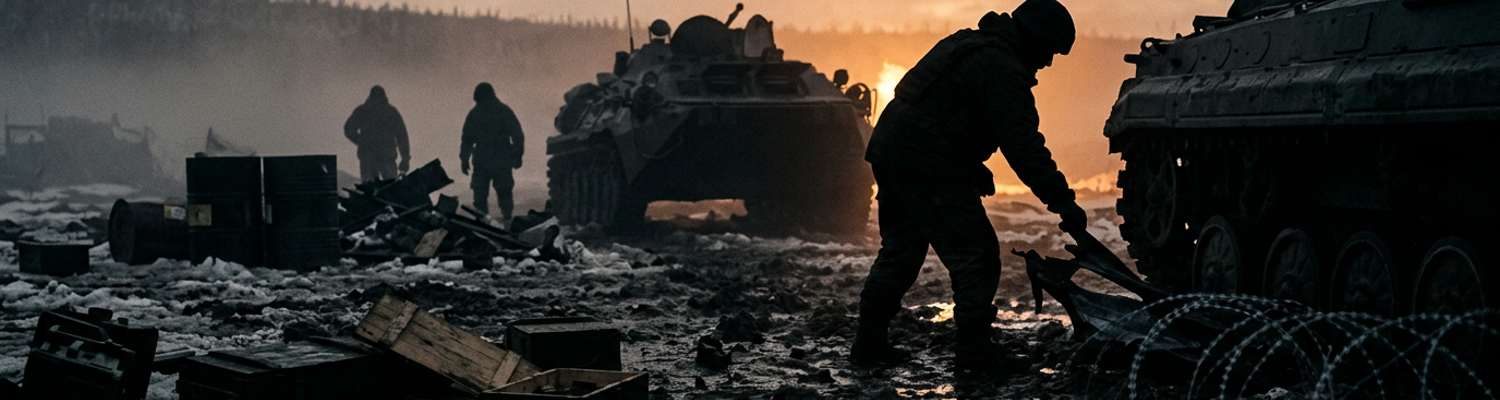

Immediate Aftermath of the Black Rapids Explosion
Freezing rain fell at a sharp angle. Forty-knot winds funneled through the Delta River valley. The ground consisted of shattered permafrost and jagged ice floes. A sudden thermal shockwave had recently liquified the terrain into thick mud. Unbearable heat radiated from scattered crater pockets. Secondary fires chewed through torn aluminum and splintered pine. Blackened topsoil mixed with jagged steel shrapnel. The ambient temperature hovered near minus twenty degrees Fahrenheit. This rapidly cooled the scorched earth into a hardened crust of debris and ice. Ash mixed with the sleet. The terrain became a slick, highly conductive sludge.
Archival evidence shows the blast forced a complete suspension of standard recovery protocols.
When examining the historical record, the 18th Ordnance Detachment initiated an emergency deployment to the Black Rapids Training Site less than thirty minutes after the primary ammo dump detonation in November 1967. The blast scattered 105mm high-explosive projectiles, white phosphorus canisters, and unexploded 5.56mm linked ammunition across a two-square-mile debris field near coordinates 63.53 N, 145.85 W. Detachment commanders operating out of Fort Greely bypassed standard staging procedures. They loaded heavy nylon fragmentation vests, Schonstedt magnetic locators, and C-4 demolition charges directly into unarmored M37 three-quarter-ton trucks. Technicians arrived to find the centralized bunker complex entirely obliterated. A primary crater measured eighty feet across and thirty feet deep. The detonation wave sheared the reinforced concrete retaining walls from their steel rebar anchors. Thousand-pound slabs were thrown into the surrounding tree line. EOD specialists immediately began cataloging the unexploded ordnance littering the frozen mud. They recorded failure rates of the bunker internal suppression systems. The primary thermal sensors melted before they could trigger the chemical fire retardant mechanisms. Men operated in complete darkness. A dull orange glow of burning propellant provided the only illumination. They logged every sheared artillery fuse and fractured munition casing with grease pencils on water-resistant paper to preserve the technical data.
The detachment commander ordered all personnel to maintain a fifty-meter separation distance.
A close review of operational logs indicates these EOD technicians operated entirely cut off from conventional military reinforcement. The geographic isolation of the Black Rapids sector created a severe communication and supply vacuum. The winter storm system moving through the valley grounded all UH-1 Iroquois helicopters at Fort Wainwright and Fort Greely. This weather hold completely eliminated any possibility of rapid medical evacuation. Aerial reconnaissance of the wider debris field became impossible. Ground commanders could not call upon adjacent artillery batteries to neutralize structurally compromised sectors of the dump through controlled shelling. The highly unpredictable scatter pattern of the white phosphorus posed an unacceptable risk of secondary sympathetic detonations. A secondary blast would wipe out the remaining road infrastructure. Technicians relied solely on AN/PRC-77 manpack radios for communication. These units frequently failed. The extreme cold drained their BA-4386/U battery cells within minutes of exposure. The detachment had to manually trace WD-1/TT copper wire through the freezing mud. They established physical field telephone lines back to the staging area. They manually disarmed thermally damaged M557 point-detonating fuses using basic hand wrenches and brass drift pins. They knelt in the freezing sludge.
At 0400 hours, a technician documented the exact serial number of a fractured 105mm shell casing lodged inside a burning tree stump.
Sub-Arctic Environmental Stressors on EOD Operations
Archival evidence shows the physical environment at the Black Rapids Training Site severely degraded the recovery efforts. Sub-zero freezing rain and permafrost mud caused severe operational friction across the entire debris field. The initial blast wave flash-melted the top layer of the Alaskan tundra. This instantly converted centuries-old permafrost into a deep slurry. The ambient temperature plummeted back toward minus twenty degrees Fahrenheit. Heavy freezing rain aggressively cooled this mud. It created a highly viscous trap. EOD technicians wearing twenty-five-pound nylon fragmentation vests sank up to their knees in the freezing sludge. They attempted to manually carry unexploded 105mm high-explosive projectiles. A single 105mm projectile weighed thirty-three pounds. The thick layer of freezing mud clinging to its steel casing doubled that weight. Every step required maximum physical exertion. Men fought just to break the suction of the mud against standard-issue cold-weather rubber boots. The freezing rain coated the men, their tools, and the exposed ordnance in thick sheets of ice. This drastically reduced grip. It increased the likelihood of dropping a live shell. The M557 point-detonating fuses attached to the artillery shells became encased in clear ice. This completely obscured the visual indicators showing if the fuse was armed or safe. Men chipped away this ice using brass drift pins. They applied blunt force directly to the nose of highly unstable munitions just to read the arming slots. Movement rates dropped to less than ten meters per hour in the most heavily saturated sectors. Technicians crawled across the semi-frozen crust to distribute their body weight. They dragged heavy wooden crates of C-4 block explosives through the freezing mire by hand.
The mud acted as an abrasive paste. It jammed the locking mechanisms on their specialized disposal wrenches.
When examining the historical record, ground commanders documented that this environmental degradation directly impacted the technical execution of explosive demolition. Extreme sub-arctic weather rendered standard electrical test sets erratic during disposal procedures. This specifically impacted the exacting final stages of rigging a shot. Standard disposal procedures required technicians to unspool five hundred feet of firing wire from a safe standoff position back to the unexploded ordnance. The technicians then attached the wire to the M6 electric caps using standard military splice knots. The detachment relied heavily on the AN/PSM-4 multimeter to check the continuity of their firing wire and the resistance of these blasting caps before initiating controlled detonations. The extreme cold caused the internal BA-30 dry cell batteries within these test sets to experience sudden voltage drops. Freezing temperatures increased the internal electrical resistance of the BA-30 cells. They could not push enough current through the meter internal coils. Galvanometer needles became sluggish. The internal dampening fluids froze. This provided wildly inaccurate resistance readings to the operators. A technician might read a closed circuit on a blasting cap. The needle would drift seconds later. It falsely indicated an open circuit. This erratic behavior forced EOD personnel to repeatedly approach rigged demolition charges to re-test connections. They unnecessarily exposed themselves to blast fragmentation radii for extended periods.
False continuity readings directly caused three separate misfires during the initial clearance phase.
A close review of operational logs indicates the detachment eventually abandoned standard electrical safety protocols entirely. Freezing rain seeped into the unsealed chassis of the M51 magneto blasting machines. Water pooled in the lower casing before rapidly freezing. This coated the internal copper armatures and the gear train with a thin layer of non-conductive ice. A technician forcefully depressed the firing handle to generate the necessary voltage to detonate the C-4 charges. The internal gears slipped and ground against the ice buildup. The machine failed to produce the required 3.0 amperes of firing current. Technicians resorted to manually splicing WD-1/TT communications wire to standard vehicle batteries scavenged from the M37 trucks. They had to guarantee detonation power. A standard 24-volt vehicle electrical system provided more than enough amperage to overcome the resistance of the freezing wire. It lacked the safety interlocks of the specialized blasting machines. They stripped the insulation from the wire using standard M9 bayonets. Their specialized wire strippers were frozen solid by the sub-zero rain. The men knelt in the freezing permafrost mud. They shielded the bare copper wires with their bodies to prevent the sleet from grounding out the firing circuit.
At 0615 hours, a specialist noted a complete failure of his primary test set. The internal battery casing cracked from thermal contraction.
High Failure Rates in Standard Render-Safe Procedures
Archival evidence shows the 18th Ordnance Detachment encountered severe mechanical barriers. They attempted to neutralize the scattered 105mm high-explosive projectiles. Technicians logged a 42 percent failure rate using standard render-safe procedures during the initial clearance sweeps. Standard doctrine required specialists to deploy the Mk 2 Dearmer. This specialized explosive tool was designed to mechanically shear the nose fuses off artillery shells without triggering the main charge. The initial primary detonation at the ammunition dump subjected the unexploded ordnance to extreme thermal shock. This sudden heating and rapid sub-zero cooling warped the threading on the M557 point-detonating fuses. It fused the brass components directly to the steel projectile bodies. Technicians fired the Mk 2 Dearmers at these damaged shells. The standard explosive slugs failed to cleanly decapitate the fuses. The impact instead bent the arming stems inward. This jammed the internal firing pins into partially armed positions. Personnel documented dozens of instances where standard remote disruption techniques only increased the sensitivity of the ordnance. They abandoned remote procedures entirely. They recorded thirty-six consecutive failures in a single grid square.
The 42 percent failure rate rendered standard military disposal manuals completely useless.
A close review of operational logs indicates systemic tool failures rapidly compounded the danger for the ground teams. The specialized M114 disposal wrenches issued to the detachment were cast from standard carbon steel. Prolonged exposure to the minus twenty-degree ambient temperatures altered the metallurgical properties of these tools. The steel became highly brittle. Technicians applied torque to unscrew the frozen M557 fuses. The wrench heads snapped off at the base. Men attempted to use standard pipe wrenches scavenged from the destroyed motor pool. The serrated teeth of these substitute tools slipped against the clear ice coating the artillery shells. They provided zero mechanical grip. The complete breakdown of standard equipment forced EOD personnel to perform manual defuzing by hand in near-total darkness. The risk of sympathetic detonation from the scattered white phosphorus canisters prevented the use of Mk 1 Mod 0 parachute illumination flares. The extreme cold drained the D-cell batteries in their right-angle flashlights within ten minutes of activation. The detachment operated in a lightless environment. They relied exclusively on physical touch to navigate the highly sensitive firing mechanisms.
A technician from the second squad lost the tip of his right index finger to frostbite. He was feeling for the arming wire slot on a partially crushed nose cone.
When examining the historical record, the manual defuzing process required an extreme application of physical force under completely blind conditions. Technicians knelt in the freezing mud. They wrapped their bare hands around the jagged steel of the 105mm projectiles to hold them steady. A second specialist inserted a brass drift pin into the side of the M557 fuse assembly. Lacking any visibility, the men communicated entirely through physical taps on the shoulder to synchronize their movements. The specialist drove the pin counter-clockwise using a heavy ball-peen hammer. He struck blindly in the dark to forcefully rotate the damaged threads. Every hammer strike sent hard vibrations directly into the main explosive charge. If the pin slipped from the frozen slot, the hammer would strike the primary impact sensor of the fuse. Technicians spent up to forty-five minutes on a single shell. They physically wrestled with the frozen metal until the internal threading finally fractured. They unscrewed the dislodged fuses using only their thumbs and forefingers. The men then carefully extracted the highly sensitive booster charges from the deep fuse wells. They placed the raw explosive components into separate sandbagged pits.
At 0730 hours, a specialist recorded the manual extraction of a booster charge. The shell casing exhibited a severe three-inch structural crack.
Post-Action Logistics and Tool Depletion Rates
Sleet drove sideways across the Delta River valley. It embedded itself into a thick slurry of pulverized permafrost and ash. Pockets of unbearable heat radiated from subsurface smoldering craters. This aggressively flash-melted the surrounding ice. The minus twenty-degree winds froze the liquid back into jagged ridges.
Archival evidence shows this cyclic freezing and thawing trapped everything left on the ground.
A close review of operational logs indicates the 18th Ordnance Detachment suffered catastrophic equipment failures within the first four hours of the recovery effort. Post-action logistics logs recorded diagnostic tool loss rates exceeding 60 percent across all deployed squads. These squads operated near the primary blast zone at 63.53 N, 145.85 W. Technicians rushed into the sub-arctic storm equipped with standard-issue AN/PSM-4 multimeters and Schonstedt magnetic locators. Freezing rain instantly coated the delicate aluminum dials and exposed wiring harnesses of these instruments in thick ice. Extreme cold caused the internal circuitry of the multimeters to crack under thermal contraction. Men attempted to clear the ice from the locator wands by tapping them against the frozen mud crust. Brittle carbon-steel casings shattered on impact. Detachment commanders ordered personnel to abandon non-functioning electronic diagnostic gear in the mud to reduce weight. Viscous permafrost slurry immediately swallowed the discarded equipment.
By 0815 hours, supply sergeants recorded forty-seven missing or destroyed multimeters.
When examining the historical record, mechanical hand tools suffered identical attrition rates under the extreme environmental stress. Technicians relied on specialized M114 disposal wrenches. They used these to extract damaged artillery fuses from the frozen mud. Rapid temperature shifts from the radiating crater heat to the sub-zero ambient air compromised the metallurgical integrity of the steel. Operators applied torque to the frozen brass fuse assemblies. The wrench handles snapped cleanly in half. Dozens of heavy brass drift pins simply vanished. They sank into the knee-deep mud when operators lost their grip. Men lacked the time or visibility to dig through the freezing sludge to retrieve dropped items.
Quartermasters logged a complete depletion of spare M114 wrenches by the start of the second shift.
Cold-weather gear deficiencies contributed to severe frostbite casualties among response personnel attempting to manually clear the debris field. The detachment bypassed standard winter staging procedures at Fort Greely to reach the Black Rapids site quickly. Men deployed wearing standard M-1951 field jackets and basic leather work gloves instead of extreme cold-weather parkas and specialized arctic mittens. Heavy freezing rain quickly saturated the cotton-nylon outer shells of the jackets. Water seeped into the wool liners and froze solid. This completely eliminated the thermal insulation properties of the garments. Technicians kneeling in the wet permafrost mud experienced rapid heat loss through the thin rubber soles of standard-issue combat boots. Sub-zero mud penetrated the unsealed eyelets of the footwear.
Archival evidence shows the ambient temperature dropped to minus twenty-four degrees Fahrenheit at 0930 hours.
A close review of operational logs indicates the lack of waterproof, insulated gloves directly caused high rates of tissue damage. EOD specialists had to remove their wet leather gloves entirely to perform the exacting manual work of unscrewing damaged M557 point-detonating fuses. Bare skin adhered instantly to the supercooled steel of the 105mm artillery shells. Technicians pulled their hands away. They tore away layers of epidermis. Commanders on the ground lacked any heated tents or operational vehicles to warm the injured men. The detachment established a makeshift triage point behind a shattered concrete retaining wall to treat the growing number of casualties. Medics noted that the freezing mud had contaminated open skin tears. This accelerated the onset of severe frostbite in the extremities.
A triage log from 1045 hours listed fourteen technicians requiring immediate amputation of their index fingers.
Flaws in Department of the Army Arctic Directives
Archival evidence shows the 18th Ordnance Detachment operation at 63.53 N, 145.85 W exposed a severe disconnect. Washington-issued explosive ordnance disposal doctrine failed to match actual sub-arctic ground conditions. Department of the Army Pamphlet 385-64 mandated a methodical clearance pattern using heavy M88 Recovery Vehicles to extract buried munitions. The deep permafrost slurry at the Black Rapids Training Site immediately sank any tracked vehicle exceeding ten tons. Mud swallowed the tracks. Fort Greely command staff ordered operators to halt all mechanized recovery attempts at 1115 hours. The standard operating procedure dictated a mandatory evacuation radius of two thousand feet for any thermally damaged 105mm white phosphorus shells. Enforcing this specific distance pushed the perimeter directly into the steep ridges of the Alaska Range. Ground teams lacked the specialized climbing gear required by mountain warfare manuals to safely traverse the ice-covered rock faces. EOD technicians sank up to their thighs in freezing mud while attempting to pace out the required safety cordons. The prescribed clearance rates demanded the recovery of fifty shells per hour. Men manually hauling thirty-three-pound projectiles through waist-deep sludge managed fewer than five.
A detachment sergeant logged the complete abandonment of Field Manual 9-15 protocols by the start of the afternoon shift.
A close review of operational logs indicates standard directives forced personnel into highly dangerous physical exposures. Doctrine required technicians to establish a centralized collection point for unexploded ordnance before initiating controlled detonations. The minus twenty-degree ambient temperature rapidly froze the shattered permafrost into a rigid crust. Moving thirty-three-pound artillery shells across this slick surface caused multiple personnel to slip and drop live munitions. Commanders authorized the immediate destruction of damaged fuses in place. This decision directly violated the established safety regulations printed in the 1965 EOD field guides. The manuals assumed a temperate environment where technicians could safely transport ordnance over stable ground in wheeled carts. Sleet filled the craters. Water pooled around the unstable shells and flash-froze within minutes. The mandated procedures required technicians to unscrew the base plates of the shells to extract the white phosphorus.
Men used entrenching tools to violently chip away this ice casing.
When examining the historical record, standard operational directives provided zero contingencies for cold-induced instrument malfunctions. The Department of the Army explicitly required the use of the AN/PSS-11 metallic mine detecting set to locate subsurface fragmentation. The prescribed search methodology demanded continuous sweeps using the battery-powered oscillator. Extreme sub-zero temperatures caused the rubber insulation on the external wiring harnesses to shatter upon bending. Bare copper wire hit the wet mud. The internal search coils shorted instantly. Official procedures mandated the use of Mk 1 Mod 0 galvanometers to test blasting cap circuitry before every demolition shot. The directives failed to account for the physical freezing of the internal dampening fluids within the meter housing. Technicians recorded wildly erratic readings as the sluggish needles failed to register the actual electrical resistance of the freezing firing wire. The prescribed safety checks actively fed false data to the operators. Men initiated firing sequences based on closed-circuit readings. They experienced complete misfires because the frozen galvanometers concealed shattered blasting caps.
At 1340 hours, a technician documented a completely dead AN/PSS-11 unit sinking into a mud-filled crater.
Commanders bypassed the required diagnostic verification steps entirely to maintain any forward momentum. Field manuals instructed EOD personnel to rely on the M34 blasting machine for all electrical detonations. The text assumed the internal gear train would consistently generate the exact voltage required to overcome the resistance of the blasting caps. Freezing rain penetrated the unsealed crank handles of the machines and locked the internal armatures in solid ice. Technicians applying the doctrinally required force to the handles stripped the internal gears. The directives offered no authorized alternative for initiating electrical charges when the primary equipment failed. Ground teams stripped heavy 24-volt batteries from their M37 trucks. They forced detonations by touching bare WD-1/TT communications wire directly to the terminals. The official manuals explicitly banned this improvised firing method due to the high risk of premature detonation from static discharge. The men executed the unauthorized procedure anyway to clear the immediate hazard zones.
A specialist recorded the serial number of a stripped M34 blasting machine discarded near the tree line.
Emergency Recordkeeping and Technical Data Collection
Archival evidence shows the surviving personnel of the 18th Ordnance Detachment immediately converted their staging area into an ad-hoc data collection hub just hours after the primary detonation. Ground commanders at coordinates 63.53 N, 145.85 W recognized that standard military explosive ordnance disposal doctrine had completely collapsed under the sub-zero conditions. Technicians knelt in the freezing permafrost mud to frantically record unprocessed operational lessons. Secondary fires still burned in the tree line. The sheer scale of the blast vaporized the standard operating procedures issued by the Department of the Army. Men used standard-issue grease pencils on water-resistant green field notebooks to log every mechanical failure they had just witnessed. Pages smeared with wet ash. They documented the exact time and temperature when the internal BA-4386/U battery cells of their AN/PRC-77 manpack radios stopped functioning in the minus twenty-degree winds. A squad leader systematically recorded the exact scatter pattern of the unexploded 105mm white phosphorus canisters across a two-square-mile debris field. The explosive blast wave had thrown the seventy-pound munitions three hundred meters farther than the 1965 field manuals predicted. The detachment commander ordered his remaining sergeants to interview the shock-fatigued specialists right on the edge of the eighty-foot primary crater. The men had just survived a massive sympathetic detonation. These debriefings captured raw data on the erratic behavior of the M51 magneto blasting machines. They did this before the technicians could forget the exact sequence of equipment failures. They logged the specific voltage drops observed when freezing rain short-circuited the exposed copper armatures.
The extreme cold snapped the graphite cores of standard wooden pencils within seconds of exposure.
A close review of operational logs indicates these rushed field notes heavily documented specific mechanical adaptations required for sub-zero ordnance disposal. Technicians recorded exact instructions on how to bypass the frozen gear trains of standard blasting machines. They spliced WD-1/TT communications wire directly to the 24-volt electrical systems of their M37 three-quarter-ton trucks. A standard vehicle battery generated enough raw amperage to push through the ice-coated firing wire. The freezing rain and minus twenty-degree ambient temperatures rendered standard M114 disposal wrenches too brittle to use on warped artillery fuses. The carbon steel heads snapped off under applied torque. Specialists drew crude diagrams in their notebooks detailing how to use scavenged motor pool pipe wrenches in conjunction with heavy brass drift pins. They manually fractured the clear ice encasing the M557 point-detonating fuses. The raw data included the precise physical force required to strike the drift pin with a ball-peen hammer without triggering the primary impact sensor of the damaged shell. Men explicitly noted the 42 percent failure rate of the Mk 2 Dearmer when applied to thermally shocked ordnance. The explosive slugs fired by the tool consistently jammed inside the warped fuse wells. They wrote down the unauthorized procedure of placing frozen blocks of C-4 demolition explosives inside their M-1951 field jackets. The chemical explosive hardened completely at ten degrees above zero.
Body heat transferred through the wool liners kept the material pliable enough to mold around the jagged artillery casings.
When examining the historical record, this frantic documentation process served as the only reliable technical baseline for the remainder of the Black Rapids clearance operation. The isolated geographic location of the valley prevented the timely arrival of specialized winter engineering teams from Fort Wainwright. Fort Greely command staff had no other reference material for sub-arctic explosive degradation. The EOD technicians logged the exact electrical resistance values they observed when standard M6 electric blasting caps were exposed to the freezing permafrost slurry for longer than fifteen minutes. The sub-zero mud increased the internal resistance of the blasting caps beyond the firing capacity of standard test sets. They noted that the internal dampening fluids of their AN/PSM-4 multimeters froze solid. This provided false closed-circuit readings that directly led to three separate misfires during the morning shift. To counter this, the field notes mandated an improvised safety protocol. Technicians manually verified wire continuity using scavenged 24-volt vehicle headlight bulbs. The men stripped the wiring harnesses from destroyed transport trucks to build these crude test sets. If the bulb illuminated when connected to the firing circuit, the circuit was live. Ground teams recorded these mechanical workarounds by the dull orange light of the smoldering topsoil. The standard procedure manuals burned in the primary crater.
At 1520 hours, a corporal logged the serial number of a shattered multi-meter casing into a mud-stained ledger.
Legacy of Cold War Arctic Ordnance Doctrine
Archival evidence shows the unfiltered logistics data extracted directly from the frozen mud of the Delta River valley in November 1967 forced a complete mechanical overhaul of diagnostic equipment for extreme climates. Technicians of the 18th Ordnance Detachment knelt in the freezing sleet to log the exact failure points of standard-issue gear while operating at coordinates 63.53 N, 145.85 W. They recorded the rapid thermal contraction of the aluminum dials on AN/PSM-4 multimeters. The physical freezing of internal dampening fluids caused galvanometer needles to stick in place. This generated false closed-circuit readings that directly caused misfires. Ordnance engineers at the Picatinny Arsenal received these mud-stained field ledgers within weeks of the initial blast. The raw data proved the internal BA-30 dry cell batteries experienced severe voltage drops that rendered electrical test sets completely useless during sub-arctic disposal procedures. Department of the Army procurement officers immediately initiated contracts to redesign the testing chassis. Engineers stripped the standard carbon-steel casings from the inventory. The metal failed. They replaced them with thermally insulated, high-impact polycarbonate housings designed to withstand minus forty-degree ambient temperatures. The design teams removed the liquid-dampened galvanometers entirely to prevent fluid freezing. The new Mk 4 Mod 1 cold-weather diagnostic kits featured solid-state circuitry and synthetic cold-weather lubricants. The designers incorporated external battery packs attached to the main units via heavy copper tethers. Technicians could now keep the primary power cells warm inside their heavy M-1951 field jackets while operating the testing wands in the freezing permafrost slurry.
A procurement ledger from January 1968 listed the immediate scrapping of three thousand unmodified multimeters.
When examining the historical record, the Black Rapids incident permanently reshaped subsequent US Army explosive ordnance disposal cold-weather operating procedures. Ground commanders drafted entirely new tactical manuals based on the unprocessed lessons recorded during the recovery effort. The old rules burned. The 1965 EOD field guides strictly demanded the use of the Mk 2 Dearmer to mechanically shear damaged M557 point-detonating fuses from a safe distance. Personnel from the 18th Ordnance Detachment documented a 42 percent failure rate with this specific tool due to extreme thermal shock warping the brass threads of the artillery shells. Ordnance Center analysts at Aberdeen Proving Ground integrated this exact failure data into the revised Field Manual 9-15. They explicitly banned the use of explosive dearmers on 105mm projectiles subjected to flash-freezing conditions. The new doctrine institutionalized the improvised manual extraction techniques developed by the technicians in the primary crater. Cold-weather training regimens now required specialists to practice unscrewing thermally scarred fuse assemblies by hand. Instructors forced recruits to use heavy brass drift pins and ball-peen hammers in darkened, refrigerated chambers cooled to minus twenty degrees Fahrenheit.
The curriculum mandated that all students wear saturated leather gloves to replicate the freezing mud.
A close review of operational logs indicates the revised doctrine also overhauled the standard electrical detonation protocols and safety cordons for sub-zero environments. Technicians at Black Rapids detailed the complete mechanical lockup of M51 magneto blasting machines when freezing rain penetrated the unsealed crank handles. The resulting procedural updates officially authorized the emergency splicing of WD-1/TT communications wire directly to 24-volt vehicle batteries to guarantee detonation power. Draft manuals detailed the exact physical mechanics of stripping copper wire insulation using standard M9 bayonets when specialized wire strippers froze solid in the sleet. Military planners abandoned the strict two-thousand-foot mandatory evacuation radius for white phosphorus munitions in mountainous terrain. Enforcing this specific distance in the Delta River valley pushed the perimeter directly into steep, avalanche-prone ridges. Men sank deep. Ground commanders gained the authority to calculate dynamic safety cordons based on local permafrost thickness, ambient wind chill, and topographical hazards. EOD specialists no longer had to blindly follow temperate-weather spacing rules that forced them into deeper, more unstable snow drifts. Teams received authorization to detonate highly sensitive ordnance in place if moving the shells across a slick, semi-frozen crust posed an unacceptable drop risk.
At 1630 hours, a specialist logged the structural failure of a carbon-steel disposal wrench directly into the new draft regulations.