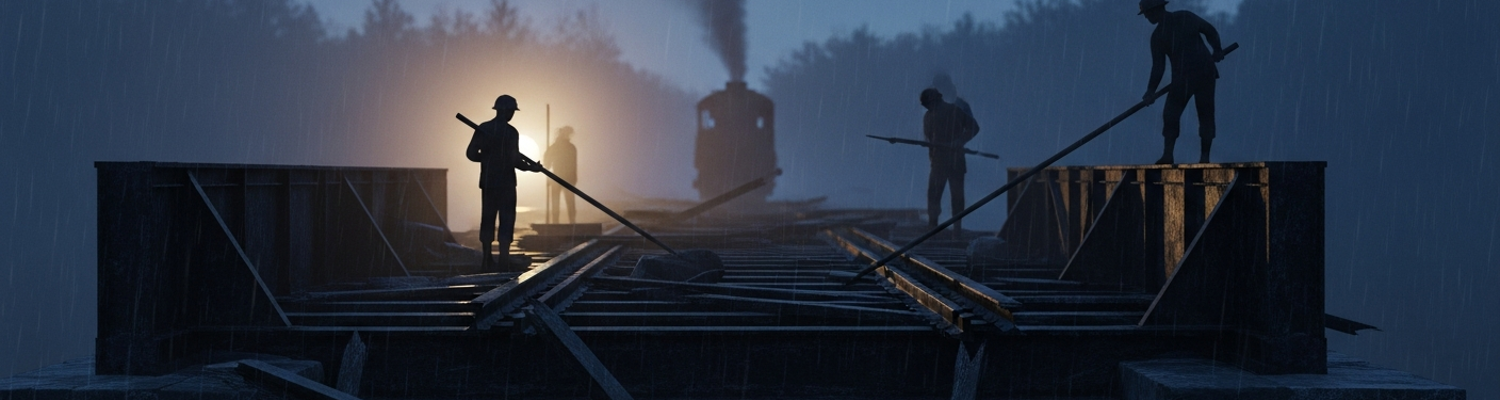

At the Siege of Petersburg, the United States Military Railroad laid twenty-one miles of new track. It operated twenty-five locomotives, moved over two hundred seventy-five pieces of rolling stock, and logged 2.3 million miles of operation. This engineering effort existed in a state of perpetual crisis, a direct result of the partisan war defining the Virginia theater. The strategic impact of disrupted supply lines was not a matter of isolated incidents. It was a systemic drain on Union offensive power. A close review of operational logs from 1862 through 1864 shows a direct correlation between intensified guerrilla attacks on the Orange and Alexandria Railroad and the slowing of Union advances. An offensive, such as the one planned by Major General John Pope, could be stalled for critical days not by a pitched battle, but by the loss of a single railroad bridge. A destroyed culvert was a loss of momentum. It meant thousands of infantrymen sat idle while engineers labored. It meant a cavalry force was rendered immobile as forage for its thousands of mounts failed to arrive from the depots at Alexandria.
The campaign of logistical attrition was the hallmark of partisan units like John S. Mosby’s 43rd Battalion Virginia Cavalry. Operating with near-perfect intelligence from a sympathetic local populace, Mosby’s Rangers did not need to win battles to be effective. Their war was one of the captured courier pouch, the burned wagon train, and the derailed locomotive. The tactics were simple and repeatable. A few men could pry spikes from the outside rail on a sharp curve, sending a multi-ton locomotive and its cargo crashing down an embankment. Telegraph lines, the nervous system of a modern army, were routinely cut, isolating Union forces and blinding their commanders. The cumulative effect was significant. Union field commanders were forced to detach thousands of troops from their main combat strength to serve as guards for every bridge, depot, and wooding station along hundreds of miles of track. Archival evidence (NARA Record Group 92) shows entire infantry regiments assigned to nothing but rear-area security, their fighting potential bled away not by enemy armies but by the constant threat of a few dozen horsemen. This created a phantom front line that stretched the length of every supply route, thinning the concentration of force available for decisive action.
The initial Union response was one of resilient engineering. The U.S. Military Railroad Construction Corps, under the direction of Herman Haupt, performed incredible feats, replacing complex truss bridges in a matter of days. They soon found themselves trapped in an unsustainable cycle. A bridge over the Rappahannock might be rebuilt in a week, only for partisans to burn a smaller, less-defended trestle ten miles down the line two nights later. The Construction Corps was fixing symptoms, not the disease. The recognition of this reality marked a shift in Union strategy. Command correspondence from 1863 onward reveals a growing understanding that the partisan war could not be won with hammers and saws. It demanded a tactical answer. Orders began to authorize the creation of counter-guerrilla units and punitive actions against the civilian communities that sheltered the rangers. The policy shifted from simply repairing damage to actively rooting out the cause, holding local inhabitants responsible for attacks and forcing prominent Confederate sympathizers to ride the trains as hostages to deter sabotage.
Confederate Guerrilla Infrastructure Sabotage
The operational nexus of this partisan war was a swath of Northern Virginia that became known as “Mosby’s Confederacy.” A close review of operational logs shows this area, primarily encompassing Fauquier and Loudoun counties, was the epicenter of sustained attacks. This region, running from the Bull Run Mountains west to the Blue Ridge, was not chosen by accident. Its rolling terrain, dotted with sympathetic farms and dense woods, provided perfect ground for irregular cavalry. It was bisected by the Orange & Alexandria Railroad, a primary artery pumping men and materiel south from the depots in Alexandria. For units like John S. Mosby’s 43rd Battalion, this geography offered the ability to strike a vulnerable target and then disperse, melting back into a supportive local population.
Destruction was a science.
The methods were efficient and required little specialized equipment. A small team of rangers could approach a section of railroad at night, often on a sharp curve to maximize the effect of a derailment. Using simple railroad wrenches, they would remove the spikes and fish plates connecting two rails on the outer side of the bend. The rails, no longer secured, would spread under the weight of an approaching locomotive, sending the train crashing down an embankment. Telegraphs were an even simpler target. Wires were not merely cut, which could be quickly spliced. Ranger teams would pull down entire sections of wire spanning multiple poles and carry it away, forcing Union repair crews to string entirely new lines. Bridges and trestles, particularly wooden ones, were favored targets. Partisans would use augers to drill into primary support timbers, packing the holes with gunpowder or flammable materials before setting them alight. This ensured a deeper, more structurally compromising burn that extended repair times from hours to days.
A close examination of U.S. Military Railroad Construction Corps records reveals a demoralizing pattern of destruction and repair. The corps, under Herman Haupt, could perform engineering miracles, often rebuilding a major bridge in under a week. Yet, this resilience was met with an immediate partisan response. After Union engineers rebuilt the Potomac Creek Bridge in May 1862, it became a high-profile target. While the main spans might become too heavily guarded, the guerrillas would shift their focus. A bridge rebuilt by a thousand men over nine days could be rendered useless by a dozen men burning a small, undefended culvert five miles down the track two nights later. This pattern repeated itself constantly along the Orange & Alexandria and Manassas Gap railroads. The partisans observed Union repair techniques, noting which smaller, secondary structures received less protection. The Union response became a frantic chase, fixing one break only to have another appear elsewhere, a process that consumed manpower, resources, and time. Union commanders were forced to detach thousands of soldiers from the main offensive force simply to guard hundreds of miles of track, an operational drain that kept a significant number of troops away from the front lines.
Ineffective Union Pacification Efforts
Federal attempts to sever the bond between partisan units and the civilian population of northern Virginia were aggressive, systematic, and a categorical failure. A close examination of official orders reveals a strategy based on collective punishment. Beginning in July 1862, Major General John Pope, commanding the new Army of Virginia, issued a series of directives that defined this hard-war approach. General Orders No. 5 authorized Union forces to subsist on the local countryside, providing vouchers payable only after the war and only upon proof of loyalty. General Orders No. 7 explicitly stated that civilians living within five miles of any guerrilla attack would be held responsible. They were to be forced into labor details to repair the damage and compelled to pay for the cost of the Union troops supervising them. General Orders No. 11 was the bluntest instrument, ordering the arrest of all disloyal male citizens. Those who took a loyalty oath could remain, but those who refused were to be expelled beyond army lines. If they returned, they would be treated as spies and subject to execution.
These measures backfired.
Instead of cowing the populace of counties like Loudoun and Fauquier, Pope’s proclamations galvanized Confederate loyalty. The policies were perceived not as a legitimate act of war but as an attack on the civilian population, transforming latent support for the Confederacy into active participation in the resistance. The social fabric of this region was built on deep-seated loyalties, with a majority of the white community embracing the partisan cause from the outset. This was their home; the Union army was an invader. Federal policies that resulted in the seizure of property and the burning of homes, such as those carried out by troops under General George Custer, only deepened this conviction. Fear was a dual-edged weapon. While Union commanders hoped the threat of reprisal would pacify the area, the partisans wielded fear far more effectively. John S. Mosby and his rangers made it clear that collaboration with Federal authorities would be met with retribution. Caught between two implacable forces, the majority of citizens chose the one they considered their own.
The result of this failed pacification was one of the most effective intelligence and support networks of the war. It was a decentralized system, relying on the civilian population to function as the eyes and ears of the partisan bands. Women, children, and old men tracked Union troop movements, noted the size of patrols, and timed the schedules of supply trains. This information was relayed through a clandestine courier system known as the “Secret Line,” a network of safe houses and clandestine routes that funneled reports to Mosby and other commanders. This network rendered Union counter-guerrilla operations almost useless. Federal troops were moving through a landscape where every local was a potential enemy scout. The rangers, meanwhile, could disperse after a raid and blend seamlessly back into the civilian population, boarding in local homes where they were treated as heroes. They were sheltered, fed, and provided with fresh mounts, allowing them to rest and refit without the need for a vulnerable, fixed encampment. A Federal cavalryman noted that every farmhouse was a refuge and every farmer’s son was either with Mosby or in the regular Confederate army.
Engineer Corps Material and Resource Depletion
A review of operational logs from the U.S. Military Railroad Construction Corps reveals a constant demand for specific construction materials. Rebuilding the sabotaged arteries of the Union war effort was an enterprise of immense consumption. Every destroyed trestle, burned bridge, or section of torn-up track demanded an immediate replacement of physical resources. The primary commodity was timber, required in vast quantities. Construction crews needed seasoned oak for railroad ties, long-leaf pine for the structural members of truss bridges, and acres of corduroy wood for temporary roadbeds. Parallel to this was the demand for iron. A single mile of new track required not just the heavy iron rails, but also thousands of spikes and hundreds of joint-fastening fish plates. The constant destruction meant that stockpiles at the main depot in Alexandria were in a perpetual state of depletion.
The work was labor-intensive. It was performed by thousands of men, including skilled civilian engineers, soldiers detailed from infantry units, and large numbers of formerly enslaved people designated as laborers. To be effective, these crews required a continuous supply of hand tools: adzes and broadaxes for shaping timbers, large augers for boring holes, spike mauls, track wrenches, and countless shovels. When a guerrilla raid destroyed a bridge, it often meant the construction crew’s tool caches were lost as well, either captured or thrown into a river. Replacing these items became a secondary logistical challenge, a supply chain running alongside the primary effort to move ammunition and rations to the front.
Maintaining supply lines for these bulky and heavy materials to forward engineer companies was a tactical nightmare. The same partisans who targeted the main railroad lines found supply trains carrying replacement rails and tools to be equally valuable targets. A six-mule team pulling a wagon loaded with iron rails was slow, cumbersome, and highly vulnerable. Records from the Army of the Potomac (Record Group 393) show that wagon trains designated for engineer support were frequently attacked, particularly in the vicinity of the Wilderness and around Brandy Station. Major John Mosby’s rangers demonstrated a keen understanding of this process, recognizing that destroying a wagon full of bridge bolts could delay a critical repair just as effectively as blowing up a culvert. This forced Union commanders to provide armed escorts for what were essentially rolling hardware depots, further diluting combat strength.
Heavy equipment was scarce at the point of need. The Union’s industrial advantage did not always translate to having the right machinery available at a forward location. The rapid reconstruction of major spans, like the Potomac Creek Bridge, often had to be accomplished with a shocking lack of mechanical assistance. Herman Haupt frequently lamented the inadequate supply of proper tools for his exhausted crews. Lacking steam-powered pile drivers, engineers and their labor battalions were forced to drive foundation piles into riverbeds by hand, using heavy weights hoisted by block and tackle. Without cranes, massive pre-cut timbers for bridges had to be wrestled into place using rope systems and sheer manpower, a dangerous and slow process. The absence of portable steam sawmills meant that wood often had to be felled and shaped with axes. This reliance on manual labor, dictated by the difficulty of transporting heavy machinery through hostile territory, directly impacted repair speed. A bridge that could have been erected in three days with a steam crane might take nine without one, leaving an entire Union army stalled.
Union Engineer Morale and Operational Exhaustion
Official records of the U.S. Military Railroad Construction Corps rarely used words of despair, yet company muster rolls and field correspondence from Virginia paint a clear picture of profound morale decay. The letters and diaries of the engineers and the infantrymen assigned to protect them speak of a bone-deep weariness that went beyond physical exertion. A recurring theme is the sense of futility. An engineer with the Army of the Potomac might spend a week of back-breaking labor rebuilding a trestle over a muddy creek, only to learn that partisans had burned an identical structure ten miles down the line before the first supply train had even crossed the new one. This cycle was relentless. Archival evidence shows spikes in sickness and desertion within engineer and supporting infantry units that correlate directly with periods of intensified guerrilla activity along the Orange & Alexandria Railroad. Commanders’ reports increasingly noted that the men were “worn out” and “broken down,” not from battle, but from the unending task of reconstruction. The work was not only laborious but also fraught with peril, as repair crews were frequent targets for ambush, forcing them to work with a rifle always within arm’s reach.
It was a grim, repetitive battle against physics and entropy, waged with axes and spike mauls. The psychological impact of this continuous repair-destruction cycle was corrosive. Soldiers described a state of constant tension, where the sound of a snapping branch in the woods could signal an impending attack. They wrote of a gnawing frustration, knowing that their most strenuous efforts were merely a temporary patch on a permanently bleeding artery. The physical toll was severe. Rebuilding a single wooden bridge by hand, wrestling massive, rain-soaked timbers into place high above a riverbed, and driving piles into rocky Virginia soil was exhausting. The psychological weight was heavier. It was the knowledge that their work was a monument to their own exhaustion, destined to be consumed by fire and sabotage, often within days. This created a unique form of combat fatigue, born not of the sudden terror of a pitched battle, but of the slow, grinding certainty that their labor was in vain.
This operational exhaustion directly constrained Union strategic objectives. An army that cannot supply itself cannot advance. Multiple Union offensives in Virginia were slowed or stalled not by Confederate armies, but by a single burned bridge on the Orange & Alexandria or Virginia Central Railroads. A planned advance by Major General John Pope in 1862 was critically delayed, giving Confederate forces valuable time to concentrate against him. A review of operational timelines shows that corps commanders were frequently forced to halt their entire commands for days, consuming precious rations and forage, while they waited for Herman Haupt’s construction crews to perform yet another miracle. The time lost was irreplaceable. It translated directly into lost tactical opportunities, allowing Confederate armies to shift troops, erect new defensive works, or escape encirclement. The sheer number of troops siphoned off from the main fighting force to guard hundreds of miles of vulnerable track represented a massive drain on combat power. By targeting the engineers and their work, the partisans were able to dictate the tempo of the war in Virginia, imposing a frustrating, exhausting friction on every Union movement.