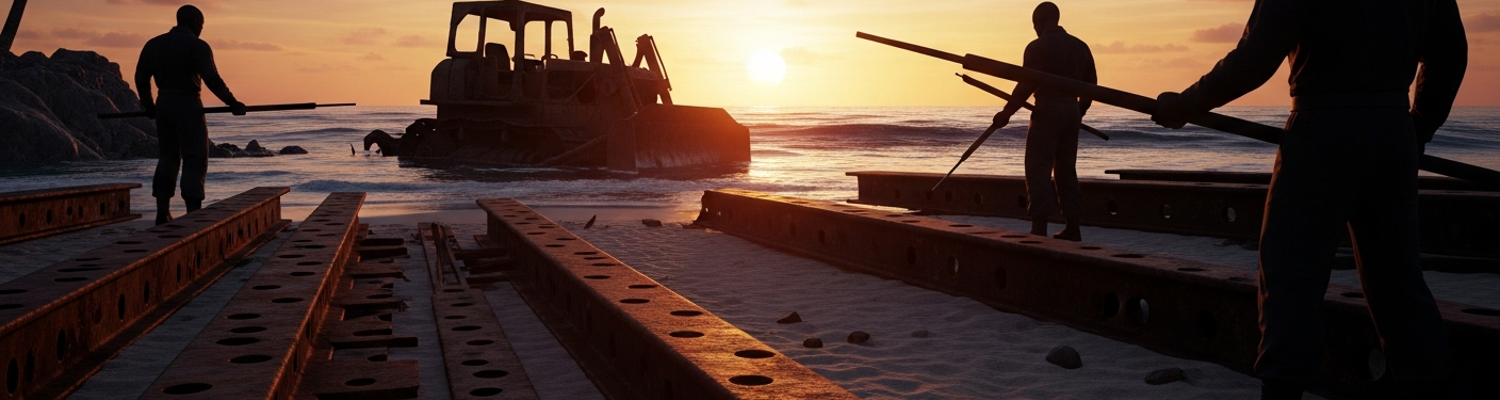

Pacific Atoll Expeditionary Force Launch
The initial struggle for the atoll was not against an enemy force but against the misery of confinement within the steel hulls of transport ships. Before a shot was fired, the Marines of the new expeditionary force were worn down by the oppressive Pacific heat, the constant roll of the sea, and the anxiety of an unknown destination. Sleep was stolen in short bursts amid the groaning of the ship’s frame and the close-packed warmth of hundreds of bodies. To keep from seizing up, they marched for miles on deck, circling the same capstans and deck guns. Hunger was a dull ache, only partially addressed by tinned rations. This was a new form of warfare where the first opponent was distance itself.
The entire endeavor originated from Joint Board Authorization 355-B. This directive, approved in the autumn of 1942, authorized an experimental Marine force for a new type of mission. The unit, designated the 9th Provisional Marine Brigade, was not a frontline combat formation. Its purpose was to test the strategic concept of expeditionary advance base seizure and construction. The authorization called for establishing a semi-permanent military outpost on a remote, presumably undefended, Pacific atoll. The thinking was that a specialized force could bypass a full-scale invasion, instead planting a functional airbase deep within enemy territory through speed and engineering. This would create a forward operating position for projecting air power, disrupting enemy supply lines without a major fleet action. The plan was a high-stakes gamble on logistics and engineering over brute force.
The target selected was an obscure coral ring designated “Atoll 734” on naval charts, a speck in the central Pacific. The initial landing force, composed primarily of elements from the 21st Naval Construction Battalion (Seabees) and Marine engineering detachments, found a difficult environment. The atoll was a narrow crescent of coral and sand, barely a dozen feet above sea level at its highest point, with a dense interior of salt-resistant scrub. There was no fresh water, no natural harbor, and the lagoon was studded with treacherous coral heads. The first wave’s objective was not to secure a beachhead from enemy fire, but to carve one from the island itself. They used pontoon causeways to bridge the shallow reef and get the first pieces of heavy equipment onto solid ground.
The initial engineering payload was ambitious. Archival evidence from the transport ships' manifests shows an unprecedented ratio of construction material to traditional munitions. Onboard were twelve Caterpillar D8 bulldozers, eight LeTourneau Model F scrapers for runway grading, and two mobile rock-crushing plants intended to process the island’s coral into aggregate. The manifest listed over 20,000 individual sections of pierced steel planking, or Marston Matting, needed for a 4,000-foot expeditionary runway capable of handling medium bombers. Prefabricated Quonset hut components, water distillation units, electrical generators, and tens of thousands of gallons of diesel fuel and aviation gasoline filled the cargo holds. The operation was a bet that this engineering capability could be landed and assembled before the first major resupply, a wager that hinged on a new and unproven logistical doctrine.
That wager soured almost immediately. The first scheduled resupply, conducted while the task force was still en route, exposed flaws in the concept of underway replenishment. The oiler USS Neosho attempted a new “abeam” refueling technique with the transport USS Libra. In moderate swells, the experimental high-pressure fueling nozzle’s coupling, a new manganese-bronze alloy design, failed under dynamic stress. The connecting hose whipped free, spraying the deck with fuel. A subsequent attempt two days later was aborted when fuel filters on the transport ship’s intake pumps became clogged with particulate matter, a sign of contaminated fuel from the depot. The mission’s success depended on a constant flow of diesel to power the generators and bulldozers. A review of the task force commander’s log (TF 62.4) shows that by the time land was sighted, the force already faced a fuel crisis, with less than ten days of operational fuel to begin the construction task.
Tropical Attrition of Fortified Outposts
Operational logs from the 9th Provisional Marine Brigade on Atoll 734 document a conflict waged not against an armed adversary, but against the chemistry of the tropics. The constant salt spray and high humidity acted as a ceaseless solvent, actively dissolving the tools of war. Within three days of being unpacked, the steel bodies of new Type 95E electrical generators showed blooms of surface rust. The most pressing threat was to the 20,000 sections of pierced steel planking, the interlocking Marston Matting intended to form the runway. The manganese steel alloy was designed to be corrosion-resistant, but the unceasing exposure to salt air and coral dust overwhelmed the material’s properties. The interlocking hooks and slots that held the planks together developed a coating of rust that swelled the metal, making it impossible to join the sections without brute force from sledgehammers. This slowed construction and risked fracturing the planks, compromising the integrity of the runway project. Post-action reports from Marine detachments note that the operating rods and gas cylinders of M1 Garand rifles required field-stripping and cleaning multiple times a day to prevent the actions from seizing.
The environment was consuming the machines.
The environmental assault was compounded by a severe shortage of tools and replacement parts. The expeditionary doctrine that launched the Atoll 734 mission was built on the assumption that heavy equipment could be brought ashore and operated continuously until the first major resupply. This proved to be a ruinous miscalculation. The initial cargo manifest for the USS Libra was heavy on bulk materials but dangerously light on the specific components needed to maintain the machinery. When the main hydraulic lift ram on a Caterpillar D8 bulldozer began leaking fluid after its seals were abraded by fine coral dust, there were no replacements. Maintenance logs from the 21st Naval Construction Battalion show that Seabees spent eighteen hours attempting to fashion a new seal from salvaged rubber and canvas, an improvisation that failed under the pressure of the hydraulic system. A similar crisis occurred with the mobile rock-crushing plants. The hardened steel jaws, designed to process river gravel, began to chip and fracture when fed the exceptionally hard coral dredged from the lagoon. Lacking the specialized high-tensile welding rods needed for a durable repair, the crews used general-purpose rods, resulting in welds that repeatedly failed and put the crushers out of action for days at a time.
Operationally threatening failures crippled the outpost’s power and communications. The encampment’s electrical grid relied on a trio of diesel generators, but the contaminated fuel that had plagued the task force en route was now joined by airborne coral dust. The fine, abrasive powder was drawn past the engine’s standard air filters, mixing with condensation inside the fuel system to form a grinding paste. A detailed analysis of the lead generator’s maintenance record shows this slurry scored the engine’s cylinder walls, leading to a progressive loss of compression. Without tools for a complete engine overhaul, the Seabee mechanics attempted a desperate field repair. They fashioned shims from flattened brass ammunition casings to place behind the piston rings, hoping to improve the seal. The fix held the engine together for just fifty hours before it failed completely. At the same time, the island’s link to the outside world, an early-model TBX radio transceiver, proved unsuited for the environment. High humidity caused constant condensation to form between the plates of its tuning capacitors, shorting out the signal. The only way for operators to send a message was to disassemble the radio, bake the components over a controlled fire to drive out moisture, and then rapidly reassemble it to transmit before the dampness once again rendered it useless.
Remote Garrison Logistical Breakdown
The initial shipments of supplies and personnel to Atoll 734 represented a high-water mark that would not be seen again for long stretches. Unit after-action reports reveal that the infrequent and unpredictable nature of resupply became the single greatest threat to the garrison’s operational capacity. The long-range replenishment doctrine was new and untested, relying on a small number of specialized supply ships stretched thin across the Pacific. When a scheduled drop was delayed by a week, then two, the effects cascaded through every facet of life on the atoll. Fuel for the bulldozers and generators was the first to be rationed, slowing runway construction. This was followed by food, with mess sergeants ordered to cut daily allotments, stretching stocks of canned goods and dry stores to their limit. The isolation was profound. For weeks at a time, the only link to the outside world was the crackle of a failing radio.
This isolation created a medical crisis. Initial planning had failed to account for the true demand for anti-malarial drugs. The Japanese capture of the Dutch East Indies had choked off the global supply of quinine, forcing Allied forces to rely on the synthetic substitute, Atabrine. But initial supply estimates for the 9th Provisional Marine Brigade were catastrophically low. Medical logs show that within a month, the atoll’s surgeon was forced to reserve his dwindling Atabrine stocks for only the most severe malaria cases. This left the majority of the men exposed. The consequences were immediate, with manpower losses from malaria soon rivaling those from construction accidents. The constant threat of infection from coral cuts added to the problem. The island’s sharp surfaces inflicted countless minor wounds on the construction crews. Without adequate supplies of sulfa powder and sterile dressings, these small injuries frequently developed into deep, festering infections in the hot, humid environment. The lack of clean water for sanitation made dysentery a constant presence, further weakening the men.
Fragmented and often desperate messages began to filter back to the Joint Board in Washington. Communications were a constant struggle. The garrison’s TBX radio was a heavy, multi-part field set ill-suited for the tropics; its internal components were highly susceptible to moisture, and operators frequently had to dry the parts over a fire to get a signal out. The reports that did reach the rear echelons painted a grim picture of systemic collapse. They were not strategic overviews but piecemeal cries for help: a request for specific hydraulic seals for a bulldozer, an urgent plea for more Atabrine, a report on the failing compression of a primary generator. To the planners in Washington, these fragmented reports from a single, experimental outpost were likely viewed as isolated technical issues, not as evidence of a flaw in the new expeditionary doctrine. The reality of an entire garrison being consumed by its environment was lost in the bureaucratic distance, translated into line items on a delayed shipping manifest.
Joint Board Strategic Doctrine Reassessment
The reports trickling back to Washington from Atoll 734 were initially filed as isolated technical problems. Internal correspondence shows that planners on the Joint Board continued debating tonnage allocations for future, similar operations, unaware of the systemic collapse of the doctrine they had authored. The turning point came not as a single report but as a series of garbled messages detailing the near-total failure of runway construction. The interlocking hooks of the Marston Matting, the foundation of the expeditionary airbase concept, were being destroyed by rust before they could even be laid. This was not a mechanical issue to be fixed with a spare part; it was a failure of material science that invalidated the core of the mission. The quiet response was the issuance of a document designated Joint Board 350, Serial 500. It was not a plan for action, but a directive for study. It convened a special subcommittee to analyze the efficacy of unsupported advance base establishment in light of initial reports from the 9th Provisional Marine Brigade. The language was sterile. The implications were not.
The subcommittee’s work, conducted under the authority of JB 350, Serial 500, quickly became a post-mortem for a strategy that was still, in theory, active. The central assumption of Joint Board Authorization 355-B, that a small engineering force could rapidly create a self-sustaining outpost, was proven false. Theoretical planning had envisioned a compliant piece of empty geography. A review of the planning documents (NARA Record Group 218) shows fuel consumption for the Caterpillar D8 bulldozers was calculated using standard earth-moving tables. These failed to account for the engine strain of grinding through dense, abrasive coral. Construction timelines for the runway were projected from demonstrations on temperate Virginia airfields, not a salt-saturated atoll where steel planks were rusting shut in their crates. The analysis dissected the failure of the USS Neosho’s underway replenishment, recognizing that the entire supply chain was only as strong as a single, experimental manganese-bronze fuel coupling that had failed in a moderate swell. The concept of an undefended island had been misinterpreted as a passive one, ignoring the biological and chemical hostility of the tropical environment. The island fortress was a trap, consuming men and equipment at a rate no theoretical resupply schedule could match.
This failure directly reshaped the future of the Pacific War. The findings compiled under JB 350, Serial 500 effectively killed the concept of small, unsupported expeditionary airbases. A detailed examination of planning documents for the subsequent island-hopping campaigns reveals a clear and immediate doctrinal shift. The new approach was one of overwhelming, systematic power. Instead of nimble forces bypassing enemy strongholds, the new doctrine called for massive fleet actions to isolate and reduce them. Instead of relying on a few specialized supply ships, future operations would be sustained by entire service squadrons and huge floating bases anchored at protected deep-water fleetages. The idea of a single battalion carving out one runway was replaced by plans to seize and hold entire islands, allowing whole Naval Construction Regiments to build multiple airfields, extensive depots, and harbor facilities. The hard lesson of Atoll 734 was that there were no shortcuts across the Pacific. The tyranny of distance and environment could not be outsmarted; it had to be overcome by a logistical effort of unprecedented scale.
Geopolitical and Logistical Implications
The collapse of the Atoll 734 experiment sent a political shockwave through the War and Navy Departments. The initial concept, Joint Board Authorization 355-B, had been politically palatable because it was limited in scope, promising strategic gain without a large-scale industrial and military commitment. Its failure was a political liability. The loss of even a small, experimental garrison was politically toxic, evoking the recent fall of Wake Island. That defeat, where a small force of Marines and civilians had been overwhelmed, created a potent rallying cry but also a deep-seated political aversion to leaving any American force isolated. The reports from Atoll 734, detailing an outpost being consumed not by the enemy but by its own supply failures and the environment, created a crisis of confidence in Washington’s strategic planning. It forced a debate on resource allocation. A new strategy would require a massive, dedicated logistical fleet, diverting steel and shipyard capacity from combat vessels to unglamorous but essential support ships like oilers, tenders, and transports.
This realization, born from the hard data of failed generators and rusting steel on a remote atoll, fundamentally reshaped strategic planning for the Pacific War. The findings of the special subcommittee, convened under JB 350, Serial 500, invalidated the entire doctrine of small, unsupported forward bases. A close examination of subsequent operational plans reveals a complete reversal. The new doctrine was built around the concept of overwhelming logistical power, spearheaded by newly formed Service Squadrons. These formations, which some in high command considered the true secret weapon of the Pacific Fleet, were not mere resupply convoys but entire floating, mobile naval bases. The initial plan for Service Squadron Ten, for example, called for 100 ships, including destroyer tenders, repair ships, survey vessels, floating drydocks, and specialized barges for everything from ammunition to ice cream production. By the end of the war, the Service Force would grow to nearly 3,000 ships. This commitment ensured that future operations would not be tethered to distant bases like Pearl Harbor; instead, the base would travel with the fleet.
This industrial-scale logistical commitment sent its own powerful geopolitical signals. To allies like Australia, it was a definitive statement of America’s intent to prosecute the Pacific War to its conclusion. To the Japanese high command, it demonstrated an industrial and organizational capacity that was impossible for them to match. Japanese strategy relied on fortified island perimeters to attrite enemy forces, but they had consistently neglected their own logistical capabilities.
The direct operational consequence of this doctrinal shift was the creation of massive advance fleet anchorages, the complete antithesis of Atoll 734. At Ulithi Atoll, a huge natural lagoon located between Guam and Palau, the Navy established the largest and most active naval facility in the world. Where Atoll 734 had a single, failing runway, the Seabees at Ulithi built multiple airfields capable of handling heavy transport traffic. Where the 9th Provisional Brigade had been crippled by a single failed fuel coupling, Ulithi became a tanker depot for the entire Pacific Fleet. At its peak, the anchorage held over 700 ships, from battleships and carriers to a fleet of specialized repair and supply vessels that could rebuild a carrier’s flight deck or lift a cruiser out of the water in a floating dry dock. This floating metropolis, with a temporary population the size of a major city, allowed the fleet to operate for months on end in the Western Pacific, thousands of miles from its home ports.