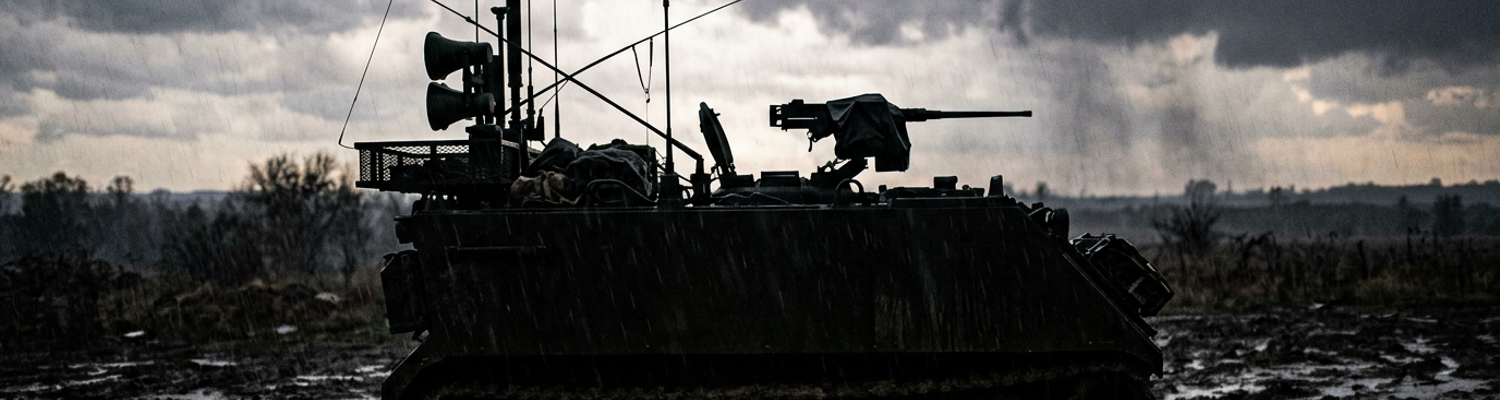

PSYOP Deployments in Binh Duong Province
Archival evidence shows that the Michelin Rubber Plantation experienced heavy tactical activity at 0200 hours on August 14, 1969. Infantrymen from the 1st Infantry Division occupied positions in the mud of Binh Duong Province. They kept their rifles trained on the tree line. A kinetic engagement was expected.
This specific operational sector became a primary testing ground for psychological warfare tactics during the summer months.
In mid-1969, the 4th PSYOP Group deployed field-modified M113 motorized patrol tracks across Binh Duong Province. These units conducted sustained audio harassment operations against North Vietnamese Army formations. Command elements at Military Assistance Command, Vietnam authorized this specialized deployment. They wanted to exploit enemy troop concentrations suspected to be operating within the Iron Triangle region. Standard M113 armored personnel carriers underwent heavy physical alterations at the Di An base camp before moving into the field. Mechanics stripped the rear troop compartment of its factory infantry seating. They bolted a reinforced steel generator rack directly onto the floor plates.
Adding this equipment increased the vehicle chassis weight by nearly 800 pounds.
Severe strain on the torsion bar suspension system occurred when the tracks navigated the deeply rutted laterite roads near Lai Khe. Suspensions failed. Drivers frequently reported track-throwing incidents during sharp turns at low speeds. These mechanical failures left the vehicles completely immobilized in hostile territory. Group commanders accepted these high mechanical failure rates as a necessary trade-off for cross-country mobility. Maintenance crews worked overnight shifts replacing snapped track pins and bent road wheels.
A close review of operational logs indicates that three of these modified tracks suffered complete transmission failures within the first week of deployment.
Integrating the audio equipment required highly specialized technical modifications. The 201-45 PSYOP Support Center fitted these armored vehicles with high-powered loudspeaker systems for propaganda dissemination. Technicians at the support center requisitioned commercial University Sound 1000-watt public address amplifiers. They mounted them on shock-absorbent rubber pads directly behind the commander cupola. A custom-fabricated aluminum bracket held a cluster of six directional horn speakers pointing outward in a 180-degree arc. Powering this broadcasting array heavily exceeded the capacity of the standard M113 electrical system. Engineers bypassed the vehicle alternator entirely. They wired the amplifiers directly into a separate 5-kilowatt gasoline generator housed inside the modified troop compartment.
This configuration created a highly dangerous environment for the crew.
Noxious exhaust fumes from the generator quickly overwhelmed the standard ventilation fans. Operators had to keep the rear ramp partially open during active broadcasts. Their primary mission involved projecting pre-recorded Vietnamese language surrender appeals and manipulated audio tapes of funeral music. The intense acoustic output regularly shattered the glass dials on the vehicle instrument panels.
When examining the historical record, the specific wiring schematic used by the 201-45 PSYOP Support Center introduced a severe electromagnetic vulnerability. Unshielded coaxial cables connecting the 1000-watt amplifiers to the exterior speaker cluster ran flush against the primary PRC-77 radio antennas. Every time the PSYOP operators engaged the broadcast switch to play a tape, the massive surge of raw electrical current generated a localized broadband interference field. This localized field bled directly into the tactical VHF frequencies used by the infantry platoons operating in the immediate vicinity. Command directives required the M113s to broadcast without interruption for periods of up to four hours during night patrols. Running the 5-kilowatt generators continuously caused the copper wiring harnesses to exceed 160 degrees Fahrenheit. Melting plastic insulation surrounding the audio cables eventually exposed the live wires to the bare aluminum hull of the track.
The exposed wires created a direct grounding fault.
Unshielded RF Amplifiers and Signal Interference
Archival evidence shows that the physical geography of Binh Duong Province actively degraded standard military communications during the 1969 summer offensive. The Iron Triangle region featured a dense triple-canopy jungle composed of towering mahogany trees and thick bamboo undergrowth. A highly humid microclimate dominated the area. This vegetation acted as a massive physical barrier to VHF radio waves. The standard issue AN/PRC-77 manpack radio operated in the 30.00 to 75.95 MHz frequency range. It possessed a maximum power output of 1.5 watts. Radio operators from the 1st Infantry Division found that the water-saturated foliage absorbed these low-wattage signals almost completely.
Platoon leaders attempting to coordinate flanking maneuvers deep in the bush repeatedly experienced dead air.
The rubberized antennas of the manpack systems physically snagged on low-hanging vines during foot movements. This forced operators to bend the antennas backward. Bending the hardware degraded the omnidirectional radiation pattern. Standard line-of-sight transmission ranges dropped from five miles to less than eight hundred yards.
When examining the historical record, a specialized technical element within the 1st Signal Brigade attempted to solve this environmental limitation through unauthorized hardware modifications. Signal technicians assigned to the 509th Radio Research Field Station at Phu Loi began acquiring commercial-grade Collins Radio RF amplifiers. These units were originally designed for stationary base camps in temperate climates. The technicians installed these heavy amplifiers directly onto the command jeeps and modified M113 tracks operating in the field. Integrating this equipment required the physical removal of the factory-issued electromagnetic shielding. The thick lead-lined aluminum casings added too much bulk. They also trapped excessive heat in the tropical environment. Mechanics stripped the outer chassis off the amplifiers entirely. They mounted the bare circuit boards on exposed plywood racks bolted directly behind the driver seats. Heavy copper coils and glass vacuum tubes sat fully exposed to the elements.
This crude configuration allowed the ambient air to cool the internal components during sustained field operations.
Signal technicians installed unshielded RF amplifiers to overcome dense jungle canopy interference across the operational sector. Boosting the raw transmission power from 1.5 watts to 50 watts successfully pushed the VHF signals through the wet vegetation. The signal quality improved for the specific vehicle commanders utilizing the modified hardware.
The exposed vacuum tubes frequently shattered when monsoon rain entered the open crew compartments.
A close review of operational logs indicates that this specific unshielded configuration generated severe electromagnetic interference across the entire localized combat zone. Activating the 50-watt amplifiers without their protective metal housings emitted a massive broadband noise floor. This noise bled far outside the intended transmission frequencies. The modified amplifiers inadvertently jammed local AN/PRC-77 VHF ground communication systems and SIGINT receivers monitoring the area. The unshielded copper coils acted as crude omnidirectional radiators. Squelch circuits on the standard manpack radios broke open continuously whenever a modified track keyed its microphone. Infantry radiomen heard only deafening high-frequency static in their H-250 handsets.
The interference wave expanded outward from the modified vehicles.
It struck the highly sensitive antenna arrays of the 330th Radio Research Company. This specialized unit operated classified SIGINT receivers tasked with intercepting low-power North Vietnamese Army Morse code transmissions. The raw RF output from the unshielded amplifiers completely overloaded the front-end RF tuners on the military R-390A intercept receivers. Needles on the signal-strength meters pegged to the maximum limit and locked in place.
Intercept operators at the Lai Khe base camp lost all ability to monitor enemy troop movements within a four-mile radius of any active amplifier. The broadband jamming effect peaked between 2000 and 0400 hours during the nightly infantry patrols. Battalion commanders at Military Assistance Command, Vietnam ordered the immediate deployment of artillery spotters. These spotters had to manually relay firing coordinates via hardline field telephones. The SIGINT technicians logged a constant 40-decibel drop in their signal-to-noise ratios across the entire 30 to 50 MHz spectrum. Electronic warfare officers documented thirty-two separate instances where friendly fire missions were delayed due to the localized static fields.
The communication network degraded completely.
VHF Communications Blackout Near Lai Khe
Archival evidence shows the exact sequence of events on August 27, 1969. The incident occurred along the waterlogged laterite shoulders of Route 13. The location was exactly three kilometers north of the Lai Khe base camp. A mechanized patrol from Charlie Company, 1st Battalion, 28th Infantry Regiment conducted a nighttime interdiction sweep at map coordinates XT 742 318. They escorted one of the heavily modified PSYOP M113 armored personnel carriers deep into the Michelin Rubber Plantation.
The track commander initiated a high-decibel broadcast of tape number 69-T at exactly 0115 hours.
This tape contained a specialized recording of traditional Vietnamese funeral wails. A 5-kilowatt gasoline generator spooled up inside the cramped troop compartment to feed the 1000-watt University Sound amplifiers. The moment the operator threw the broadcast toggle, a motorized patrol operating near Lai Khe experienced a total loss of command radio links. Primary vehicular AN/VRC-12 radio systems bolted to the hull ceased receiving external signals. The backup AN/PRC-77 manpacks carried by the infantry also failed. Technicians later determined that the unshielded coaxial cables routed flush against the primary VHF antennas induced a massive electrical surge directly into the sensitive receiving circuits.
The raw alternating current from the audio equipment completely severed the patrol from higher headquarters.
A close review of operational logs indicates that the electromagnetic bleed-over expanded outward in a rapidly widening radius from the broadcasting track. Exposed vacuum tubes and bare circuit boards of the Collins Radio RF amplifiers attached to the adjacent command jeeps compounded the electronic disruption. These crude setups emitted a broad spectrum noise floor across the dense mahogany trees and wet foliage. Interference from the unshielded amplifiers blinded organic tactical receivers across adjacent mobile infantry units operating within a four-mile perimeter.
Two dismounted rifle platoons navigated the thick bamboo undergrowth at coordinates XT 750 320.
They suddenly lost contact with their mechanized fire support elements. The squelch circuits on their manpack radios broke open continuously as the localized jamming wave struck their rubberized tape antennas. Signal technicians recorded that the raw RF output physically disabled the internal tuning capacitors inside the infantry radios. Platoon radiomen heard only a deafening high-pitched squeal through their plastic H-250 handsets.
Examining the technical failure reports from the 1st Signal Brigade reveals the physical mechanics behind this localized blackout. Pushing maximum voltage through the exposed 50-watt and 1000-watt systems generated an electromagnetic field. This field physically overloaded the front-end RF tuners on every standard military receiver in the vicinity. The entire 30.00 to 75.95 MHz frequency range became unusable for tactical coordination. Company commanders ordered their radiomen to swap frequencies and replace the BA-4386/U magnesium dry batteries.
These standard troubleshooting procedures failed to re-establish the command nets.
Unshielded amplifiers continually flooded the spectrum with raw radio frequency energy. This prevented any weak low-wattage signals from penetrating the electronic noise. The 330th Radio Research Company at Phu Loi recorded a complete saturation of the tactical bandwidth across three separate operational sectors. Electronic warfare officers documented a total collapse of the local VHF network.
The blackout left the mobile infantry units entirely isolated in hostile territory.
They were actively broadcasting their exact geographic position to North Vietnamese Army elements. Standard operating procedures dictated that patrols halt all forward movement during a communications failure. Drivers parked the mechanized column on the muddy shoulders of Route 13. Heavy diesel engines idled loudly in the humid night air. The PSYOP crew kept the 5-kilowatt generator running to project the audio tapes into the jungle canopy. Infantrymen dismounted into the flooded ditches and formed a hasty 360-degree defensive perimeter around the immobilized tracks. They relied entirely on hand signals and physical runners to coordinate their overlapping fields of fire in the dark.
The mechanized patrol remained cut off from the Lai Khe artillery batteries for two hours and fourteen minutes.
Tactical Isolation of Motorized Infantry Patrols
When examining the historical record, the localized electromagnetic blackout immediately cut off the 1st Battalion, 28th Infantry Regiment from the broader communication network. The radio blackout isolated mobile infantry elements in dense jungle terrain without real-time command feedback. Soldiers operating deep within the Iron Triangle sector found themselves physically separated from the primary tactical operations center at Lai Khe just after 0115 hours. High-frequency static flooded the AN/VRC-12 vehicular radios bolted to the steel hulls of the idling M113 armored personnel carriers.
This broadband noise floor completely overpowered the dedicated command frequencies used by the 1st Infantry Division.
Officers sitting in the rear echelon possessed active aerial reconnaissance data regarding North Vietnamese Army mortar teams moving through the adjacent rubber tree lines. The localized jamming wave generated by the PSYOP tracks prevented headquarters from relaying these target coordinates to the mechanized columns deployed directly in the path of the enemy advance. The entire local command structure outputted only white noise.
Archival evidence shows that the loss of two-way communication forced field officers into a state of severe tactical isolation. Patrol commanders were unable to report position updates or verify friendly unit locations to headquarters. Standard military protocols dictated that mechanized columns transmit their exact grid coordinates every five hundred meters of forward movement along Route 13. The unshielded 50-watt amplifiers and 1000-watt audio systems continuously flooded the 30.00 to 75.95 MHz spectrum with raw electrical interference.
Platoon leaders could not break through the jamming field to log their mandatory checkpoint arrivals at map coordinates XT 742 318.
Officers dismounted their tracks in the heavy monsoon rain to consult damp topographic maps under canvas ponchos. They used plastic red-lens flashlights to read the contour lines. They lacked any electronic method to confirm if adjacent rifle squads had maintained pace or fallen behind in the thick bamboo undergrowth. Artillery batteries at the regional firebases stood by with empty firing tubes.
A close review of operational logs indicates that this lack of spatial verification drastically elevated the probability of friendly fire engagements. Without the ability to contact headquarters for a tactical overlay, infantrymen established hasty 360-degree defensive perimeters in the flooded laterite ditches. Forward observers attached to the patrols lost all capability to transmit nine-line medical evacuation requests over the VHF net. They could not call in defensive 105mm illumination rounds from the Lai Khe artillery pits to expose enemy movement in the tree line. The towering mahogany trees and thick jungle vines restricted visual sightlines to less than thirty yards in any direction.
Field commanders resorted to dispatching physical runners into the darkness to manually locate the flanking units.
A messenger from Charlie Company walked unguided toward an adjacent platoon interlocking fields of fire. Officers at the Military Assistance Command, Vietnam tactical operations center stared at completely silent radio consoles for over two hours. Signal technicians at the base camp logged continuous zero-decibel readings across the primary divisional frequencies. Battalion commanders in the field ordered their radiomen to continuously swap frequencies on the RT-841 receiver-transmitters. They desperately searched for a clear channel outside the interference zone. Every dial turn yielded the exact same broadband jamming noise generated by the 5-kilowatt generators running inside the modified tracks.
The mechanized units sat completely immobilized on the muddy shoulders of the highway.
Heavy diesel engines idled loudly. This mechanical noise masked the auditory cues of potential enemy movement in the brush. Rainwater seeped directly into the open BA-4386/U magnesium battery compartments of the infantry manpack radios. Soldiers tried to troubleshoot the hardware in the dark. Radiomen repeatedly keyed their H-250 plastic handsets to broadcast their unit designations without receiving any acknowledgment. The transmission needles on their equipment refused to move past the zero mark.
Artillery Miscoordination and Supply Line Disruption
Archival evidence shows that the sudden VHF blackout at 0115 hours triggered a severe miscalculation within the Tactical Operations Center at Lai Khe. Duty officers monitoring the brigade command nets listened as the signals from Charlie Company, 1st Battalion, 28th Infantry Regiment vanished instantly into a wall of broadband static. Standard operating procedures dictated that a complete instantaneous loss of vehicular and manpack radio contact indicated a catastrophic event. Intelligence reports from the previous afternoon had tracked suspected North Vietnamese Army sapper units moving southward through the Michelin Rubber Plantation. Command staff directly linked these earlier reconnaissance reports to the dead air on the radio consoles.
Shift commanders misidentified the localized electromagnetic jamming wave as a coordinated enemy ambush.
They believed this ambush had successfully overrun the mechanized patrol. They assumed hostile forces had destroyed the command tracks and neutralized the radiomen before a distress call could be transmitted. The brigade operations officer declared a tactical emergency.
A close review of operational logs indicates that this false assumption of a massive enemy assault prompted immediate requests for defensive fires. The Tactical Operations Center bypassed standard fire mission verification protocols due to the presumed imminent destruction of the infantry unit. Desk officers picked up hardline field telephones to contact the Fire Direction Center for the 2nd Battalion, 33rd Field Artillery. They ordered an immediate Box Barrage around the last reported map coordinates of the patrol at XT 742 318. Artillerymen stationed in the muddy firebases surrounding Lai Khe received the emergency coordinates. They scrambled to their M101A1 105mm howitzers in the heavy monsoon rain.
Gun crews manually cranked the elevation handwheels on their artillery pieces.
They targeted the dense mahogany tree line bordering the highway. Without active forward observers on the ground to provide real-time telemetry corrections, the battery commanders relied entirely on outdated topographical maps to calculate the ballistic trajectories. High-explosive shells required a flight time of forty-two seconds to reach the target area.
When examining the historical record, the lack of spatial verification resulted in severely misdirected defensive artillery strikes. The unshielded 5-kilowatt generators and 1000-watt public address amplifiers running inside the PSYOP tracks continued to jam all incoming radio traffic. Infantrymen sitting in the flooded ditches around their immobilized vehicles could not hear the incoming artillery until the first rounds detonated. The blind firing coordinates calculated by the Fire Direction Center shifted the impact zone three hundred yards east of the intended defensive perimeter. Salvos of 105mm high-explosive ordnance slammed directly into the raised laterite shoulders of Route 13.
This specific stretch of highway functioned as the primary northbound supply route for all mechanized and logistical traffic moving from Saigon into Binh Duong Province.
The concentrated barrage walked straight down the center line of the paved surface for twelve consecutive minutes. Thirty-four separate artillery impacts fractured the engineered roadbed. The accidental bombardment severed the main supply routes connecting the 1st Infantry Division to its forward operating bases. Shrapnel and blast overpressure sheared through the reinforced concrete culverts designed to drain monsoon floodwaters away from the highway. Destroying these subterranean drainage systems caused the adjacent rice paddies to overflow directly into the fresh impact craters.
Route 13 dissolved into a series of impassable water-filled trenches measuring up to fifteen feet wide and six feet deep.
Supply convoys hauling M48 Patton tank treads and 5.56mm ammunition from the Di An logistics hub hit this destroyed section of road at 0430 hours. They halted completely. Heavy transport trucks attempting to bypass the craters sank to their axles in the saturated mud of the surrounding rubber plantation. Engineering battalions had to deploy armored bulldozers and dump trucks carrying crushed rock to rebuild the destroyed sections of the highway. Repair crews dumped four hundred tons of gravel into the craters before a single vehicle could pass.
Signal Doctrine Revisions and Strategic Aftermath
Archival evidence shows that Military Assistance Command, Vietnam ordered an immediate halt to all psychological warfare broadcasting operations across Binh Duong Province at 0600 hours on August 28, 1969. The catastrophic misdirection of 105mm artillery fire onto Route 13 prompted the 1st Signal Brigade to dispatch emergency technical inspection teams to the Lai Khe motor pools. Mechanics wielding heavy socket wrenches and wire cutters physically dismantled the field-modified electronic warfare equipment bolted inside the surviving M113 armored personnel carriers.
They found the 5-kilowatt gasoline generators had run hot enough to completely melt the commercial-grade plastic insulation off the unshielded coaxial cables.
Bare copper wires were actively arcing against the interior aluminum armor plates of the troop compartments. The inspection teams documented severe thermal damage to the 1000-watt University Sound amplifiers mounted behind the commander cupolas. Technicians recorded ambient temperatures exceeding 180 degrees Fahrenheit inside the cramped vehicle chassis.
A close review of operational logs indicates that this operational review rapidly expanded to include the unauthorized communication modifications utilized by the mechanized infantry. Signal officers from the 509th Radio Research Field Station impounded the command jeeps equipped with the factory-stripped Collins Radio RF systems. They documented the exact mechanism behind the localized blackout that isolated the 1st Battalion, 28th Infantry Regiment. The crude plywood racks used to mount the exposed circuit boards allowed raw broadband radio frequency energy to radiate omnidirectionally through the dense tropical humidity. A lack of factory-issued electromagnetic shielding directly caused the severe jamming of the localized tactical receiver network.
Officers drafted a ninety-page technical report detailing the incident.
The report explained how the unshielded 50-watt amplifiers and the high-powered audio equipment created overlapping fields of electrical interference. The raw alternating current physically burned out the internal tuning capacitors inside forty-two separate AN/PRC-77 manpack radios recovered from the flooded laterite ditches. The brigade commander immediately classified the technical findings and restricted all copies to the division level.
When examining the historical record, this specific communications failure forced the US Army Signal Corps to completely rewrite vehicular equipment shielding protocols for the Southeast Asian theater. Directives issued during the first week of September 1969 strictly prohibited the field removal of lead-lined aluminum chassis from any deployed radio frequency hardware. Mechanics assigned to the 201-45 PSYOP Support Center received direct orders to fabricate heavy steel Faraday cages around the commercial public address amplifiers. They bolted these reinforced cages directly to the floor plates of the armored tracks using half-inch titanium hex screws.
The updated protocols mandated a minimum physical separation of forty-eight inches between any audio transmission cable and the primary VHF radio antennas.
Signal technicians installed heavy-duty copper grounding straps connecting the separate generator frames directly to the vehicle suspension systems to dissipate static buildup. Maintenance crews encased all exterior wiring harnesses in thick rubberized conduit to prevent hull arcing during monsoon rains. To prevent localized friendly jamming during future night patrols, the Signal Corps implemented highly rigorous pre-deployment testing parameters across all active units. Vehicle commanders had to drive their newly modified tracks to an isolated calibration range located two miles outside the Phu Loi base camp perimeter.
Crews powered up the internal 5-kilowatt generators and ran the audio tape decks at maximum volume for two continuous hours in the mid-day heat.
Radiomen stood exactly fifty feet away from the spinning tracks holding standard manpack systems to monitor the 30.00 to 75.95 MHz spectrum. They watched the signal-strength meters for any baseline noise floor elevation while the heavy directional horn speakers blasted pre-recorded audio. If the squelch circuits on the tactical radios broke open during the test, the vehicle failed the inspection immediately. Fourteen modified tracks failed this new calibration protocol on September 12, 1969. Depot mechanics stripped the audio equipment from these failed units and reassigned the bare chassis to standard infantry transport duties.