
Military doctrine after the First World War was driven by a singular obsession: avoiding a repeat of trench warfare’s grinding attrition. Theorists like Giulio Douhet in Italy and Billy Mitchell in America argued for a new form of war, one waged from the air. They envisioned massed formations of long-range bombers bypassing armies to strike directly at an enemy’s industrial heartland. The objective was to shatter the capacity and will to fight, forcing a swift conclusion. The U.S. Army Air Corps embraced this doctrine of high-altitude, daylight precision bombing. This strategic choice was a foundational belief that the bomber would always get through, a concept dictating the design of the next generation of aircraft. The entire strategy hinged on an aircraft that could fly high and far, defending itself without fighter escorts, which lacked the necessary range.
The Boeing Model 299 was the physical manifestation of this doctrine. First flown on July 28, 1935, it represented a significant technological leap. Unlike contemporary twin-engine bombers, the Model 299 had four powerful Pratt & Whitney radial engines, providing superior speed, altitude, and range. An early flight from Seattle to Ohio averaged 252 miles per hour, a remarkable performance for its size. Its all-metal construction and a bomb load capacity up to 4,800 pounds were impressive, but its defensive armament was what captured the public imagination. A reporter, observing the prototype's numerous machine gun stations, dubbed it a “flying fortress,” a name Boeing immediately trademarked. The initial design featured five machine gun mounts, a number that would increase in later models, creating the impression of an aircraft that could fight its way through enemy skies alone. This was not just an aircraft; it was a self-contained weapon system.
The promise of self-sufficiency was built into its deployment tactics. Army Air Forces doctrine centered on the “combat box,” a tightly organized, three-dimensional formation of bombers. These formations, with dozens of B-17s staggered by altitude and position, were designed to create interlocking fields of machine-gun fire. A squadron of twelve aircraft, arranged in high, low, and lead elements, formed the basic building block for larger group and wing formations of up to 108 bombers. The theory held that this dense concentration of .50-caliber machine guns would present an impenetrable wall of lead to any attacking fighter. Planners believed this massed firepower was so effective that fighter escorts were unnecessary. The survivability of the B-17 was considered a calculated certainty based on firepower and formation discipline.
The doctrine of the self-defending bomber was first tested on August 17, 1942. A dozen B-17Es from the 97th Bombardment Group lifted off from Polebrook, England, to strike railroad yards at Rouen-Sotteville in occupied France. This initial mission was a cautious probe. The target was close, allowing a heavy escort of RAF Spitfires, a luxury unavailable for deep-penetration raids into Germany. The mission commander was Colonel Frank Armstrong, with Major Paul Tibbets as the lead pilot and Brigadier General Ira C. Eaker, commander of Eighth Air Force’s Bomber Command, aboard as an observer. The raid was a success, with roughly half the bombs landing in the target area and all aircraft returning. This outcome created a dangerous sense of overconfidence. It appeared to validate the core tenets of American airpower theory.
This initial optimism was short-lived.
The Luftwaffe’s response was swift and adaptive. German fighter pilots quickly identified the vulnerabilities of the combat box. Initial attacks from the rear proved costly against the overlapping fire from the B-17s' tail and waist gunners. Archival evidence shows a rapid tactical shift by German fighter wings. They began favoring high-speed, head-on attacks. Closing at a combined speed over 500 miles per hour, fighters like the Focke-Wulf Fw 190 gave the B-17’s nose gunners only seconds to acquire and fire. The Fw 190, heavily armed with cannons, was particularly devastating. Luftwaffe pilots learned to aim for the cockpit to eliminate the pilots or for the wing roots, where fuel tanks and engines were clustered. By December 1942, the head-on pass was the preferred assault method, systematically dismantling American defensive formations.
The consequences of these evolving German tactics became clear throughout 1943. Attrition rates climbed to unsustainable levels. A review of operational logs reveals it was statistically impossible for a crew to complete its 25-mission tour. The raid on the Regensburg Messerschmitt factory and the Schweinfurt ball-bearing plants on August 17, 1943, resulted in the loss of 60 B-17s, a casualty rate of nearly 16 percent for a single day. The second raid on Schweinfurt on October 14, 1943, known as “Black Thursday,” was even more catastrophic. Of 291 B-17s dispatched, 60 were shot down and another 17 were damaged beyond repair, a loss of 77 bombers. More than 600 airmen were lost.
The aircraft itself, operating at performance extremes, became an adversary. At altitudes up to 30,000 feet, crews faced temperatures that could plunge to -60 degrees Fahrenheit. Frostbite was a constant threat for gunners at open waist-gun positions. The electrically heated flight suits were unreliable. Oxygen systems, essential for survival in the unpressurized fuselage, could freeze or be damaged by flak, leading to hypoxia. The .50-caliber machine guns were also susceptible to the cold, with lubricants freezing and causing jams at the worst possible moment. Mechanical failures, from runaway propellers to engine fires, were frequent, turning the technological marvel into a high-altitude trap.
Operational logs from 1943 reveal a catastrophic flaw in the defensive doctrine of the B-17E and F models. The combat box theory relied on interlocking fire, but Luftwaffe analysis, particularly by pilots like Egon Mayer, identified a blind spot directly in front of the bomber. Attacking formations of Focke-Wulf Fw 190s began to favor high-speed, head-on passes from the 12 o'clock high position. The combined closing speed often exceeded 500 miles per hour, giving the bomber’s nose gunner mere seconds to react. The armament in the bomber's frameless plexiglass nose was frequently a single, manually aimed .50-caliber machine gun on a flexible socket mount with limited traverse. German pilots executed a slight diving approach, placing them outside the effective firing arcs of both the top turret and the ball turret until the final moments. This tactic rendered the most heavily armed portions of the bomber useless, allowing cannon-equipped fighters to concentrate fire on the vulnerable cockpit and wing roots with minimal return fire.
These gunners held the most dangerous jobs on the aircraft.
The unpressurized fuselage introduced an insidious enemy: the atmosphere. At operating altitudes over 25,000 feet, survival depended on a complex network of oxygen lines running from G-1 low-pressure storage cylinders to each crew station. The delivery system was rife with failure points. A crewman’s moist breath could freeze inside the exhaust valve of his A-14 mask, causing it to fail. A gunner maneuvering in the cramped waist section could accidentally kick his partner’s oxygen hose loose. A single piece of flak shrapnel could sever a line. The onset of anoxia was subtle, beginning with impaired judgment and tunnel vision before progressing to unconsciousness and death in as little as 60 seconds. Crews performed mandatory intercom checks every 15 minutes, a grim roll call to ensure no one had silently succumbed.
The cold was a physical weapon. Temperatures inside the bomber plummeted to 40 and 50 degrees below zero Fahrenheit. Archival evidence shows that for a period in 1943, frostbite accounted for half of all Eighth Air Force crew casualties, with one study concluding that 75% of these cases were due to faulty equipment. The waist gunners, standing by open windows, were the most exposed, comprising 50% of all frostbite injuries before their positions were enclosed on the later B-17G model. Crewmen relied on Type F-1 electrically heated flight suits, which were notoriously unreliable. The suits were wired in series; a single break in the fragile internal wiring would cause the entire suit to go cold. Conversely, electrical shorts could cause severe burns. This same paralyzing cold congealed the lubricating oil in the Browning M2 machine guns, causing sluggish firing mechanisms or a complete jam.
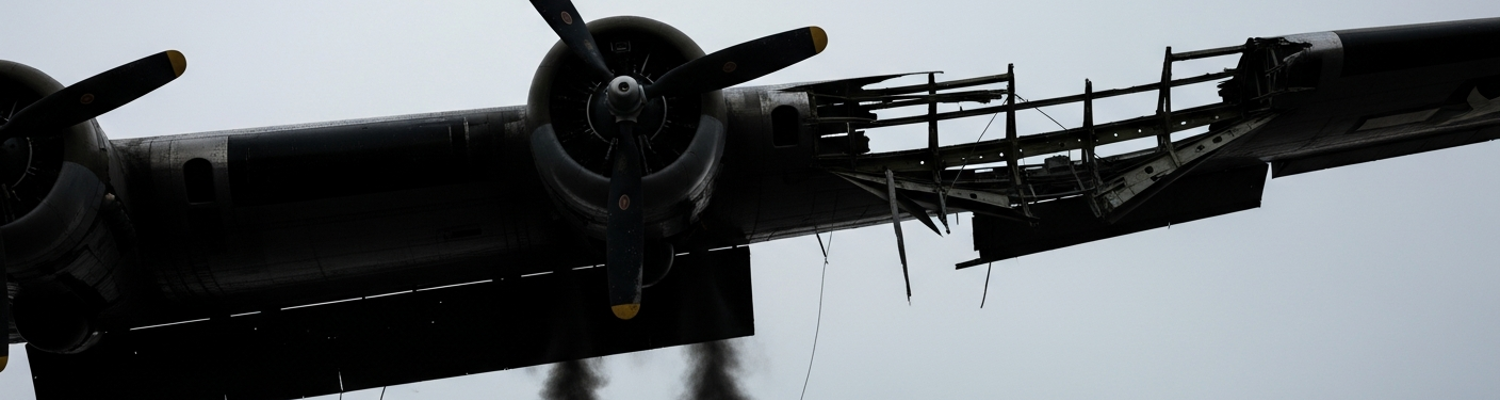
The first indication of failure came as a percussive shock that slammed through the airframe. At 25,000 feet over industrial Germany, a German 88mm anti-aircraft shell detonated just off the right wing. Jagged metal shrapnel tore through the number three engine nacelle. Post-mission damage reports from the Eighth Air Force indicate this was a common point of impact. The hardened steel fragments severed oil lines servicing the Wright R-1820 Cyclone engine. On the flight deck, the crew felt the violent, unnatural shaking through the control yokes. The flight engineer saw the oil pressure gauge for number three plummet to zero as the cylinder head temperature began a terrifying climb. The pilot, fighting the controls as the dying engine created asymmetric drag, gave the immediate command to feather the prop. The procedure was meant to stop the propeller from windmilling, reducing drag and preventing the engine from tearing itself apart.
It was already too late.
The loss of a single engine dropped the bomber out of the combat box, a wounded straggler falling behind the protective screen of its squadron’s guns. This was the moment Luftwaffe pilots waited for. Analysis of German tactical doctrine shows that fighter wings, or Jagdgeschwader, would shadow bomber streams, waiting for flak to isolate an aircraft before attacking. Within minutes, Focke-Wulf Fw 190s pounced. They executed high-speed, head-on passes, a tactic developed to exploit the B-17’s forward defensive weaknesses. Their 20mm cannons opened up, the high-explosive shells designed for maximum structural damage. Several rounds slammed into the right wing’s main spar. The explosive fillers detonated on impact, ripping through the aluminum alloy structure. The crew heard the impacts as deafening metallic cracks, feeling the wing flex violently. The B-17’s durable design could absorb incredible punishment, but German pilots knew that enough concentrated cannon fire on this single structural element could cripple the aircraft.
The main wing spar was now compromised.
On the flight deck, the situation had become untenable. The number four engine, also on the damaged right wing, began to emit a high-pitched metallic grinding. This was the signature of failing bearings within the propeller reduction gearbox, likely shaken loose by the flak blast or cannon strikes. The noise indicated the engine was moments from seizing. The pilot and co-pilot fought the controls, applying full left rudder trim to counteract the drag from the two failing engines. Then, the grinding from the number four engine ceased. It was replaced by a violent lurch as the engine seized. With two engines gone on the same side, the aircraft was now aerodynamically uncontrollable. The bomber began a slow, inexorable roll to the right. The nose dropped, and the aircraft entered the beginning of a terminal dive. The pilot, seeing the ground rush up, gave the final order.
The bail-out bell rang through the fuselage.
The intricate web of electrical and communication wiring running along the fuselage was catastrophically severed. Damage patterns from flak and cannon fire show these bundles were exceptionally vulnerable. A single explosive shell could simultaneously destroy the RC-36 interphone system connecting the ten-man crew and the radios linking the bomber to the formation. For the crew, this meant immediate, total isolation. The pilot could no longer receive damage reports from the rear. They were ten men trapped in separate compartments of the same falling machine. This electronic silence was compounded by the loss of the SCR-274-N command set and the BC-348 liaison receiver. The radio operator’s station was a known point of impact, and its destruction meant no distress call could be sent. The aircraft had become a ghost.
This sudden silence was absolute.
The bomber, its right wing shredded and two engines on that side now dead weight, became unstable. Analysis of B-17 flight characteristics shows that while the aircraft could often limp home on two engines, the loss of both on the same wing created an overwhelming asymmetric drag. The aircraft began a slow roll to the right. The pilot and co-pilot, bracing against their yokes, would have used all their strength applying full left rudder and aileron, but the forces were too great. As the bank angle increased, the nose dropped, and the bomber transitioned into a spiraling, high-speed dive. Inside the fuselage, centrifugal force pinned men to the skin of the aircraft, making movement a desperate struggle. The airframe, never designed for such stresses, began to protest with loud groans and the shriek of tearing metal as G-forces exceeded its structural limits.
Survival was now measured in seconds.
With the aircraft unresponsive, the final command had to be given. Since the interphone was dead, the pilot’s voice was useless. B-17 pilot training manuals show a clear, non-verbal protocol: the A-2 bailout alarm bell. The pilot would have reached for a switch on the instrument panel, triggering a loud, insistent ringing from bells located throughout the fuselage. The signal was unmistakable: one long, continuous ring meant abandon ship. For the crew, this was the start of a frantic, drilled sequence. Men disconnected their oxygen hoses and heated suit wires, grabbed their clip-on AN-6510 chest-pack parachutes, and fought the crushing G-forces to get to an escape hatch. The navigator and bombardier aimed for the nose hatch, the pilots might try to exit through the cockpit’s side windows, and the men in the rear headed for the waist windows or the aft door. Each movement was a battle to escape a spinning, disintegrating trap.
The jarring ring of the A-2 bailout alarm bell initiated a sequence of desperate actions. The centrifugal forces of the aircraft’s spiral pinned them against the bulkheads. Each man had to disconnect from the bomber’s life support, unhooking his oxygen mask and heated suit wires, before reaching for his chest-pack parachute. Crewmen wrestled the heavy packs into position and clipped the harness snaps onto their D-rings, a task made nearly impossible by the G-forces. Then came the exit. They tumbled out into the 20,000-foot-high chaos, a scattering of individuals ejected from their shared steel coffin into the freezing, thin air.
Their survival was not guaranteed.
The descent was a study in contrasts. A violent jerk confirmed the parachute had opened, followed by an abrupt, profound silence. Suspended beneath the silk canopy, each airman was a solitary, slow-moving target. Below, the patchwork of German fields grew steadily larger. The landing itself was another uncontrolled event, with men coming down in farm fields, tangled in trees, or crashing into tile roofs. Disoriented, often injured, and separated, they were now isolated infantrymen in enemy territory with no weapons.
The German response on the ground was methodical. A downed Allied bomber acted as a beacon. The task of capturing airmen fell to a combination of local Wehrmacht patrols, rural police, and Luftwaffe ground personnel. Armed soldiers converged on the landing sites, rounding up the dazed survivors. Each airman was searched for weapons and documents. The brief period of freedom between bailout and capture was over in minutes.
From the field, the captured crew began a journey into a highly organized intelligence-gathering system. The first stop was a local command post before they were handed over to the Luftwaffe. All captured Allied airmen were funneled to a central transit and interrogation center known as Durchgangslager der Luftwaffe, or Dulag Luft, near Oberursel. Here, the initial phase of captivity began. Upon arrival, crewmen were placed in solitary confinement, a psychological tool to breed anxiety. The interrogations that followed were not typically brutal. Debriefing reports from former prisoners reveal that German interrogators were often polite, English-speaking officers who employed sophisticated psychological techniques. An interrogator might present a bogus Red Cross form, asking for squadron numbers and home bases under the guise of notifying next of kin. They often demonstrated deep knowledge of the airman’s unit, creating the impression that resistance was pointless. This was a ruse, built on an extensive card-index system. Allied crews were trained to provide only name, rank, and serial number, but the interrogators at Dulag Luft were masters at turning small talk into valuable intelligence.
Daily existence for a captured Allied airman, now a Kriegsgefangener or “Kriegie,” became a technical problem of survival. Prisoner diaries from camps like Stalag Luft III reveal that German-issued rations were systematically insufficient. The German military provided “non-working” civilian rations calculated to provide approximately 1,928 calories per day, far below the 2,150 needed for an inactive adult male. The diet consisted largely of watery potato soup, coarse dark bread often adulterated with sawdust, and a meager portion of meat roll or sausage. The result was constant hunger and a slow degradation of physical health. One former prisoner, captured at 187 pounds, weighed only 111 pounds upon his liberation after 14 months. Survival became dependent on the arrival of Red Cross parcels. These boxes, containing items like Spam, corned beef, and powdered milk, were a lifeline, but their delivery was erratic. Medical supplies were similarly scarce. Camp infirmaries were poorly equipped, and captured Allied medical personnel had to improvise. A War Department report noted that dental care was unsatisfactory and obtaining eyeglasses was exceptionally difficult. The lack of basic medicines meant minor wounds could become life-threatening.
The psychological attrition of long-term confinement was as damaging as the physical deprivation. The initial trauma of being shot down was followed by the acute stress of interrogation, which then gave way to a chronic, grinding boredom. Debriefing reports show that the primary enemy inside the wire was the monotonous passage of time. The camps were chronically overcrowded; wooden barracks designed for 80 men were often packed with 110 or more. The only private space was a man’s own bunk. To combat the mental strain, the prisoners, primarily resourceful officers, created a complex internal society. They established camp libraries, organized sports leagues, and built theaters that staged sophisticated productions. They published internal newspapers and ran a clandestine radio to receive BBC news. These activities were a deliberate, organized defense against despair and a method of maintaining military discipline.
Under the 1929 Geneva Convention, officer prisoners of war could not be compelled to perform labor. This was a critical distinction from the conditions in other types of Nazi camps. A 1944 U.S. Military Intelligence Service report on Stalag Luft III confirmed that officers were not required to work. This lack of required labor created its own problem: immense tracts of unstructured time. To fill the void, many officers volunteered for tasks. They staffed workshops, making cooking pans from repurposed biscuit tins or weaving brooms from Red Cross parcel cordage. Gardening was also permitted, and though the sandy soil was poor, small individual plots provided a minor supplement to the diet and a significant psychological benefit. This structured, voluntary work was a tool for maintaining a sense of purpose.
The final failure of the B-17 was a cascade. For the crew, the realization that the machine could not protect them dawned in the seconds after bailout. Suspended in silence beneath their parachutes, they were ten isolated men where a single crew had been moments before. The technological promise of the Flying Fortress was a burning wreck spiraling towards the German countryside. The theory of the combat box had been dismantled by Luftwaffe fighter tactics. The machine had failed mechanically and tactically, leaving its human component to its fate.
Their war in the air was over.
A new one was about to begin on the ground.
The psychological impact of captivity began almost immediately but would endure for decades. After capture, airmen entered the closed world of a prisoner of war camp. Studies of former prisoners conducted decades later revealed the deep persistence of trauma, with high rates of anxiety, depression, and insomnia. Even 40 years after the war, a quarter of former POWs reported being bothered by these symptoms. For many, the trauma never ended; studies found that even 65 years after their captivity, veterans still experienced clinical levels of post-traumatic stress disorder. The survivor’s guilt over crewmates who did not survive the shootdown remained a powerful stressor for more than 70 years.
The legacy of these early B-17 crews is written in strategic necessity. During 1943, the odds of a crewman completing his 25-mission tour were just one in four. The catastrophic losses of missions like Black Thursday made it clear that the doctrine of the unescorted heavy bomber was a failure. These losses, amounting to over 25 percent of the attacking force on a single day, forced a halt to deep-penetration raids into Germany. The sacrifice of these crews provided the hard data that forced a change in Allied air strategy. The high cost directly led to the prioritization of developing and deploying long-range escort fighters, most notably the P-51 Mustang. It was only when these fighters could accompany the bombers all the way to the target and back that the air war over Germany could be won. The Eighth Air Force ultimately suffered more than 26,000 dead, approximately half of the entire U.S. Army Air Force’s casualties in the war. The early B-17 crews paid the price for a flawed theory, and their failure forced an adaptation essential for eventual victory.