
Initial CAG Reconnaissance
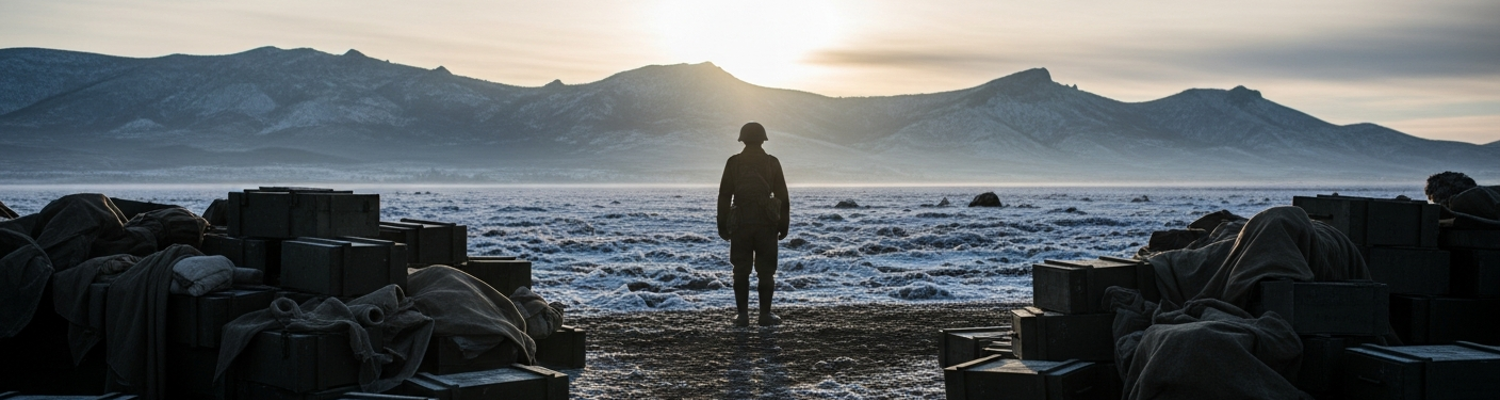
The late autumn rains of 1944 turned the Crimean peninsula into a cold, impassable morass. A churned sea of glutinous black mud, frozen solid by night and thawing into a vehicle-swallowing bog by day, defined the terrain. This was the brutal aftermath of the Soviet offensive that retook the region from German forces in May. The fighting had been savage, compounding years of harsh occupation. Infrastructure across the peninsula, from the Perekop Isthmus to the southern coast, was systematically demolished. Retreating German and Romanian armies, followed by the scorched-earth policies of the Soviets, had left roads cratered and rail lines severed. The major ports of Sevastopol and Yalta were choked with sunken ships and debris. What the fighting had not destroyed, neglect and the elements were rapidly claiming. This was the environment that awaited the first American observers, a landscape stripped bare of function.
Into this desolation came the advance elements of the U.S. Army’s Civil Affairs mission.
A close review of operational logs (NARA Record Group 338) indicates the primary mission of these small, specialized Civil Affairs Group (CAG) reconnaissance teams was to assess the feasibility of hosting the upcoming tripartite conference, codenamed Argonaut. Their arrival was a study in institutional friction. The teams, composed of specialists in public health, engineering, and logistics, landed at the hastily repaired Saki airfield. They were immediately confronted by the two dominant forces in the region: the shattered environment and the unyielding control of the Soviet NKVD.
Transport was the first and most persistent failure point. Standard American two-and-a-half-ton trucks proved almost useless in the deep mud, their tires unable to find purchase. The teams became dependent on their Soviet liaisons for tracked vehicles or the use of local horse-drawn carts. This dependency severely restricted their freedom of movement. Archival evidence shows every request for transport, fuel, or route clearance was a bureaucratic struggle. NKVD minders cited security concerns to deny access to areas deemed sensitive. These areas often included critical infrastructure nodes the teams needed to evaluate, such as water treatment plants and power stations.
The reports filed by these initial CAG teams painted a grim picture for conference planners. The primary rail line from the mainland to Simferopol was inoperable in multiple sectors, with key bridges destroyed. Road travel was hampered not only by mud but by the continued threat of unexploded ordnance. The teams assessed that a massive, immediate engineering effort would be required simply to make the route from the airfields to the proposed conference sites at the Livadia, Yusupov, and Vorontsov palaces passable for the Allied delegations. The public health situation was reported as dire. Water sources were widely contaminated. The civilian population, already suffering from years of deprivation, was on the brink of a humanitarian crisis with outbreaks of typhus and cholera considered an immediate threat. The CAG reports noted the complete collapse of civilian medical services. Beyond the physical devastation, the teams reported on the intangible but pervasive atmosphere of Soviet control. All inspections were chaperoned. All interactions with the local population were heavily monitored by the NKVD. The reports confirmed any American logistical or civil affairs effort on the peninsula would not be a partnership but a subordinate operation, functioning entirely at the pleasure of Soviet authorities.
Crimean Infrastructure Devastation
Operational logs from the advance CAG teams reveal a landscape systematically dismantled. The primary artery for any large-scale movement of personnel and materiel onto the peninsula, the single-track railway running south from the mainland, was functionally nonexistent. Retreating German forces had executed a textbook demolition campaign. At every gorge and waterway, steel truss bridges were severed with precision charges, their superstructures dropped into the ravines below. Entire sections of track bed had been destroyed using specialized 'Schienenwolf' track-wrecker plows, which lifted the rails and simultaneously shattered the wooden sleepers. This left behind miles of twisted metal and splintered wood. Repair assessments noted it was not a matter of patching gaps. Entire bridges needed to be rebuilt from the foundations up, and kilometers of track had to be completely re-laid through terrain still infested with mines.
The roads offered no viable alternative.
What few paved surfaces existed outside the main towns were cratered beyond use for the American trucks, which became hopelessly mired in the freezing mud. For Allied planners, the two primary points of entry by sea, Sevastopol and Yalta, presented an equally grim picture. The port of Sevastopol, fought over for 250 days, was a graveyard of naval and civilian vessels. German demolitions had scuttled blockships in the main channel. Archival photographs show pier facilities, cranes, and warehouse structures as little more than piles of rubble and twisted steel. Yalta’s port, though smaller, was similarly choked. CAG engineering reports detailed the need for extensive salvage and dredging operations simply to clear a single channel for a liberty ship, a task that would require weeks of work and heavy equipment that was not available. Every assessment confirmed the same conclusion: the peninsula was cut off, its circulatory system of rail, road, and port facilities deliberately and effectively severed.
Beyond the wreckage of transport infrastructure lay a catastrophic collapse of basic life-sustaining systems. The destruction was a core component of scorched-earth policies enacted by both retreating German and advancing Soviet forces. Water sources across the region were deliberately contaminated, with retreating units dynamiting wells or dumping animal carcasses into reservoirs. This act turned a public health challenge into an imminent crisis. Reports from the period detail the rapid spread of diseases born from contaminated water and the collapse of sanitation. Typhus, cholera, and dysentery became widespread among the surviving civilian population. The electrical grid was nonexistent. Power stations and transformer substations had been primary targets for demolition teams. This meant no power for water pumps, what few hospitals remained, or the billets being prepared for the Allied delegations. The American mission was faced with the problem of building a functioning enclave from scratch in a territory where the foundations of modern existence had been erased.
Soviet Progress Report Discrepancies
Official Soviet communiqués, issued with triumphant regularity in the lead-up to the Argonaut conference, painted a heroic picture of socialist reconstruction. State-controlled media depicted a peninsula, ravaged by fascist occupiers, being reborn through the tireless efforts of the Soviet worker. These accounts spoke of thousands of laborers, organized into disciplined brigades, clearing rubble and rebuilding critical infrastructure at a pace that defied the harsh winter conditions. Decrees from the Council of National’s Commissars detailed ambitious plans for the immediate restoration of sanatoriums, agricultural systems, and the economy of the entire Crimean region. Reports specifically claimed the main rail lines from the mainland were being rapidly restored. Port facilities at Yalta were being cleared. The imperial palaces designated for the delegations were being returned to their former glory. The narrative was one of overwhelming manpower and revolutionary zeal conquering the devastation of war, a powerful message of resilience intended as much for the coming Allied leaders as for domestic consumption.
This was to be a demonstration of Soviet capacity, a Potemkin village on a peninsular scale.
The findings of the advance Civil Affairs Group teams directly and consistently contradicted the optimistic Soviet progress reports. Where Soviet accounts claimed functional rail lines, CAG engineering assessments documented hastily built wooden trestles replacing demolished steel bridges. These temporary structures were assessed as being incapable of supporting the weight of heavy American locomotives. The track beds were often unballasted, causing rails to shift under even light loads. The official narrative of fully restored palaces clashed with ground-level inspections that found the Livadia, Yusupov, and Vorontsov palaces still in a state of profound disrepair. CAG public health specialists noted a complete lack of potable running water, forcing reliance on untreated local wells. Electrical power was nonexistent. The Soviets installed a patchwork of low-capacity German and American portable generators whose wiring was often dangerously frayed and whose fuel supply was unreliable. Instead of the grandly decorated interiors described in Soviet briefings, American observers found rooms hastily patched with plaster, windows covered with boards or tarps, and a pervasive infestation of lice and other vermin. The thousands of skilled workers lauded in Soviet reports were, in reality, often columns of German prisoners of war and local women performing heavy manual labor with primitive tools, all under the watchful, unyielding eyes of NKVD guards.
This divergence between official Soviet accounts and the ground truth observed by CAG personnel was a calculated feature of the operational environment, managed directly by the NKVD. The difficulty experienced by the American teams was a deliberate instrument of control. Every request for inspection, every query for technical data, was filtered through NKVD channels, which used security as a pretext to obscure deficiencies and manage the Allied perception of their capabilities. Archival evidence shows Soviet officials would present beautifully drafted schematics of fully repaired water and power grids during briefings, even as American engineers on site could plainly see that the systems were inoperative. It was a strategy of asserting dominance through information control, projecting an image of hyper-efficiency while hiding the severe limitations of their post-war industrial and logistical base. The CAG teams found themselves in an undeclared contest, not against a physical enemy, but against a pervasive, bureaucratic wall of deception.
Soviet Bureaucratic Obstruction
Archival evidence from the Argonaut planning files (File Ref: ARG-LOG-7B) reveals a systematic and deliberate campaign of bureaucratic obstruction orchestrated by the Soviet hosts. This was not simple administrative difficulty but a calculated strategy of control, executed on the ground by the NKVD, which held absolute authority over the Crimean peninsula. The American Civil Affairs Group teams, tasked with making the conference sites viable, found their primary opponent was not the shattered terrain, but their Soviet counterparts. Every request for site access was transformed into a protracted negotiation. When CAG engineers sought to conduct foundational assessments of demolished bridges along the critical rail line from Saki, their NKVD liaisons would delay for days, citing vague security protocols or the supposed presence of uncleared German minefields. When access was eventually granted to inspect the Livadia, Yusupov, and Vorontsov palaces, it was often for strictly limited windows of time. This prevented the thorough, room-by-room inspections needed to plan for electrical wiring and plumbing. This tight leash was a tool of perception management; the NKVD actively prevented American specialists from documenting the full extent of the filth, vermin infestation, and structural disrepair that contradicted the official Soviet narrative of heroic restoration.
Every American request, from a jeep to a map, was a negotiation.
This strategy of obstruction extended directly to the sharing of resources. American logisticians had planned to supplement their own equipment with Soviet assets, a reasonable assumption for a joint Allied undertaking. The reality was a near-total refusal to cooperate. Operational logs show repeated American requests for heavy-lift cranes to clear wreckage from the Yalta port, essential for docking the ship that would serve as a communications hub and floating barracks. These requests were consistently denied. Soviet officials claimed the equipment was indispensable for other, higher-priority reconstruction efforts elsewhere. When the Americans asked for access to stockpiles of captured German building materials or local timber, they were stonewalled. The head of the U.S. Military Mission in Moscow, Major General John R. Deane, became deeply frustrated by this pattern, noting in his communications that the Soviets simply could not comprehend giving without taking. This forced American engineering and supply officers into a state of improvisation, scavenging materials from German military boneyards and cannibalizing their own damaged equipment for spare parts.
The most intense friction point became the allocation of basic life-support commodities, particularly fuel. The American contingent brought its own portable generators, crucial for powering everything from lighting in the palaces to the sensitive communications equipment needed by the delegations. The Soviets controlled all fuel depots on the peninsula. The NKVD used this control as a lever, dispensing gasoline and diesel in small, insufficient quantities that forced American officers into a daily struggle for allocations. Records detail how American motor pools were frequently idle and palace restoration work was halted for hours, all for want of fuel that was known to be available but was being deliberately withheld. It was a clear assertion of dominance, reminding the American mission that their ability to function, down to the most basic level, was entirely at the pleasure of the Soviet state.
Disparate Allied Logistical Supplies
The chaotic arrival of American and British supplies at the Saki airfield quickly devolved into a logistical nightmare, a direct consequence of uncoordinated, multi-national procurement. A close review of operational logs shows the material backbone for Operation Argonaut was sourced from disparate, often incompatible, supply systems. The most immediate failures were electrical. American engineers unpacked brand-new portable generators designed to run on the U.S. standard of 110-volt, 60-hertz alternating current. They were fundamentally incompatible with the captured German and Soviet-provided equipment, which operated on a 220-volt, 50-hertz system. The frequency mismatch alone was enough to burn out the motors in sensitive communications gear and water pumps. The problem was compounded by a complete lack of standardized plugs, forcing electrical engineers to spend days in the freezing mud, painstakingly splicing cables and attempting to fabricate crude transformers from scavenged parts.
This was a direct result of parallel, non-communicating supply chains.
The U.S. Army Quartermaster Corps, the U.S. Navy Seabees supporting the USS Catoctin communications ship, and the British Royal Engineers each planned their logistical requirements in a vacuum. This resulted in absurd redundancies and critical omissions. Supply manifests detail the delivery of three separate types of construction-grade lumber, each milled to different dimensional standards, American, British Imperial, and captured German stock, rendering them almost impossible to use together for structural repairs in the palaces. Crates of food rations, shipped from depots as far away as the United States, arrived mislabeled or with their contents spoiled. One documented incident shows a crate marked “Medical Instruments” was opened to reveal tinned sausages, while a nearby pallet labeled “Signal Corps Radio Tubes” contained bags of flour. The absurdity peaked with the need to provision for the specific tastes of the three leaders, a task no standard military procurement system was designed for.
All these disparate supplies were dumped into makeshift staging areas wholly inadequate for the task. The primary depot was little more than an open, windswept field adjacent to the Saki landing strip, where thousands of tons of materiel were exposed to the elements. There were no paved hardstands. Heavy crates of machinery and ammunition quickly sank into the semi-frozen mud, becoming irretrievable. Archival photographs show disorganized mountains of wooden boxes, steel drums, and canvas-wrapped equipment, with no discernible system for inventory or retrieval. Under the watchful eyes of NKVD guards, American supply clerks attempted to create a semblance of order with handwritten signs nailed to wooden posts, but the sheer volume of arriving cargo overwhelmed their efforts. Pilfering was rampant, not only by desperate local civilians but also by Soviet work details who viewed the American supplies as a common resource pool to be exploited for their own reconstruction projects, a practice the NKVD observers made no effort to stop.
Inter-Service Supply Disputes
The U.S. Navy’s arrival created an entirely new dimension of logistical friction. A close review of operational logs shows the amphibious force flagship USS Catoctin dropped anchor in the wreckage-choked harbor of Sevastopol and immediately established a self-contained, Navy-centric world. The ship, a floating communications headquarters and billet for President Roosevelt and his immediate staff, operated with its own supply chain, its own priorities, and its own command structure entirely separate from the U.S. Army’s sprawling and desperate land-based mission.
This created two parallel, and often competing, American logistical operations on the same peninsula.
The fundamental conflict was over port priority. The Army’s Quartermaster Corps, responsible for sustaining the entire land-based effort of thousands of soldiers, engineers, and support personnel, required the port to unload bulk cargo: heavy construction equipment, trucks, fuel drums, and thousands of tons of rations and building materials. Their success was measured in tonnage moved from ship to shore. In contrast, the Navy’s priority was the security and comfort of the Catoctin and the presidential delegation. Archival evidence shows Navy-controlled landing craft and launches were frequently dedicated to moving personnel, diplomatic pouches, and high-priority stores for the ship’s company, while Army cargo ships laden with essential engineering supplies waited offshore for clearance to unload. The Army, looking at the devastated port of Sevastopol, saw a bottleneck for a continental-scale problem. The Navy saw a forward operating base to be secured and maintained for a specific, high-level diplomatic function.
From the ports, the conflict extended inland to the shattered road network. The two services maintained entirely separate motor pools. Records from the period document repeated instances of Army Quartermaster units being denied the use of Navy vehicles. A request from an Army engineering battalion to borrow a two-and-a-half-ton truck to move critical generator parts from Sevastopol to the Livadia Palace became a formal inter-service negotiation. The Navy’s transport assets were reserved for its own personnel and missions, such as moving sailors to and from shore leave or transporting officers between the ship and the conference sites. This forced Army units, already critically short on operational vehicles due to the mud and mechanical failures, to cannibalize their own wrecks for parts or lose days waiting for their own limited transport to become available.
The most acute friction point was the requisition of specific, high-value equipment. The two services operated from different procurement lists, with incompatible parts and machinery. When an Army-installed water pump at the Yusupov Palace failed, a Civil Affairs Group engineer discovered that the Navy’s Seabee contingent attached to the Catoctin had a compatible replacement in their shipboard stores. The Army Quartermaster officer on site was unable to simply acquire it. The request had to be formalized and sent up the Army chain of command, then transferred to the Navy command structure, which had no established procedure for issuing its mission-critical spares to another service. The request was denied. Army engineers were ultimately forced to fabricate a repair using parts stripped from a captured German truck, a field-expedient solution far less reliable than the American-made spare part sitting in a crate less than fifty miles away.
Lavish Conference Accommodations
Logistical manifests for Operation Argonaut reveal a directive that stood in jarring opposition to the surrounding devastation: the creation of opulent, secure enclaves for the Allied delegations. The primary conference site, the Livadia Palace, was to be restored to a state of pre-war grandeur. This was an enormous undertaking. Soviet records document that over fifteen hundred railroad cars carrying building materials, furniture, food, and personnel were dispatched to the peninsula for the conference preparations. The palace itself, damaged during the occupation, required an estimated twenty thousand workdays to repair. American and Soviet personnel worked to restore interiors, but the effort was largely cosmetic. Behind hastily plastered walls and beneath polished floors, the guts of the building were a wreck. There was no functioning plumbing or potable water. A patchwork of American and captured German generators provided unreliable electricity. To create an illusion of imperial splendor, entire suites of furniture, along with fine china, crystal, and linens, were shipped from hotels in Moscow. Vast quantities of luxury foodstuffs, caviar, smoked sturgeon, and premium wines and spirits, were brought in to supply the lavish banquets planned for the leaders.
This was not a restoration. It was the construction of a Potemkin village.
The resources committed to this temporary luxury existed in a state of profound moral tension with the conditions just outside the palace gates. In the months leading up to the conference, the recently liberated Crimean population was in a state of near-total collapse. The Soviet deportation of the Crimean Tatars in May 1944 had ethnically cleansed the peninsula of nearly 200,000 people, leaving their homes and lands abandoned. Those who remained, ethnic Russians, Ukrainians, and others, faced starvation and rampant disease in the wake of years of brutal occupation and the systematic destruction of infrastructure. There was no functioning medical system, and outbreaks of typhus were an immediate threat. American Civil Affairs Group officers on the ground were specialists trained to manage precisely these kinds of humanitarian crises by restoring sanitation, distributing food, and organizing medical care. The official language of the “Declaration of Liberated Europe,” which would be signed at the conference, even spoke of carrying out emergency relief measures for distressed peoples.
The reality of their mission was something else entirely. Instead of providing civilian relief, the CAG officers found their efforts redirected to ensuring the comfort of the coming delegations. Their logistical expertise was used not to distribute medicine but to manage the delivery of bathroom fixtures and liquor. A review of internal communications from the period reveals a deep sense of disillusionment among these officers. They filed field reports detailing the public health emergency and the desperate need for basic supplies among the local population, only to find their observations ignored. These dispatches created a practical and ethical dilemma for the men on the ground, who were forced to hoard medical supplies and food for the exclusive use of the conference attendees while turning away starving civilians.
These uncomfortable reports from the field were systematically suppressed. Higher command, operating under the umbrella of the Office of Censorship, classified or heavily redacted any information that could disrupt the public narrative of Allied unity or embarrass their Soviet hosts. Directives were clear: the focus was the conference. Any documentation of the humanitarian crisis was deemed a distraction that could fuel political criticism back home. The moral conflict experienced by the CAG officers was thus buried under layers of official secrecy. Their reports, which documented the true cost of creating a bubble of luxury in a landscape of human suffering, were filed away, a silent, archival testament to the fractured priorities of the Argonaut mission.
Hearts-and-Minds Public Relations
Declassified directives indicate the entire Argonaut enterprise was conceived as a public relations spectacle. The operational priority was never humanitarian relief for the ravaged Crimean population but the flawless execution of a diplomatic performance centered on great power optics. This directive created immediate and intense inter-Allied friction. American Civil Affairs Group officers, whose doctrine was built around stabilizing civilian populations, were instead ordered to focus exclusively on preparing the insulated luxury of the conference sites. Their expertise in sanitation and public health was not used to combat the typhus threatening the locals, but to ensure that the bathrooms in the Livadia Palace had running water. Logistical capacity was diverted from distributing food and medicine to transporting fine china, crystal, and linens shipped from Moscow hotels. The mission became a source of deep disillusionment for the American specialists on the ground. They were forced to hoard supplies for the delegations while observing a full-blown humanitarian crisis just beyond the palace gates.
This was a performance for a global audience, staged by the Soviets.
The entire operation was documented by a contingent of Allied journalists who became, in effect, well-managed witnesses to a visible failure. Archival evidence of press directives from the U.S. Office of Censorship shows reporters were subject to strict controls from their own governments, alongside the pervasive surveillance of the Soviet NKVD. The official narrative they were expected to report was one of seamless Allied unity and the successful conclusion of a historic conference. Journalists, however, documented a profound sense of confinement and frustration. They could physically see the Potemkin village for what it was. They witnessed the columns of German prisoners of war and local women performing forced labor. They saw the armed NKVD guards who prevented any unauthorized contact with the desperate local population. The contrast between the lavish banquets thrown by the “Big Three” and the gaunt faces of civilians outside was impossible to ignore, yet impossible to report freely.
What they witnessed could not be reconciled with the official story.
This disconnect ensured the total failure of any “hearts-and-minds” component of the American presence. The local Crimean population did not experience the arrival of the Western Allies as a moment of liberation or relief. They witnessed powerful foreigners occupying the palaces of former Tsars, feasting on delicacies while they starved, and operating under the thumb of the same secret police that had terrorized the peninsula for years. For the American press corps, this visible contradiction undermined the very purpose of their presence. They were there to project an image of Allied strength and shared democratic values, but the scene on the ground was one of cynical power politics. The frustration was not just about censorship; it was about being forced to participate in a Soviet-managed propaganda effort that made a mockery of the principles, like those in the newly signed Declaration on Liberated Europe, that the conference was supposed to champion. The enduring image from Yalta was not one of partnership, but of an American mission complicit in projecting a fraudulent image of Soviet strength and beneficence.