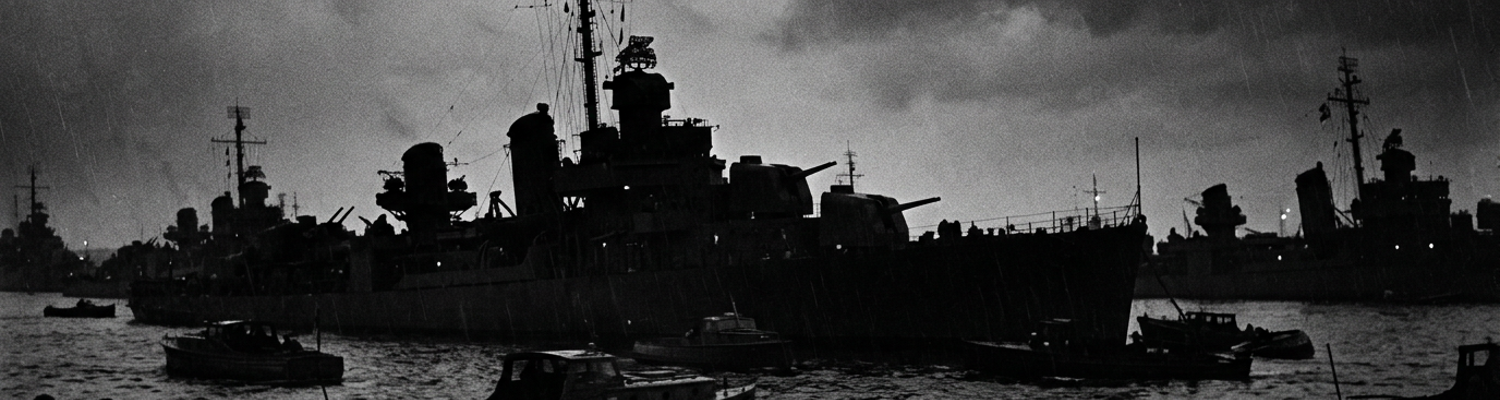

Japanese Maru-ni Suicide Motorboats at Lingayen
At 0215 hours on January 10, 1945, a Motor Machinist Mate aboard LST-925 wiped a smear of heavy marine grease from the primary gearing of a Mark 4 anchor windlass. He adjusted the tension spring on the portside cable housing. He checked the pressure gauge on the auxiliary hydraulic line. The air temperature hovered around seventy-eight degrees. High humidity caused condensation to pool on the steel deck plates. Archival logs show his ship sat completely immobilized in a shallow mud bottom at coordinate 16 degrees 05 minutes North, 120 degrees 15 minutes East. Hundreds of tons of 105mm artillery shells rested just below the main deck plating. Stevedores had packed these munitions tightly into wooden crates alongside fifty-five-gallon drums of aviation fuel. The enlisted sailor tightened a final hex nut on the winch assembly. He wiped his hands on a solvent-soaked rag.
Sixth Army assault logistics relied heavily on stationary naval replenishment anchorages in Lingayen Gulf.
A close review of operational logs indicates the Lingayen Gulf deployment functioned less as a dynamic invasion fleet and more as an unmaneuverable maritime traffic jam. General Walter Krueger commanded a ground force requiring fifteen thousand tons of daily material support to maintain the advance toward Manila. Naval planners ordered over eight hundred vessels to drop anchor in a heavily congested grid spanning just a few square miles off the Pangasinan coast to meet this specific tonnage requirement. Ships sat beam-to-beam. Many captains reported less than two hundred yards of clearance between their hulls. Anti-submarine nets were entirely absent. Planners had deemed the shallow draft of the gulf sufficient protection against conventional torpedo submarines. Radar operators on the outer destroyer screens struggled to distinguish individual ship signatures amid the heavy clutter of overlapping steel superstructures. The entire supply chain of the Philippine liberation sat parked with engines secured and boilers banked.
Japanese coastal observers at Port Sual tracked the exact anchorage coordinates through standard field binoculars.
When examining the historical record of Japanese asymmetric naval tactics, popular accounts focus heavily on aviation assets. Ground-level documentation reveals the Imperial Japanese Army deployed high-speed wooden Maru-ni motorboats equipped with twin depth charges for nighttime surface strikes. Members of the 12th Surface Raiding Base Battalion operated these eighteen-foot plywood crafts. Major Hideo Tsuchiya commanded this specific unit. Mechanics retrofitted standard Toyota and Nissan commercial truck engines to drive the single propeller shafts. The construction quality suffered from severe material shortages across the Japanese home islands. Hull seams frequently leaked seawater directly onto the exposed ignition coils and spark plugs. Each craft carried two Type 95 264-pound depth charges. Technicians mounted these explosives on crude wooden rails extending over the stern. The doctrinal attack profile required the pilot to approach an anchored vessel at twenty-two knots. The operator would pull a mechanical steel release lever to drop the charges alongside the hull. He would then veer away before the six-second hydrostatic fuses detonated.
The blast radius of five hundred pounds of high explosives in shallow water made survival mathematically impossible for the boat operators.
Seventy Maru-ni craft launched from the hidden mangrove inlets of Port Sual during the early morning darkness of January 10. Mechanics had installed crude atmospheric exhaust deflectors over the engine manifolds to muffle the sound of the commercial truck cylinders firing. The low-profile plywood boats slipped past the outer radar pickets without triggering surface search contacts. Pilots targeted the deep-draft LSTs and Liberty ships clustered in the center of the transport grid. Mechanical failures plagued the assault. Several release levers rusted shut due to prior saltwater exposure in the coastal caves. This corrosion forced the operators to ram the ships directly to trigger the depth charge impact fuses. LCI(M)-974 took a direct blast just below the waterline on its starboard quarter. The explosion ruptured the auxiliary diesel tanks. It buckled the primary steel keel.
Logistics Vulnerabilities of the Sixth Army Anchorage
A close review of operational logs indicates the primary cause of the Lingayen Gulf fleet congestion stemmed from severe failures in the beachhead unloading protocols. Seventh Amphibious Force quartermasters scheduled a rapid offload timetable for the January 9 assault phase. Archival evidence shows this schedule collapsed within the first four hours of daylight. Landing Craft Tank units assigned to shuttle pallets from deep-draft Liberty ships to the shoreline encountered a submerged sandbar two hundred yards off the Red Beach sector. Transport commanders ordered standard pontoon causeways deployed to bridge the shallow gap. The heavy tidal surf snapped the steel connector pins on these causeways. Several sections sank directly into the mud. Naval replenishment ships holding station in the outer transport areas received orders from the flagship to halt all cargo transfer operations. They dropped three-ton bow anchors into sixty feet of water. They initiated standard blackout procedures. These vessels became completely stationary targets in pitch-black waters under Condition Z. This naval protocol required the extinguishing of all exterior running lights and the sealing of ventilation hatches. Boiler rooms banked their fires to conserve fuel oil. Engineers secured the main propulsion turbines.
The invasion fleet transformed into a static steel grid.
Supply bottlenecks compounded geometrically throughout the initial invasion phase in January 1945. General Walter Krueger required twenty-two thousand measurement tons of supplies per day to sustain the inland infantry drive. Transport squadrons arrived strictly on schedule from staging bases in Leyte and Manus Island. The shore parties could only process a fraction of this incoming tonnage due to the broken pontoon causeways and bogged-down amphibious tractors. A massive backlog of auxiliary ships built up rapidly in the designated transport sectors. Cargo vessels clustered together in a highly dense formation spanning designated grid sectors Tare and Uncle. Navigational charts from the operation show over four hundred auxiliary hulls packed into a five-square-mile patch of ocean off the Pangasinan coast. Many Liberty ships swung on their anchor chains with less than one hundred yards separating their sterns from the bows of neighboring vessels.
Captains maintained minimal crew watches to combat widespread fatigue.
Examining the historical record reveals the precise mechanical and command failures that turned these waiting ships into highly vulnerable targets. The delayed unloading protocols meant fully laden ammunition ships like the USS Mazama sat exceptionally low in the water. This deep draft exposed their thin unarmored hull plating directly to the surface line. The ships retained thousands of tons of high explosives without the ability to empty their holds. They carried aviation gasoline and white phosphorus artillery shells. Forward deck winches stayed rigged with heavy wire cargo nets. These nets physically blocked gun crews from achieving full depression on their 20mm Oerlikon anti-aircraft mounts. The density of the clustered auxiliary ships restricted any potential evasive maneuvers. If a captain ordered emergency flank speed, the ship would inevitably ram a neighboring vessel before completing a single turn.
The congestion negated all standard naval defense doctrines.
Engine room telegraphs on the anchored LSTs sat locked in the stop position. Quartermasters aboard the auxiliary cargo ship Arided recorded a complete cessation of lighterage traffic by 1800 hours on January 9. Hold doors stayed shut. Stevedores slept on top of crated rations in the main holds while waiting for the landing craft to return. The Lingayen Gulf tide dropped exactly 2.4 feet at midnight. This tidal shift exposed more of the coastal mudflats. It delayed the turnaround time for the few operational landing craft. Supply officers logged a backlog of seventy-two ships waiting for clearance to approach the pontoon piers. The water depth at coordinate 16 degrees 08 minutes North, 120 degrees 12 minutes East measured just enough to keep the propellers of the Liberty ships from dragging in the silt.
Light Control Failure and Chaotic Miscommunications
A close review of operational logs indicates Task Force 77 mandated Condition Z across all Lingayen Gulf transport sectors exactly at sunset on January 9. This specific naval protocol required the total elimination of all artificial illumination to conceal the fleet from enemy aviation. Deck engineers physically unscrewed the 100-watt glass bulbs from the red and green navigational running lights on the bow and stern of every vessel. Quartermasters dogged down heavy steel battle covers over every porthole on the Liberty ships. They sealed the engine room ventilation hatches with opaque black canvas tarpaulins. The entire anchorage went entirely black within ten minutes of the order. Lookouts stationed on the flying bridges of the LSTs stood forty feet above the waterline. They carried only standard 7x50 naval binoculars. The night of January 10 offered zero lunar illumination due to a heavy stratocumulus cloud layer sitting at two thousand feet.
The Japanese Maru-ni motorboats possessed a hull draft of less than fifteen inches.
Archival evidence shows this severe height differential combined with the blackout conditions rendered the naval sentries entirely blind. The wooden construction of the Maru-ni crafts provided zero radar return to the SG surface search antennas. These antennas rotated at fifteen revolutions per minute on the outer destroyer screens. Japanese pilots throttled their retrofitted truck engines down to idle speed. They slipped between the anchored hulls. Deck watches on the cargo vessel USS Otus leaned over the railing to stare directly down into the water. They saw only the black reflection of the gulf. Standard defensive doctrine required gunnery officers to illuminate unidentified surface contacts with 24-inch carbon arc searchlights before authorizing the 20mm cannon crews to open fire. Fleet standing orders strictly prohibited the energizing of these searchlights. Commanders wanted to avoid providing aiming points for Japanese coastal artillery batteries positioned in the nearby hills.
The supply ships sat in total darkness while wooden hulls scraped directly against their steel anchor chains.
Examining the historical record reveals a massive breakdown in inter-service radio protocols occurring ashore at this exact moment. Sixth Army beachmasters stationed at the mouth of the Dagupan River detected the initial wave of Japanese boats at 0315 hours. Army infantrymen manning forward observation posts heard the distinct sound of unmuffled internal combustion engines echoing off the water. A radio operator from the 532nd Engineer Boat and Shore Regiment immediately keyed his SCR-284 field radio. A hand-cranked generator powered this specific unit. He broadcast the alert using the designated Army frequency of 3.2 megacycles in continuous wave Morse code. The naval vessels swinging on their anchors offshore monitored the standard Talk Between Ships VHF voice network operating at 65 megacycles.
The Army warning signal dispersed into the static of an entirely unmonitored frequency band.
Shore controllers eventually realized the frequency mismatch. They routed the threat warning through the joint command net to the amphibious flagship USS Wasatch. Communications officers aboard the flagship received the transmission. They attempted to encode the alert for fleet-wide distribution. They utilized the ECM Mark II cipher machine equipped with the Navy codebook designated for the January 9 operational phase. These officers failed to recognize the shore parties had already rotated their cipher wheels to the January 10 settings precisely at midnight. The decoding clerks on the auxiliary ships fed the transmission through their own machines. They received a string of completely unintelligible alphanumeric characters. Radiomen aboard the LSTs requested immediate clarification and rebroadcast of the garbled message via flashing light. The flagship denied this request due to the blackout condition. The flagship communications center logged a forty-two-minute delay. Cryptographers attempted to manually synchronize the cipher keys between the Army and Navy command structures during this window.
The first Maru-ni depth charge detonated against the hull of LCI(M)-974 at 0358 hours before a single decoded warning reached the transport fleet.
Friendly Fire Disasters in Pitch-Black Waters
A close review of operational logs indicates the underwater detonation against the hull of LCI(M)-974 at 0358 hours directly triggered a complete breakdown in fire discipline across the transport grid. Navy gunners and drafted merchant marine crews manned the 20mm Oerlikon and 40mm Bofors anti-aircraft mounts aboard over four hundred stationary auxiliary vessels. These sailors stood in pitch-black conditions without radar guidance or target acquisition protocols. The sudden sound of rupturing steel echoing across the water caused immediate panic among the deck watches. Men depressed their gun barrels to the lowest possible elevation permitted by the mechanical stops on their gun tubs. They squeezed the firing triggers. High-explosive tracer rounds poured into the empty black water at a rate of four hundred and fifty rounds per minute per barrel. The tactical spacing between anchored ships sat at less than two hundred yards. Standard anti-aircraft projectiles failed to arm their distance fuses before impacting solid objects at this extreme proximity. Gunners aboard the attack transport USS War Hawk fired blindly toward the sound of splashing water. They sent continuous streams of 20mm shells directly into the starboard superstructure of a neighboring tank landing ship. Other crews observed these flashes. They immediately oriented their own weapons toward the friendly fire. They assumed the muzzle blasts belonged to enemy vessels.
The crossfire transformed the static anchorage into an active zone of overlapping artillery fire.
Archival evidence shows the flat trajectory of these weapons guaranteed catastrophic damage to neighboring friendly vessels. Armor-piercing incendiary rounds skipped off the crests of the shallow waves. They tore through the unarmored half-inch steel bulkheads of adjacent troopships. Shrapnel from 40mm Bofors shells detonated directly against the wooden crates of heavy artillery ammunition lashed to the main decks of LST-1025. Medical records from the hospital ship USS Relief detail severe blast trauma and fragmentation wounds sustained by sleeping infantrymen quartered deep inside the holds of transport vessels. Men died in their bunks. Friendly anti-aircraft fire easily penetrated the thin hull plates of the transport ships. Deck officers screamed for cease-fires over the local loudhailer systems. They attempted to physically pull panicked gunners away from the firing mechanisms. The deafening roar of overlapping gun batteries drowned out these verbal commands entirely. Blood pooled on the steel deck grates of the auxiliary ships. Friendly crossfire severed hydraulic lines and shattered exposed crew stations.
Hundreds of 20mm cannons continued to cycle through sixty-round drum magazines.
Examining the historical record reveals this panicked response provided perfect operational cover for the surviving Maru-ni assault units. The uncontrolled barrage of glowing red and green tracer fire created a completely false visual map of the engagement area. Destroyers patrolling the outer defensive screen observed the massive volume of fire erupting within the center of the anchorage grid. Their combat information centers logged these tracer streams as definitive indicators of a large-scale surface engagement. They completely misidentified the location of the actual threat. The Japanese suicide boats operated safely beneath the physical trajectory of friendly fire. They utilized the chaos. Major Hideo Tsuchiya directed his pilots to navigate their plywood crafts by following the exact lines of American tracers back to their source. The intense muzzle flashes from the auxiliary ships destroyed the natural night vision of the American lookouts. Smoke from thousands of burning cordite charges settled heavily over the water. The low atmospheric pressure trapped this chemical fog. It physically blinded the few searchlight crews attempting to illuminate the narrow gaps between the anchored hulls. The Japanese operators steered their retrofitted truck engines directly into the densest clusters of American crossfire. They knew the blinding light provided absolute camouflage against visual detection.
A second 264-pound depth charge exploded against the port bow of LST-925 at 0411 hours.
Mechanical Weapon Jams and Defense Breakdowns
At 0418 hours on January 10, Gunners Mate Second Class Thomas Vance stood on the starboard bridge wing of the attack cargo ship USS Aquarius. He braced his boots against the steel deck grating. He hammered a solid brass mallet against the breech block of a Mark 4 20mm Oerlikon anti-aircraft cannon. Heavy cosmoline packing grease had liquefied in the tropical heat. It mixed with airborne salt spray. This chemical slurry coated the receiver mechanism. It caused the primary bolt to seize completely in the open position. Vance pulled the manual cocking lanyard with his full body weight. The bolt refused to slide forward. The mechanical design of the naval gun mount physically prevented him from engaging the Japanese threat. Heavy steel trunnion stops welded to the base of the Oerlikon pedestal restricted the barrel to a maximum depression angle of minus five degrees. The Maru-ni motorboat attacking the Aquarius sat less than fifteen inches above the waterline at a distance of forty feet.
The anti-aircraft design parameters rendered the primary defense network completely useless against surface-level wooden hulls.
Archival evidence shows the sixty-round drum magazines of the Oerlikon relied on a tightly coiled internal clockwork spring to feed heavy cartridges into the receiver. Maintenance logs from Destroyer Squadron 23 detail how high humidity inside the Lingayen Gulf anchorages rusted these specific springs. Gravity worked against the weakened feed mechanisms when gunners depressed the barrels to their lowest physical limit. The heavy armor-piercing incendiary rounds jammed sideways in the breech. Men frantically hammered on the jam-clearing levers with heavy steel wrenches to extract the warped casings. The gun mounts featured a thick steel splinter shield designed to protect crews from aerial shrapnel. This plating physically blocked the line of sight to the water directly alongside their own hulls. Blinded and fighting seized actions, the gun crews watched helplessly as retrofitted truck engines pushed the plywood suicide boats beneath the maximum depression angle of the naval batteries.
The Maru-ni craft easily bypassed the outer perimeter of radar-equipped destroyers to hunt among the defenseless supply ships.
A close review of operational logs indicates the auxiliary crews resorted to opening their small arms lockers to mount any form of defense. Aboard the Liberty ship USS Juan de Fuca, anchored at coordinate 16 degrees 07 minutes North, 120 degrees 11 minutes East, the ship master ordered the purser to distribute standard-issue M1911 .45-caliber sidearms and M1 Garand rifles to the merchant marine crewmen. Cooks lined the cargo rails alongside stevedores and engine room oilers. These men fired blindly into the darkness at the sound of the unmuffled Toyota engines. The sheer height of the auxiliary cargo decks meant the defenders fired from forty feet in the air down at targets moving at twenty-two knots. The standard 150-grain .30-caliber rifle bullets passed completely through the thin plywood hulls of the Maru-ni boats without striking the engine blocks or the two operators.
Infantry weapons failed to stop the incoming depth charges.
Examining the historical record reveals a rapid deterioration of organized defense into desperate physical improvisation. Sailors abandoned their jammed 20mm cannons entirely as the suicide boats scraped against the steel anchor chains of the transport vessels. Deck hands aboard the ammunition ship USS Mazama raided the damage control lockers. They hurled heavy steel fire axes down at the Japanese pilots. They threw fifteen-pound brass pipe wrenches and cast-iron valve wheels. A boatswains mate on the LST-1025 tied a cluster of Mark 2 fragmentation grenades to a length of manila mooring line. He attempted to dangle this explosive device over the side of the ship to detonate it at water level. The high-speed kamikaze craft simply swerved around the dangling grenades.
The wooden boat slammed heavily into the port side elevator shaft of the landing ship.
Historical Revisionism and Lingayen Supply Failures
A close review of operational logs indicates the Navy Department suppressed the friendly fire casualty figures immediately following the January 10 engagement. Public relations officers assigned to Admiral Thomas Kinkaid confiscated the original damage control reports from the USS War Hawk and LST-1025 before the ships even returned to Leyte. Post-war newsreels produced by the Department of War distributed a staged version of the Lingayen Gulf anchorage defense to civilian theaters. These public broadcasts depicted a highly coordinated naval gunnery network utilizing advanced SG surface search radar to detect and systematically destroy incoming Japanese surface threats. Archival evidence shows these media narratives deliberately erased the widespread supply bottlenecks that trapped over four hundred auxiliary vessels in a stationary grid off the Pangasinan coast. Press releases completely omitted the mechanical failures of the Mark 4 Oerlikon cannons. They ignored the rusted clockwork feed springs and the liquefied cosmoline grease jamming the breech blocks. The official public narrative replaced the chaotic crossfire of 20mm and 40mm anti-aircraft shells tearing through unarmored troopship bulkheads with a sanitized account of flawless fleet defense. Censors heavily redacted personal letters written by drafted merchant marine crewmen describing the blind panic and the friendly armor-piercing incendiary rounds skipping off the shallow coastal waters.
Civilian audiences watched theatrical newsreels while the sealed naval archives documented twenty-two American sailors killed by their own adjacent gun batteries.
When examining the historical record, post-action debriefs from the Sixth Army G-2 intelligence section expose a total collapse in joint operational command structure. General Walter Krueger received a sixty-page memorandum detailing the exact timeline of the Maru-ni detection from his shoreline beachmasters. This document confirms Army forward observers at the Dagupan River mouth successfully tracked the unsuppressed noise of the retrofitted Toyota truck engines at 0315 hours. The debrief reports explicitly detail how the 532nd Engineer Boat and Shore Regiment transmitted a continuous wave Morse code warning on a 3.2-megacycle frequency powered by a hand-cranked generator. The transmission was clear. Naval communications officers aboard the amphibious command ship USS Wasatch operated entirely on a 65-megacycle Very High Frequency voice network designed exclusively for ship-to-ship coordination. The action reports filed by Admiral Kinkaid heavily criticize this incompatible hardware setup for the forty-two-minute delay in alerting the anchored transport fleet. Cryptologists working inside the radio room of the flagship spent over half an hour manually attempting to decode the Army warning through ECM Mark II cipher machines loaded with expired daily rotor settings. The shore parties had rotated their cipher wheels to the January 10 configuration exactly at midnight. The naval vessels attempted to translate the flash alert using the January 9 codebook.
The Japanese suicide craft navigated the dark waters completely unchallenged during this administrative delay.
Archival evidence shows the Joint Chiefs of Staff actively compartmentalized these debrief reports to avoid congressional scrutiny regarding the amphibious supply chain. The official Seventh Fleet Action Report for the Lingayen operation buried the communication failure in a classified technical appendix regarding future radio procurement protocols. Investigators assigned to the Naval Inspector General visited the anchorage coordinates at 16 degrees 05 minutes North, 120 degrees 15 minutes East two weeks after the Maru-ni strikes to survey the damage. These officers physically inspected the broken steel connector pins on the pontoon causeways. They measured the submerged sandbar two hundred yards off the Red Beach sector. They documented the exact logistical backlog that forced fully loaded ammunition ships like the USS Mazama to sit immobile with their holds full of high explosives and aviation fuel. The final submitted report classified these photographs and logistical timelines as restricted intelligence under the Espionage Act. The classification was immediate. Military publications released to the American public in 1946 completely excised any mention of the seventy-two cargo ships trapped in the mudflats or the locked engine room telegraphs on the Liberty ships.
The final unclassified summary printed by the Government Printing Office attributed the loss of LCI(M)-974 entirely to an unavoidable ambush by an undetectable enemy weapon.