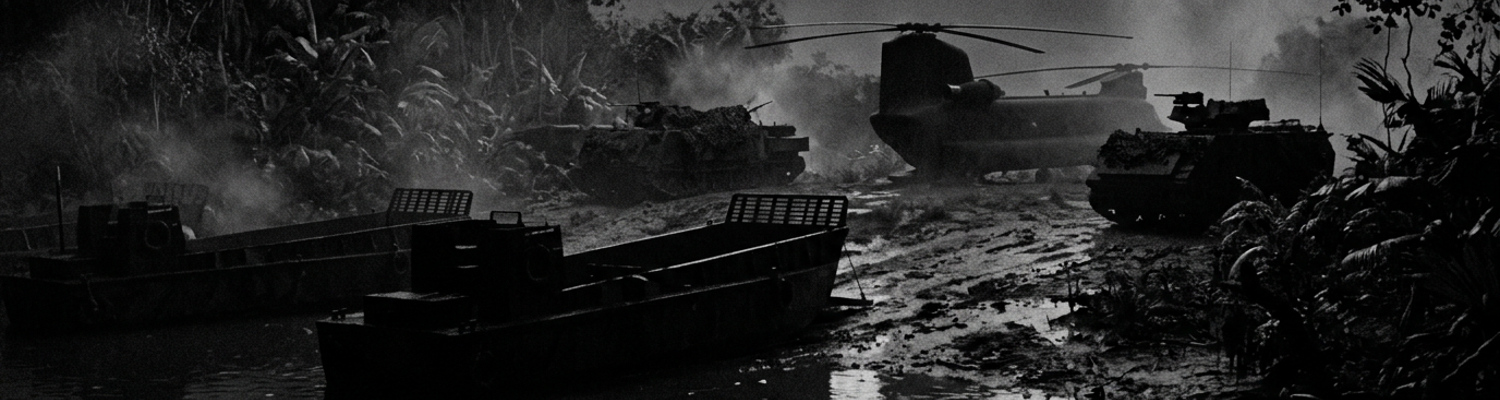

Operation VICTOR V Riverine Probes
The overland advance up Highway 1 collapsed the moment Japanese combat engineers detonated the concrete bridges spanning the coastal ravines. X Corps command immediately scrapped the frontal assault timetable. Elements of the 24th Infantry Division found themselves crammed into the steel wells of Landing Craft Mechanized and Landing Craft Vehicle Personnel units. These shallow-draft vessels belonged to the 533rd Engineer Boat and Shore Regiment. Eighth Army launched these deep penetration riverine probes along the Mindanao River in April 1945. They attempted to outflank the Japanese 30th Division. The Rio Grande de Mindanao was a muddy waterway overgrown with dense triple-canopy jungle. This vegetation severely restricted the maneuverability of the flotilla. Diesel engines overheated as the 533rd pushed against the current. Coxswains fought both the water and the sheer weight of infantry equipment loaded beyond standard capacity.
Japanese 75mm field guns and hidden Type 92 heavy machine-gun nests raked the unarmored bulkheads from elevated riverbanks.
Archival evidence shows that daylight close air support proved highly ineffective against camouflaged shore batteries hidden beneath the dense foliage. Shrapnel tore through the thin steel of the landing craft. It mixed with the thick smell of river mud and burning fuel. Enlisted men huddled below the gunwales. They depended entirely on suppressing fire from the rivercraft's exposed .50 caliber mounts. The 533rd navigated entirely by compass and dead reckoning. They pushed deep into hostile territory where any engine stall resulted in immediate drift into the enemy-held shore. Submerged logs and sandbars hid beneath the brown water. These obstacles caused frequent groundings. Stationary boats became immediate targets for mortar crews zeroed in on the river bends.
Survival relied entirely on nocturnal air cover.
A close review of operational logs indicates the survival of the riverine flotilla depended on P-61 Black Widow night fighters. Squadrons like the 419th Night Fighter Squadron operated out of Moret Field in Zamboanga. They flew directly into the river valley after dusk. The Northrop-designed interceptors featured a 66-foot wingspan. Twin Pratt & Whitney R-2800 Double Wasp engines powered the heavy airframes. Radar operators seated in the rear compartment manipulated the SCR-720 radar arrays. They struggled to separate the radar signatures of Japanese artillery positions from the heavy ground clutter of the twisting riverbanks. Cathode-ray tubes frequently displayed false returns due to the high tropical humidity. Airborne crews relied heavily on the visual identification of enemy tracers.
Pilots dropped to dangerously low altitudes.
Black Widows skimmed just above the jungle canopy at 250 miles per hour to confirm the muzzle flashes of enemy guns. Target acquisition triggered the release of four 20mm Hispano M2 cannons and four .50 caliber Browning machine guns. Concentrated firepower shredded the tree lines. The high-explosive rounds silenced the Japanese batteries before they could range the slow-moving engineer boats below. Heavy armor plating on the Black Widows absorbed return fire from small arms. Pilots made multiple passes over the same entrenched positions. Boat commanders communicated using SCR-300 backpack radios. They vectored the P-61s toward suspected ambush sites along the blind curves of the Mindanao River. Strafing runs dropped thousands of hot brass casings directly onto the decks of the landing craft. Men of the 24th Infantry Division listened to the deep drone of the R-2800 engines circling overhead in the pitch black. Twin engines masked the sound of the approaching landing craft. This acoustic interference degraded the Japanese ability to coordinate defensive fire.
Nocturnal River Landing Casualties
The primary flanking timetable disintegrated at 2140 hours. The lead LCVP of the 533rd Engineer Boat and Shore Regiment slammed into a submerged mahogany trunk at a blind bend near Tamontaka. Gray Marine 6-71 diesel engines seized as the twin-disc marine gear violently locked. Sudden impact threw thirty fully loaded infantrymen of the 24th Infantry Division against the steel bow ramp. Enlisted soldiers navigated chaotic river networks under pitch-black jungle conditions. They remained entirely blind to the muddy banks closing in on both sides of the Rio Grande de Mindanao. Triple-canopy foliage completely blocked out ambient moonlight. Coxswains strained over the wooden helms of their unarmored craft. They attempted to read magnetic compasses that spun wildly due to the concentrated iron of the infantry weapons packed into the troop wells. Water rushed over the gunwales. Ruptured fuel lines flooded the floorboards with slick liquid.
The 533rd lost all visual contact with the shoreline by 2215 hours.
When examining the historical record, dead reckoning proved mathematically impossible against the unpredictable four-knot current of the inland waterway. Boat commanders relied on faint silhouettes of the tree line against the slightly less dark sky. They maintained their heading upriver toward Fort Pikit. Submerged sandbars frequently caught the shallow-draft vessels. Crews reversed thrust and violently revved the engines to break free from the suction of the riverbed. Aggressive mechanical noise echoed up the ravines. This completely nullified any element of surprise. Infantrymen sat shoulder-to-shoulder in the damp steel wells. They clutched M1 Garand rifles coated in waterproof cosmoline. Abrasive river grit quickly mixed with the protective grease. High tropical humidity trapped the engine exhaust at the water level. Men inhaled concentrated carbon monoxide and diesel fumes for hours on end. Fresh water cooling pumps on the LCMs clogged with river silt. Engine block temperatures spiked past safe operating limits.
A fouled rudder cable sent one landing craft drifting sideways into the dense mangrove roots.
Nocturnal insertion teams faced immediate ambushes and extreme psychological strain during riverine landings. Elements of the Japanese 30th Division waited in camouflaged spider holes dug directly into the elevated riverbanks at Peidu Pulangi. Type 92 heavy machine guns opened fire at a range of less than fifty yards. These weapons sent 7.7mm armor-piercing rounds tearing straight through the three-quarter-inch plywood and thin steel bulkheads of the passing landing craft. Hot shrapnel and splintered wood showered the enclosed troop compartments. Muzzle flashes temporarily blinded the American boat crews. Sudden illumination destroyed their night vision. The flotilla plunged into complete sensory chaos. Overlapping reports of Japanese 75mm mountain guns firing at point-blank range drowned out the shouted orders of the platoon leaders. Enlisted men could not return fire without risking friendly hits on the other boats navigating the tight formation.
Geysers of brown river water erupted over the gunwales.
Artillery shells detonated just below the surface. Psychological strain compounded rapidly as the ramps finally dropped into the fast-moving water. Infantrymen charged forward into total darkness. They expected solid ground. They instead plunged into neck-deep mud pits heavily seeded with sharpened bamboo stakes. The sheer weight of their sixty-pound combat packs dragged several men straight to the bottom of the river. Overhead, the twin R-2800 Double Wasp engines of the supporting P-61 Black Widows generated a pulsating physical vibration. Aircraft fired 20mm high-explosive incendiary rounds into the tree line just thirty yards ahead of the landing elements. Hundreds of ejected brass shell casings rained down from the sky. They struck the helmets and exposed skin of the soldiers attempting to establish a perimeter in the flooded marshland. Radio operators carrying eighty-pound SCR-300 backpack transceivers fought to keep their antennas above the waterline. The 24th Infantry Division secured a fifty-yard beachhead at coordinates 07°13'N 124°33'E by deploying Browning Automatic Rifle suppression fire directly into the muzzle flashes of the Japanese emplacements.
Quartermaster Supply Line Collapse
A close review of operational logs indicates the Eighth Army supply chain fractured completely along the twenty-mile stretch of unimproved track between Parang and the river basin at Cotabato. Elements of the 542nd Quartermaster Battalion attempted to push convoys of heavily loaded GMC CCKW two-and-a-half-ton cargo trucks through the flooded jungle tracks. Extreme tropical humidity hovered constantly at ninety-eight percent. This saturated environment turned the red clay of Route 1 into a deep adhesive sludge. Mud instantly filled the tire treads of the passing vehicles. Axle shafts snapped under the extreme torque as drivers slammed their manual transmissions into low gear. Heavy rain washed away the timber corduroy roads built just hours earlier by combat engineers. Cardboard ammunition sleeves dissolved into wet pulp inside the cargo beds. Wooden crates swelled rapidly in the damp heat. Steel binding bands snapped. Loose mortar shells spilled directly into the corrosive mud.
The 542nd Quartermaster Battalion abandoned twenty-three completely immobilized trucks in a single afternoon.
Commanders at X Corps headquarters reacted to the inland route collapse by redirecting all available cargo aircraft. They supported the isolated infantry units holding the forward river perimeters. Fifth Air Force C-47 Skytrain crews flying out of Tacloban dropped pallets of .30 caliber ammunition and medical plasma directly into the jungle canopy. Heavy canvas cargo parachutes frequently snagged in the upper branches of 150-foot tall dipterocarp trees. Enlisted quartermasters hacked through dense underbrush with machetes. They recovered rusted cans of C-rations that had burst open upon impact with the ground. This aggressive shift in aerial delivery priorities instantly severed the resupply pipeline for specialized maintenance units operating in the rear echelons. Technical aviation equipment sat stranded on the loading docks at Leyte for weeks.
Canvas tarpaulins rotted off the forward supply dumps within forty-eight hours.
Archival evidence shows this logistical breakdown in the interior caused an immediate cascade failure at the forward airfields. Mechanics belonging to the 419th Night Fighter Squadron at Moret Field near Zamboanga faced a severe shortage of specialized electronic components. Essential maintenance supplies failed to reach the tarmac. Ground crews found themselves operating completely without Type IV silica gel desiccant packs. These simple chemical absorbers provided the only defense against the extreme tropical moisture infiltrating the highly sensitive electronics of the P-61 Black Widow night fighters. The complex SCR-720 radar arrays housed inside the fiberglass nose cones of the interceptors required a completely dry operating environment to function. Moisture condensed rapidly on the delicate glass surfaces of the cathode-ray tubes. High-voltage magnetrons began to arc directly against the damp aluminum bulkheads of the aircraft. Dielectric breakdowns occurred across the unsealed terminal blocks.
Water pooled inside the primary copper waveguides.
Outgoing radio frequencies distorted into useless static. The absence of these standard desiccant packs grounded entire squadrons of heavy interceptors. Crew chiefs attempted to dry the complex wiring harnesses using the intense exhaust heat generated by the R-2800 Double Wasp engines. Ground personnel routed flexible canvas ducting from the engine stacks directly into the open radar compartments. This improvised drying method subjected the delicate electronics to extreme temperature fluctuations. Intense heat melted the protective rubber insulation straight off the main coaxial cables. Bare copper wiring corroded green overnight due to the salt air blowing across the runway from the Sulu Sea. Airborne radar operators lost the physical ability to distinguish the radar signatures of Japanese shore batteries from the heavy ground clutter of the dense mahogany forests.
SCR-720 Radar Corrosion and Failure
A close review of operational logs indicates the total loss of airborne tracking occurred at 2314 hours over coordinates 07°15'N 124°30'E. Flight Officer David Kendall sat locked inside the rear compartment of a P-61 Black Widow. He stared at a sudden blinding flash of green light across his primary cathode-ray display. The heavy interceptor banked sharply at 200 feet above the Rio Grande de Mindanao. Dense jungle canopy rushed past the Plexiglas canopy in absolute darkness. Kendall twisted the gain control knobs on the SCR-720 radar console. His equipment responded with the sharp smell of burning electrical insulation. High-voltage arcing echoed from the fiberglass nose cone directly ahead of the cockpit. The Western Electric 720A magnetron had violently short-circuited. This component generated the high-frequency microwaves required to map the terrain below. Its catastrophic failure instantly severed the crew's ability to track the Japanese Type 92 heavy machine-gun nests targeting the 533rd Engineer Boat and Shore Regiment landing craft. The pilot wrestled the twin Pratt & Whitney R-2800 engines into a steep climb. He avoided colliding with the unseen mahogany trees lining the riverbanks.
Ambient atmospheric moisture completely disabled the primary targeting array in less than three seconds.
Archival evidence shows the root cause of this electronic collapse originated on the supply docks at Leyte. Cargo planes prioritizing medical plasma and small arms ammunition completely bumped specialized chemical absorbers from the flight manifests. Quartermasters failed to ship standard Type IV silica gel desiccant packs to the forward airstrips at Moret Field. These basic chemical absorbers functioned as the sole defense against the ninety-eight percent ambient humidity characterizing the Mindanao interior. Without the required packaging, the saturated tropical air easily penetrated the unsealed fiberglass radomes of the P-61 interceptors parked on the pierced steel planking. Water vapor condensed directly onto the bare copper resonant cavities of the magnetrons. The extreme heat of the vacuum tubes during pre-flight warmups baked this moisture into a highly conductive green patina of copper oxide. Dielectric breakdowns stripped the protective resistance from the terminal blocks. Airborne radar operators found themselves attempting to push microwaves through an array of actively corroding metal components.
Raw electricity grounded out against the damp aluminum bulkheads.
This rapid degradation of sensitive electronics dictated the survival rate of the infantrymen trapped in the riverine flotilla. Radar system failures plagued over sixty percent of night intercept missions during the April 1945 campaign. Out of every ten sorties launched from Zamboanga, six returned with fully loaded ammunition bays due to complete electronic blackouts. Squadron commanders dispatched fully armed Black Widows into the river valley. The majority of their aircraft lost radar lock before reaching the operational zone. Interceptor crews navigated without instrumentation through the winding ravines. They possessed four 20mm Hispano M2 cannons but lacked the technical capacity to aim them at the camouflaged shore batteries. Ground controllers operating SCR-300 backpack radios from the flooded decks of LCMs screamed for suppressive fire. P-61 pilots listened to the panicked radio traffic while staring at completely blank indicator scopes. The lack of functional radar forced these heavy fighters to rely entirely on unaided visual observation to spot muzzle flashes in the pitch-black jungle.
Flight crews routinely dropped altitude to fifty feet just to visually confirm the position of the river bends.
When examining the historical record, the sheer volume of aborted sorties left the 24th Infantry Division exposed to continuous nocturnal ambushes. Mechanics at Zamboanga attempted to strip the corroded magnetrons from the aircraft housings between missions. They found the internal wiring harnesses fused together by repeated short circuits. Ground crews scrubbed the oxidized copper components with aviation fuel and wire brushes. This aggressive scraping removed the precision factory tolerances required for the radar to accurately separate ground clutter from enemy artillery positions. Repaired SCR-720 units managed to power on. The displays showed unbroken static interference. Degraded copper waveguides scattered the outgoing radio frequencies into useless electronic noise. Radar operators spent hours trapped in the vibrating rear compartments. They desperately tried to recalibrate the sweep frequency while Japanese 75mm anti-aircraft shells detonated in the airspace immediately surrounding the fuselage.
Improvised Aviation Maintenance Procedures
A close review of operational logs indicates flight line temperatures at Moret Field reached 112 degrees Fahrenheit by mid-afternoon on April 14, 1945. Aviation mechanics assigned to the 419th Night Fighter Squadron worked directly on the pierced steel planking of the Zamboanga airstrip. They fought to keep the delicate avionics operational. Perforated metal absorbed the tropical sun and radiated heat upward into the unprotected wheel wells of the sixty-foot P-61 Black Widow interceptors. Enlisted ground crews stripped off their standard-issue herringbone twill shirts to function in the suffocating heat. This ninety-eight percent moisture saturation turned the airfield into a highly corrosive environment for the specialized tracking equipment housed inside the aircraft. Men climbed onto the twin tail booms. They maneuvered around the Pratt & Whitney R-2800 Double Wasp engines with heavy steel wrenches slipping from their wet grip. Mechanics frequently sustained second-degree burns when their bare shoulders brushed against the unshielded exhaust stacks during routine cowling inspections.
Maintaining the complex SCR-720 radar arrays required hours of continuous physical labor.
Technicians worked inside unventilated spaces reeking of hydraulic fluid and hot aluminum. Fiberglass radomes on the nose of the heavy fighters acted as thermal traps. Internal compartment temperatures pushed past 140 degrees. Sweat dripped continuously from the foreheads of the technicians directly onto the exposed terminal blocks of the Western Electric 720A magnetrons. A single drop of saline moisture across the unsealed copper waveguides instantly short-circuited the entire tracking system during pre-flight engine run-ups. Archival evidence shows the complete absence of factory replacement parts forced these exhausted mechanics to invent highly destructive maintenance procedures. Supply officers at X Corps headquarters failed to deliver the required Type IV silica gel desiccant packs to the forward echelon cargo dumps. Water vapor condensed heavily onto the bare copper resonant cavities of the radar tubes overnight.
Ground crews of the 419th attempted makeshift drying methods.
Crew chiefs ordered their men to route flexible canvas ducting from the hot engine exhausts of the R-2800s directly into the open radar housings. They blasted 200-degree ambient air across the delicate electronics. Thick carbon monoxide fumes filled the compartments. This aggressive improvised heating baked the moisture out of the cathode-ray displays. It simultaneously melted the protective rubber insulation straight off the main coaxial cables. High-voltage wiring fused together under the intense thermal stress. Raw copper lay exposed to the humid salt air blowing in from the Sulu Sea. Mechanics resorted to scrubbing the thick green oxidation off the terminal blocks using high-octane aviation fuel and stiff wire brushes. This abrasive cleaning method permanently destroyed the precision factory tolerances required for the SCR-720 radar to function correctly. Ground personnel scraped away microscopic layers of conductive metal along with the copper oxide patina.
Altered dimensions inside the waveguides caused the high-frequency microwaves to scatter erratically.
Technicians reassembled the cleaned magnetrons and initiated ground tests on the Zamboanga tarmac to verify the 10,000-volt power supply. Raw electricity arched violently across the degraded terminal blocks. Showers of white-hot sparks sprayed against the damp aluminum bulkheads of aircraft number 42-39448. Fire suppression teams stood by with carbon dioxide extinguishers during every radar calibration attempt. They listened to the sharp cracking sound of electrical shorts echoing across the runway. Flight crews watched their primary indicator scopes fill with unbroken static interference just hours before their scheduled takeoffs. Improvised maintenance kept the heavy interceptors mechanically capable of flight but entirely blind to the Japanese shore batteries waiting in the river bends at coordinates 07°13'N 124°33'E. Airborne radar operators launched into the darkness relying on equipment that had been cooked and scrubbed into a state of permanent electronic degradation.
Tropical Disease and Non-Battle Casualties
A close review of operational logs indicates the supply chain for the 24th Infantry Division collapsed under the environmental pressure of the Mindanao river basin. Quartermasters at the Parang beachhead stacked thousands of cardboard K-ration boxes directly on the muddy ground without wooden pallets. Ambient air temperatures exceeded 100 degrees Fahrenheit by mid-morning. This intense heat melted the protective wax coatings designed to seal the individual meal units. Rainwater saturated the exposed cardboard packaging. It seeped into the compressed cheese and pork luncheon meat tins through microscopic manufacturing defects in the metal seams. Anaerobic bacteria multiplied rapidly inside the compromised metal cans. Toxic gas bloated the containers. Infantrymen holding the perimeter at coordinates 07°13'N 124°33'E consumed this spoiled food in complete darkness to avoid revealing their positions to Japanese snipers.
Severe bacillary dysentery swept through the forward rifle companies of the 34th Infantry Regiment.
Men experienced violent gastrointestinal cramping and rapid dehydration. They lost the physical ability to carry their nine-pound M1 Garand rifles. A single spoiled tin of pork luncheon meat incapacitated an entire machine-gun squad within four hours of consumption. Archival evidence shows this dietary collapse coincided with an aggressive outbreak of severe dermatophyte infections across the entire Eighth Army vanguard. Soldiers waded through waist-deep marshland for seventy-two consecutive hours during the push toward Fort Pikit. Their M-1943 combat boots filled entirely with abrasive river silt and stagnant water. Microscopic fungi thrived in the dark environment trapped inside the heavy leather footwear. Epidermophyton floccosum aggressively colonized the saturated skin of the infantrymen. The outer layers of the epidermis turned dead white and sloughed off in large raw sheets. Deep bleeding fissures formed between the toes and across the weight-bearing soles of the feet.
Secondary bacterial infections caused by Staphylococcus aureus entered the open wounds from the contaminated river mud.
Supply officers at X Corps headquarters failed to distribute standard-issue zinc undecylenate antifungal powder to the frontline units. Soldiers resorted to rubbing high-octane aviation fuel stolen from the 533rd Engineer Boat and Shore Regiment onto their rotting skin. This improvised chemical treatment caused severe chemical burns without killing the underlying fungal spores. Battalion surgeons documented men physically unable to stand as the flesh peeled directly off their heels. Relentless precipitation actively accelerated the physiological breakdown of the enlisted personnel. Heavy monsoon downpours struck the Rio Grande de Mindanao valley every afternoon at exactly 1400 hours. Sudden storms dropped up to three inches of rain per hour onto the exposed infantry positions. Floodwaters washed away the shallow slit trenches dug by the riflemen. Fighting holes filled with thick brown sludge.
Soldiers spent their nights submerged in mud.
Days brought exposure to 112-degree solar radiation reflecting off the river surface. Extreme temperature fluctuations triggered massive thermal exhaustion across the combat theater. Men sweated out their internal sodium reserves while carrying sixty-pound canvas rucksacks through the dense jungle underbrush. Core body temperatures spiked past 104 degrees Fahrenheit. The central nervous system stopped regulating internal heat. Soldiers stopped sweating entirely. They collapsed into the mud with resting heart rates exceeding 160 beats per minute. The 34th Infantry Regiment recorded forty-seven severe heat stroke casualties before noon on April 17. X Corps command decisions exacerbated this physical deterioration during the critical first week of the inland push. Logistics officers prioritized the delivery of .30 caliber armor-piercing ammunition over standard sodium chloride tablets. Frontline troops lacked the chemical supplements required to replace the salt lost through continuous physical exertion in the tropical heat.
Mindanao Night Interception Tactics
A close review of operational logs indicates the total loss of airborne tracking directly severed the primary fire support mechanism for the 533rd Engineer Boat and Shore Regiment operating along the Rio Grande de Mindanao. Mechanics belonging to the 419th Night Fighter Squadron at Moret Field attempted to launch P-61 Black Widows to cover the nocturnal river penetrations. These heavy interceptors carried SCR-720 radar arrays housed inside unsealed fiberglass nose cones. High tropical humidity saturated the interior compartments during the seventy-two-hour push toward Fort Pikit. Quartermaster units failed to supply specialized fungicide coatings. Type IV silica gel desiccant packs never arrived. Hermetically sealed terminal blocks for the Western Electric 720A magnetrons remained unavailable. Combined ground and air operations demonstrated the absolute necessity for tropicalized radar equipment as the existing hardware rapidly disintegrated. Water vapor condensed directly onto the bare copper resonant cavities.
Moisture baked into a highly conductive green patina of copper oxide during engine warmups on the pierced steel planking at Zamboanga.
Airborne radar operators lost the physical ability to separate the radar signatures of Japanese 75mm shore batteries from the heavy ground clutter of the dense mahogany forests. Raw electricity grounded out against the damp aluminum bulkheads of the aircraft. Pilots dropped to fifty feet above the water. They relied entirely on unaided visual observation to spot muzzle flashes in the pitch-black jungle. Dielectric breakdowns stripped the protective resistance from the main coaxial cables before the aircraft even reached the target grid. Archival evidence shows this widespread electronic degradation forced X Corps command to alter their entire defensive doctrine along the riverbanks. Ground controllers operating SCR-300 backpack radios from the flooded decks of Landing Craft Mechanized units screamed for suppressive fire. Blind interceptors could not accurately deliver the requested ordnance.
The lack of functional radar forced the 24th Infantry Division to secure their fifty-yard beachheads through sustained close-quarters engagements.
Enlisted men stepped off the steel bow ramps directly into neck-deep mud pits near Peidu Pulangi. They expected heavy 20mm high-explosive incendiary rounds from the P-61s to suppress the Japanese Type 92 heavy machine-gun nests. Blank indicator scopes in the aircraft above meant the infantrymen had to eliminate these camouflaged spider holes using Browning Automatic Rifles and standard-issue fragmentation grenades. Flight crews listened to the panicked radio traffic while circling uselessly at 250 miles per hour over the canopy. Enlisted personnel endurance remained the primary factor in sustaining riverine perimeter defenses at coordinates 07°13'N 124°33'E. Soldiers waded through flooded marshland for forty-eight consecutive hours to hold the line against elements of the Japanese 30th Division.
Extreme temperature fluctuations triggered massive thermal exhaustion across the combat theater.
Ambient air temperatures exceeded 112 degrees Fahrenheit by mid-morning. Temperatures dropped rapidly into the low sixties after dusk. Men sweated out their internal sodium reserves while carrying sixty-pound canvas rucksacks and bandoliers of .30 caliber armor-piercing ammunition through the dense jungle underbrush. Core body temperatures spiked past 104 degrees. The central nervous system stopped regulating internal heat. Infantrymen collapsed into the abrasive river silt with resting heart rates exceeding 160 beats per minute. Platoon leaders ordered their exhausted men to dig shallow slit trenches using entrenching tools. Heavy monsoon downpours struck the valley at 1400 hours. Water washed away these defensive positions and filled the fighting holes with thick brown sludge. M1 Garand rifles coated in waterproof cosmoline quickly became jammed with the wet clay. Soldiers spent their nights submerged in this mud. They fought off repeated nocturnal assaults using fixed bayonets and sheer physical force. Sleep deprivation degraded their cognitive functions. Squad leaders physically shook their men awake to man the water-cooled .30 caliber machine gun emplacements. Medical officers tagged the bodies and left them on the muddy riverbank.