
Archival Evidence of Early Airborne Radar Limitations
Executing sustained heavy bomber operations from a newly captured coral strip required functioning supply chains. Popular media portrays United States Navy night patrols as precision strikes utilizing infallible radar. Archival evidence shows the exact opposite regarding the capabilities of the period. The APS-2 and early airborne radar sets installed on PB4Y-2 Privateers were highly temperamental analog systems. Operators stared at glowing cathode-ray tubes. These screens routinely failed to distinguish between a Japanese subchaser and a localized rain squall. Ground clutter blinded the sensors near coastlines. Displays became unreadable when bombers approached the islands. Air superiority existed only during daylight hours. At night, Japanese twin-engine Mitsubishi G4M bombers and Nakajima Ki-43 fighters flew freely through the airspace around the Ryukyu Islands. American radar operators frequently lost contacts in the static generated by electrical storms over the East China Sea.
Reliance on electronic navigation often led aircrews hundreds of miles off course.
They broke radio silence to request directional bearings from surface vessels.
There was no backup electronic system to correct a navigational error in the dark over hostile water.
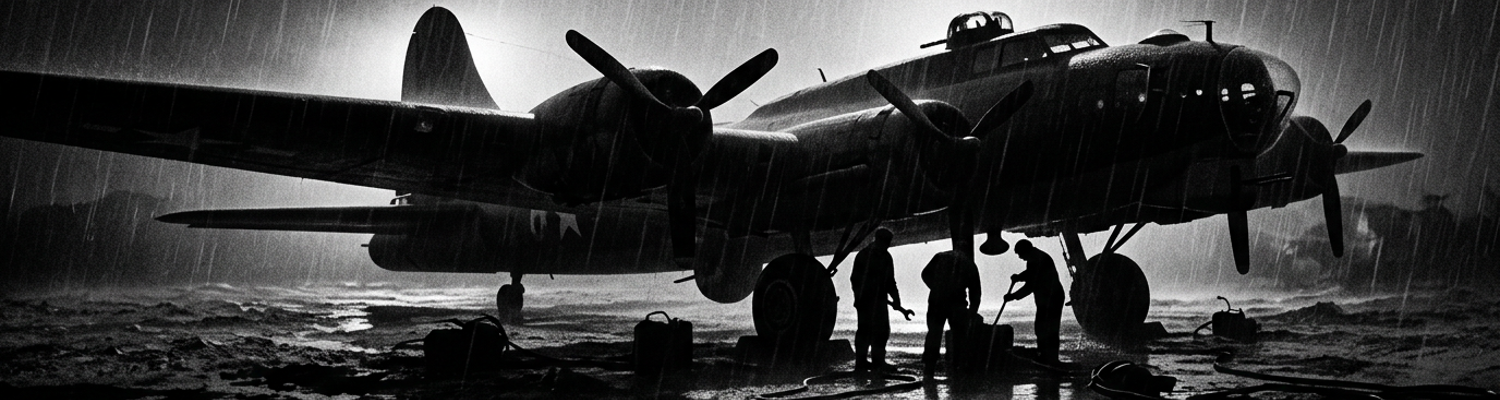
Historical records from May 1945 show Patrol Bombing Squadron 123 faced severe equipment degradation at Yontan Field on Okinawa. Ground crews encountered conditions upon arrival that rapidly destroyed their aircraft. Heavy spring rains turned the dirt and coral airstrip into a highly corrosive mixture of mud and crushed limestone. This wet slurry oxidized the aluminum skin. It fouled the 1,200-horsepower Pratt and Whitney R-1830 Twin Wasp engines. Mechanics lacked hardened hangars. They performed engine swaps in open downpours. The highly sensitive SWOD Mk 9 Bat radar-guided glide bombs proved completely unsuited for Pacific humidity. Squadron logs indicate that during the last week of May, an entire shipment of these experimental weapons was written off. Saltwater intrusion had fused their internal wiring. Maintenance personnel routinely cannibalized damaged Privateers to keep a fraction of the squadron flight-worthy.
Low-altitude minelaying and anti-shipping missions across the East China Sea were defined by mechanical friction.
Flights toward the Tsushima Straits and the Shantung peninsula required pilots to fly at altitudes as low as 200 feet.
This avoided early warning radar.
At this height, the dense air caused the PB4Y-2 Privateers to consume fuel at an accelerated rate. Navigators struggled constantly with manual fuel transfer valves located in the unpressurized fuselage. These valves frequently jammed due to temperature fluctuations. Unbalanced weight distribution in the wings required the pilots to physically fight the yokes to maintain level flight. On multiple occasions in early June, aircraft ditched into the sea. A corroded fuel selector switch failed to open the auxiliary bomb bay tanks. This starved the outer engines of aviation gas. Anti-shipping strikes involved dropping unguided 500-pound general-purpose ordnance manually. Bombers flew directly into concentrated anti-aircraft fire from Japanese coastal freighters. Mechanical sights required the bombardier to calculate wind drift and airspeed by hand. The pilot violently maneuvered to avoid tracer fire. A single 20mm shell striking the unarmored hydraulic lines of the Privateer tail turret would instantly drain the entire fluid system. This locked the control surfaces. The heavy bomber went into an uncontrollable dive toward the water.
On June 27, Lieutenant J. E. Vincent and his entire crew were shot down over the southern coast of Korea.
A mechanical failure slowed their evasive turn.
Squadron commanders recognized that the technical superiority of their equipment was a liability in the saltwater environment. Fully loaded, the four-engine bombers carried an excess of 70,000 pounds. This placed heavy physical loads on the landing gear during night takeoffs from the compromised runway at Yontan. Tires blew out regularly on the jagged coral. Fully fueled Privateers skidded off the airstrip into the adjacent revetments. Crash crews stood by with foam trucks during every pre-dawn launch.
Corrosive Environment at Yontan Field
Deploying thirty-ton four-engine bombers to an active combat zone lacking paved taxiways guaranteed a catastrophic rate of equipment failure.
Archival evidence shows Patrol Bombing Squadron 123 arrived at Yontan Field on Okinawa in May 1945 to establish operations. Staging long-range PB4Y-2 Privateer patrol bombers from this newly secured airfield required operating under a severe supply shortage. The 73rd Naval Construction Battalion had barely filled the Japanese bomb craters with crushed coral. Heavy rains immediately turned this temporary aggregate into a highly abrasive slurry. Mechanics attempting to service the Pratt and Whitney R-1830 engines sank to their knees in the mud. Spare parts did not exist on the island. Ground crews cannibalized damaged airframes to patch shrapnel holes in the unarmored single-tail empennage of the Privateers. Hydraulic lines controlling the Erco bow turrets regularly clogged with limestone dust blown across the open dispersal areas. Officers filed daily reports detailing fractured landing gear struts. These were caused by taxiing fully loaded aircraft over uneven, hastily graded earth. Ordnance teams loaded heavy munitions by hand. Specialized bomb hoists sank into the saturated ground. High ambient moisture corroded electrical relays inside the bomb release mechanisms.
The engineering tolerances of the aircraft degraded daily.
A close review of operational logs indicates the primary mission parameters demanded nocturnal interdiction of Japanese coastal shipping lanes. Aircrews navigated the expanse of the East China Sea and the broader Ryukyu arc entirely in the dark. The objective involved severing the maritime supply lines supporting the Japanese garrison on Okinawa from the home islands and occupied China. Flight paths stretched from the Amami Islands up toward the Yangtze River Delta. Navigators tracked convoys consisting of small wooden luggers and heavily armed sea trucks. PB4Y-2 crews carried combinations of 500-pound general-purpose bombs and Mk 24 FIDO acoustic torpedoes in their twin bomb bays. Identifying these small, low-profile vessels against the black ocean surface relied entirely on the erratic returns of the APS-2 search radar. Operators stared at the monochrome scopes for hours. Cathode-ray tubes frequently burned out due to voltage spikes from the internal generators. Without functioning electronics, bombardiers had to visually acquire targets by dropping magnesium parachute flares.
These flares illuminated the target.
They simultaneously blinded the flight crew.
The exact position of the bomber was advertised to enemy gunners for miles.
When the radar failed, pilots flew blind through the dense maritime weather fronts characterizing the spring transition period in the East China Sea. Executing low-altitude mine drops required flying at highly dangerous heights under total blackout conditions with minimal navigational aid. Standard operating procedure for deploying Mk 25 and Mk 26 magnetic influence mines dictated an absolute maximum release altitude of 200 feet. Pilots often descended to 100 feet to ensure precise placement in the narrow shipping channels off the western coast of Kyushu. Heavy bombers lacked terrain-following radar. Altimeters relied on barometric pressure readings that shifted violently during sudden localized squalls. Navigators calculated drift and ground speed using a mechanical E-6B flight computer and a stopwatch. Aircrews operated with all exterior lights extinguished. Exhaust stacks of the Twin Wasp engines glowed bright blue in the darkness. This visual signature provided Japanese coastal anti-aircraft batteries with an easy aiming point. Flak suppression was nonexistent during these solo sorties. A single 20mm round striking the unpressurized fuselage could easily sever the control cables running to the elevators. Crews attempting to execute sudden evasive maneuvers at 100 feet frequently misjudged their bank angles in the pitch-black conditions. Dipping a wingtip into the ocean swells resulted in immediate structural disintegration at 200 miles per hour.
Flight mechanic reports from May 28 list three aircraft returning with severed rudder trim tabs.
Ground fire originating from hidden coastal barges caused the damage.
AN APS 15 Radar Dielectric Breakdown
When examining the maintenance logs of VPB-123 from June 1945, the rapid degradation of the electronics dominates the daily reports.
The tropical marine atmosphere severely corroded AN/APS-15 radar suites.
This caused frequent mid-mission cathode-ray display failures. Originally designed for high-altitude operations in the European theater, the H2X radar chassis lacked proper environmental sealing for the Pacific. Salt-laden moisture penetrated the unpressurized receiver-transmitter units housed in the belly of the PB4Y-2 Privateers. Internal components rusted. High humidity caused immediate dielectric breakdown inside the pulse modulators. Operating the displays required thousands of volts of electricity. Damp, salty air allowed this high voltage to arc across the internal terminals instead of flowing through the designated circuits. High-voltage arcs melted the delicate internal solder joints. This created permanent hardware faults mid-flight. Aviation Radio Technicians spent hours baking the magnetron assemblies in improvised ovens constructed from empty oil drums to drive out the moisture. It never worked. Once the bombers climbed to operational altitude, the sudden temperature drop caused heavy condensation to form on the internal glass envelopes. Monochrome green screens would suddenly bloom with intense brightness before burning out completely.
The operators stared at broken glass.
Archival evidence shows that saltwater damage destroyed critical electrical wiring. Privateers took off through deep puddles of seawater and crushed coral slurry scattered across the damaged airstrip. Liquid blasted up into the unsealed bomb bays and lower fuselage compartments where the main wiring trunks ran along the aluminum stringers. Copper wires turned green with verdigris within forty-eight hours of exposure. Constant heat and humidity rotted the heavy rubber insulation encasing the cables. Saltwater seeped directly into the multi-pin Amphenol connectors linking the radar components. Galvanic corrosion between the copper pins and the aluminum airframe accelerated the destruction of the electrical pathways. Short circuits plagued the entire system. Inoperable AN/APS-15 systems added hundreds of pounds of excess mass. Aircraft burned precious aviation fuel to carry broken components across the ocean. Ground crews lacked specialized replacement cables in their limited supply chain. Mechanics resorted to cannibalizing wiring harnesses from wrecked aircraft dragged off the runway. They stripped away layers of wet insulation to find a few feet of uncorroded copper. A single short in the main trunk line instantly disabled the entire search apparatus.
The hardware simply died.
A close review of operational records indicates that aircrews were regularly forced to navigate and locate maritime targets blind over hostile, pitch-black waters. With the APS-15 completely inoperable, bombardiers and navigators relied exclusively on dead reckoning across the East China Sea. Flight paths required flying 600-mile routes toward the Tsushima Straits or the coastal waters of Kyushu without any electronic guidance. Heavy spring cloud cover frequently obscured the stars. Pilots flew in a total blackout environment over an ocean filled with jagged outcroppings and heavily armed Japanese picket ships. Locating a 150-foot coastal freighter in the dark required the pilots to descend to dangerously low altitudes. They stared through the plexiglass windshields searching for the faint phosphorescent wake of a moving vessel against the black water. It was physically exhausting. Without radar altimeters, the risk of flying directly into the ocean swells increased exponentially. Navigators calculated wind drift using only mechanical E-6B flight computers and stopwatches. Pilots staring into the featureless void for hours frequently experienced severe spatial disorientation. The horizon line vanished entirely. Distinguishing the sky from the sea required constant reference to the analog artificial horizon instrument. Dropping magnesium parachute flares to illuminate a suspected target area immediately exposed the unarmored bombers to 25mm anti-aircraft fire from unseen gunboats below. Flight logs from June 12 record two Privateers breaking radio silence near coordinates 31 degrees North 129 degrees East to report total sensor failure.
They aborted their interdiction sweep.
They turned back toward Okinawa.
Solenoid Seizures and Metallurgical Failures
Archival evidence shows that the primary offensive capability of Patrol Bombing Squadron 123 collapsed under the relentless environmental exposure of the Ryukyu island chain.
Daily mission parameters required PB4Y-2 Privateer aircrews to drop 1,000-pound Mk 26 magnetic influence mines into the shallow shipping channels off western Kyushu. Delivering these weapons required precise electronic actuation through bomb-rack solenoids mounted inside the unsealed bays of the aircraft. Spring squalls and continuous exposure to salt fog at Yontan Field drove corrosive moisture directly into these electromagnet release mechanisms. Internal copper wire coils oxidized rapidly. A hardened layer of green verdigris formed across the electrical contacts. When a bombardier pressed the release toggle over a target area, the electrical current failed to bridge the corroded gap to actuate the mechanical sears.
Two tons of explosives stayed locked to the shackles.
Ground crews documented the aftermath of these electrical failures daily. Mechanics attempting to troubleshoot the AN-M2 bomb racks found the solenoid plungers physically seized inside their housings. Crushed coral and saltwater slurry kicked up by the landing gear during takeoff baked onto the moving parts. This cemented the release latches in the closed position. Pilots flying at 150 feet above the ocean surface suddenly found themselves carrying dead weight that they could neither drop on the enemy nor jettison for safety. Asymmetrical load imbalances occurred when one rack functioned while the opposite side failed. Flight logs from June 4 record a Privateer fighting severe right-wing drag for four hours after a port-side mine release failure near the Shantung peninsula.
The pilot physically wrestled the control column until his hands blistered.
When examining the historical record regarding defensive armament, the AN/M2 Browning .50-caliber machine guns installed in the Erco bow and Martin dorsal turrets suffered catastrophic metallurgical failures. Engaging heavily fortified Japanese coastal gun emplacements along the shores of Amami Oshima demanded sustained suppressive fire from the bomber crews. Gunners held down their triggers to pour armor-piercing incendiary rounds into the concrete bunkers below. Operating at a cyclic rate of 800 rounds per minute generated extreme heat inside the steel barrels. Standard operating procedures dictated firing in short, controlled bursts to allow the ambient air to cool the metal. Silencing radar-directed Type 98 20mm anti-aircraft batteries forced gunners to ignore standard thermal limitations.
Gun barrels routinely exceeded 1,200 degrees Fahrenheit.
At these temperatures, the structural integrity of the ordnance degraded instantly. Friction from copper-jacketed bullets traveling down the superheated bore stripped the internal rifling completely flat. Without the stabilizing spin imparted by the rifling, the projectiles tumbled erratically upon exiting the muzzle. This destroyed any ballistic accuracy. Sustained heat warping then caused the heavy barrels to physically droop under their own weight. Erco bow turret operators reported their guns seizing mid-burst as the warped metal prevented the short-recoil action from cycling the next round into the chamber. Mechanics back at Yontan routinely documented barrel droop exceeding three degrees off the center axis. Extracting the jammed casings from the warped chambers required ground personnel to hammer the bolts open with brass mallets.
Gunners flew into hostile airspace with useless weapons.
A close review of operational logs indicates that these compounding armament failures left the heavy PB4Y-2 Privateers completely defenseless against low-altitude anti-aircraft fire and enemy night interceptors. Carrying thousands of pounds of jammed magnetic mines reduced the top speed of the bombers to less than 170 knots. Slow and heavy aircraft could not outrun the twin-engine Nakajima J1N1 Irving night fighters patrolling the southern approaches to the home islands. When Japanese interceptors detected the exhaust flames of a burdened Privateer, they attacked from below targeting the unarmored wing tanks. American gunners tracking the incoming fighters squeezed the triggers on their warped .50-caliber machine guns and heard only a dull mechanical click.
Steel firing pins struck jammed rounds in the deformed breeches.
Without returning fire, the bombers absorbed concentrated bursts of 20mm cannon shells. Evasive maneuvers were physically impossible due to the asymmetrical weight of the hung ordnance trapped in the bomb bays. Coastal anti-aircraft batteries on the Satsuma Peninsula tracked the slow-moving targets visually as they lumbered across the horizon. Shrapnel easily penetrated the aluminum skin. It severed the hydraulic lines and electrical cables required to maintain flight. On June 18, Japanese ground fire struck the starboard wing of a crippled Privateer attempting to limp back to Okinawa on three engines. Losing altitude rapidly, the bomber impacted the surface of the East China Sea at coordinates 31 degrees 15 minutes North 130 degrees 05 minutes East.
Search and rescue flying boats found only a slick of aviation fuel and floating seat cushions the following morning.
Incompatible Frequencies and IFF Authentication Errors
When examining the historical record from June 1945, the airspace above Okinawa suffered from a complete breakdown in basic radio communication between military branches.
Seventh Fleet naval controllers stationed aboard amphibious command ships like the USS Estes utilized high-frequency transmitting equipment to coordinate fleet defense. Land-based Army Air Forces night fighters relied exclusively on very high-frequency SCR-522 transceivers. The Northrop P-61 Black Widows of the 548th Night Fighter Squadron operated out of Ie Shima.
The two systems were physically incapable of connecting.
Naval Combat Information Centers tracked incoming Japanese Mitsubishi G4M bombers on their SK air-search radars from miles offshore. Intercepting these threats required shipboard operators to dictate target vectors to a radioman below decks. This sailor typed the coordinates into a teletype machine routed via relay to a ground station on the island. Army personnel manually carried the paper slip across a dirt compound to a VHF operator. This operator then broadcast the delayed heading to the P-61 pilots holding at 15,000 feet.
The delay averaged twelve minutes.
Army pilots banking their heavy aircraft to intercept the relayed coordinates found empty sky. Japanese bombers had already dropped their ordnance on the airfield and exited the sector long before the transmission reached the cockpit.
Archival evidence shows that a lack of standardized Identification Friend or Foe protocols turned the night sky along the Ryukyu arc into a high-risk friendly fire zone. Navy PB4Y-2 Privateers and Army Air Forces interceptors both utilized the Mk III IFF transponder system. The daily encryption codes required to authenticate these electronic signals were issued by entirely different command structures. The Seventh Fleet distributed code sheets to the radar picket destroyers stationed north of Okinawa. Army Air Forces intelligence officers distributed a separate set of authentication frequencies to their flight crews launching from Yontan Field.
They rarely matched.
Returning from a low-altitude patrol over the East China Sea forced PB4Y-2 crews to cross the naval picket line in total darkness. Destroyers like the USS Laffey interrogated the incoming radar contacts using directional antennas. The bomber transmitted a response on the Army frequency. Navy receivers registered a hostile blank on their displays.
Gunners immediately engaged the target.
Radar-directed Mk 37 fire control systems locked onto the unverified blips. Five-inch 38-caliber anti-aircraft guns fired Mk 32 proximity-fused fragmentation shells directly into the flight paths of returning American bombers. Pilots executed violent evasive dives toward the water to avoid being shredded by their own fleet. Flight logs from late May detail multiple Privateers returning to base with jagged shrapnel holes punched through their vertical stabilizers by Navy proximity bursts.
A close review of operational logs indicates that these inter-service communication gaps directly compromised the strategic mining campaign off the western coast of Kyushu. VPB-123 received target coordinates for Mk 26 magnetic influence mine deployments from Army Air Forces intelligence officers. The Army utilized a terrestrial grid mapping system based on landmass reference points. Naval navigators relied on maritime charts plotting standard latitude and longitude. Translating between these two systems was handled over static-filled telephone lines connecting the command tents at Yontan Airfield.
Numbers were transposed.
Privateer crews took off into the night carrying four thousand pounds of explosives intended for the narrow shipping channels near Kagoshima Bay. Following the flawed Army-provided coordinates, navigators directed their pilots miles off course into the vast expanse of the East China Sea. Aircrews descended to 200 feet under heavy cloud cover and dropped their entire payloads based on the faulty grid conversions.
The mines sank into deep water.
Tons of high explosives were deposited into empty ocean trenches near coordinates 31 degrees 30 minutes North 129 degrees 15 minutes East. Bombers burned hundreds of gallons of aviation fuel to deliver ordnance into useless sectors. Ground crews spent hours loading the heavy munitions by hand only for the weapons to sink 600 feet to the seafloor without ever arming their magnetic triggers.
Unauthorized Field Modifications and Supply Chain Collapse
When examining the historical record, the daily operations of Patrol Bombing Squadron 123 succeeded exclusively through unauthorized field modifications and extreme physical endurance rather than the prescribed technological doctrine of the Navy Department.
Official maintenance manuals required the replacement of Pratt and Whitney R-1830 Twin Wasp engines after a strict limit of combat flight hours. Ground crews at Yontan Field possessed zero crated replacement engines throughout the entire month of June 1945. Mechanics kept the heavy bombers airborne by stripping cylinders, spark plugs, and magnetos from wrecked airframes abandoned in the adjacent coral revetments. Aviation machinists bypassed the severely corroded AN/APS-15 radar wiring harnesses by physically routing uninsulated copper wire directly through the unpressurized crew compartments. Bypassing the internal circuit breakers created a constant fire hazard inside the fuselage. Pilots flew fourteen-hour maritime interdiction sweeps toward coordinates 30 degrees North 128 degrees East while holding manual fuel transfer valves open with vice grips to prevent outer engine starvation. The internal temperature of the unheated cockpit dropped below freezing at operational altitudes.
Aircrews sustained permanent nerve damage in their hands from physically fighting unbalanced control yokes through turbulent tropical storm fronts.
A close review of operational logs indicates that post-war declassified flight records document abort rates frequently exceeding forty percent during the peak of the Ryukyu campaign. Systemic hardware degradation caused the majority of these mission failures. Fully loaded PB4Y-2 Privateers weighing 65,000 pounds routinely taxied to the end of the crushed-coral runway only to rupture high-pressure hydraulic lines before the pilot could advance the throttles. Abrasive limestone dust destroyed the rubber seals inside the brake calipers. Severe interservice organizational friction compounded these mechanical breakdowns. Army Air Forces quartermasters controlled the primary aviation fuel dumps on the western side of the island. Army logisticians prioritized 100-octane gasoline allocations for their own P-47 Thunderbolt fighter squadrons attached to the Twentieth Air Force. Navy supply officers from VPB-123 frequently arrived at the fuel depots with requisition paperwork only to be denied the 2,800 gallons required to fill a single patrol bomber. Command disputes over daily supply priority forced Navy aircrews to launch on nocturnal anti-shipping strikes toward the Tsushima Straits with partially empty auxiliary wing tanks.
Pilots aborted missions directly over hostile waters when their analog gauges registered insufficient aviation fuel to complete the return leg to Okinawa.
Archival evidence shows the Okinawa night patrol campaign exposed the severe physical strain required to sustain late-war naval aviation at the extreme end of a six-thousand-mile Pacific supply chain. Moving heavy ordnance and specialized electronic equipment from California required weeks of transit on slow cargo vessels. Upon arrival at Hagushi beach, Navy stevedores dumped unsealed wooden crates containing sensitive radio tubes directly onto open landing craft exposed to heavy salt spray. Truck drivers hauled these compromised supplies over unpaved dirt roads to Yontan. The crates sat in standing mud for weeks. Ground crews lacked hardened shelters or concrete tarmac. Ordnance teams loaded 500-pound general-purpose bombs into the high bomb bays of the Privateers using crude wooden ramps and muscle power. Mechanized Mark 6 bomb hoists sank completely into the saturated limestone slurry. Maintenance personnel worked twenty-hour shifts in constant downpours while suffering from acute dysentery caused by drinking water drawn from contaminated local wells. Replacing a single shattered plexiglass blister on an Erco bow turret required mechanics to drill out hundreds of aluminum rivets by hand in complete darkness to comply with blackout regulations.
On June 22, three mechanics collapsed under the starboard wing of Bureau Number 59382.
They were attempting to manually torque a bent landing gear strut in ninety-degree heat.