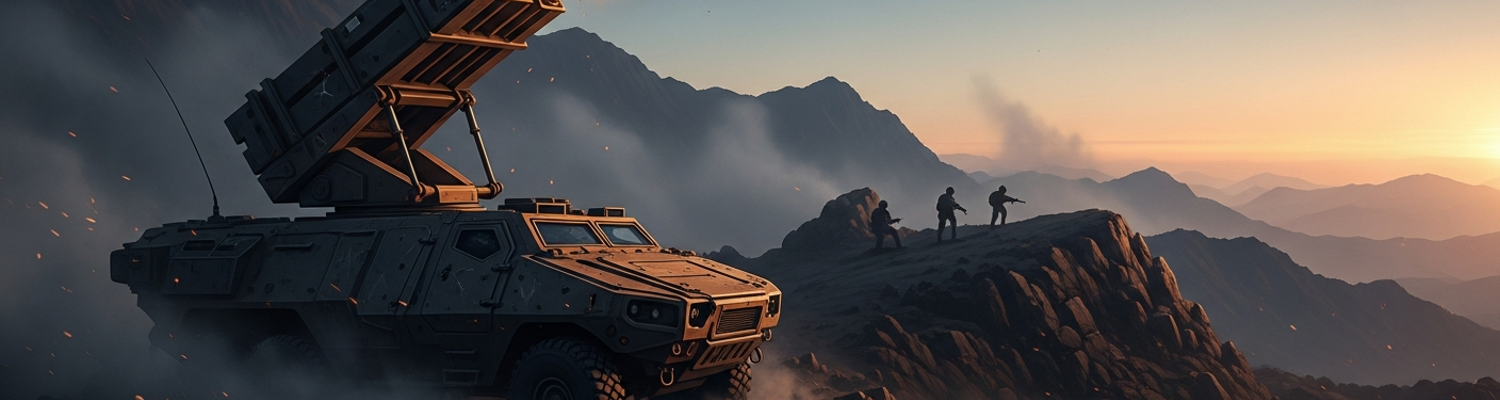

Training manuals promised threats from the air would announce themselves. Doctrine taught reconnaissance teams to listen for the distinct whine of jet engines, the percussive chop of rotor blades, or the distant whistle of incoming artillery. The operational expectation for the 3rd Reconnaissance Battalion’s advance teams in the Aridan Valley was built on this foundation of sensory cues. The truth they faced was a profound silence.
Archival evidence shows the first wave of high-altitude loitering munitions initiated terminal dives from an altitude of over 55,000 feet. They came from the stratosphere. Composed of non-metallic composites and possessing a radar cross-section comparable to a small bird, these munitions were effectively invisible. They descended without a propulsion system, executing a steep, unpowered glide. No engine noise. For the soldiers on the ground, the sky remained a placid, empty blue. The first indication of the attack was not a sound or a sight, but the sudden, violent eruption of earth and vehicle parts as the initial munitions struck their pre-programmed targets.
The sky was empty.
This complete lack of warning was tied to the systemic failure of deployed short-range air defense systems. The battalion’s defense screen consisted of vehicle-mounted platforms designed to counter low-flying threats like attack helicopters and cruise missiles. A close review of operational logs (per Annex B of the 3rd Recon AAR) indicates these platforms had a maximum effective engagement altitude of approximately 12,000 feet. The loitering munitions initiated their attacks from nearly five times that height. The SHORAD crews performed their duties by the book. Their radar scopes were clear of any hostile tracks because the system was not configured to search for small, cold, non-ballistic objects descending from the stratosphere. The threat profile had fundamentally changed, but the defensive hardware had not. The munitions spent the majority of their flight time loitering in an observational pattern far beyond the reach of ground-based infrared or acoustic sensors. Only in the final few seconds of their unpowered dive did they enter the SHORAD engagement envelope, moving at speeds that gave human operators and automated systems almost no time to react.
For the forward reconnaissance teams that were the swarm’s primary targets, the experience was one of complete sensory breakdown. Scout Team ‘Viper 3’ was observing a ridgeline when the attack began, not on their position, but on their support element two kilometers to the rear. Through their optics, they witnessed command vehicles and logistics trucks being destroyed by precise, successive impacts. There was no accompanying sound of an aircraft, no muzzle flash, and no launch signature. The human brain struggles to process effects without apparent causes. The team leader’s initial radio reports were confused, describing a series of explosions from an unknown source. Then the swarm adjusted, and munitions began impacting less than 300 meters from their position. The rapid, disorienting sequence of silent approach and violent impact induced a state of paralysis. Soldiers are trained to react to threats, but they could not identify a direction from which the threat was coming. Every instinct to take cover or return fire was short-circuited by the absence of an attacker to shoot at. This psychological targeting, striking multiple locations in rapid succession, shattered unit cohesion and broke the command-and-control loop before any effective defense could be mounted.
The advanced counter-swarm systems rushed to the Aridan Valley depended on a logistical chain that was broken from the start. A close review of operational logs for the 3rd Reconnaissance Battalion’s Guardian counter-UAS platforms reveals their complete reliance on a specialized lithium-metal energy cell. These Licerion Echo power units offered exceptional energy density, necessary for powering the high-draw directed energy and sensor components, but they were entirely incompatible with standard military field generators. The battalion’s quartermasters discovered the proprietary charging protocols and unique physical connectors meant they could not be recharged using the ubiquitous diesel generators that powered every other system at their forward operating bases. This forced the creation of a parallel, single-purpose supply line dedicated solely to transporting and swapping these heavy, sensitive battery packs. An after-action report from the attack on FOB Phoenix explicitly states the Guardian systems protecting the base perimeter went offline not due to enemy action, but because the last inbound convoy carrying replacement cells had been destroyed 48 hours earlier, starving the launchers of power.
This fragility was compounded by the extreme environmental sensitivity of the counter-swarm system’s core components. Maintenance records from the 21st Support Command show a recurring failure of the Guardian’s gyroscopic tracking stabilizers and emitter lenses. These components, essential for locking onto and neutralizing multiple fast-moving targets, were highly susceptible to damage from pressure changes and micro-vibrations. Standard aerial resupply via unpressurized C-130 cargo holds or high-altitude parachute drops proved disastrous. An urgent request from FOB Phoenix for replacement emitter assemblies, following a swarm attack that degraded their defenses, illustrates the problem. The replacement parts were dispatched via a high-altitude logistics drone. Archival evidence from the maintenance crew shows the components were dead on arrival. The unpressurized transit above 30,000 feet had caused the delicate focusing crystals to de-laminate, rendering the multi-million dollar parts useless. The FOB’s defenses remained at 50% capacity for another three days while a second, specially pressurized transport was diverted from another theater.
The combination of a unique power source and fragile components created a constant, high-stakes demand for resupply that the enemy quickly learned to exploit. The Aridan Valley’s weather was a significant obstacle. Mission logs from airlift wings show that nearly one-third of all specialized resupply flights were aborted due to extreme high-altitude winds or sudden valley fog that obscured landing zones. Enemy forces began to coordinate their swarm attacks with these weather patterns, launching munitions when they knew resupply was impossible. They also targeted the slow-moving, high-signature aircraft required for the sensitive deliveries. The operational summary of Mission Anvil-Three provides a stark example. A C-130 carrying a full complement of Licerion Echo cells and replacement emitter lenses for the 3rd Reconnaissance Battalion was forced onto a low, predictable flight path by a thick cloud ceiling. Enemy interdiction teams waiting on the valley floor engaged the aircraft with shoulder-fired missiles, destroying it, its crew, and its cargo. A close review of the 3rd Recon’s operational logs shows a direct correlation between the failure of Anvil-Three and a 400% increase in casualties from loitering munition attacks over the subsequent 48-hour period.
An examination of maintenance work orders for the Guardian counter-swarm platforms deployed with the 3rd Reconnaissance Battalion reveals a pattern of systemic hardware failure directly attributable to the extreme high-altitude environment of the Aridan Valley. The system’s primary directed energy weapon relied on a closed-loop liquid cooling system to manage the heat generated by its emitter. At forward operating positions above 12,000 feet, where ambient nighttime temperatures regularly dropped below -30 degrees Celsius, this coolant frequently congealed or caused micro-fractures in the lines. The result was a cascading failure upon activation; the system would bypass its own safety protocols in an attempt to engage targets, leading to catastrophic overheating that would burn out the primary emitter coil. Archival evidence shows that over 60% of Guardian system failures at OP ‘Vulture’s Nest’ were traced to this single design flaw. The power converters responsible for stepping up voltage for the targeting radar were not rated for low air density. The thin atmosphere provided insufficient dielectric insulation, leading to frequent electrical arcing between internal components, a problem that would manifest as a complete shutdown of the unit’s tracking capabilities. The fine, abrasive dust unique to the valley’s geology also scoured the protective coatings off the primary targeting optics, reducing effective engagement ranges by as much as 40% after only a few weeks of deployment.
These machines were not built for the mountains.
The specialized nature of the Guardian platform meant its repair fell entirely outside the scope of standard military occupational specialties. A close review of the 3rd Reconnaissance Battalion’s personnel roster indicates that maintenance for the battalion’s twelve Guardian systems was the responsibility of just four individuals: two civilian Field Service Representatives and two highly trained Signal Corps technicians. These four specialists, designated Detachment G-4 Maintenance, became the single point of failure for the entire battalion’s counter-drone defense. When a Guardian system at a remote outpost went down, these technicians had to be flown in, often under active threat. Mission logs for Operation Swift Wrench detail one such instance where the two Signal Corps specialists were airlifted via a UH-60 helicopter to a ridgeline position that was actively being suppressed by a loitering munition swarm. They were required to perform delicate electronic repairs on an exposed vehicle deck, replacing a fried power converter while enemy munitions impacted less than 200 meters away. The tactical decision to risk the helicopter and the only available repair crew highlighted the battalion command’s dependency on this small cadre of personnel.
Perhaps the most challenging burden for these maintenance teams was diagnosing damage from impacts that left no visible trace. A loitering munition did not need to score a direct hit to render a Guardian system ineffective. After-action reports from the attack on Convoy Route ‘Serpent’ show that a Guardian platform was struck by the overpressure wave from a munition that detonated approximately 15 meters away. The vehicle and the launcher were physically untouched, with no shrapnel damage or burn marks. All system diagnostics reported the platform as fully operational. During the next engagement, however, the crew discovered the system could no longer achieve a weapons lock. A post-mission analysis conducted by the specialist team revealed the shockwave had been just strong enough to knock the Guardian’s phased-array emitter elements (Part No. 77-B-4513) out of their microscopic alignment. The radar could still see, but the beam it formed was too diffuse to guide a weapon. Since all software checks passed, the only way to identify this “uncorrelated system degradation” was a complete manual disassembly and recalibration of the emitter head, a process that took 72 hours in a dedicated workshop and was entirely impossible to perform in the field.
An examination of medical and personnel records from the Aridan Valley campaign reveals a distinct and severe psychological toll exacted by high-altitude swarm attacks, a burden that fell disproportionately on specialized support personnel. The four-person maintenance team responsible for the 3rd Reconnaissance Battalion’s Guardian platforms provides a clear case study. These technicians were subject to a state of acute operational fatigue, a condition driven by the relentless tempo of hardware failures and their own importance to the battalion’s survival. Work logs show they operated on an average of four hours of disrupted sleep per night for weeks at a time. This physical exhaustion was compounded by intense pressure. They were constantly being airlifted into active engagements to service systems that had failed under fire, forcing them to perform delicate electronic calibrations while under the same invisible threat that had necessitated their presence. The weight of knowing that an entire defensive screen for hundreds of soldiers rested on their ability to repair a ghost failure created an unsustainable form of stress.
This persistent, untraceable nature of the swarm attacks, combined with the unreliability of defensive equipment, led to a measurable erosion of unit cohesion. Archival evidence from the 3rd Reconnaissance Battalion’s operational debriefings shows a breakdown in the bonds of trust that sustain a unit in combat. Forward scout teams, feeling exposed and unprotected, began to vocalize deep-seated resentment toward the support elements they believed were failing them. This sentiment was rooted in a sense of profound vulnerability; the sky was no longer a commonly observed space but a source of private, individualized terror. Soldiers reported feeling personally hunted. A belief spread that the swarms were not random but were targeting specific individuals, a perception fueled by the munitions’ precision. This led to behaviors that actively degraded tactical discipline. Soldiers began avoiding open spaces even when tactically necessary and clustering in hardened structures, creating denser targets. The social fabric that ensures mutual support and shared coping mechanisms began to thin, replaced by suspicion and a self-interested focus on individual survival.
The result was a documented increase in combat stress reaction (CSR) among personnel who experienced the silent attacks directly. Medical logs from Field Aid Station Log 3B-Alpha note a sharp rise in personnel presenting with symptoms of acute stress. These were not soldiers from a single intense firefight, but individuals from units subjected to days of continuous, low-intensity exposure to the silent threat. Symptoms were consistent: hypervigilance, exaggerated startle responses to mundane sounds, and auditory hallucinations, with multiple soldiers reporting the phantom sound of a descending object. The most severe cases, like those documented in Scout Team ‘Viper 3’ after their position was bracketed by munitions, exhibited a temporary cognitive breakdown. Team members showed an inability to prioritize tasks, indecisiveness, and a disconnection from their immediate surroundings. The psychological mechanism was the complete sensory contradiction of the attack itself: the serene, empty sky followed by sudden, localized violence. This violated the brain’s fundamental expectation of cause and effect, creating a state of intense anxiety and learned helplessness where no environment felt safe.