
Within hours of the first Japanese attacks in December 1941, over half of the modern combat aircraft belonging to the U.S. Army Forces Far East (USAFFE) were annihilated on the ground. The stunning loss handed air supremacy to the invaders and defined the grim terms for the land campaign to follow. The strategic geography of northern Luzon would dictate every opening move. A review of USAFFE operational plans (Record Group 407, NARA) indicates that American and Filipino war planners saw the island’s northern sector not as a line to be held, but as a massive delaying mechanism. Its function was to absorb the initial shock of the main Japanese invasion and slow its momentum. The topography was everything. The wide shores of the Lingayen Gulf offered the most direct amphibious entry to the Luzon Plain, a corridor leading straight to Manila. The sparse road networks, mainly Route 3 and Route 5, acted as funnels, channeling any mechanized advance southward. For the defenders, controlling the junctions and bridges along these routes was the entire game. The rugged Cordillera Central to the east and the Zambales Mountains to the west formed natural barriers, constricting any Japanese advance and making a rapid, broad-front offensive difficult. Any effective defense of the Philippines hinged on executing a successful delaying action in northern Luzon, trading land for the time needed to enact the broader strategic plan.
Lieutenant General Masaharu Homma’s Japanese Fourteenth Army operated on an opposing and aggressive timetable. Archival evidence shows Homma's plan was built on speed. The objective was the subjugation of the entire Philippine archipelago in approximately 50 days, a schedule dictated by Imperial Japanese High Command's larger Pacific conquest schedule. The main assault fell to the 48th Division, a seasoned mechanized infantry unit with combat experience from China. Their mission was to land on the southern shores of Lingayen Gulf on December 22, 1941, drive south, and seize Manila. This was not planned as a battle of attrition. Japanese doctrine emphasized bypassing strongpoints, using infiltration to disrupt command, and collapsing the enemy’s will to fight. A secondary, smaller landing by the 16th Division at Lamon Bay, south of Manila, would execute a pincer movement, trapping USAFFE forces. Homma’s operational calculus left little room for error, as the 48th Division was slated for withdrawal in early February for the invasion of the Dutch East Indies.
In response, USAFFE headquarters, under General Douglas MacArthur, reluctantly activated War Plan Orange-3 on December 23. This long-standing contingency plan was a strategy of retrograde movement. It acknowledged the impossibility of defeating a major Japanese landing on the beaches. The plan called for the five designated Military Areas of the Philippines to conduct a strategic withdrawal into the highly defensible Bataan Peninsula. There, a force of around 80,000 soldiers and refugees would attempt to hold out for a projected six months, awaiting a relief effort from the U.S. Pacific Fleet. The execution of this complex maneuver fell to the North Luzon Force, commanded by Major General Jonathan M. Wainwright. His force, composed largely of undertrained and poorly equipped Philippine Army divisions, was tasked with holding a series of five defensive lines to stall the Fourteenth Army’s push.
The core of Wainwright’s delaying strategy was the 26th Cavalry Regiment (Philippine Scouts). This unit, numbering just under 800 troopers, was the most professional and mobile fighting force available. While other divisions struggled with basic mobilization, the 26th Cavalry was a cohesive unit of veteran Filipino enlisted men and American officers, equipped with M1 Garand rifles and possessing a high degree of training. Their mission was to act as a covering force, confronting the Japanese advance elements head-on, forcing them to deploy, and then withdrawing before becoming decisively engaged. From December 22 to December 24, the regiment conducted a classic series of rearguard actions, fighting at Rosario and Binalonan. These engagements, though costly, were successful in slowing the Japanese advance just enough to allow the disorganized Philippine Army divisions to pull back. By the end of Christmas Eve, the 26th Cavalry had been reduced to 450 men, but their sacrifice had bought the days needed for the main body of the North Luzon Force to begin its retreat toward Bataan.
Operational logs show the 26th Cavalry Regiment was designated the primary reconnaissance and covering force for Wainwright’s entire North Luzon Force. This assignment was a direct result of the unit’s unique capabilities. They were to operate ahead of the main force, screen the army’s movements, and provide early warning of Japanese advances. Specifically, they were tasked with covering the wide-open western flank, a region of rough country and limited roads stretching toward the Zambales Mountains. This mission was intended to prevent Japanese forces from hooking around and enveloping the main body of Wainwright’s army as it withdrew toward Bataan.
The regiment was the stoutest opposition the Japanese 14th Army initially encountered. From December 22nd to December 24th, the 26th Cavalry executed a textbook delaying action. The fighting was intense. At Binalonan on December 24, the regiment faced the Japanese 4th Armored Regiment, using the terrain to separate infantry from their tanks and disabling the vehicles with grenades. This action, and others at Rosario and Damortis, forced the Japanese advance to slow and fight for territory the Americans had no intention of holding. The sacrifice was enormous; by the end of Christmas Eve, the regiment’s fighting strength had been slashed from nearly 800 troopers to approximately 450. This loss of life and material bought time, allowing fragile Philippine Army divisions to pull back from the initial onslaught.
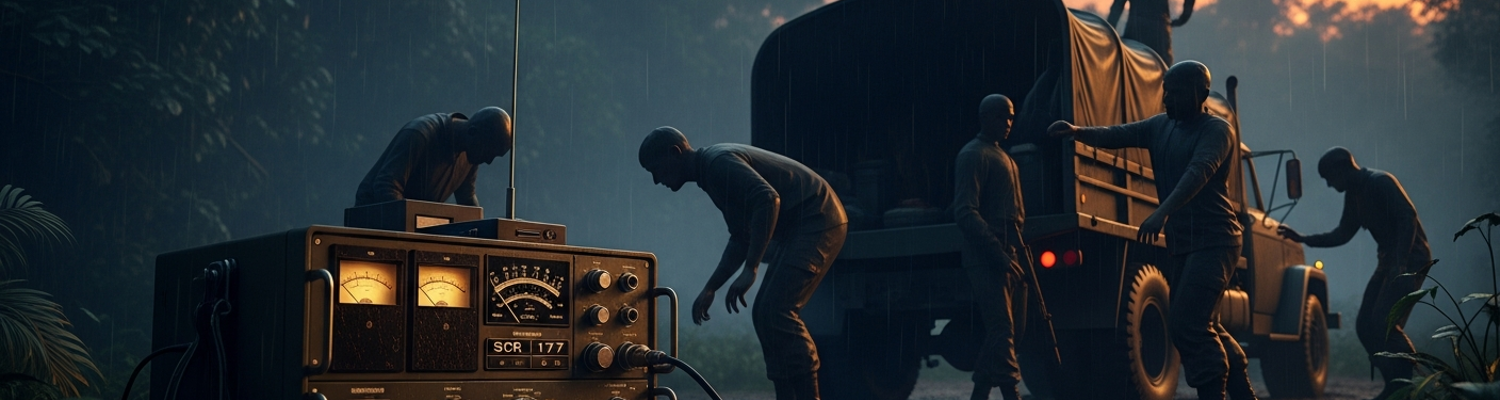
Communication of the intelligence gathered during these violent encounters relied on an early doctrine centered on the SCR-177 radio set. The SCR-177 was a “Set, Complete, Radio,” not a simple tactical device. It was a high-powered AM transmitter designed for long-range communications between headquarters echelons. It was housed in a K-52 van towed by a truck and powered by a separate gasoline generator. Its deployment was a cumbersome affair, requiring a stationary position and the erection of a 30-foot vertical antenna to achieve maximum range.
This was not a system designed for front-line, mobile warfare.
The 26th Cavalry adapted its use for their reconnaissance mission. The plan involved sending scouting patrols far forward. These patrols would then dispatch couriers back to the hidden, pre-positioned radio truck. From there, intelligence on Japanese strength and disposition would be encoded and transmitted directly to Wainwright’s North Luzon Force headquarters, bypassing intermediate command layers. This innovative use provided USAFFE command with near-real-time updates from the fluid front. The very power that made the SCR-177 useful for transmitting information also made it a conspicuous electronic source in the Luzon highlands, easily tracked by direction-finding equipment.
A review of the SCR-177’s technical specifications reveals a system designed for static, rear-echelon command. The SCR-177-B was a heavy, multi-component system weighing over 1,200 pounds. Its heart was the BC-191 transmitter, a 75-watt unit that, along with its receiver, was transported in a dedicated truck. Power was not drawn from the vehicle’s engine but from a separate, gasoline-powered PE-49 or PE-75 generator that had to be unloaded and positioned, creating a significant noise and logistical footprint. Achieving the radio’s maximum theoretical range required erecting complex antenna systems, often supported by multiple 30-foot masts. While these could, under ideal conditions, push a telegraphy signal out to 100 miles, this was a best-case scenario over flat terrain. For voice communication, the effective range dropped to just over 30 miles. For a mobile cavalry unit, the lengthy setup and teardown time, the system’s weight, and its reliance on a noisy, stationary generator made it an operationally awkward tool.
The entire architecture of interwar radio technology was built upon fragile components ill-suited for a tropical combat environment. The core of the SCR-177 was its array of vacuum tubes. These glass tubes were susceptible to failure from the vibration of travel over rough roads and the shock of nearby artillery. The high humidity of the Philippines degraded insulation and promoted corrosion on internal components, leading to shorts and unpredictable performance. Temperature fluctuations caused frequency drift, a phenomenon where the transmitter or receiver would wander off its assigned channel, requiring constant retuning by a skilled operator. The process of standardizing training for radio operators was still in its infancy. Proficiency varied widely. This was a delicate instrument demanding expert care and a stable operational environment, neither of which existed in the chaos of the retreat.
The mountainous and jungle-choked topography of Luzon presented a formidable obstacle to reliable radio communication. The SCR-177 operated using Amplitude Modulation (AM) on high frequencies, typically between 1.5 and 4.5 MHz. Radio waves in this band propagate primarily via line-of-sight and ground waves. The dense, wet foliage of the jungle absorbed and scattered these signals. The steep ridges of the Cordillera Central and Zambales Mountains created vast radio shadows, completely blocking communication. A patrol dropping into a ravine or moving behind a mountain could find itself instantly cut off. The advertised 100-mile range was a fiction in this environment. Actual reliable range was dictated entirely by the specific terrain between the transmitter and receiver. A signal that was strong one moment could vanish the next simply by moving a few hundred yards. This unpredictability turned the radio from a command tool into a temperamental variable, forcing commanders to rely on older methods like runners.
This high-powered transmission was a liability. While necessary to attempt to overcome the terrain, the 75-watt AM signal was an unmistakable source for Japanese intelligence units. Japanese forces in 1941 possessed proficient signals intelligence (SIGINT) capabilities, including radio direction-finding (RDF) equipment. Using a network of listening posts, they could triangulate the source of a strong transmission with considerable accuracy. The American signals were not encrypted; they were sent in the clear or used codes that Japanese cryptanalysts had experience breaking. Every time the 26th Cavalry’s radio team set up their antenna and fired up their generator to send a report, they were broadcasting their own position to a listening enemy. This was compounded by the threat of jamming. Even rudimentary jamming techniques, such as broadcasting noise on the same frequency, could render the American frequency unusable.
Operational logs from the North Luzon Force indicate the initial reports from the 26th Cavalry’s forward observers were clear. Then, the signals began to degrade. Radio operators at regimental headquarters logged instances of severe interference on the frequencies assigned to their lead reconnaissance troops. This was not atmospheric disturbance or the fade associated with distance. It was a deliberate electronic assault. At unpredictable intervals, the American radio net would be flooded with a deafening, high-pitched carrier wave, a squeal that drowned out all attempts at transmission. On other occasions, the interference manifested as a wash of modulated static. Japanese signals units were working to create uncertainty.
The electronic assault did not happen in a vacuum.
This enemy action compounded the physical limitations of the SCR-177 system. The radio's reliance on a high-power transmitter to punch a signal through the jungle made it an obvious target for Japanese direction-finding teams. The heat and humidity of the tropics worked against the delicate vacuum tubes, causing frequent component failures and pronounced frequency drift. An operator might find his channel clear of jamming only to realize his transmitter had wandered off its assigned frequency, a problem requiring a difficult recalibration while stationary and exposed. This created a cascade of vulnerabilities. A reconnaissance troop, already contending with a signal weakened by a mountain ridge, would suddenly find its frequency blanketed by Japanese jamming. The operator, unable to determine if the loss of contact was due to terrain, equipment malfunction, or enemy action, faced an impossible choice: remain silent and hope the signal returned, or transmit again and confirm his position to a listening enemy.
The breaking point arrived during the withdrawal actions around December 24, 1941. A lead element, Troop F, operating far out on the western flank, lost all contact with regimental headquarters. Their last received transmission was a chaotic burst of static-laced voice, a partial report on enemy mechanized movement that was abruptly cut off by a powerful jamming signal. After that, only silence. At the command post, staff officers could not know the troop’s fate. They were blind on a key sector of the front. The 80 men of the forward element might have been ambushed. They could have suffered an equipment failure. Or they could be actively engaged in a firefight, needing support that could not be sent because their location was unknown. The loss of this single radio link instantly erased an intelligence source, transforming a screened flank into a gaping void in the USAFFE defensive line.
At Major General Jonathan M. Wainwright’s North Luzon Force headquarters, the sudden silence from Troop F’s radio was not initially interpreted as the catastrophe it was. Command post diaries from late December 1941 reveal a mindset conditioned by pre-war doctrine and the pressures of managing a large-scale withdrawal. The prevailing assumption among the staff was that radio silence from a reconnaissance unit could be a positive indicator. It could mean the troop had successfully broken contact, was maneuvering to a new observation post, and was observing strict electronic discipline to avoid Japanese direction-finders. In the absence of a distress call, the staff defaulted to an optimistic reading. “No news is good news” became a dangerous mantra in a command post struggling to track the movements of entire divisions, not just a single cavalry troop. The operational tempo was frantic. Wainwright’s main responsibility was executing the complex withdrawal of the North Luzon Force toward Bataan under War Plan Orange-3. A single silent radio on a supposedly quiet flank did not register as an immediate crisis.
This flawed interpretation led to a failure to act.
Because Wainwright’s headquarters assumed Troop F was intact, no revised orders were issued. There was no attempt to dispatch couriers or send a relief patrol. The staff’s attention was consumed by more visible emergencies. The main Japanese advance down the central plains was shattering the inexperienced Philippine Army divisions. Logistical channels were in chaos. Demolition teams worked to blow bridges just ahead of the Japanese advance. The coordination of these disparate actions soaked up all available command bandwidth. From the perspective of a staff officer tracking the collapse of the 11th Division or the desperate stand of the 91st, the silence of a single cavalry troop seemed like a minor variable. This inaction was not born of negligence, but of a complete saturation of the command system, a system that then fell back on doctrinal assumptions that were proving lethal.
The impact of this intelligence vacuum was absolute. The assumption of success at headquarters created a fiction on their operational maps. A sector of the western flank, believed to be screened by the troopers of the 26th Cavalry, was in reality an unguarded void. The Japanese 14th Army now had an open corridor to infiltrate forces around the western edge of Wainwright’s main body. The entire American and Filipino retreat was channeled southward along a limited number of roads, primarily Route 3. The appearance of a Japanese flanking force, emerging unexpectedly from the Zambales foothills to sever that route, would have been an unmitigated disaster. It would have cut off the retreating divisions from their sanctuary in Bataan, turning an orderly withdrawal into a panicked rout. The silence from Troop F’s radio meant that USAFFE had no warning of the enemy’s most dangerous potential course of action.
Operating on its last known orders and deprived of any new intelligence by the radio failure, the isolated element of the 26th Cavalry continued its advance. Japanese signals intelligence units, having pinpointed the cavalry troop’s last transmission and noting the subsequent radio silence, correctly deduced the American unit was moving blind. This allowed elements of the Japanese 48th Division’s reconnaissance regiment to establish a deliberate ambush along the cavalry’s most probable axis of advance. They selected a narrow defile in the foothills, a natural choke point where the road dipped through dense vegetation. Heavy machine guns were pre-sited in interlocking fields of fire. Mortars were registered on the road itself. Riflemen concealed themselves on the high ground overlooking the approach. For the 80 troopers moving forward, there was no warning. The lead scouts of the column rode directly into the prepared kill zone.
The effect was instantaneous.
The lead riders and their horses were cut down by machine-gun fire from multiple concealed positions. As the main body of the troop rounded the bend, they were met with a prepared curtain of fire. Mortar rounds began to fall with precision, landing among the panicked horses and the troopers who were trying to dismount and seek cover. The disciplined response expected of a cavalry unit was rendered impossible. The terrain offered no viable cover, and the sheer volume of Japanese fire suppressed any attempt to organize a coherent defense. Within minutes, the troop ceased to exist as an effective fighting formation, its leadership likely eliminated in the opening salvos. The engagement devolved into a slaughter, with surviving troopers cut down as they tried to fight back or escape. The reconnaissance element that was supposed to screen the army’s flank was annihilated.
The tactical destruction of this single troop had immediate and severe strategic consequences for Major General Wainwright’s entire North Luzon Force. The ambush did more than just eliminate 80 fighting men; it completely compromised the western flank of the USAFFE defensive scheme. With the reconnaissance screen shattered, a vast, unguarded corridor was now open, leading directly from the Zambales foothills to the rear of the main American-Filipino battle lines. Japanese commanders now had a perfect opportunity to infiltrate forces around Wainwright’s flank and strike the north-south artery, Route 3. This single road was the lifeline for the thousands of soldiers of the 11th and 21st Divisions as they conducted their fighting withdrawal toward Bataan. The loss of the cavalry screen meant there were no longer any American eyes in this sector to provide warning of such a maneuver. The carefully timed sequence of withdrawals across defensive lines D-4 and D-5 was now placed in extreme jeopardy, not by a frontal assault, but by a threat to its unprotected rear.