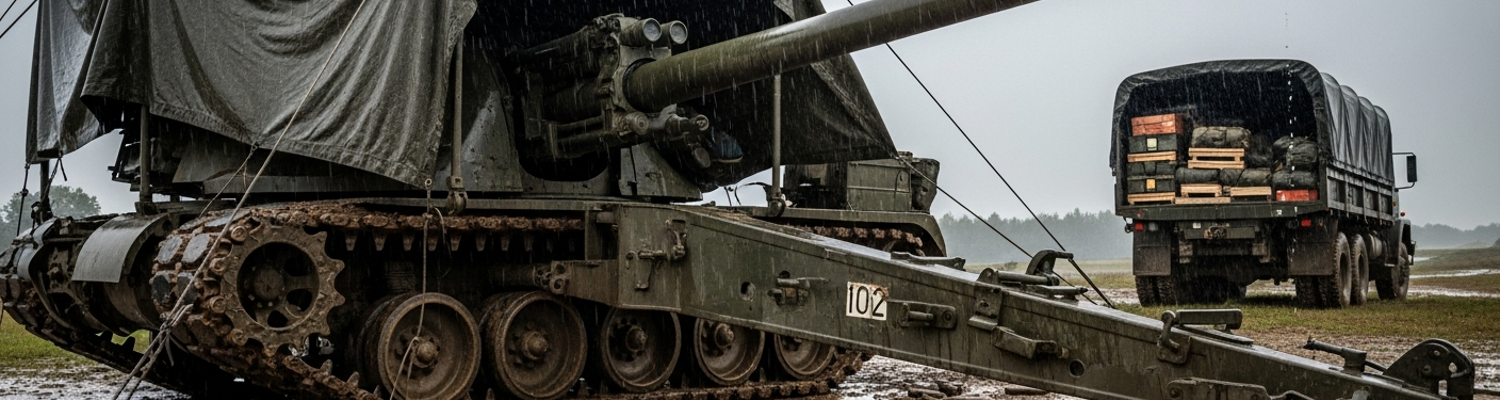

Enemy artillery strength was a known quantity. Intelligence reports detailed thousands of tube assets and rocket launchers, a grid of firepower capable of saturating any target. Allied firebases did not counter with numbers. They countered with superior technology and a constant flow of ammunition. That flow was about to stop.
The monsoon arrived as a physical force. A close review of operational logs from the II Corps tactical zone shows a clear pattern. Supply convoys were being defeated by the environment itself. On primary supply arteries like Route 19, the laterite clay surface devolved into a viscous, red-brown sludge. The standard M35 2.5-ton cargo trucks found their dual rear axles spinning without purchase. Steel winch cables snapped under the strain of pulling vehicles sunk to their frames. A single immobilized truck could halt an entire convoy for a full day-night cycle. Maintenance records from the period (NARA Record Group 472) document a surge in clutch burnouts and transmission failures as drivers fought the terrain.
The decision was made to use tracked M548 cargo carriers to haul pallets of 105mm shells forward, a role they were not designed for. This only shifted the point of failure. The higher operational tempo on the M548s resulted in track and suspension breakdowns deep in unsecured territory, creating vulnerable targets.
The guns were running dry. At forward fire support bases like the isolated FSB Kestrel near the Laotian border, the 105mm howitzer batteries of the 101st Airborne Division felt the consequences directly.
These positions were designed for 360-degree defense, wholly dependent on their own firepower. The M102 howitzer, light and possessing a high rate of fire, was a potent weapon.
Its crews were now forced into a painful ammunition calculus. Archival evidence shows that during the height of the monsoon, daily ammunition expenditure was rationed to as few as five rounds per gun per day for anything other than a direct ground assault. Supply sergeants became misers. Their chalkboards tracked individual high-explosive and white phosphorus rounds with grim precision. Illumination rounds, once used liberally, now required direct authorization from the battalion commander.
Gun crews, accustomed to action, were left in a state of enforced idleness. Their tubes were cold. They listened to the drumming of rain on the sandbagged roofs of their gun pits.
This logistical strangulation translated into long waits for fire support. An infantry platoon making contact with a larger enemy force would send a frantic call for an immediate fire mission. The forward observer’s coordinates would be relayed to the firebase’s Fire Direction Center. The FDC personnel would plot the target, calculate deflection and quadrant elevation, and pass the data to the gun line. Then, a delay. The battery executive officer, checking the fire mission against his ammunition status board, would have to deny the request or place it in a queue.
An immediate suppression mission became pending resupply. After-action reports indicate waits of 30 minutes to an hour were common for high-priority fire missions. For units pinned down, 30 minutes was an eternity. Tactical initiative was lost. Casualties mounted.
The rain did more than turn the ground to mud. It waged a dedicated war on the electromagnetic spectrum. A technical review of field equipment from the period reveals a systemic vulnerability in tactical communications.
The AN/PRC-25 radio was known to be generally robust. It had one significant vulnerability. The handset was highly susceptible to moisture. Saturated air during the monsoon was enough to degrade signal clarity, allowing static to overpower a speaker's voice. During heavy rain, water infiltration into the microphone element could render transmissions completely unintelligible. Radio Telephone Operators developed field-expedient fixes, stretching the plastic from battery blocks over their handsets. This was a flimsy defense.
Compounding the equipment issue were atmospheric physics. The air, thick with moisture and agitated by storm fronts, scattered and absorbed the line-of-sight VHF radio waves. A signal that was clear in the dry season became a faint whisper, forcing units to use high-power relays that created an electronic target for enemy signals intelligence.
For the forward observers of the 2nd Battalion, 28th Infantry, the communication breakdown was about to manifest in a catastrophic way.
Hunkered down in a waterlogged observation post designated Blue 2, a three-man team tracked a North Vietnamese Army 82mm mortar crew setting up in a treeline. The target coordinates were confirmed: XT 893 416. The FO, wrestling with his AN/PRC-25, began transmitting the fire mission request to the Fire Direction Center at FSB Pershing, several kilometers to the rear.
His first two attempts were lost to static. On the third, a partial transmission broke through.
The FDC, straining to hear over the hiss, received the call. Archival records of the FDC log show the target was recorded not as XT 893 416, but as XT 898 416. A single numeral was misheard.
The five-hundred-meter shift was not questioned. The FDC crew plotted the coordinates, calculated the firing solution for Mission 7-1-4, and transmitted the data to the gun pits of B Battery, 2nd Battalion, 320th Field Artillery.
Six M102 105mm howitzers executed the command. Within ninety seconds, six high-explosive shells were arcing through the storm.
They did not impact the NVA mortar position. They slammed directly into the center of Ap Doan Ket, a small, neutral hamlet of rice farmers.
The six shells, carrying a combined total of nearly 30 pounds of Composition B explosive, detonated almost simultaneously. The fragile structures of bamboo and thatch were obliterated. Wooden homes were shredded into lethal projectiles. Superheated fragmentation from the steel shell casings scythed through the village.
There was no immediate battle damage assessment. The FO at Blue 2 saw no impacts on his designated target. His report back to the FDC logged the standard term SHOT, OVER. This was followed by a confused transmission indicating END OF MISSION, TARGET NOT ENGAGED.
The FDC at FSB Pershing logged the mission as complete and moved on.
No ground patrol could be dispatched to the impact zone. It was deep within a contested area.
Official operational records simply noted the expenditure of six HE rounds on a suspected enemy position.
The loss of life in Ap Doan Ket was uncounted. It existed only as a five-hundred-meter discrepancy in a radio log.
In a leaking general-purpose tent near the gun pits of FSB Kestrel, a supply sergeant from the 101st Airborne Division and his two clerks began the methodical work of accounting for the failure.
Caked in the same red-brown sludge that had defeated their convoys, they worked under the dim light of a single lantern. Their skin was pale and wrinkled from weeks of dampness.
Early stages of immersion foot were present.
Their task was not one of strategy, but of grim, tactile accounting. They physically counted the remaining 105mm shells, sorted serviceable fuzes from those corroded by moisture, and documented the dozens of M548 and M35 vehicles sitting deadlined just outside the wire.
A persistent, low-grade fever ran through the team, a product of poor sanitation and exposure. Every movement was an effort, their limbs heavy with fatigue.
The air was thick with the smell of wet canvas, diesel, and cordite.
Their fingers, stiff and clumsy, fumbled with the catches on ammunition crates, the wood swollen and soft.
The sergeant, a career NCO, pushed them on, his voice a low rasp. This raw data, captured now, was more valuable than any polished report written weeks later.
His desk was a discarded ammunition crate. His paperwork was a stack of DA Form 2404 Equipment Inspection and Maintenance Worksheets, already curling from the humidity.
A review of these initial, hand-written reports reveals a litany of breakdown. With a grease pencil, the sergeant meticulously noted the serial numbers of M102 howitzers whose breechblocks had seized.
He logged the high number of dud rounds from specific ammunition lots, hypothesizing that moisture had penetrated the seals on propellant casings. He cross-referenced maintenance logs from the motor pool, detailing the precise point of failure on the M35 trucks.
The sergeant’s notes also captured the communications breakdown. He recorded the high failure rate of the AN/PRC-25 radio handsets, noting field-expedient waterproofing had failed.
Most chillingly, he drew a direct line from this equipment failure to the tragedy at Ap Doan Ket.
He took the FDC log from B Battery, 2nd Battalion, 320th Field Artillery, showing Mission 7-1-4 called on coordinates XT 898 416. He placed it alongside the after-action statement from the 2nd Battalion, 28th Infantry’s forward observer, which listed the correct target as XT 893 416 and noted the target was not engaged.
The 500-meter discrepancy, born of static, was now officially documented in smudged graphite and mud.
The after-action reviews, specifically the annexes contained within the report designated Cases 357 cont. 363, documented a cascade of interconnected failures. These were not isolated incidents. They were symptoms of a system pushed past its breaking point.
A close review of these files shows the problems began with the ammunition itself. Point-detonating fuzes from specific production lots, stored under extreme humidity, exhibited a high failure rate. Moisture penetrated the supposedly weatherproof seals, corroding delicate internal mechanisms. Even when a fire mission was executed, a significant percentage of rounds would either fail to arm or bury themselves deep in the soft, waterlogged earth before detonating, muffling their effect.
Gun crews began referring to these rounds as duds, a simple term for a complex logistical and manufacturing breakdown.
Compounding the material failures were deep gaps in tactical procedure. The tragedy at Ap Doan Ket was a direct result.
A detailed analysis of the event reveals the breakdown was not simply a misheard coordinate. It was the failure of a doctrine that lacked a mandatory safeguard for such conditions.
Standard operating procedure in the Fire Direction Center did not require a verbatim read-back of target coordinates from the forward observer. Such a step would have instantly caught the 500-meter error. The protocol assumed a level of signal clarity that the monsoon rendered impossible.
The garbled transmission from the RTO at observation post Blue 2 should have triggered an immediate request for confirmation using a pre-established code. Instead, operating under pressure with a queue of pending fire missions, the FDC crew of the 2/320th Field Artillery processed the corrupted data as it was received.
The six-gun volley was fired. Because no battle damage assessment could be conducted, the mission was logged as complete. The operational blindness exposed the most critical gap.
The flawed protocols governing indirect fire in a counter-insurgency context.
The concept of Harassment and Interdiction fires, unobserved shoots at suspected enemy transit routes, was predicated on an assumption of an empty battlefield. In the dense, fluid operational area around FSB Kestrel, this was a lethal fiction.
The incident at Ap Doan Ket was an H&I fire in all but name. It was unobserved, unconfirmed, and its effects were unknown.
The existing protocols lacked a mechanism for positive target identification in degraded weather, relying instead on the assumed accuracy of a single point of data. There was no secondary verification system, no cross-referencing with available intelligence on civilian population centers, which were often poorly mapped.
The doctrine was built for a conventional war on the plains of Europe, not for a tangled fight in triple-canopy jungle.
Cases 357 cont. 363 identified this as the core problem. The artillery was employing tactics of annihilation in a war that demanded precision, and the protocols had not yet adapted.
The field-level reports, written on rain-swollen paper, coalesced into an indictment of existing artillery doctrine. A review of after-action annexes from II Corps shows these were not pleas for more equipment, but demands for immediate changes to procedure.
The raw data on high dud rates, the documented failures of AN/PRC-25 handsets, and the 500-meter targeting error that destroyed Ap Doan Ket were compiled.
The evidence was irrefutable. Established methods of delivering indirect fire were failing in the monsoon environment. The failures were systemic.
Read-backs became mandatory. In response to the clear link between garbled radio transmissions and lethal errors, one of the first adjustments was a change to communications protocol.
A proposed Adverse Weather Checklist circulated for review mandated a verbatim read-back of all grid coordinates from the transmitting forward observer. A simple roger or copied was no longer sufficient.
FDC crews were required to repeat the entire grid, forcing the FO to confirm its accuracy before the first firing data was calculated. This introduced a deliberate delay, but it was seen as a necessary safeguard.
For the 105mm ammunition, recommendations focused on forward storage. Units were advised to construct semi-permanent, climate-controlled bunkers for fuzes and powder charges, using layers of sandbags and plastic sheeting to create a barrier against the dampness.
The lessons learned went beyond technical adjustments. They forced a re-evaluation of fundamental artillery tactics. Harassment and Interdiction fires, a staple of conventional warfare, proved to be dangerously indiscriminate.
A close analysis of firing logs from units like the 2/320th Field Artillery showed a high volume of H&I missions fired nightly. In the context of a counter-insurgency, firing thousands of high-explosive shells at targets that were not positively identified was deemed an unacceptable risk.
The new, emergent doctrine began to stress the primacy of positive control. Except for troops-in-contact emergencies, fire missions would increasingly require visual confirmation from a forward observer or verification from a secondary intelligence source.
The era of firing at a set of coordinates on a map was coming to a close, replaced by a demand for confirmed targets and observed effects.
Firing charts in the FDC were to be updated with the most recent intelligence on civilian locations, adding another layer of verification before a lanyard was pulled.