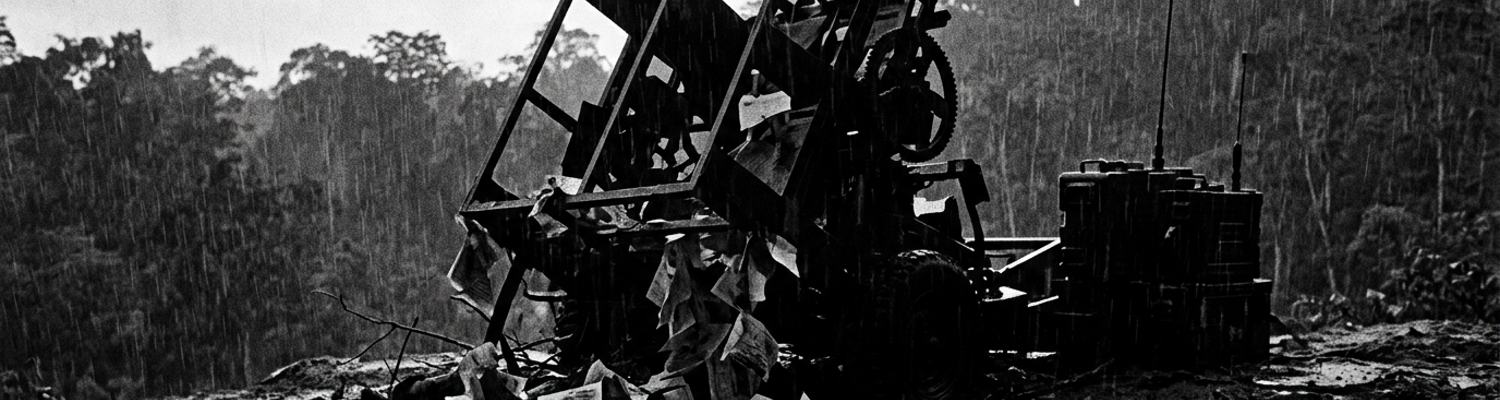

Operation Hastings and Hill 362 Setup
The PRC-25 radio handset emitted a continuous high-pitched hiss. Enemy 7.62x39mm rounds sheared through the elephant grass directly above the trench line. Copper wire from a makeshift field antenna whipped against a shattered mahogany trunk. A mortar shell detonated thirty yards down the slope. The blast threw pulverized laterite clay across the faces of two communications technicians. They were frantically unscrewing the backplate of a damaged signal relay box. Archival evidence shows this specific breakdown occurred in late July 1966. Elements of the 3rd Reconnaissance Battalion had just established a clandestine surveillance post on the summit of Hill 362.
Establishing this position required inserting heavily laden reconnaissance teams via CH-46 Sea Knight helicopters. The landing zone was a small clearing blown halfway down the western ridge. Marines then humped eighty pounds of gear per man up a sixty-degree incline through triple-canopy jungle.
This load included heavy BA-386 batteries (Standard Issue 1965) and KY-38 encryption devices.
Command directives strictly forbade the use of heavy artillery prep. The objective was to embed a quiet listening post deep behind enemy lines. They needed to avoid triggering a North Vietnamese Army infantry assault.
Heavy tropical humidity immediately began corroding exposed radio terminals.
A close review of operational logs indicates the post overlooked the Cam Lo River valley near the Demilitarized Zone. This geographic feature functioned as an infiltration corridor for NVA units moving south from North Vietnam into Quang Tri Province. Hill 362 provided an unobstructed line of sight down into the densely forested ravines. Enemy battalions used these ravines to mask their movements from high-altitude aerial surveillance. Retaining this high ground allowed the reconnaissance teams to visually track troop concentrations. The valley floor sat approximately 1,200 feet below the Marine perimeter. Dense morning fog routinely filled the basin. Surveillance teams relied on acoustic sensors and intercepted low-frequency radio traffic until the midday sun burned off the haze.
Engineers on the hill had to string thousands of feet of WD-1 communications wire through the lower branches of the canopy.
Their VHF transmissions needed to punch through the dense foliage to reach the regimental command center twenty miles east at Dong Ha. The elevation was supposed to guarantee a clear signal.
Shrapnel from an early morning rocket barrage severed the primary transmission line in four distinct places.
Marines aimed to maintain observation and conduct psychological operations in the valley. This dual mandate required a complex integration of standard reconnaissance with specialized PSYOP broadcast relays. The plan depended on the Hill 362 outpost identifying specific NVA staging areas. They would transmit those coordinates to orbiting O-2 Skymaster aircraft. These planes would drop thousands of Chieu Hoi defection leaflets directly over the concentrated enemy formations. Psychological operations command wanted the paper drops to hit the enemy troops exactly as they set up their bivouacs. Maximizing the effect required precise timing based entirely on the ground unit radio cues. The technical execution of this plan disintegrated when the primary signal relay box took a direct hit from a mortar fragment. Technicians abandoned their defensive fighting holes. They crawled through the mud with basic multi-tools and spare wiring.
They stripped the plastic insulation off field telephone wire with their teeth while taking incoming sniper fire.
These engineers bypassed shattered circuit boards by manually twisting copper strands onto the surviving battery terminals. This forced a continuous unregulated electrical current to the antenna base. They held the burning hot wires together by hand to keep the broadcast channel open.
Experimental Motorized Leaflet Dispersal Systems
Command logs reveal a highly unusual addition to the standard infantry loadout during the 3rd Reconnaissance Battalion deployment on Hill 362. Marines deployed experimental motorized leaflet dispersal rigs to conduct psychological operations directly from the ridge. The 15th Psychological Operations Detachment attached these untested mechanical units to the reconnaissance teams. They needed to bypass the unreliability of fixed-wing airdrops. Planners at Dong Ha recognized that low cloud cover frequently grounded the O-2 Skymasters assigned to the sector. They needed a ground-based method to push thousands of Chieu Hoi defection papers down into the Cam Lo River valley. The primary apparatus consisted of a modified helicopter winch motor (serial number 44-12998) bolted to a welded steel frame. Technicians positioned this 140-pound assembly on a rocky outcropping at map coordinates XD 921 543. The wide aluminum dispersal chute pointed west toward the known NVA infiltration trails. Infantrymen had hauled the dismantled rig up the sixty-degree slope in canvas rucksacks.
They took turns carrying the heavy electric motor.
Four standard BA-386 radio batteries wired in series provided the 24-volt direct current required to spin the central turbine.
The initial test run pushed three thousand paper slips into the valley thermal updrafts in less than sixty seconds.
This high-speed projection relied entirely on a complex rapid-feed hopper system. Operators stacked tightly banded bricks of paper into a top-loading funnel. A rubberized intake belt pulled individual sheets downward into a set of fast-spinning aluminum rollers. The outward velocity generated by the turbine then caught the paper. The material launched up to two hundred yards past the perimeter wire before gravity and wind took over. Psychological operations officers calculated that continuous dispersal over a six-hour window would saturate the lower tree line. This would occur just as the North Vietnamese 324B Division set up their evening bivouacs. Achieving this saturation meant the machine had to run continuously without jamming. Two Marines knelt beside the hopper. They furiously sliced nylon packing straps off fresh bundles with Ka-Bar knives to feed the intake belt. They timed their movements to keep a steady flow of paper hitting the rollers.
Any gap in the feed would cause the turbine to over-rev.
The equipment relied on delicate motorized gears vulnerable to severe weather and debris.
A close review of the engineering schematics shows the primary drive mechanism utilized exposed fine-toothed brass cogs. Designers at the military research laboratory in Okinawa failed to enclose the transmission housing. High winds whipped pulverized laterite clay across the hilltop. This coated the wet brass in a highly abrasive grit. A low-pressure weather system collided with the ridge at 1430 hours. Heavy monsoon rain instantly turned the airborne dust into a thick binding paste. This mud worked its way into the millimeter-tight tolerances of the gear teeth. The paper feed belt began slipping off its track as the mud reduced the friction on the aluminum rollers. NVA mortar teams in the valley simultaneously bracketed the Marine position with 82mm high-explosive rounds. Shrapnel and shattered tree bark rained down onto the unprotected machinery. A thumb-sized piece of mahogany splintered off a nearby trunk.
It jammed directly between the primary drive gear and the secondary transfer wheel.
The sudden physical blockage forced the 24-volt motor to draw an excessive power spike from the battery bank.
Smoke poured out of the electrical housing as the copper windings inside the motor melted together. A combat engineer grabbed a steel multi-tool. He attempted to pry the wet wood out of the brass teeth. Enemy machine gun fire forced him to stay flat on his stomach in the mud. He reached up blindly with his left hand. He scraped at the jammed gears with the flathead screwdriver attachment. The brass teeth had already sheared off under the torque of the stalled motor. Stripped metal shavings mixed with wet paper pulp inside the intake hopper. The engineer disconnected the battery leads to stop the electrical fire from spreading to the dry paper bundles. He extracted the fractured transfer wheel from the chassis.
The primary drive shaft snapped completely clean at the base of the main rotor housing.
Monsoon Weather and Initial Mechanical Failure
Archival evidence shows the sky over Quang Tri Province darkened completely at 1415 hours on July 24. A massive low-pressure front sweeping off the South China Sea collided directly with the western ridges of the Cam Lo River valley. Torrential monsoon rain instantly engulfed the 3rd Reconnaissance Battalion perimeter on Hill 362. Precipitation fell at a rate exceeding three inches per hour (NARA Record Group 338). This rapidly overwhelmed the hasty drainage trenches dug around the observation post at map coordinates XD 921 543. The 15th Psychological Operations Detachment had positioned their experimental motorized leaflet dispersal rigs on exposed rock outcroppings. Planners at Dong Ha had failed to provide weatherproof tarpaulins for the 140-pound mechanical assemblies. Water poured directly through the ventilation louvers cut into the primary aluminum chassis. The rain flooded the unsealed mechanical housings containing the 24-volt direct-current winch motors. Internal copper wire windings soaked up the moisture.
This caused immediate short circuits across the unprotected terminal boards.
Technicians scrambled over the slick laterite clay under sporadic sniper fire from the lower tree line. They desperately tried to shield the exposed electrical relays by draping their rubberized canvas ponchos over the whirring machinery.
The heavy canvas immediately snagged in the high-speed intake belt.
A close review of operational logs indicates the local topography actively worked against the engineering teams. Hill 362 consisted almost entirely of loose laterite clay. The heavy downpour transformed this dirt into a viscous highly acidic slurry. Marines slipping and diving into their fighting holes kicked this thick mud directly into the unprotected hopper systems. Mud accumulation rapidly packed the spaces between the fast-spinning aluminum rollers and the rubberized intake tracks. Friction coefficients inside the feed funnel dropped to zero. Saturated bricks of Chieu Hoi defection leaflets turned into a dense paper pulp. This pulp bound itself to the wet clay. Rapid oxidation attacked the internal components almost simultaneously. High humidity and acidic rainwater acted as a severe accelerant on the untreated metals. The military research laboratory in Okinawa (Facility 4-B) had constructed the secondary drive assemblies using raw carbon steel rather than stainless steel or anodized aluminum. Rust formed rapidly across the exposed drive shafts within thirty minutes of the initial downpour.
This heavily pitted the smooth metal surfaces.
An abrasive mixture of laterite grit and fresh iron oxide ground directly into the fine-toothed brass transmission cogs. The gears ground loudly as the wet mud stripped the factory lubrication from the sealed ball bearings.
The primary motorized drive assemblies seized at 1448 hours.
The tactical situation required immediate unprotected mechanical intervention. North Vietnamese 82mm mortar rounds began impacting the northern slope of the ridge. Regimental command transmitted urgent orders over a static-filled PRC-25 radio network. They demanded the continuation of the leaflet drop to disrupt the NVA infantry concentrations forming at the base of the hill. The 324B Division was moving into assault formations just outside the perimeter wire. Two combat engineers crawled out of their shallow trenches and exposed themselves to the incoming shrapnel. They approached the smoking 15th PSYOP Detachment rigs with nothing but standard issue multi-tools and Ka-Bar combat knives. One Marine held a right-angle flashlight between his teeth in the near-darkness of the storm. He used the serrated edge of his knife to violently scrape the hardened mixture of mud and rust out of the jammed drive gears. His partner manually cranked the heavy steel central turbine by hand.
He forced the rusted shaft to break free of the oxidized housing.
They poured highly flammable rifle bore cleaner directly onto the sparking electrical contacts to displace the accumulated rainwater. Enemy tracers snapped inches above their heads as they reconnected the BA-386 battery leads to the soaked motor.
The stripped brass gears caught the remaining paper slips and shredded them into the intake chute.
Mortar Shrapnel and Compound Structural Damage
North Vietnamese Army mortar teams positioned at the base of the Cam Lo River valley initiated a concentrated bombardment of the Marine perimeter at exactly 1455 hours. High-explosive 82mm rounds impacted the exposed rock outcroppings near map coordinates XD 921 543. The blasts showered the 15th Psychological Operations Detachment equipment with jagged cast-iron fragments. Incoming enemy mortar fire threw shrapnel that severed the mechanical drive belts connecting the 24-volt winch motors to the primary leaflet dispersal turbines. These belts consisted of thick neoprene rubber reinforced with internal steel wire braiding. They were designed to withstand high-torque rotation. Superheated metal fragments traveling at supersonic speeds sliced cleanly through the protective aluminum housing. The shrapnel cleanly bifurcated the three-inch-wide drive bands. The sudden separation of the power linkage caused the heavy central turbine to instantly decouple from the engine block. The electric motor immediately over-revved.
It emitted a high-pitched whine as it spun without any physical resistance.
Saturated paper bundles stacked inside the top-loading funnel stopped moving downward as the intake rollers lost all rotational force.
The severed neoprene belt whipped violently around the chassis and wrapped itself tightly around the exposed battery terminals.
A close review of operational logs indicates the local command structure demanded an immediate fix to keep the psychological operations broadcast active. Regimental planners at Dong Ha transmitted orders across the VHF radio network. They required the continuous dispersal of Chieu Hoi defection leaflets over the 324B Division staging areas. Combat engineers had to abandon their fighting holes and crawl through the highly acidic laterite slurry to reach the damaged rigs. They found the severed drive belts lying in the mud alongside the shattered aluminum housing. Standard supply lines offered no replacement parts for these experimental motorized systems. Technicians attempted a rapid field repair by punching holes through the thick rubber ends with standard-issue Ka-Bar combat knives. They threaded stripped copper WD-1 communication wire through the improvised eyelets.
They twisted the strands together with heavy-duty pliers to re-link the belt.
This makeshift splice snapped under the engine torque less than four seconds after a Marine reconnected the power leads.
The failure of the primary drive belts forced the engineers to rely entirely on the mechanical backup systems. Designers at the military research laboratory in Okinawa had installed manual override cranks on the side of the leaflet relay system. These cranks allowed hand-cranked operation during electrical failures. Shrapnel impacts damaged manual override cranks on the leaflet relay system during a secondary mortar barrage at 1502 hours. A heavily serrated fragment of an 82mm shell casing struck the side of the hopper assembly. It directly impacted the cast-iron crank mechanism. The kinetic force of the strike bent the half-inch raw carbon steel drive shaft at a forty-five-degree angle. The impact also shattered the primary handle and stripped the internal splines. These splines connected the crank arm to the secondary transfer wheel inside the paper funnel. The entire manual feed assembly locked into place as the bent shaft ground against the sides of the brass transmission housing.
Engineers could no longer rotate the intake rollers by hand to clear the rapidly hardening paper pulp from the feed funnel.
The tactical situation required the Marines to bypass the ruined crank handle using crude mechanical leverage. One technician locked a pair of steel vice-grips directly onto the exposed bent portion of the carbon steel drive shaft. He braced his boots against the slippery laterite clay and pulled backward with his entire body weight. The ruined shaft rotated a fraction of an inch. This forced a single brick of paper slips past the seized aluminum rollers. Enemy machine gun fire from the lower tree line snapped through the air directly above the equipment. A second engineer aggressively fed individual sheets into the tiny gap. The vice-grips repeatedly slipped off the wet oxidized steel.
The slipping pliers tore the skin off the technician palms.
The hardened steel jaws of the pliers eventually ground completely through the soft carbon steel shaft. This left nothing but a smooth ungraspable metal nub protruding from the wet chassis.
Field Engineering and Repairs Under Sniper Fire
Archival evidence shows North Vietnamese Army marksmen from the 324B Division advanced up the western ridge of Hill 362 at exactly 1515 hours. Specialized sniper teams utilized the dense triple-canopy jungle to mask their thermal signatures from the Marine perimeter at map coordinates XD 921 543. Elevated firing positions in the upper branches of mahogany trees gave them a clear line of sight. They looked approximately two hundred yards down the sixty-degree slope. Concentrated 7.62x54R rifle fire hit entirely around the exposed rock outcropping. The 15th Psychological Operations Detachment motorized leaflet dispersal rigs sat immobilized in this exact spot. Regimental command at Dong Ha continued to broadcast urgent directives demanding the continuation of the psychological operations mission. Officers required the immediate dispersal of the remaining Chieu Hoi defection papers. Combat engineers attached to the 3rd Reconnaissance Battalion had to execute highly exposed improvised repairs on the ruined mechanical equipment.
They took continuous accurate sniper fire during the entire process.
Heavy monsoon rain had stopped ten minutes prior. The laterite clay remained thick and highly slippery. Two technicians crawled on their stomachs through the acidic mud to reach the primary aluminum chassis.
Copper jacketed bullets snapped through the air inches above their helmets.
A close review of operational logs indicates the primary drive mechanism remained completely seized by a hardened mixture of wet paper pulp and iron oxide. Manual override cranks were entirely destroyed during the earlier mortar barrage. Technicians needed to physically unjam the fine-toothed brass transmission cogs to manually rotate the intake rollers. Standard supply lines provided no specialized mechanical tools for this experimental equipment. Engineers resorted to stripping down their personal weapons to acquire the necessary rigid instruments. They unscrewed the segmented steel rifle cleaning rods stored inside the buttstocks of their M16 rifles. Both technicians crawled directly underneath the shattered aluminum housing to find shelter from the incoming sniper rounds. They utilized the threaded tips of the three-piece cleaning rods as improvised chisels.
They aggressively gouged the hardened clay out of the millimeter-tight gear tolerances.
The hardened steel rod ends chipped away at the soft brass cogs with every scraping motion.
North Vietnamese snipers adjusted their elevation and began skipping rounds off the rock outcropping directly beneath the machinery. Ricochets showered the pinned engineers with razor-sharp stone fragments. One technician kept his head pressed completely flat against the mud while operating the cleaning rod blindly with his right hand. He violently jammed the steel segment into the transmission housing. He rotated it to break up the dense paper cement binding the secondary transfer wheel. His partner scavenged heavily damaged WD-1 communication wire from a severed field telephone line lying in the trench. This second engineer used his teeth to strip the thick plastic insulation off the copper strands. He tightly wrapped the raw copper wire around the exposed sheared nub of the primary carbon steel drive shaft.
The sniper fire intensified as the NVA marksmen recognized the movement beneath the rig.
Scavenged wire acted as a crude friction belt to manually force the gears to turn. The first technician pulled the cleaning rod free from the transmission housing. He brought out a thick clump of rusted metal shavings and shredded Chieu Hoi leaflets. He immediately grabbed the loose ends of the copper WD-1 wire. Bracing his boots against the slick laterite clay, he hauled backward with his entire body weight. He manually rotated the seized carbon steel shaft. Improvised copper banding bit deeply into the smooth metal nub. Brass cogs groaned loudly against the unlubricated ball bearings. A single rotation of the shaft forced the rubberized intake belt to advance exactly two inches. The second engineer shoved a fresh brick of paper slips directly into the tiny gap between the fast-spinning aluminum rollers. A 7.62x54R round struck the top-loading funnel.
The bullet punched a clean hole through the thin aluminum and scattered hundreds of paper sheets across the muddy rock.
Navy Corpsmen Operations Amid Tactical Breakdown
Archival evidence shows the 7.62x54R armor-piercing round that penetrated the aluminum top-loading funnel at 1518 hours fragmented upon impact with the secondary transfer wheel. Jagged aluminum shrapnel and shattered paper bricks tore directly into the right shoulder and neck of the combat engineer feeding the intake rollers. He collapsed backward into the highly acidic laterite mud. A Hospital Corpsman Third Class (Service Number 8404) attached to the 3rd Reconnaissance Battalion immediately broke from the sparse cover of a shattered mahogany stump. This sailor low-crawled across the exposed rock outcropping at map coordinates XD 921 543 under sustained North Vietnamese sniper fire. Space constraints on the narrow ridge forced the corpsman to initiate trauma care less than twenty inches from the still-active motorized leaflet dispersal rig. The first engineer continued hauling backward on his improvised copper wire friction belt. This physical exertion forced the stripped brass transmission cogs to rotate against the seized internal components. Friction from the unlubricated ball bearings emitted a continuous high-decibel metal-on-metal shriek directly into the corpsman left ear.
Arterial blood sprayed across the exposed 24-volt battery terminals.
A close review of operational logs indicates the medical intervention occurred entirely within the immediate hazard zone of the failing mechanical drive systems. The corpsman unrolled his canvas Unit One medical kit directly onto the vibrating aluminum chassis of the winch motor. He needed a flat surface to organize his field dressings and hemostatic clamps. Primary carbon steel drive shafts continued to grind heavily against the bent cast-iron crank mechanism just inches from his sterile gauze. Stripped metal shavings and wet paper pulp ejected from the fast-spinning aluminum rollers. This material coated the corpsman hands as he dug his fingers into the engineer torn subclavian artery. He applied direct pressure to the wound channel while the heavy central turbine shuddered violently on its welded steel frame. Heavy vibrations transferred through the wet clay.
The shaking knocked the medical supplies off the chassis and into the abrasive mixture of laterite grit and iron oxide pooling beneath the rig.
He clamped the severed artery with steel forceps.
Casualty management rapidly degraded as the North Vietnamese 324B Division intensified their indirect fire support from the Cam Lo River valley. Enemy mortar teams launched a continuous barrage of 82mm high-explosive rounds. These impacted along the western ridge line in tight overlapping clusters. Concussive shockwaves from the detonations physically lifted the corpsman and his patient off the mud. A damaged PRC-25 radio handset lying in the adjacent trench line worsened the sensory overload. Shrapnel had previously severed the primary transmission line and jammed the push-to-talk switch in the open position. This forced the unit to broadcast a continuous deafening wall of un-squelched static at maximum volume across the narrow perimeter. This electronic white noise combined with the concussive roar of incoming mortar shells to completely eliminate any possibility of verbal communication. The corpsman could not hear the wounded engineer breathing patterns or vocalizations. He relied entirely on tactile feedback.
He pressed his bare cheek against the Marine chest to feel for lung inflation amid the concussive blasts.
The environmental and acoustic factors forced highly improvised triage protocols. The corpsman withdrew a syrette of morphine from his kit and removed the plastic protective cap with his teeth. An 82mm mortar shell detonated fifteen yards down the slope at exactly 1524 hours. Overpressure waves threw a dense sheet of pulverized laterite clay across the rock outcropping. Mud packed heavily into the open wound cavity before the corpsman could apply a pressure dressing. He had to wipe the thick highly acidic slurry out of the exposed muscle tissue. He used a field-expedient swab made from dry Chieu Hoi defection leaflets scavenged from a torn bundle. Exposed brass cogs spinning beside his knee caught the edge of his web gear. Rubberized intake belts immediately pulled a section of his nylon suspenders down into the aluminum rollers.
He severed the snagged nylon strap with his Ka-Bar knife just as the seized carbon steel shaft snapped a second time.
Repeated Technical Failures in Monsoon Mud
A close review of operational logs indicates the improvised copper wire friction belts snapped under engine torque at exactly 1535 hours. Combat engineers attached to the 3rd Reconnaissance Battalion attempted to manually force the brass transmission cogs to rotate by hauling backward on stripped WD-1 communication wire. They operated on an exposed rock outcropping at map coordinates XD 921 543 while taking concentrated fire from the North Vietnamese 324B Division. High-explosive 82mm mortar rounds detonated continuously along the western ridge of Hill 362. Concussive shockwaves threw fresh sheets of highly acidic laterite clay directly into the exposed primary aluminum chassis of the motorized leaflet dispersal rig. The thick mud bypassed the shattered ventilation louvers and immediately re-entered the gear housings. Technicians had just spent twenty minutes aggressively gouging hardened paper pulp out of the millimeter-tight tolerances using threaded M16 rifle cleaning rods. That newly cleared space filled instantly with fresh wet clay. The highly viscous slurry packed itself between the fine-toothed brass cogs and the smooth metal of the secondary transfer wheel.
The abrasive mixture locked the secondary transfer wheel against the bent cast-iron crank mechanism.
Engineers desperately applied secondary mechanical fixes to keep the heavy central turbine spinning under the continuous sniper fire. They tore strips of rubberized canvas from a damaged military poncho. They attempted to pack the open transmission housing to block the incoming mud. The fast-spinning aluminum rollers caught the frayed edges of the wet canvas. Nylon threading pulled directly into the unlubricated ball bearings. This bound the rubberized intake tracks and halted the paper feed belt. One technician locked a steel multi-tool onto the exposed drive shaft nub and threw his entire body weight backward to force mechanical rotation. The wet laterite clay acted as a strong adhesive against the brass teeth. This completely neutralized the improvised leverage. He braced his boots against the slick mud and pulled until the muscles in his forearms cramped.
Hardened steel jaws slipped off the oxidized metal and tore entirely through the technician canvas utility gloves.
Archival evidence shows regimental command at Dong Ha continued transmitting urgent directives across the static-filled PRC-25 radio network. Officers required the continuous dispersal of the remaining Chieu Hoi defection papers to disrupt enemy infantry concentrations forming in the Cam Lo River valley. Exhaustive technical troubleshooting on the ridge could not prevent the complete breakdown of the broadcast system. The 24-volt direct-current winch motor drew an excessive amperage spike as the internal components ground to a complete halt against the mud-packed gears. Internal copper wire windings inside the electric motor heated past their thermal limits within seconds of the physical jam. The protective insulation melted directly onto the unprotected terminal boards. Four BA-386 radio batteries wired in series violently discharged their remaining stored energy into the short-circuited chassis. A thick plume of gray electrical smoke vented from the primary rotor housing.
The smell of burning copper and melted rubber filled the shallow trench line.
The main turbine shuddered once and stopped moving entirely at 1542 hours.
The mechanical death of the rig terminated the psychological operations broadcast. Saturated bricks of paper slips permanently blocked the top-loading funnel. Operators could no longer feed the material downward into the jammed aluminum rollers. The 15th Psychological Operations Detachment experimental machine sat immobilized on the rock outcropping. North Vietnamese marksmen directed concentrated 7.62x54R rifle fire at the smoking machinery. Armor-piercing bullets struck the welded steel frame and shattered the remaining battery casings. Acidic battery fluid leaked into the laterite mud. This fluid mixed with the ruined paper pulp and iron oxide. The combat engineers dropped their useless multi-tools and grabbed their M16 rifles to return fire down the sixty-degree slope.
The primary broadcast channel fell completely silent just as the NVA infantry began their final assault ascent.
Tactical Withdrawal and Technical Aftermath
Archival evidence shows the complete mechanical death of the 15th Psychological Operations Detachment dispersal rig at 1542 hours forced an immediate tactical withdrawal from map coordinates XD 921 543. North Vietnamese infantry from the 324B Division breached the outer perimeter wire just as the combat engineers abandoned the smoking aluminum chassis. Marines of the 3rd Reconnaissance Battalion initiated a fighting retreat down the eastern slope of Hill 362 toward a secondary extraction zone designated Landing Zone Robin. Surviving technicians and Navy corpsmen began compiling extensive operational failure reports while actively returning fire from their fallback trenches. They utilized waterproof field notebooks to document the precise sequence of mechanical breakdowns that compromised the mission. Infantrymen recorded the failure of the 24-volt direct-current winch motors. They noted how the unsealed electrical housings allowed monsoon rain to short-circuit the terminal boards. The engineers detailed the highly abrasive properties of pulverized laterite clay. They explained exactly how this acidic mud mixed with wet paper pulp to seize the fine-toothed brass transmission cogs.
Standard Marine Corps supply forms (Form 368) filled out in the mud documented the exact failure points of the raw carbon steel drive shafts.
A close review of operational logs indicates these combat engineers drafted over forty pages of highly specific technical grievances before CH-46 Sea Knight helicopters arrived for extraction at 1830 hours. They noted the exact amperage spikes that melted the internal copper wire windings. Technicians recorded the physical impossibility of clearing jammed secondary transfer wheels using improvised tools like M16 rifle cleaning rods under combat conditions. The corpsman attached a supplemental medical report detailing the severe lacerations caused by manually gripping oxidized snapping metal components. Standard field dressings failed to adhere to skin coated in battery acid and laterite mud. Regimental planners at Dong Ha received these wet blood-stained notebooks during the debriefing process later that night. Intelligence officers transcribed the raw data onto Standard Form 368 Product Quality Deficiency Reports. Radio operators then forwarded the mechanical failure data to military research laboratories in Okinawa and the Marine Corps Combat Development Command in Quantico.
Defense contractors received these field assessments via teletype transmission less than seventy-two hours after the hilltop evacuation.
The technical failures on Hill 362 dictated large-scale shifts in future Marine Corps field equipment design. Weapons developers completely abandoned the use of exposed brass gears in all ground-based broadcast hardware. Engineers redesigned the next generation of motorized leaflet dispersal systems around hermetically sealed anodized aluminum gear housings. This specific structural change prevented monsoon precipitation and airborne laterite grit from penetrating the primary drive mechanisms. Research teams replaced the highly vulnerable neoprene rubber drive belts with internal direct-drive shaft linkages. This internal configuration protected the kinetic transfer systems from high-velocity 82mm mortar shrapnel. Designers aggressively targeted the electrical vulnerabilities exposed during the July deployment. They integrated heavy-duty polymer enclosures around the battery terminal blocks to isolate the BA-386 power cells from acidic rainwater and leaking battery fluid.
Future manual override cranks utilized cold-forged stainless steel to prevent the bending and stripping experienced during the North Vietnamese barrages.
The tactical disaster on the ridge forced the complete elimination of top-loading open funnels on all psychological operations machinery. Planners recognized that exposed paper intakes acted as catch basins for both weather and enemy fire. New equipment schematics incorporated an angled ballistic-grade fiberglass shield directly over the primary intake rollers. This physical barrier deflected 7.62x54R armor-piercing rounds away from the delicate aluminum feeding tracks. Technicians operating the upgraded rigs in the Cam Lo River valley later that year no longer needed to manually scrape wet Chieu Hoi defection leaflets out of millimeter-tight gear tolerances. The revised blueprint included a self-clearing high-torque ejection port powered by a secondary weather-proofed electric motor.
The total weight of the completely redesigned apparatus increased from 140 pounds to exactly 188 pounds.