
Palau Campaign Strategic Imperatives
Operation Stalemate II, the American invasion of the Palau Islands in September 1944, was born from a direct strategic calculation. The entire operation existed to protect the right flank of General Douglas MacArthur’s impending return to the Philippines. Planners in the Central Pacific Area, under Admiral Chester W. Nimitz, saw the Japanese-held airfields in the Palaus as a direct threat to the sea lanes and support formations for MacArthur’s landings on Leyte. Neutralizing these islands was a preparatory step. A necessary one.
A close review of operational logs from the Joint Chiefs of Staff shows a deep strategic division. Two primary paths to defeat Japan were debated: MacArthur’s island-hopping campaign through the Philippines and Nimitz’s proposal to bypass them for Formosa and Okinawa. President Roosevelt’s decision to side with MacArthur locked in the Palau campaign as a non-negotiable prerequisite. The success of the entire Philippines invasion depended on it.
Within this high-level strategy, the small volcanic island of Angaur had a specific, engineered purpose. While the 1st Marine Division was assigned the main objective of Peleliu and its airfield, Angaur, six miles south, was designated as the site for a new, heavy bomber-capable airstrip. Intelligence projections concluded the single airfield on Peleliu would be insufficient for the scale of air operations needed to cover the Philippines and neutralize other Japanese bases in the Carolines. The U.S. Army’s 81st Infantry Division, the Wildcats, was ordered to take Angaur. Army engineering battalions were to immediately begin constructing a 7,000-foot runway for B-24 Liberator bombers. The island itself, a dense jungle of hard coral limestone, was a poor choice for construction. The mission was clear regardless. This phosphate-mining outpost had to become a forward airbase. The 494th Bombardment Group was already slated to operate from the future field, its B-24s tasked with missions supporting the Philippines.
Japanese command, under Lieutenant General Sadae Inoue, understood the Palau Islands' position within their “Absolute National Defense Zone” and prepared a new kind of defense. Archival evidence reveals a significant shift in Japanese doctrine, informed by bloody lessons from prior island battles. Instead of attempting to annihilate American forces on the beaches, a tactic that had proven futile, Inoue’s orders for the 14th Division defenders emphasized defense-in-depth. The strategy was to allow the Americans to land, draw them inland, and bleed them in a protracted battle of attrition from a network of caves, bunkers, and fortified ridges. While large-scale naval reinforcement was not planned, Japanese forces on Peleliu did receive sporadic support from other islands, sustaining the fighting. The core of the strategy was to make the cost of capturing the islands so high it might force a negotiated peace. Suicidal charges were forbidden. The new imperative was to hold prepared positions and kill as many invaders as possible from the Umurbrogol massif on Peleliu and the rugged terrain of Angaur’s Romauldo Hill.
84th Signal Company Angaur Deployment
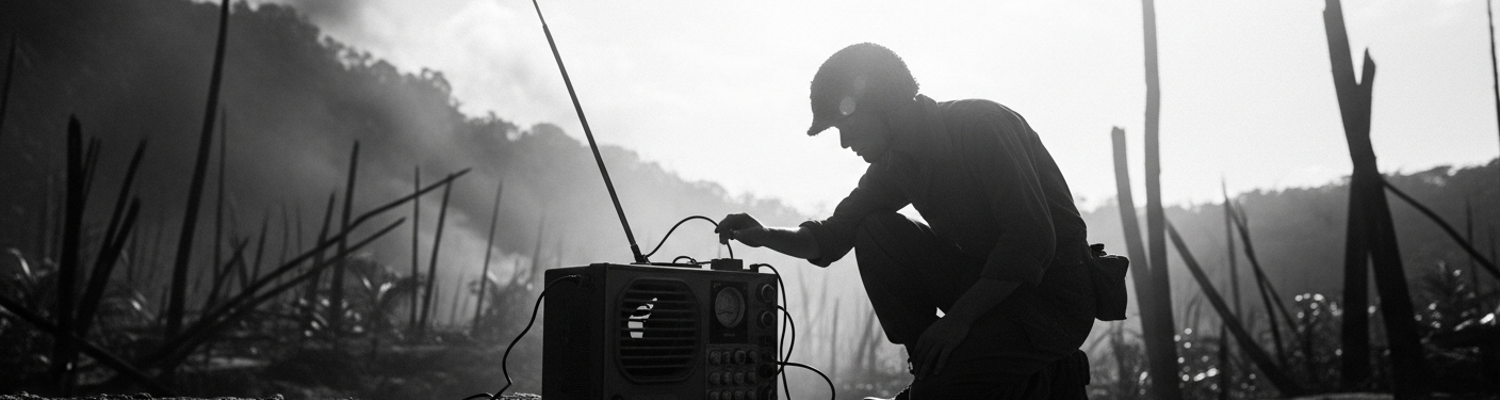
The 84th Signal Company (Forward), an organic element of the 81st Infantry Division, deployed to Angaur Island on 17 September 1944. Operational logs show their arrival was part of the third and fourth waves of the amphibious assault. This sequencing was deliberate, getting them ashore once the 321st and 322nd Regimental Combat Teams had secured a minimal beachhead. They were not shock troops. Their weapons were antennas and vacuum tubes. Their purpose was to establish the electronic nervous system for the island operation.
The men waded through the surf onto Blue and Red Beaches, hauling waterproofed crates and heavy equipment onto the shattered coast. Their primary challenge was the immediate movement of their core communication apparatus: the SCR-399 radio sets. Each set was a complex assembly of a BC-610 transmitter, multiple receivers, and a BC-939 antenna tuner, all housed in a 2.5-ton 6x6 truck or a stand-alone HO-17 shelter. Accompanying this was the equally burdensome PE-95 power generator, typically hauled on a one-ton K-52 trailer. Without it, the high-powered radios were inert blocks of steel. Moving these vehicles and trailers off the beach and through the cratered, coral-choked terrain was a monumental physical task. It demanded brute force and field-expedient engineering just to advance a few hundred yards inland.
An improvised command post was established with desperate speed. The signal company’s main detachment co-located with the 81st Division’s forward command post in a clearing carved from the jungle. The position was a raw scar in the landscape, offering little protection from indirect fire. Signalmen dug frantically into the unforgiving coral limestone, struggling to create revetments for the HO-17 shelters and the PE-95 generators. The constant, deafening drone of the generators became an immediate and unwelcome beacon, a sound signature that would inevitably draw Japanese mortar and artillery fire.
A primary technical function of this early CP was to deploy the long-wire and 45-foot vertical antennas for the SCR-399. This involved stringing wire through the blasted canopies of the few remaining trees, a hazardous job for linemen who had to expose themselves to potential sniper fire. The successful establishment of this node was the absolute prerequisite for the division commander, Major General Paul J. Mueller, to exercise any meaningful command and control over his separated combat teams.
The initial mission scope was twofold, focused on weather and communication. First was the immediate collection and transmission of meteorological data. This was a core enabler for the entire Palau campaign. AAF weather services, for which the Signal Corps often provided personnel and equipment, were tasked with providing detailed forecasts essential for air operations and naval gunfire support. Teams from the 84th deployed field weather kits, including instruments to measure barometric pressure, temperature, and humidity. They launched and tracked pilot balloons, or pibals, using theodolites to calculate wind speed and direction at various altitudes. This information was of direct consequence for both artillery fire missions on Angaur and for the pilots of the 7th Air Force who would soon fly from the island. These raw observations were encoded and transmitted via the new radio net, feeding a larger theater-wide meteorological picture.
Second was the setup of a radio relay station. Angaur was a link in a chain of command stretching from the beachhead back to III Amphibious Corps headquarters and across the seven-mile strait to the 1st Marine Division on Peleliu. The SCR-399, with its powerful high-frequency signal, was capable of this over-water communication. On the island itself, the 84th had to establish reliable links between General Mueller’s CP and the command posts of the 321st and 322nd infantry regiments. Their tactical nets often used shorter-range FM radios like the SCR-300 or vehicle-mounted sets. The island’s rugged terrain created significant interference and dead zones for VHF radio waves, which are limited to line-of-sight. The men of the 84th were constantly troubleshooting, repositioning antennas and experimenting with frequencies to overcome the island’s physical obstructions.
Nascent Forward Air Control Operations
The concept of directing tactical airpower from the ground was, by late 1944, an ad-hoc science forged in the Pacific. On Angaur, this took the form of Army signalmen from the 81st Division’s signal company forming improvised Air Liaison Parties, a doctrine borrowed from experience in other theaters. These teams, often just a few soldiers, were tasked with providing terminal guidance for aircraft belonging to entirely different branches of the armed forces.
Operational logs show the primary air support for the Army’s fight on Angaur and Peleliu came from Navy F6F Hellcat and Marine F4U Corsair fighter-bombers. These were launched from escort carriers of the U.S. Third Fleet offshore. This created a complex command problem. An Army sergeant from the 81st Signal Company, positioned near the front line fighting in the Romauldo Hill complex, would be responsible for communicating directly with a Navy pilot thousands of feet above. He would be attempting to guide ordnance onto a Japanese cave entrance mere yards from American positions.
The technical and doctrinal challenges of implementing this early form of forward air control (FAC) in the dense terrain of Angaur were profound. The primary communication tool for these forward parties was a VHF radio, often a man-portable set like the AN/TRC-7, designed for ground-to-air communication. These radios were plagued by limitations. Their very-high-frequency signals were strictly line-of-sight. The rugged coral ridges and dense jungle canopy of Angaur could easily block transmissions. A FAC team might have to repeatedly expose itself to enemy fire, scrambling to different positions simply to establish a clear signal. The doctrine was also immature. Army ground teams used terminology and procedures unfamiliar to Navy and Marine pilots, who had their own developing methods for close air support. Post-action reports from across the Pacific theater highlight frequent confusion over target marking, grid coordinate systems, and attack headings. These errors could have catastrophic results. The process was a nerve-wracking exercise in trust, with pilots having to put complete faith in the disembodied voice of a soldier they could not see.
This tenuous link became essential for severing the final lifelines to the Japanese garrison. While large-scale naval reinforcement of the Palaus was impossible, Japanese forces still made desperate attempts to shuffle troops and supplies between the larger island of Babeldaob, Peleliu, and Angaur. These movements typically consisted of small convoys of armed barges and launches, often under the cover of darkness. Air Liaison Parties played a direct role in countering this threat. Ground observers from the 321st or 322nd Infantry Regiments would spot the barge traffic in the six-mile strait separating Angaur from Peleliu and relay the information to the FAC team. The controller would then vector in aircraft to interdict these targets. Directing air strikes at night against small, moving watercraft was exceptionally difficult. It often required the aircraft to drop flares to illuminate the target area before making a strafing or bombing run. Every successful strike further isolated the defenders under Major Ushio Goto, tightening the siege.
Signal Equipment Logistical Shortfalls
A close review of operational logs reveals the 81st Signal Company landed on Angaur chronically underequipped. The unit’s Table of Organization and Equipment, the doctrinal blueprint for its capabilities, had been stripped bare by theater-wide shortages. The logistical effort required to support a multi-front global war meant that units at the far end of the supply chain often received equipment piecemeal, if at all. Competition for the newest radio systems was fierce. The European theater and higher-priority operations frequently took precedence. For the men of the 84th, this was a dangerous deficiency. They were tasked with maintaining the electronic nervous system of a divisional operation using a patchwork of older, worn-out equipment.
This supply deficit forced a heavy reliance on temperamental and outdated radio sets. The SCR-193 and the SCR-284 were the principal examples. The SCR-193, a vehicle-mounted high-frequency transmitter and receiver, was a pre-war design. While powerful for its time with a 75-watt output, it was mechanically complex. Its dynamotor power supply, the BD-77, was a known point of failure. Its master-oscillator design required careful tuning and was susceptible to frequency drift in the extreme heat and humidity of the tropics.
The SCR-284, while technically more portable, was a burden. The complete set, including its hand-crank generator, weighed over 100 pounds. It was often broken down into multiple loads for transport by several men. In the rugged jungle and coral terrain of Angaur, this was a significant tactical liability. Reports from other Pacific campaigns, such as New Georgia, noted that the SCR-284 was so heavy and prone to humidity damage that it was sometimes simply left behind. Its transmitter-receiver unit, the BC-654, was notoriously difficult to carry, described as having the size and weight of a modern window air conditioner. Its Micamold brand paper capacitors were infamous for degrading in moist environments, causing performance to fall far below specifications. For the signalmen on Angaur, these were life-threatening flaws.
The situation was made worse by documented delays in receiving both spare parts and newer radio systems. The logistical pipeline for the Pacific was long and fraught with competing priorities. While more advanced sets like the SCR-299 were proving highly effective in other theaters, their distribution to secondary operations like Angaur was slow. The SCR-299, a powerful truck-mounted mobile station, offered significantly greater range and reliability. Its value had been proven from North Africa to Normandy. Yet, records from the Pacific theater consistently highlight the frustration of signal officers waiting for these systems to arrive. The problem extended to the smallest components. A single failed vacuum tube or a burnt-out resistor could render a radio useless. The vast distances and shipping shortages meant that requisitions for spare parts could take weeks or months to fill. This forced signalmen to become masters of improvisation, cannibalizing damaged sets for usable components and attempting field repairs that were far beyond standard procedure.
Angaur Counter-Attack Critical Relay
Operational logs from the 81st Infantry Division’s push against the Japanese defenses on Angaur show the heaviest fighting coalesced around the northwestern corner of the island. Here, in the tortured landscape of coral ridges and caves the Americans named Romauldo Hill and the Bowl, Major Ushio Goto’s veteran defenders fought a battle of attrition. On September 29, 1944, twelve days after the initial landings, elements of the 322nd Regimental Combat Team were attempting to reduce a series of fortified caves near the gorge leading into the Bowl. This position was later named Bloody Gulch.
At approximately 14:00 local time, Japanese forces launched a sudden, localized counter-attack from hidden positions. The attack was not a large-scale charge but a coordinated assault by platoon-sized elements using machine guns and mortars from mutually supporting caves. It was designed to dislodge the Americans pressing on the Bowl’s entrance. Almost immediately, the tactical radio net collapsed. The airwaves flooded with a grating roar, a deliberate jamming effort from a Japanese transmitter likely positioned deep within the Romauldo Hill complex. This was a common Japanese tactic, using a carrier wave modulated with raw alternating current or a fluctuating tone to disrupt American FM and AM frequencies. For the forward companies of the 322nd, pinned down by accurate fire, the electronic noise was as dangerous as the incoming mortars.
The critical link in this sector was a two-man Signal Corps team attached to a forward platoon. Their job was to maintain communication with the regimental command post, a lifeline for calling in fire missions from the 105mm howitzers of the 906th Field Artillery Battalion. The radio operator, a technician first class, was already a casualty of the campaign. He was suffering from a severe case of dysentery, a malady that afflicted hundreds on the island due to poor sanitation and contaminated water. The disease caused debilitating abdominal cramps and weakness, conditions made worse by chronic combat fatigue. His equipment was the SCR-284, a heavy and temperamental radio set. The main BC-654 unit weighed 45 pounds. Power came from a hand-cranked generator, the GN-45, which required a second man to turn a handle continuously to produce the necessary voltage.
This was the situation at 14:05.
The five-minute sequence began with the platoon leader screaming for artillery coordinates. The operator, doubled over with cramps, struggled to tune the BC-654’s dial through the crushing static. The Japanese jamming signal was a pulsed howl. His assistant frantically worked the generator crank, his knuckles scraping against the coral rock he used for cover. The physical effort required to maintain a steady crank speed was immense. Any fluctuation would cause the radio’s voltage to drop, making transmission impossible.
The operator switched from voice to Morse code. He hoped the narrower bandwidth could punch through the interference. He keyed a short, pre-arranged code for a fire mission on a specific grid square just beyond his platoon’s position. The jamming continued. He adjusted the antenna, a simple wire thrown over a blasted tree stump, trying to improve the signal propagation. He keyed the message again. And again. His hearing was strained, listening for the faint click of acknowledgement that might or might not come.
At 14:10, three 105mm high-explosive shells landed precisely on the suspected mortar positions. The transmission, sent through a wall of electronic noise by a sick man using a radio known for its poor performance, had gotten through. The Japanese fire slackened almost immediately. The counter-attack lost its momentum, allowing the infantry to regain fire superiority. The operator received no confirmation; the jamming was still too intense. He only knew the outcome when the incoming mortar rounds stopped.
FAC Strike Delay Consequences
Operational logs from late September 1944 identify a lethal intersection of communication failure, tactical delay, and enemy action in the seven-mile-wide strait separating Angaur from Peleliu. An Army Signal Corps Forward Air Control party, attached to the 81st Infantry Division, identified a high-priority target. Three Daihatsu-class landing barges were spotted moving south from the Babeldaob archipelago, likely attempting to reinforce the last pocket of Japanese resistance on Angaur or to infiltrate Peleliu. The FAC team, operating from a precarious observation post on one of Angaur’s northern ridges, began the painstaking process of vectoring in a flight of F4U Corsairs on combat air patrol. The target coordinates had to be relayed with absolute precision. The barges were small, moving targets, and the proximity of American naval assets meant any error in the grid passed to the pilots could result in a friendly fire incident.
The system failed.
The request for the air strike was subject to immediate and critical delays. After-action reports across the Pacific theater reveal such delays were a common flaw in the nascent science of forward air control. The F4U Corsairs, likely from a Marine Fighter Squadron operating off the newly captured Peleliu airfield, were not on dedicated standby for this specific sector. The initial call from the Angaur FAC team went into a congested radio net, competing with other tactical traffic from the ongoing ground battles on both islands. The first delay was systemic; the request had to be authenticated and prioritized by a tactical air control center before the pilots could be cleared to engage.
A second delay was technical. The line-of-sight nature of the VHF radios was hampered by terrain. A slight shift in the Corsairs’ patrol pattern or the barges’ movement behind a coastal feature could sever the link, forcing the FAC operator to wait precious minutes for the aircraft to come back into a viable position for receiving updated coordinates. During this interval, the Japanese barges continued their transit, unmolested.
This delay had fatal consequences for a nearby Marine reconnaissance patrol. A small team from the 1st Marine Division, operating in a rubber boat, was conducting clandestine hydrographic survey work near one of the small, unnamed islets in the strait. Their mission was likely to chart currents and potential landing sites for future operations. Their stealth was their only defense. The unmolested Japanese Daihatsu barges, armed with multiple Type 96 25mm cannons or heavy machine guns, stumbled upon the exposed Marine position. Without the suppressive fire of the delayed air strike, the Japanese crews were able to bring their full armament to bear on the reconnaissance team. The Marines were caught in open water with no cover and no support. The engagement was one-sided and lasted less than two minutes.
By the time the F4U Corsairs were finally cleared and vectored onto the target, the damage was done. The pilots, guided by the frantic corrections of the FAC, executed their attack runs, strafing the barges with their .50 caliber machine guns and potentially dropping high-explosive bombs. The lead Daihatsu was sunk immediately, and a second was left burning and disabled. The third, damaged, managed to beach itself on a nearby shore. From a tactical perspective, the strike was a partial success, neutralizing two of the three threats. For the men of the Marine reconnaissance patrol, it was a complete failure.