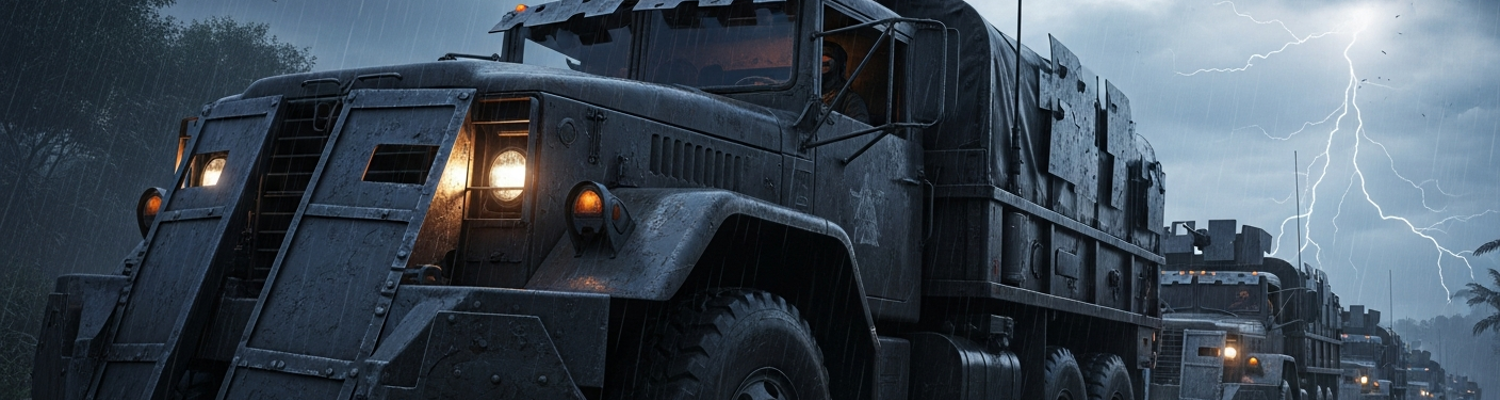

The concept of armoring the vehicles of the war began with a simple, brutal equation. A 7.62mm round fired from an AK-47 could penetrate the aluminum hull of an M113 armored personnel carrier. The solution was equally simple in concept. Bolt on more steel. The execution, however, was a logistical fistfight. Archival evidence shows the primary source for this life-saving steel was not Army quartermaster depots, but distant U.S. Navy shipyards. Plates were cut from decommissioned vessels or pulled from vast naval stores at places like Subic Bay in the Philippines and Yokosuka, Japan. This created an immediate inter-service dependency that sat at the heart of the problem. Navy cargo ships, already tasked with supplying a massive war effort, had to allocate space for what was essentially raw industrial material.
This steel was dead weight.
Operational logs from the ports of Cam Ranh Bay and Da Nang indicate that once the steel plate arrived in-country, its journey had only just begun. The Navy’s responsibility ended at the pier. From there, the Army’s own strained transportation network had to take over. Getting a multi-ton shipment of steel from the coast to an inland base like An Khe or Pleiku was a hazardous, time-consuming operation. Convoys on key arteries like Route 19 were frequent targets for ambushes. The very material intended to protect soldiers was itself a high-risk cargo. Air transport via C-130 was an option, but cargo space was at a premium, fiercely contested by commanders who needed ammunition, food, and medical supplies. A request for airlift for raw steel plate was often denied in favor of more immediate combat necessities. The result was a slow, stuttering flow of armor plate from the sea to the jungle workshops where it was desperately needed.
The workshops themselves represented the next major constriction in the supply chain. These were not purpose-built factories. They were typically maintenance depots, like the 509th Transportation Company’s facility at Long Binh, staffed by mechanics and welders whose primary job was to fix broken-down trucks and generators. Their task was suddenly expanded to include the custom fabrication of armor kits. The term kit is misleading; it suggests standardization. There was none. A review of field modification directives shows that designs for this hillbilly armor or gun truck armor were often drawn up on the spot, tailored to the specific vehicle and the materials on hand. This bespoke approach meant there was no economy of scale. Each piece had to be measured, cut with slow oxy-acetylene torches, and then painstakingly welded into place.
Welders could not keep up.
The demand for armored gun trucks to protect convoys and up-armored M113s for jungle patrols far outstripped the fabrication capacity of these small depots. A single maintenance battalion might only have a handful of skilled welders and a limited number of arc welding machines. The work was slow, hot, and dangerous. The constant need to improvise designs meant that production was an artisanal craft, not an industrial process. This created severe backlogs. A transportation company might have half its trucks waiting in line for armor plating, leaving them unable to perform their primary mission of moving supplies. The fabrication bottleneck ensured that even when the raw steel was available, its conversion into usable protection was a slow bleed.
Beyond the bulk steel plates, long lead times for specialized materials choked the process. Attaching the armor required specific high-tensile strength bolts and fasteners that would not shear off upon impact. These were not standard inventory items in a forward area. A request for a specific grade of bolt had to travel up the supply chain, often all the way back to depots in the United States. The official procurement system was too slow, with lead times often stretching from 90 to 180 days for a single crate of specialized fasteners. The same applied to welding supplies. Certain types of steel required specific welding rods to create a bond strong enough to withstand kinetic impacts. When these ran out, work stopped. Field expedients, like using salvaged materials, were common. Gun truck crews from the 8th Transportation Group became notorious for scrounging armor plate from wrecked vehicles, using whatever bolts they could find, simply because waiting for the official supply system was not a survivable option.
A review of 1st Logistical Command’s after-action reports reveals a system perpetually on the verge of collapse. The journey for a piece of heavy equipment from a naval vessel to a forward fire base was a multi-stage fight against friction. Deep-draft ocean-going ships carrying M48 Patton tanks or bulk steel plates could not navigate the inland river systems, forcing a transfer of cargo at coastal hubs like Cam Ranh Bay or the Army-managed Newport facility in Saigon. This was the first great bottleneck. In these crowded harbors, a 50-ton tank had to be painstakingly lifted by a ship’s crane, a single point of failure, and lowered onto a smaller Landing Craft Utility (LCU) or a powered barge. This process, known as lighterage, was agonizingly slow and entirely dependent on calm seas and perfectly functioning shipboard equipment. A single crane failure could halt the offloading of a ship’s entire hold for days. The process of breaking down palletized cargo into individual, man-handled loads for smaller river craft further compounded delays.
The system bled time at every handover.
Archival evidence from the 9th Infantry Division’s operations shows the next failure point with grim clarity: the forward riverine base. An outpost like Đồng Tâm in the Mekong Delta was not a port; it was a patch of dredged river sand carved out of a swamp. There were no concrete piers or heavy-lift cranes waiting. Landing craft simply drove their bows onto the muddy riverbank. Operational logs show the daily struggle to get a twenty-ton M113, let alone a fifty-ton tank, off a beached landing craft and onto stable ground. The vehicle’s tracks would instantly sink into the soft, saturated soil, churning it into a quagmire. M88 recovery vehicles and bulldozers were on permanent standby, not for combat recovery, but simply to drag incoming equipment the last hundred feet from the river’s edge. Temporary piers made of aluminum matting laid over pontoons were often rated for trucks, not main battle tanks. A commander’s decision to bring an M48 across could buckle the entire structure, shutting down all resupply for that location until engineers could perform repairs.
Moving armor from the relative security of a base into the field presented the final, grinding obstacle. Planners in Saigon saw lines on a map designated as roads, such as National Route 19, but convoy logs from the 8th Transportation Group tell a different story. These highways were often narrow, unpaved tracks. During the monsoon season, the laterite clay of the Central Highlands transformed into a thick, viscous paste that could suck a 12-ton M113 down to its hull. The sheer weight of an M48 Patton was a constant crisis for local infrastructure, routinely causing the collapse of smaller, older bridges not designed for such loads. The jungle environment destroyed mechanical components. Thick vegetation would shear off antennas and external equipment, while hidden stumps and rocks could throw a vehicle’s track, immobilizing it miles from any recovery asset. Engines overheated constantly from the strain of climbing steep, muddy inclines in the oppressive heat, turning a multi-million dollar war machine into a stationary, vulnerable target. The effective operational range of an armored vehicle was not dictated by its fuel tank, but by the mechanical abuse its transmission and suspension could withstand before breaking down.
An examination of supply records from Army units like the 8th Transportation Group reveals the effect of the military’s own requisition system. When a gun truck crew needed steel plate to protect themselves from ambush, they entered a bureaucratic maze designed not for speed, but for peacetime accountability. The process began with a DD Form 1348, a single-page document intended for ordering standard-issue items. There was no box to check for quarter-inch steel plate from a decommissioned Navy ship to be used as improvised armor. This forced company clerks to either incorrectly describe the material or leave critical fields blank, guaranteeing the form’s rejection down the line. That piece of paper then began a long journey from the company motor pool, to the battalion S-4 supply officer, and eventually into the maw of the 1st Logistical Command headquartered in Saigon. An incorrect signature, a missing Federal Stock Number (FSN), or a simple typo could send the request back to its origin, weeks after it was submitted, forcing the process to restart. The system was simply not built for the rapid, non-standard demands of a counter-insurgency.
The paperwork itself became a weapon of the institutional process.
This problem was magnified by a fundamental disconnect in inter-service coordination. Archival memoranda between the services show that the Army and Navy were operating in two separate logistical universes. The Navy, as the executive agent for much of the theater’s early support, controlled the raw material. The steel plates sat in vast depots at Subic Bay or Yokosuka. Army units could not simply order from this stock. They had to submit a Military Interdepartmental Purchase Request (MIPR), a formal request that entered the Navy’s own supply system. A Navy supply chief, whose performance was judged by his ability to support carrier groups on Yankee Station or the riverine flotillas in the Mekong Delta, saw Army requests for bulk raw steel as a low-priority distraction from his primary mission. The requests lacked the correct Navy-specific stock numbers and disrupted carefully planned shipping schedules. There was no overarching authority to force the Navy to prioritize the Army’s immediate force-protection needs over its own internal requirements. The result was a slow, grudging flow of material, hampered not by a lack of supply, but by a lack of a unified system to allocate it.
The entire procurement apparatus was an artifact of a different war. The whole system was built to fight a massive, conventional land war in Europe against the Soviet Union. It was predicated on huge depots in the United States and Germany, long lead times for manufacturing, and predictable consumption rates based on established doctrine. Central to this was the Federal Stock Number, an eleven-digit code that identified every single item in the federal inventory, from a bootlace to a tank engine. This system, made mandatory in 1954, was the language of military supply. The problem was that improvised solutions had no FSN. There was no stock number for a gun truck armor kit. A unit had to order the constituent parts separately: steel plate (often using vague, non-standard descriptions), high-tensile bolts, and specific welding rods, each with its own separate, arduous requisition process. The system was designed to prevent a unit from ordering something that did not officially exist, but in Vietnam, the things that did not officially exist were often the only things keeping soldiers alive. This forced field units to operate outside the official channels, creating a thriving underground economy of scrounged, bartered, and midnight-requisitioned parts, simply because waiting on the official system was a fatal proposition.
The most immediate and widespread response to the lack of dedicated armor was the sandbag. A review of motor pool logs and photographs from units operating along ambush-prone highways like Route 19 shows that crews layered sandbags on the floors of truck cabs and along the sides of cargo beds, hoping to stop or slow small-arms fire and shrapnel. The logic was simple. A dense layer of earth could, in theory, absorb the energy of a projectile. The application, however, was plagued with problems. Sandbags were heavy, and a standard M35 2.5-ton truck, already burdened with cargo, would see its suspension sag and its engine overheat under the additional tons of dead weight. During the monsoon season, the bags became waterlogged, dramatically increasing their weight and leading to accelerated rusting of the vehicle floor pans. More critically, while a thick wall of sandbags might stop a 7.62mm round from an AK-47, it offered almost no protection against rocket-propelled grenades, which could blast through the makeshift defenses with ease. The sandbags became a crude, heavy, and insufficient stopgap born of desperation.
This insufficiency forced a shift toward steel. With official armor kits stuck in the supply pipeline, crews turned to scrounging. Maintenance sections of units like the 8th Transportation Group became experts in battlefield recovery, stripping steel plates from wrecked and abandoned vehicles, both friendly and enemy, to bolt or weld onto their own trucks. These initial efforts were crude, often consisting of single plates attached to the doors of a cab or as a shield for a machine gunner. There was no standardization. The thickness and quality of the steel were entirely dependent on what could be found. A piece of quarter-inch plate from a destroyed M113 might be welded next to a thinner piece of sheet metal cut from a building sign. The attachment methods were equally varied, using whatever high-tensile bolts could be requisitioned or, more often, bartered for. This ad-hoc armor added significant weight, but unlike sandbags, a solid steel plate offered a much higher degree of protection and became the foundational element of the gun truck evolution.
The ingenuity of unit mechanics was the factor that turned scrounged parts into functional defensive systems. These were not engineers with blueprints. They were sergeants and specialists working in open-air motor pools with oxy-acetylene torches and arc welders. A detailed analysis of surviving gun trucks reveals the complexity of their work. They had to solve problems of weight distribution to keep the trucks from becoming dangerously unbalanced. They fabricated ammunition storage bins and reinforced weapon mounts for M60 and .50 caliber machine guns, often placing them in a gun box in the truck bed that provided 360-degree fields of fire. To protect the most vulnerable part of the truck, the engine and cab, mechanics would sometimes weld the entire armored hull of a wrecked M113 onto the flatbed of an M35 truck, creating a monstrous but effective hybrid. These mechanics gave the trucks their names, painting identities on the armor they had built with their own hands, transforming standard cargo vehicles into rolling fortifications that projected a psychological message of defiance.
When battlefield scrap became scarce, crews turned to materials sourced directly from the local environment. Photographic evidence shows vehicles fortified with thick hardwood logs, strapped to the sides of M113s and trucks as a form of spaced armor designed to detonate an RPG before it hit the main hull. While less effective than steel, wood was readily available and provided a marginal increase in survivability. Another common local resource was perforated steel plating, or PSP, intended for the rapid construction of airfields. While not designed as armor, its relative thickness and availability made it a valuable commodity. Mechanics would cut sections of PSP and layer them, sometimes with sandbags in between, to create a crude form of composite armor for truck beds and doors. This use of non-standard, locally sourced materials demonstrates the extreme lengths to which soldiers went to protect themselves when the official supply system had failed them.
An examination of maintenance logs from transportation units reveals a war fought not just against an opposing force, but against the environment itself. The very air in Vietnam was corrosive. With humidity levels consistently hovering over 80 percent, particularly during the torrential monsoon seasons, metal could not survive unprotected. When welders in motor pools like those of the 8th Transportation Group fused scavenged steel plates to the frames of M35 trucks, they inadvertently created perfect conditions for decay. The intense heat from the welding torches burned away the original protective layers of paint on both the truck and the new armor. The imperfect fit of these hillbilly armor plates left gaps and crevices where water could collect. Maintenance records document a constant battle against this creeping oxidation. Floor pans under perpetually waterlogged sandbags would dissolve, electrical contacts in wiring harnesses corroded leading to shorts, and the structural integrity of the vehicle’s frame itself was steadily compromised by the relentless, creeping rust.
The added weight was a killer.
An M35 deuce and a half truck was not designed to carry tons of extra steel. The addition of sandbags, which became dramatically heavier when soaked with rain, and later, thick steel plates cut from wrecked vehicles, placed a catastrophic strain on the vehicle’s chassis. Reports from units operating over the rough, unpaved highways of the Central Highlands, like Route 19, show a dramatic increase in suspension and frame failures. The stock leaf springs, designed for a specific load capacity, would flatten and eventually snap under the constant, punishing weight. Axles and drive shafts, already stressed by the difficult terrain, were pushed past their breaking point. This added weight made the trucks top-heavy and dangerously unbalanced, increasing the likelihood of rollovers on the winding, steep inclines of passes like An Khe. Every pound of steel added for protection directly subtracted from the vehicle’s mobility and mechanical reliability, turning a cargo carrier into a slow, overburdened, and breakdown-prone target.
This mechanical strain was compounded by the suffocating tropical heat. Engines on these overloaded gun trucks were forced to work far harder, generating immense heat that the stock cooling systems struggled to dissipate in the hot, humid air. A review of after-action reports details how convoys crawling up steep grades would have vehicles constantly falling out of line with boiled-over radiators. The improvised armor itself often made the problem worse; steel plates welded around the cab and engine compartment for protection could severely restrict the airflow needed for the radiator to function effectively. An overheating engine in the middle of a slow-moving convoy on a hazardous stretch of road was a crisis. It not only stalled the entire column, creating a perfect, stationary target for an ambush, but it also took a critical defensive asset, the gun truck itself, out of the fight. The crews were then faced with a terrible choice: stay with the disabled vehicle and risk attack, or abandon it and compromise the security of the entire convoy.
The tactical playbook for ambushing American convoys in Vietnam was simple and effective. A single, well-placed sniper could paralyze an entire column. The unarmored cabs of M35 and M54 series trucks offered no protection against rifle fire. After-action reports from units like the 8th Transportation Group show a consistent pattern. Ambushers would allow lead security elements to pass before opening fire on the soft-skinned cargo vehicles in the center of the column. The primary target was almost always the driver. A single 7.62mm round from a Mosin-Nagant or SKS rifle could easily penetrate the thin sheet metal of the door or the non-ballistic glass of the windshield. A killed or wounded driver would cause the multi-ton truck to veer off the road or stop dead, creating an instant, immovable obstacle that blocked the path for all the vehicles behind it. This initial, targeted shot was the lynchpin of the entire ambush, turning a moving, difficult target into a stationary kill zone. The psychological effect was severe; drivers knew they were the priority target, leading to immense strain on the men tasked with these routine supply runs.
The sniper was just the trigger.
The full expression of these tactics relied on precise coordination and exploitation of the terrain. North Vietnamese Army and Viet Cong doctrine favored ambush sites that offered maximum concealment and natural choke points. A review of convoy ambush case studies reveals a preference for sharp hairpin turns, steep inclines, and stretches of road flanked by dense jungle or high ground, such as the An Khe and Mang Yang passes on Route 19. These locations forced convoys to slow down and stretch out, making them vulnerable. A common setup was the L-shaped ambush, where one element of fighters would be positioned parallel to the road to engage the length of the convoy, while a heavier machine gun or recoilless rifle team was placed at the end of the L to fire down the long axis of the road into the front of the stalled column. The attack would be initiated on a specific vehicle in the kill zone, often the fifth or sixth in line, to ensure a significant portion of the convoy was trapped before the engagement began. This methodical selection of ground and timing demonstrated a sophisticated understanding of the vulnerabilities of the American logistical chain, which depended entirely on these predictable, high-risk routes. The attackers, hidden in the tree line, could pour fire into the exposed vehicles before melting back into the jungle, often before a reaction force could arrive.
To completely halt a column and maximize destruction, ambushers integrated anti-vehicle mines and improvised explosive devices into their attacks. These were not random placements; they were tactical tools used with precision. A common technique was to use a command-detonated mine to disable the lead vehicle, often a gun jeep or the first cargo truck, at the same moment the sniper initiated the attack on the column’s center. This ensured the convoy was blocked at both ends. The devices themselves ranged from series-produced munitions like the Chinese DH-10 directional mine to IEDs fabricated from salvaged American ordnance. A study of these improvised weapons shows a high degree of ingenuity, with artillery shells, 500-pound bombs, and even tin cooking-oil cans packed with explosives being wired for command detonation. The placement was critical. Mines would be laid in repaired potholes or at the base of small bridges to make them harder to detect by daily road-clearing operations. The blast from a large, buried artillery shell could flip a five-ton truck or obliterate an M113, not just disabling the vehicle but vaporizing its cargo and crew. This combination of mines to trap the convoy and coordinated fire to destroy it turned supply runs into calculated gambles.
An examination of Military Assistance Command, Vietnam (MACV) directives reveals a profound chasm between the war as imagined in Saigon and the war fought daily on the roads. Headquarters mandated convoy procedures that were functionally impossible to implement. A study of convoy security case studies shows that official doctrine often called for a minimum speed of 20 to 25 miles per hour and a uniform spacing of 100 meters between vehicles. This was a regulation written for the highways of Europe, not the treacherous, unpaved surfaces of Route 19. For the men of the 8th Transportation Group, this directive was a fantasy. The road’s surface, especially through the Mang Yang and An Khe passes, was a landscape of potholes and mud that could slow a fully loaded truck to as little as three miles per hour. Attempting to maintain the prescribed speed would have destroyed the vehicles' suspensions, while the 100-meter spacing was a tactical death sentence, allowing ambushers to easily isolate individual trucks and destroy them at will. The drivers on the ground knew this, and their convoy commanders knew this, but the strategic planners miles away continued to issue security mandates based on slide-rule calculations that had no connection to the physical world their soldiers inhabited.
The headquarters bubble was opaque.
This disconnect was amplified by a systemic lack of real-time intelligence on localized threats. The intelligence cycle was a long, slow-moving process. Information about a potential ambush site gathered from a local source or a patrol had to travel up a chain of command, get processed and analyzed, and then be disseminated back down to the units that needed it. This process could take hours or even days. By the time a warning about enemy activity in a specific sector reached a convoy commander, the enemy unit was often long gone, or the ambush had already been sprung. A CIA analysis admitted that until late 1967, the intelligence community had paid scant attention to the Viet Cong’s local infrastructure and manpower, meaning the very forces orchestrating these ambushes were not properly understood or tracked. Captured documents outlining specific attack plans were sometimes dismissed or failed to reach the commanders on the ground in time. A convoy from the 8th Transportation Group departing Pleiku for Qui Nhon was a predictable target moving on a fixed route, yet the intelligence apparatus was too cumbersome to provide specific, actionable warnings about the small, mobile enemy units lying in wait. The men driving the trucks were effectively blind, operating on a battlefield where the enemy could see their every move while they themselves could see nothing beyond the next bend in the road.
The disparity between strategic intent and the situation on the ground was stark. In the air-conditioned offices of MACV, Route 19 was a line on a map, a critical artery for supplying the Central Highlands. From this perspective, the plan to run multiple convoys a day, using trailer transfer points to maximize efficiency, seemed logical. The official plan assumed a level of control and predictability that did not exist. For the soldiers of the 124th Transportation Battalion, Route 19 was Ambush Alley, a winding, 100-mile gauntlet where blown bridges were common and every patch of dense woods could hide a machine gun. The strategic plan to increase cargo throughput by having trucks make two runs per day was abandoned as soon as the ambushes began in earnest in September 1967. The wear on vehicles, combat losses, and the simple fact that road closures after dark cut the operational day in half made the planners’ tonnage goals unattainable. This was a war where there was no secure rear. The combat zone and the communication zone were one and the same, a fact that was viscerally understood by every truck driver but seemed to be a recurring surprise to the distant high command.
Operational communications logs paint a stark picture of disconnection. The very physics of the environment conspired against command and control. Standard issue AN/PRC-25 radios, the supposed lifeline between a convoy commander on Route 19 and his battalion headquarters, were line-of-sight FM systems. Their signals, designed to travel for roughly five to eight kilometers, were swallowed by the triple-canopy jungle and blocked entirely by the rolling, mountainous terrain of the Central Highlands. For a convoy from the 8th Transportation Group winding its way through the An Khe pass, this meant that a unit just around the next bend could be in a completely different world, radio-wise. This forced a reliance on airborne radio relay aircraft, a limited and vulnerable asset, or the oldest form of communication: the courier. A desperate request for fire support or medical evacuation, scribbled on a notepad and handed to a jeep driver, began a perilous journey of its own, subject to the same ambushes and mined roads the convoy was trying to survive. An answer, if it came at all, would arrive hours later, addressing a tactical situation that had long since ceased to exist, rendering the guidance from the rear dangerously obsolete before it was even received.
The system was broken.
This communications failure created a nearly opaque bubble around the headquarters elements. In the air-conditioned buildings of MACV in Saigon, commanders and their staffs made decisions based on information that was, at best, a distorted echo of events. They saw lines on maps and moved pins representing units, but they could not see the sucking mud that could halt a 5-ton truck, nor could they feel the suffocating heat that caused engines to boil over in the middle of a climb. An after-action report might note light contact, a sanitized summary of an event that, for the driver at the wheel, was a terrifying explosion of machine-gun fire and rocket-propelled grenades from an unseen enemy. Intelligence on local Viet Cong force dispositions was often poor, meaning that commanders sending convoys down roads like Ambush Alley were functionally blind to the specific threats lying in wait. The operational tempo mandated from the rear, calling for multiple runs per day to meet tonnage quotas, was a fantasy that ignored the mechanical wear and combat losses that were the daily experience of the transport units. This created a war of two perspectives: the planners who saw a logistical spreadsheet and the soldiers who saw a gauntlet of survival.
For the individual soldier, this isolation was not an abstract tactical problem. It was a deeply personal and psychological burden. A supply sergeant at a remote fire support base, watching his inventory of spare tires or welding rods dwindle, felt a unique form of helplessness. His requisitions vanished into a bureaucratic void. He was left to face the desperate, angry eyes of a gun truck crew whose vehicle was disabled for want of a part he could not provide. The truck drivers of the 8th Transportation Group and other units lived in a state of sustained, isolated fear. They knew that in an ambush, they were the primary targets. When the radio handset returned only static, it was not merely a technical failure; it was a confirmation that they were utterly alone. The profound sense of abandonment, of being a pawn moved by an unseen, uncaring hand, was corrosive. Every driver making the run from Qui Nhon to Pleiku knew that the decisions governing his life and death were being made by someone miles away, someone with clean hands and a poor understanding of the ground truth.