
In the autumn of 1918, the American Expeditionary Forces (AEF) faced a German defensive system refined over four years of conflict. Across the Meuse-Argonne sector, elements of the German Fifth Army and Army Group Gallwitz held a defense-in-depth, a network of interlocking fortifications extending nearly ten miles. Its core was the Kriemhilde Stellung, the final and most powerful section of the Hindenburg Line. This was a web of concrete pillboxes, machine gun nests with interlocking fields of fire, and dense barbed wire, all pre-sighted by thousands of artillery pieces. The terrain itself, the rugged Argonne Forest and the heights east of the Meuse River, formed a natural fortress expertly integrated into the German defensive scheme.
To break this line, General John J. Pershing committed the American First Army, a formation that would swell to 1.2 million soldiers. The scale of this force created a supply requirement of unprecedented magnitude. Operational planning (per AEF G-4 staff documents) calculated a daily need of 28 to 33 pounds of supplies per soldier. This translated to tens of thousands of tons of materiel for the entire army each day. These supplies included everything from ammunition and food to fuel, medical equipment, and fodder for transport animals. Moving this volume from the ports of St. Nazaire and Brest to frontline depots hundreds ofmiles inland was a task far beyond the capacity of road transport. The few available trucks and exhausted horses were already overwhelmed by the 60-mile redeployment from the St. Mihiel sector, a movement completed in just eleven days.
The success of the entire offensive depended on the movement of steel wheels over steel rails.
There was no alternative.
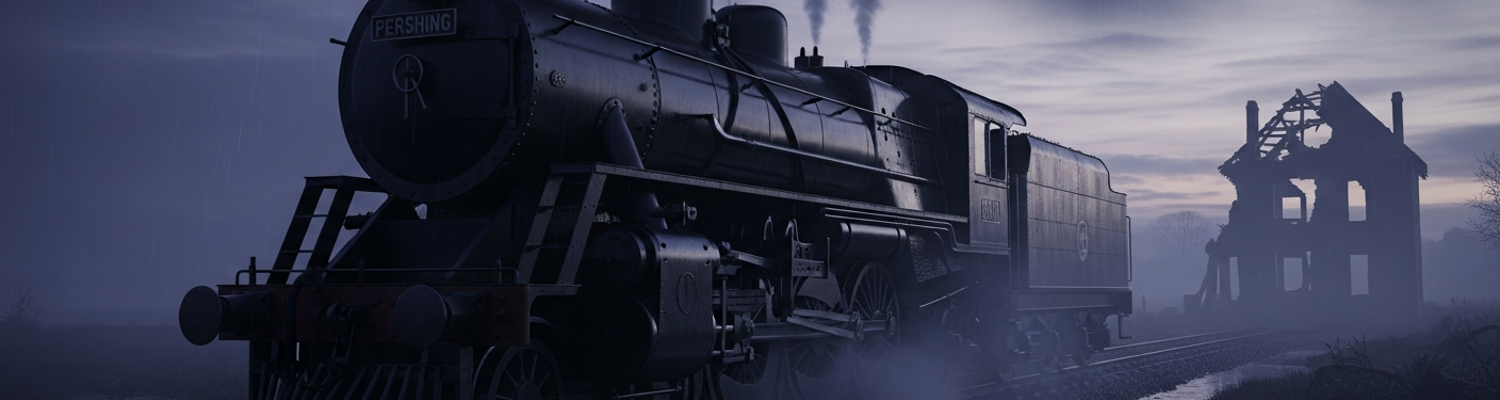
This undertaking fell to the newly formed U.S. Army Transportation Corps, directed by Brigadier General W. W. Atterbury, a railroad executive commissioned from the Pennsylvania Railroad. Atterbury’s command inherited a French railway system on the verge of collapse, worn by four years of high-intensity use. A review of operational logs (NARA Record Group 120) indicates a system plagued by deferred maintenance, with worn rails, failing rolling stock, and a confusing mix of equipment standards. To overcome this, the Americans imported their own railway infrastructure. Specialized units like the 11th, 15th, and 16th Engineer Regiments (Railway) were deployed for construction and operations. They brought with them hundreds of American-built locomotives, most notably the Baldwin 2-8-0 Consolidation type, nicknamed Pershings, and tens of thousands of freight cars assembled in France.
The American plan required not just repair but significant expansion of the network, ultimately involving the operation of over 1,500 miles of standard- and narrow-gauge track. The main arteries were trunk lines connecting massive intermediate supply depots, like the twelve-square-mile facility at Gievres, with the regulating station at Is-sur-Tille. From Is-sur-Tille, multiple lines fanned out north towards the Verdun sector. Engineer units labored to double-track main lines, build new marshaling yards, and construct light railway spurs to push supplies from railheads to the trenches. This work was conducted under constant threat from German long-range artillery and aircraft, which targeted key junctions and bridges, forcing repair crews to rebuild structures under fire. The capture of the strategic rail hub at Sedan was a primary objective of the offensive, as its control would sever the primary supply route for German forces across the front.
The weakness of any railway is its fixed and predictable nature. For the AEF in the Meuse-Argonne, this was a constant source of operational friction. A close review of Transportation Corps logs reveals a system stretched to its limit, where a single component failure could produce cascading delays. Standard-gauge lines followed known routes easily mapped by German intelligence, making them predictable targets. These were complex systems of thousands of fragile parts. A shell crater could destroy track, but the real vulnerability lay in specialized components. A destroyed switch-point, a fractured fishplate, or a sabotaged water tower could halt traffic as effectively as a demolished bridge.
Light railways, pushed forward from the main railheads, were even more susceptible. Laid quickly with minimal preparation, their tracks were easily damaged by artillery, forcing supply and repair work to be conducted almost exclusively at night.
German long-range artillery and aerial bombardment systematically targeted the chokepoints of the Allied railway network. Bridges and marshalling yards were primary targets. The destruction of a bridge over the Meuse or Aire could sever a main artery, creating an immediate backlog of supply trains. A direct hit was not always necessary; a near miss could damage abutments or approaches, rendering the structure unsafe. German gunners, often firing at extreme range, became experts at interdiction, forcing American engineer units into a constant cycle of damage and repair. Marshalling yards, the sprawling complexes where trains were sorted, were exceptionally valuable targets. The yard at Is-sur-Tille, the main regulating station for the AEF, was a vast, concentrated area of rolling stock and supplies. A successful air raid or sustained artillery barrage could destroy dozens of locomotives and hundreds of freight cars in a single attack, igniting ammunition trains and creating a tangle of wreckage that might take days to clear.
This vulnerability was compounded by threats at the tactical level from small-unit infiltration and sniper fire. German doctrine increasingly emphasized the use of highly trained Stosstruppen, or stormtroopers, operating in small, fast-moving squads. These units infiltrated Allied lines to strike at rear areas, disrupting supply and communication. Carrying light machine guns, grenades, and explosive charges, a single squad could move through no-man’s-land at night, place charges on a key section of track or at a switch, and disappear. The psychological impact of these raids created an atmosphere of constant tension for railway troops. This was magnified by the persistent threat of snipers. A single well-hidden German marksman, equipped with a Mauser Gewehr 98 rifle and a superior optical sight, could effectively paralyze a section of the line by targeting locomotive engineers, brakemen, or officers directing repair crews. This forced repair and supply movements into the limited hours of darkness, further straining an overtaxed system.
AEF intelligence officers in autumn 1918 were unprepared for the character of the German withdrawal. Intelligence structures were predicated on static trench warfare: fixed fronts and long-term observation. The German Army, however, was no longer defending a fixed line. Under orders from General Ludendorff, German forces initiated a phased, fighting retreat, abandoning the concept of holding ground at all costs. This shifted their posture to one of maximum delay and attrition, executed through the doctrine of elastic defense-in-depth. This created a profound intelligence deficit. The front was no longer a line but a fluid zone several miles deep. AEF intelligence summaries from the period reveal a command structure struggling to grasp where the main German line of resistance was, with reports often outdated by the time they reached divisional headquarters.
This gap was exploited by specialized German rearguard units, the Nachhuten, who perfected small-unit tactics designed to cripple Allied infrastructure. These were not the actions of disorganized stragglers but deliberate operations conducted by elite Stosstruppen and combat pioneers. A close examination of their methods reveals a focus on high-leverage, low-manpower sabotage. Operating in small squads, they used the devastated terrain and darkness to infiltrate behind the leading American advances, targeting the railway lines. Their goal was not large-scale destruction but precise, disruptive attacks. A single charge could destroy a critical switch mechanism, a culvert, or a water tower, halting rail traffic for hours. They also became masters of the booby trap, turning the repair process into a deadly gamble. A discarded helmet or a shovel stuck in the ground could be wired to explosives. German pioneers were issued a variety of delayed-action fuses and pressure-plate igniters specifically for this purpose.
Reconnaissance in this dynamic environment became almost impossible. Aerial observation, the main tool for mapping enemy positions, was severely restricted. Flying low and slow enough for detailed photography over the Argonne Forest made aircraft vulnerable to German machine-gun fire. From higher altitudes, the shell-pocked terrain made distinguishing between an active machine-gun nest and an abandoned one nearly impossible. Air-to-ground communication was primitive, relying on dropped messages that could be lost or delivered too late. Ground patrols sent forward often advanced into a void, bypassing hidden German positions only to be cut down by flanking fire. The German doctrine of placing main defenses on reverse slopes, invisible to direct observation, compounded this problem. American units would advance, thinking they had broken the line, only to discover they had walked into a pre-registered killing zone for German artillery and machine guns concealed kilometers to the rear.
The tactical paralysis of a key railway artery can be traced to a single German marksman in mid-October 1918. Meteorological data shows that beginning around October 9th, the Meuse-Argonne sector was inundated by persistent, cold rain. This downpour turned the shattered landscape into a sea of mud, compromising the integrity of hastily laid railway track beds. Ballast washed away, ties sank, and the ground became too soft to support a fully laden supply train pulled by a 110-ton Baldwin 2-8-0 Consolidation locomotive. The critical junction near Aubreville, a nexus for standard-gauge lines feeding the V Corps push towards the Kriemhilde Stellung, became a significant bottleneck. Visibility was often reduced to less than a hundred yards by rain and mist, grounding most reconnaissance aircraft and turning daylight repair work into a high-risk activity. For the men of the U.S. Army’s 16th Engineer Regiment (Railway), this meant working in flooded, treacherous conditions under the constant threat of German artillery.
German sniper doctrine, refined over four years, emphasized the value of specialists in rearguard actions. The team in question, likely a two-man unit, would have been equipped with a Mauser Gewehr 98 rifle fitted with a high-quality telescopic sight, likely a 3x or 4x model from Zeiss or Goerz. These marksmen were experts at infiltration and observation, trained to identify high-value targets. Their objective was not random attrition but targeted disruption. Instead of engaging infantry, they were tasked with paralyzing the infrastructure supplying the American front. German tactical manuals show these teams would establish a concealed position, a ruined farmhouse or a shell crater, and remain for days, studying the enemy’s routine. In the chaos surrounding Aubreville, their attention was drawn to the railway junction, where American engineers worked to keep the tracks open.
The attack occurred during a desperate attempt to repair a damaged switch-point mechanism on the main line just south of the Aubreville junction. A work detail from Company B, 16th Engineers, was struggling in the driving rain to replace a bent switch rod. Without a functional switch, traffic on the entire line would halt. The work was slow, the waterlogged ground making leverage difficult and the cold steel parts slippery. As the NCO in charge, a sergeant with pre-war railroad experience, knelt to align the new rod, the German sniper fired. The shot was precise, killing him instantly. A second shot targeted another specialist attempting to take his place. Panic followed. The remaining engineers, mostly inexperienced draftees, scattered for cover in the water-filled ditches. The junior lieutenant on site, unable to locate the sniper’s position in the mist, ordered a full withdrawal until darkness. The result was immediate. The partially repaired switch was left jammed, rendering the main line impassable. Within an hour, a queue of supply trains carrying ammunition for the 79th Division’s artillery, rations, and medical supplies was backed up for miles, a static target for German long-range guns. The action of a single rifle had achieved what a full artillery battery often could not: the complete severing of a logistical artery.
The direct result of the sniper’s action at the Aubreville junction was an immediate paralysis of the American V Corps' primary supply artery. Operational logs from the 16th Engineer Regiment show that the jammed switch mechanism rendered the main standard-gauge line impassable. Within hours, a backlog of rolling stock stretched for miles south of the junction. The physical blockage was absolute. Aubreville was a critical node with almost no redundancy, a single point of failure for a massive logistical apparatus. The queue of immobilized trains contained the material required for the 79th Division’s impending assault on the German defenses around Montfaucon. Entire trainloads of 155mm high-explosive shells for the 312th Field Artillery Regiment and 75mm shells for the 310th and 311th Field Artillery Regiments were halted. Behind them were cars loaded with rations, forage, and medical supplies for the 304th Medical Battalion, which was preparing for high casualties. The stalled trains became a predictable target for long-range German artillery, which began methodical harassment fire on the exposed line of cars.
This logistical breakdown translated rapidly into a loss of offensive momentum. The initial American advances of late September had already slowed by mid-October. The stoppage at Aubreville was a breaking point. For the infantry of the 79th Division, the consequences were felt within twenty-four hours. Planned artillery preparations were canceled as shell rationing was imposed. Assaults that were intended to be preceded by heavy bombardments were either postponed or forced to proceed with inadequate fire support, leading to higher casualties among the attacking waves of the 313th and 314th Infantry Regiments. A review of V Corps operational summaries (File Ref: V-Corps-SITREP-1018) indicates a sharp increase in communications from frontline commanders reporting critically low stocks of ammunition and a breakdown in the delivery of food. The physical and psychological toll on the soldiers was severe. Troops already exhausted by combat and weather now faced dwindling rations and the knowledge that their artillery support had been choked off. The operational tempo of V Corps faltered.
The paralysis at Aubreville escalated from a tactical problem into a strategic crisis for the AEF high command. The action of a single German sniper had exposed a fundamental flaw in the AEF’s logistical structure for the Meuse-Argonne Offensive: its dependence on a handful of vulnerable, single-track railway lines. The incident sent a shockwave through the Transportation Corps and up to General Pershing’s First Army headquarters. Archival analysis of AEF staff documents from this period reveals a sudden recognition of this systemic vulnerability. Planners had focused on the grand-scale movement of divisions and tonnage, but the sniper incident demonstrated that a low-cost attack on a single, specialized component could achieve the same result as the destruction of a major bridge. It forced an immediate re-evaluation of railway security protocols, diverting manpower from construction to guarding key infrastructure points. This tactical event, born from a single rifle shot, forced a strategic-level shift in thinking, revealing that the AEF's ability to wage its largest battle was balanced precariously on a few hundred miles of easily severed steel rails.