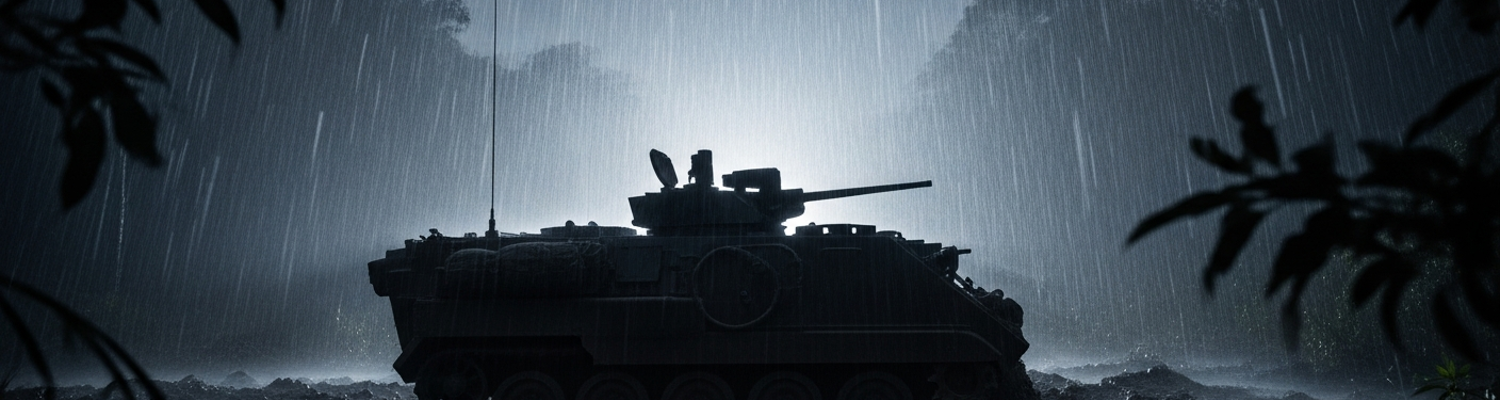

Initial M113 ACAV Doctrine
American military planners, conditioned by Cold War scenarios for the plains of Europe, envisioned a rapid, mechanized conflict in Vietnam. The operational tempo demanded by the Pentagon left little room for environmental acclimatization or significant doctrinal shifts. Units were expected to deploy and be combat-effective almost immediately, forcing a reliance on existing frameworks. The M113 Armored Personnel Carrier, a lightweight aluminum box designed to be a "battle taxi," was thrust into a role for which it was never conceived. This fundamental mismatch between equipment, doctrine, and environment would be paid for by the enlisted personnel ordered to operate the machine.
Initial American doctrine for the M113 was a direct inheritance from the perceived needs of a European war: speed and maneuverability. The vehicle was the answer to moving infantry squads across a battlefield contaminated by nuclear, biological, or chemical agents while keeping pace with main battle tanks. Its design reflected this purpose. The use of aircraft-grade 5083 aluminum alloy armor kept the weight down to approximately 11 tons, making it transportable by C-130 aircraft and amphibious. Powered by a Detroit Diesel 6V53 two-stroke V6 engine, it could achieve speeds over 40 miles per hour on roads. The core concept was to deliver troops, have them dismount to fight, and then withdraw the vehicle to a supporting position. The realities of combat in Southeast Asia immediately shattered this model. South Vietnamese forces, first to use the M113 in combat in 1962, discovered that dismounting infantry in the face of an ambush was tactically unsound. They pioneered the Armored Cavalry Assault Vehicle (ACAV) concept, transforming the transport into a fighting platform by adding shields for the commander’s .50-caliber machine gun and mounting two M60 machine guns at the rear cargo hatch. The U.S. Army adopted these field modifications, but the underlying doctrinal DNA remained fixated on mobility.
This forced evolution led to a new doctrinal focus on firepower, especially for operations in the riverine and swamp environments of the Mekong Delta. The ACAV was no longer just a transport; it became a mobile firebase. Units like the 9th Infantry Division’s riverine forces and the 11th Armored Cavalry Regiment developed tactics that leveraged the M113’s newfound armament. Formations such as the "Herringbone" were designed for 360-degree security, allowing a column of ACAVs halted on a narrow track to bring an overwhelming volume of machine-gun fire to bear in any direction. The vehicle’s amphibious capability, a key design feature, was seen as a major asset, theoretically allowing armored units to traverse the delta’s countless canals and waterways to outflank their opposition. An M113 could propel itself through calm water using its tracks, and a trim vane at the front was raised to prevent the bow from being swamped. This combination of armor, firepower, and amphibious movement created a powerful tactical tool for the war’s drier seasons, giving mechanized cavalry the ability to penetrate areas previously considered inaccessible to armored vehicles.
When the seasonal rains began, the landscape transformed, and the M113’s strengths became its most glaring weaknesses. The speed and maneuverability that defined the vehicle vanished. The ground itself turned against the machine. The reddish laterite soil of regions like the Central Highlands became a thick, abrasive clay that clogged the track system, packed into the suspension, and ground down drive sprockets. The strain on the engine and transmission was immense, leading to constant overheating and mechanical failure. A thrown track, a manageable issue on solid ground, became a disabling event in a flooded rice paddy, immobilizing the vehicle and its crew under potential enemy fire. The mud could suck a 12-ton vehicle down to its hull, turning a mobile weapon into a static, indefensible target. Its amphibious nature became a liability. The placid canals and streams swelled into fast-moving torrents that could easily swamp an M113, whose low freeboard offered little defense against the churning water. Archival evidence shows a sharp spike in vehicle losses and non-combat casualties during the monsoon seasons.
Monsoon Environment Realities
The arrival of the monsoon in the Mekong Delta was a physical transformation of the battlefield. Dry, cracked earth and dusty roads dissolved into an expanse of glutinous mud and flooded paddies. For American mechanized units, particularly those equipped with the M113 ACAV, this environmental shift was operationally debilitating. After-action reports from units like the 9th Infantry Division show that the vehicle’s primary assets, mobility and speed, were instantly nullified. The soil became a thick, abrasive paste that infiltrated every component of the vehicle’s running gear. It packed into the spaces between road wheels, gummed up drive sprockets, and accelerated the wear on track pads to an unsustainable degree. A thrown track, a repairable inconvenience on solid ground, became an immobilizing crisis in a flooded rice field, leaving the 12-ton vehicle and its crew dangerously exposed. The strain on the Detroit Diesel 6V53 engine and transmission was severe; pushing through the thick, waterlogged terrain for hours led to constant overheating and frequent mechanical failures. The M113’s amphibious capability proved largely ineffective in monsoon conditions. The placid canals it was designed to navigate swelled into fast-moving torrents. The vehicle’s low freeboard offered little protection against these currents, which could easily push a track sideways, swamp it, and drag it under.
This mechanical attrition was matched by the severe degradation of crew endurance. The aluminum hull of the M113 became a sweltering, claustrophobic box in the 100-degree heat and oppressive humidity. Rain drumming on the metal roof was deafening, making communication inside an exercise in shouting. The crew was perpetually soaked, living and fighting in wet clothes for weeks on end. Medical records from the period show a dramatic increase in non-combat casualties resulting from the environment. Immersion foot, also known as trench foot, was rampant, causing skin to break down and become infected. Fungal infections, dysentery, and malaria were constants. The psychological toll of this existence, the ceaseless noise, the heat, the wet, the mud, and the constant threat of ambush, led to deep exhaustion. Basic vehicle maintenance was neglected as crews became too fatigued to perform checks. Combat effectiveness dropped sharply; tired, sick men are slow to react, their aim is unsteady, and their judgment is impaired. The simple acts of staying dry or getting a full night’s sleep were impossible.
During the wet seasons of 1968 through 1970, these environmental factors created unique and dangerous obstacles for mechanized units. Archival evidence shows that National Liberation Front (NLF) forces learned to use the monsoon tactically. They understood that the M113s were now largely restricted to the limited network of paved roads or the elevated dikes that separated rice paddies. This predictability was a vulnerability. NLF and Viet Cong units could expertly channel American columns into pre-planned kill zones. They used command-detonated mines and booby traps with devastating effect, often fashioned from unexploded American bombs and artillery shells. A 1963 report noted the enemy’s ingenuity in creating large pits dug specifically to capture and immobilize an M113. The monsoon also degraded the effectiveness of American technological advantages. The persistent low cloud cover and torrential rain often grounded helicopters and fixed-wing aircraft, eliminating vital close air support and reconnaissance. Artillery was similarly hampered, as shells impacting the saturated ground would often bury themselves in the mud, muffling their blast or failing to detonate entirely. This left ACAV crews isolated, forced to fight with only their own weapons against an enemy who used the terrain with mastery.
Mechanized Unit Operational Challenges
Operational logs from mechanized units during the monsoon seasons reveal a consistent pattern of mechanical failure. The M113 ACAV, particularly its finely-tuned components, proved acutely vulnerable to the environmental stresses of the Mekong Delta and Central Highlands. The Detroit Diesel 6V53 engine was prone to overheating as thick, clay-like mud clogged the cooling system vents on the hull. This same abrasive mud worked its way into the vehicle’s running gear, grinding down drive sprockets, road wheel bearings, and track connectors. Unit logs frequently documented severe mechanical breakdowns, with units reporting that the additional weight of ACAV modifications and extra ammunition put unanticipated strain on the suspension systems, leading to more frequent maintenance cycles. A thrown track, a common consequence of the extreme torque on the system, became an entirely different class of emergency in a flooded paddy field. What was a manageable repair on dry land often became a multi-day recovery operation, leaving the immobilized 12-ton vehicle a static and helpless target.
When a vehicle did become mired, it was often for extended periods. The soft, saturated soil of the delta could suck an M113 down to its hull, rendering it completely immobile. Photographic archives are filled with images of ACAVs sunk in mud, their tracks spinning uselessly. Recovering a single bogged-down vehicle was a hazardous, multi-stage process that disrupted unit operations. Another M113 or a dedicated M88 recovery vehicle had to be brought in, often navigating the same treacherous terrain that trapped the first vehicle. This created a chain of vulnerability, as recovery attempts sometimes resulted in a second vehicle becoming stuck. These impromptu recovery sites, often deep in unsecured territory, exposed multiple crews to the risk of ambush for hours, or even days. An entire platoon’s mission could be derailed by a single instance of a bogged-down track, forcing commanders to divert resources, cancel patrols, and establish defensive perimeters around the stranded asset until it could be extricated. Tactical momentum, a key component of armored doctrine, was completely lost.
The pervasive dampness and grit of the wet season accelerated the decay of all equipment. After-action reports from wet season operations detailed equipment failures that went far beyond engine trouble. The AN/PRC-25 and vehicle-mounted AN/VRC-46 radios, crucial for coordinating fire and movement, suffered from the intense humidity. While the radio units themselves were rugged, their H-138/U handsets were highly susceptible to moisture, forcing crews to use improvised plastic covers to maintain functionality. The constant exposure to mud and water caused weapons like the M16 rifle and M60 machine gun to rust and jam with alarming frequency. Even personal gear disintegrated; boots rotted, uniforms were perpetually soaked, and fungal infections became a constant medical concern for troops operating for weeks in wet conditions. This systemic equipment degradation, from the primary fighting vehicle down to the individual soldier’s rifle, compounded the psychological strain of monsoon warfare.
Communication Failures and Isolation
Technical analyses of tactical communications equipment from the period show its performance was a constant issue for mechanized operations in the monsoon. The intense, driving rain and suffocating humidity attacked the electronic lifelines of M113 ACAV platoons. While the vehicle-mounted AN/VRC-46 and man-portable AN/PRC-25 radios were designed to be water-resistant, their peripheral components were acutely vulnerable. The standard issue H-138/U handset was particularly susceptible to moisture, which could penetrate the casing and short out the push-to-talk mechanism. Radio Telephone Operators (RTOs) resorted to field-expedient measures, such as stretching the plastic wrapping from battery packs over their handsets to keep them dry. The torrential downpours also interfered with radio waves, turning transmissions into bursts of static, especially under dense triple-canopy jungle. This electronic breakdown was compounded by the physical environment inside the track. The sound of heavy rain hammering on the M113’s aluminum hull was deafening, forcing crewmen to shout to be heard by the man next to them and rendering radio messages all but unintelligible.
This widespread loss of communication directly created tactical isolation on a battlefield where mutual support was the bedrock of survival. When an M113 inevitably threw a track or became bogged down in the bottomless mud, its crew was often instantly cut off. A platoon commander, his own vehicle struggling through the terrain meters ahead, might have no way of knowing that one of his tracks was immobilized and silent just behind him. The column, already stretched thin along a narrow paddy dike or jungle trail, would become fragmented into deaf and blind elements. Enemy forces understood this vulnerability explicitly. Viet Cong and NVA doctrine prioritized the destruction of radios and the killing of their operators. They knew that a mechanized column without communication was merely a series of individual, unsupported targets. An after-action report from one engagement (NARA Record Group 472) notes that NVA forces would wait for a column to become separated by terrain and communication failures before initiating an ambush, engaging the isolated sections one by one.
For the crew of a crippled and silent M113, this isolation was a critical tactical problem. Without a functioning radio, they could not call for the supporting fires of artillery or request close air support, assets that were already hampered by the low cloud ceilings and torrential rains of the monsoon. They could not request a medevac for wounded crew members. They could not report their position for an emergency resupply of ammunition, fuel, or water. Archival records detail instances of crews being stranded for days, forced to ration their dwindling supplies while trying to conduct exhausting and often futile field repairs in knee-deep mud, all under the constant threat of attack. The logistical chain, already strained to its breaking point by the impassable roads and flooded landscape, simply could not function without reliable communication. A unit that could not talk was a unit that could not be supplied, reinforced, or rescued. It was on its own, a static steel island, waiting for a physical search party to find it or for the enemy to close in.
Increased Ambush Vulnerability
The monsoon transformed the operational area into a series of predictable channels, turning American mechanized columns into targets. A single bogged or mine-damaged M113 could paralyze an entire company, creating a classic ambush opportunity. Operational records from units like the 11th Armored Cavalry Regiment show that enemy commanders intentionally allowed lead elements to pass before initiating an attack on the vulnerable, stationary center of a column halted by a disabled vehicle. The very doctrine designed to provide 360-degree fire support, the "Herringbone" formation, became a liability. It locked the ACAVs into a static, predictable arrangement, presenting a neat row of targets for rocket-propelled grenades and recoilless rifles. Recovery efforts compounded the danger, forcing M88 recovery vehicles or other M113s to expose themselves on the same treacherous ground, often resulting in multiple mired vehicles and a growing cluster of exposed crewmen. NLF ambushes were not random; they were patient, coordinated affairs designed to exploit the M113's environmental weaknesses. A disabled track was no longer just a mechanical issue; it was the designated bait for a pre-planned kill zone.
Saturated by the monsoon, the terrain provided NLF and Viet Cong forces with unparalleled concealment. The thick, dripping foliage and persistent ground fog reduced visibility to mere meters, completely negating the M113’s long-range firepower advantage. The deafening sound of torrential rain on the vehicle’s aluminum hull masked the sounds of enemy movement, allowing ambush teams to crawl into position just off the narrow tracks and dikes the vehicles were forced to use. From these hidden positions, a two or three-man team armed with a Soviet-made RPG-2 or its Chinese Type 56 variant could wait for the perfect moment. Their target was the M113’s flat aluminum side armor, which the RPG’s high-explosive anti-tank (HEAT) warhead could penetrate with ease. Archival analyses of ambush reports note the effectiveness of this tactic. A single, well-aimed RPG could ignite fuel, detonate stored ammunition, and turn the vehicle’s interior into a spalled, metal-fragment-filled space. The low cloud cover that accompanied the rains often made immediate air support impossible, leaving the ambushed column to fight it out alone against an enemy who could strike and vanish back into the obscuring jungle.
For the enlisted personnel inside the tracks, this environment created a unique and difficult form of combat stress. The attacks were arbitrary and came with no warning. A moment of quiet transit could be shattered by the sudden, violent concussion of an RPG strike, instantly transforming the cramped crew compartment into a scene of chaos. Unlike conventional battles with established front lines, the threat was omnipresent and invisible. This constant, unpredictable danger took a severe psychological toll. Studies and memoirs from the period reveal that the inability to see the enemy or anticipate an attack led to heightened states of anxiety and hyper-vigilance that exhausted soldiers mentally and physically. Survival felt random. A crewman’s life or death could depend on which side of the track an RPG hit, or whether a command-detonated mine exploded under his vehicle or the one behind it. This sense of powerlessness, combined with the physical conditions of heat, wet, and exhaustion, defined the visceral experience of combat in these units.
ACAV Crew Sensory Experience
To be inside an M113 during a monsoon downpour was to be sealed within a suffocating, metallic enclosure. The cramped interior, designed to transport eleven troops plus a two-man crew, became a claustrophobic hotbox. With the rear ramp and roof hatches battened down against the torrential rain, the space for a typical four or five-man ACAV crew and their equipment became almost nonexistent. Period accounts reveal that the air inside, thick with the humid, 100-degree heat of Vietnam, was made worse by the smell of diesel fumes, hot metal, and unwashed bodies. The constant, deafening roar of the Detroit Diesel engine, combined with the thunderous drumming of rain on the thin aluminum hull, made normal conversation impossible. Communication was reduced to shouting over the internal intercom system or using hand signals. Soldiers were packed shoulder-to-shoulder on benches, their knees interlocked, surrounded by ammunition cans, C-rations, personal gear, and the red mud that coated everything. This physical compression within a dark, jarring, and violently loud space created a persistent, low-level stress that degraded the crew’s endurance long before any contact with the enemy.
This claustrophobic confinement was paired with extreme sensory deprivation. The driver’s view was limited to the narrow field of his three M17 periscopes, which were often rendered useless by sheets of rain and mud. He was steering a 12-ton vehicle through treacherous, waterlogged terrain with a severely restricted view. The track commander, the vehicle’s primary set of eyes and ears, was faced with an impossible choice: either button up inside his cupola, where his vision blocks offered a slightly better but still limited view, or expose his head and torso to the elements and potential enemy fire to see where they were going. For the other crewmen in the back, the two M60 gunners and any dismounts, there was almost no way to see outside at all, save for tiny firing ports that were often covered. Their only awareness of the outside world came from the lurching and bucking of the hull, the changing pitch of the engine, and the disembodied, staticky voices crackling over the radio. This isolation created a deep sense of helplessness; the crew was utterly dependent on the track commander’s ability to navigate the unseen dangers of the battlefield.
The environment itself magnified the terror of combat. The constant noise and lack of visibility meant that an attack came without any warning. There was no distant crackle of rifle fire, no sight of enemy movement, only the sudden violence of an explosion. A rocket-propelled grenade (RPG) striking the M113’s thin aluminum armor was a destructive event. While the 5083 aluminum alloy armor could stop small arms fire and shell fragments, it was highly vulnerable to shaped-charge warheads. A direct hit from an RPG-2 or RPG-7 would send a jet of molten metal and superheated gas punching through the hull. The resulting overpressure in the confined space was significant, and the impact would turn fragments of the vehicle’s own armor into high-velocity projectiles, an effect known as spalling. A single RPG could ignite ammunition or fuel stored inside, turning the compartment into an inferno. For the crew, trapped, blind, and disoriented, the first indication of an ambush was often the last thing they would experience: a blinding flash, a wave of heat, and the shrapnel-filled concussion of a direct hit.
Psychological Impact on Crews
Medical records from the Vietnam War reveal a pattern of psychological distress among armored crews, with elevated rates of combat stress reaction (CSR) documented specifically in personnel operating the M113 ACAV. This was not simple combat fatigue, but a breakdown driven by a unique convergence of environmental and tactical factors. The very machine they lived in became an instrument of this breakdown. The constant, deafening noise inside the aluminum hull, the suffocating heat, and the perpetual state of being soaked and filthy ground down a soldier’s mental fortitude. These physical stressors were compounded by the tactical situation of monsoon operations. Symptoms of CSR, such as hyper-alertness, severe irritability, and an inability to concentrate, became common. In the context of an ACAV crew, this manifested as a crippling inability to perform routine tasks. A gunner would become fixated on a single, meaningless point in the jungle, while a driver would react erratically to every bump in the terrain, convinced it was a mine.
This state of hyper-vigilance was a direct response to the arbitrary and instantaneous nature of the threat. An RPG team could be concealed mere meters from the track, invisible in the dense, dripping foliage. The attack would come without warning. This constant, unpredictable possibility of instant death created a psychological state where every second was a potential ambush. Medical analyses of CSR from the period note that this sustained, high-level stress without relief led to gross disturbances in mood and behavior, a condition that left soldiers functionally incapacitated even without a physical wound.
Post-combat evaluations of ACAV crewmen commonly found severe anxiety and sleep disorders to be widespread and long-lasting conditions. Rest was a fiction. The monsoon environment made sleep an impossibility. Even when not on watch, a soldier’s body remained on high alert. The incessant drumming of rain on the hull, the whine of the engine kept running to power the radios, and the oppressive, wet heat created a sensory environment that precluded any chance of genuine rest. Medical studies confirm that insomnia was reported by up to 90-100% of Vietnam-era veterans suffering from PTSD, a condition that often began as an acute sleep disturbance in-country. This lack of sleep created a debilitating feedback loop. An exhausted soldier’s reaction time slows, their judgment becomes impaired, and their fear response intensifies. That heightened fear, in turn, makes sleep even more difficult to achieve.
Nightmares were a constant, with studies showing that over half of combat veterans with PTSD reported significant, recurring nightmares, often direct replays of traumatic events. For an ACAV crewman, this meant reliving the flash of an RPG strike or the lurch of their track being hit by a mine. The distinction between the waking state of patrol and the sleeping one blurred into a single, continuous state of anxiety. The individual troop replacement system exacerbated this, robbing units of the cohesion that might have otherwise provided a psychological buffer against the stress. A new soldier arriving in a seasoned, exhausted crew was an outsider, unable to rely on the deep bonds forged by shared experience, making him even more vulnerable to psychological decay.
The most difficult psychological issues were directly linked to the constant stress and arbitrary threats inherent to monsoon operations. The environment stripped away any sense of agency. A crewman’s survival was not a matter of skill, training, or bravery, but of random chance. Was the command-detonated mine placed under their M113, or the one behind it? Did the RPG gunner target the driver’s hatch or the commander’s cupola? This profound sense of powerlessness is a known contributor to severe psychological trauma. The war for the ACAV crew was not one of clear objectives or front lines; it was a random, lethal lottery played every single day. This reality fostered a spectrum of psychological responses, from a fatalistic detachment to reckless behavior, all symptoms of a mind trying to cope with a reality it could not control. Archival research into combat-related psychological distress highlights that a preeminent factor for troops was the persistent apprehension of becoming a casualty, a fear made exponentially worse by the invisible and unpredictable nature of guerrilla warfare.