
AN/TSQ-81 System Development
The skies over Southeast Asia were a complex problem. American airpower, from F-4 Phantoms to B-52 Stratofortresses, saturated the operational space. Controlling this armada, deconflicting flight paths, and directing ordnance onto targets often situated dangerously close to friendly ground troops was a task of extreme difficulty. The existing system, a grease-pencil-and-paper affair little changed since the Korean War, was buckling. A technological solution was required.
That solution was intended to be the AN/TSQ-81 Direct Air Support Central, or DASC.
Its design purpose was to replace manual plotting boards and voice-heavy radio nets. The DASC was conceived as a semi-automated, air-transportable command post. It would ingest data from forward air controllers, ground units, and higher headquarters, displaying it on electronic screens. The system was meant to process immediate requests for close air support, manage aircraft in its designated airspace, and coordinate strikes with artillery. An operator could see a digital representation of the battlefield, allocate an aircraft to a target, and pass mission data electronically. This was supposed to cut the time from a ground unit’s call for help to bombs on target.
Archival evidence shows the initial research and development was troubled from the start. The contract, awarded to Litton Industries, was part of a broader push within the Marine Air Command and Control System (MACCS) to modernize its capabilities. The AN/TSQ-81, however, was an Air Force program, a transportable version of their fixed-site MSQ-77 radar bombing system, adapted for Marine Corps and Army use. This joint-service origin created immediate friction. The manufacturer, Reeves Instrument Corporation, a subsidiary of Litton, was tasked with reconfiguring a large, van-mounted radar system into something helicopter-transportable. This was a top-priority, accelerated program. A prototype had to be delivered in an astonishingly short timeframe, forcing engineers to work in overlapping shifts. The rush to production meant many design choices were based on expediency, a decision with later consequences.
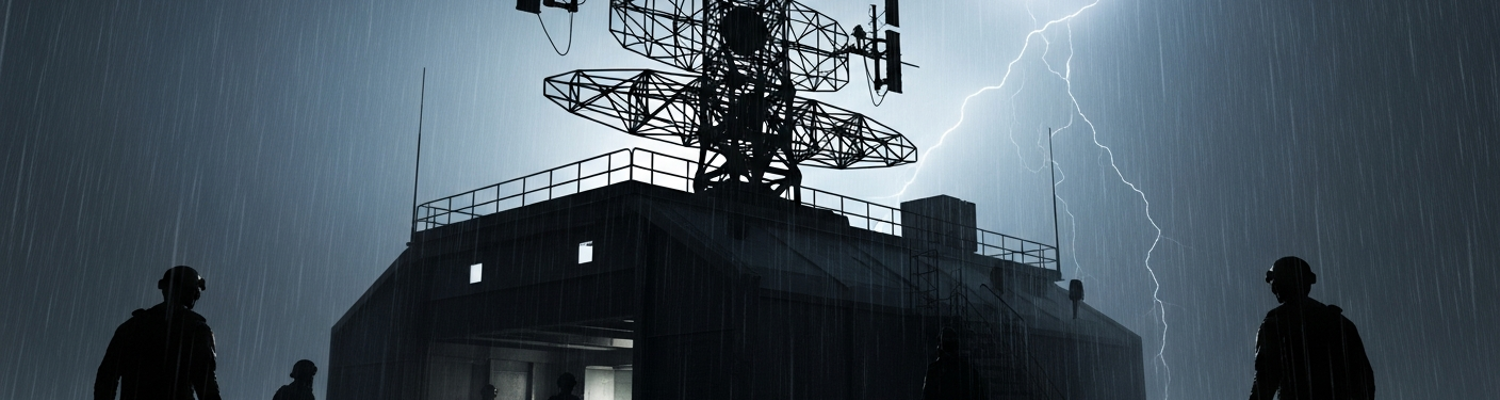
The initial engineering challenges were significant. A close review of the system’s architecture (per NARA Record Group 127) reveals the core problem. Developers were attempting to create a mobile, ruggedized system from components that were never designed for such a role. The MSQ-77, its parent, was housed in permanent installations. To make the AN/TSQ-81 transportable, engineers housed the electronics in prefabricated steel shelters designed to sit on concrete slabs. For field deployment, this was impractical. The solution was a base of bolted steel beams anchored by guy wires, a clumsy and time-consuming assembly. The heavy radar antenna could not be mounted on the shelter’s roof. It required its own separate steel support structure that straddled the main building, sealed by a rubber boot. The system relied on sensitive electronics of the era, including temperamental vacuum-tube cooling systems and data processors not built to withstand the heat, humidity, and dust of a Vietnamese fire base. The concept of air transportability was stretched to its limit. The system’s components were bulky and heavy, requiring multiple CH-53A Sea Stallion sorties for transport and a large ground crew for assembly, undermining its intended role as a nimble command center.
Vietnam Deployment and Integration
The first AN/TSQ-81 DASC systems arrived in the Republic of Vietnam earmarked for the III Marine Amphibious Force (III MAF), the senior Marine command in the I Corps Tactical Zone. This northernmost region was the scene of the most intense conventional fighting involving the Marine Corps. Marine Air Support Squadron 3 (MASS-3), which disembarked at Chu Lai in November 1966, was one of the primary units tasked with operating the new system. Command chronologies from the period show MASS-3 operating from both Chu Lai and the major air base at Da Nang. The fielding of the AN/TSQ-81 represented a top-down effort to insert a technological fix into the overloaded air support request network. The existing manual system was being strained by the operational tempo. The DASC was meant to be the digital heart of a faster, more accurate system. Its assignment to MASS-3 was only the first step in a deeply problematic integration.
Deployment was a major construction project.
The logistical burden of deploying the AN/TSQ-81 contradicted its air transportable designator. The system was a collection of components housed in two large, 12x9x40-foot metal shelters, along with a separate, heavy radar dish and its support structure. A close review of its original engineering shows it was a reconfigured version of the fixed-site MSQ-77 radar, never intended for battlefield mobility. To make it transportable, engineers at Reeves Instrument Corporation devised a foundation of bolted steel wide-flange beams, which then had to be anchored to the ground. This entire assembly was too heavy for a single helicopter lift. Transporting the system from port to a fire base required numerous sorties by heavy-lift helicopters or by C-130 cargo planes if a suitable airstrip was available. In the heat and monsoon rains of I Corps, Marine combat engineers and technicians had to level the ground, assemble the steel beam foundation, erect the shelters, and then construct the separate steel gantry that straddled the main shelter to hold the radar antenna. This process was slow and labor-intensive, making the DASC a semi-permanent fixture.
Once assembled, the AN/TSQ-81 had to function within the wider ecosystem of the Marine Air Command and Control System (MACCS). This was where the system’s parentage as an Air Force program created deep interoperability failures. The MACCS was a network of different radars, communication nodes, and command posts, each with its own function. The AN/TSQ-81, as the DASC, needed to exchange data with the Tactical Air Operations Center (TAOC), the central hub for air defense and airspace management. The hardware and software protocols were often incompatible. A review of operational logs from MACS-4, a sister squadron, details similar issues with their own data systems. Different power standards and proprietary data formats from competing contractors required undocumented field modifications just to achieve a basic connection. These technical disconnects forced controllers to revert to the very methods the DASC was meant to replace. Voice communication over tactical radio nets not only negated the system’s speed advantage but also introduced errors and delays, as targeting and aircraft control information had to be manually transcribed and relayed between two supposedly automated systems. The digital island of the AN/TSQ-81 struggled to connect to the broader archipelago of III MAF’s command structure.
The III MAF Air Control Study
By January 1968, the command and control apparatus of III MAF was under extreme pressure. The onset of the Tet Offensive that month transformed I Corps into the epicenter of the war’s most intense conventional combat, with major battles erupting from Quang Tri City to Hue. III MAF, a corps-level headquarters commanded by Lieutenant General Robert E. Cushman, was now responsible for a force of over 100,000 American and allied troops. The scale of the fighting, combined with pre-existing command friction with MACV headquarters, stretched the 1st Marine Aircraft Wing’s resources to their limits. In this environment, III MAF headquarters commissioned a comprehensive analysis of its air control network. Archival records confirm this was officially titled the Air Control Study, and it ran from January through July 1968, a period that mirrored the peak of the offensive and its immediate aftermath. The study’s mandate was a full-spectrum review of the MACCS performance, from paper-and-grease-pencil plotting boards to the newly fielded AN/TSQ-81 DASC.
The study’s wargames extended far beyond the conventional battles raging in Quang Tri and Thua Thien provinces.
A close examination of the study’s most extreme hypotheticals shows that planners were forced to confront scenarios involving weapons of mass destruction. The Tet Offensive demonstrated that North Vietnamese forces could coordinate massive, division-sized attacks on heavily fortified installations. The study extrapolated this threat. It modeled the effects of a tactical nuclear or chemical weapons attack on a primary installation like Da Nang Air Base. The analysis focused specifically on the survivability of the new technological systems. For the AN/TSQ-81, the findings were catastrophic. Its two large, unhardened steel shelters offered practically no protection from blast or radiological effects. More critically, its sensitive, vacuum-tube-era electronics were projected to be completely destroyed by the electromagnetic pulse of a nuclear burst. A non-nuclear chemical agent attack, such as with nerve gas, would render the system inoperable. Operators in bulky Mission Oriented Protective Posture (MOPP) gear could not effectively manage the system’s difficult-to-use consoles. The DASC’s reliance on exposed, diesel-powered generators and its massive, gantry-mounted radar dish were identified as indefensible vulnerabilities.
The study also folded in a complicating factor drawn from recent combat. The chaotic extraction from the Kham Duc Special Forces camp in May 1968, where military aircraft struggled to evacuate soldiers and civilians under direct fire, provided a grim new data set. Planners modeled this on a massive scale, projecting the panic-driven flight of tens of thousands of Vietnamese civilians from Da Nang or Hue in the event of an NBC attack. The resulting analysis showed that primary arteries like National Highway 1 would become impassable, choked with refugees and blocking all ground-based military logistics. This would force all operations into the air, creating an air traffic control problem of an unimaginable scale. The AN/TSQ-81 DASC, already struggling to network with other MACCS components, would be tasked with deconflicting combat air patrols, close air support strikes, helicopter resupply missions, and a massive, uncoordinated fleet of medevac and civilian rescue aircraft, all potentially operating in a contaminated airspace. The system’s processors could not handle the volume of contacts. Its fundamental design flaws made it a single point of failure in the exact scenario where centralized control was most needed.
Coordinating Assets in a Toxic Fog
The operational framework for the AN/TSQ-81 in a Nuclear, Biological, or Chemical (NBC) environment was born from Cold War necessity. Planners within the MACCS envisioned a battlefield where visibility could drop to zero and traditional methods of air control would be ineffective. In this context, the DASC was designed to be the central nervous system for all aviation assets. Its role was to ingest radar data, friendly position reports, and mission requests, creating a synthetic, all-weather picture of the battlespace on its consoles. A review of the system’s parentage, the Air Force’s AN/MSQ-77, shows this was an extension of its original design for ground-directed bombing (GDB). The concept was direct. If a pilot could not see, a controller on the ground, watching a radar screen, would guide the aircraft to its target and command the weapons release. The AN/TSQ-81 was meant to apply this principle not just to pre-planned bombing runs but to the dynamic environment of close air support, directing F-4 Phantoms and A-6 Intruders onto targets perilously close to friendly troops, all while operating under the assumption of a contaminated and obscured battlespace.
Under conditions of extreme visibility degradation, such as smoke from burning cities or the haze of a chemical agent attack, the AN/TSQ-81 was projected to be the sole means of coordinating offensive air power. Its primary tool was the ground-controlled bombing capability inherited from the AN/MSQ-77 Combat Skyspot system. An operator inside the DASC’s shelter would use the system’s X-band tracking radar to lock onto a friendly aircraft equipped with a beacon transponder. This created a solid track on the controller’s screen, representing the aircraft’s precise location, altitude, and speed, with a range extending up to 200 miles. The analog ballistic computer, a complex assembly of vacuum tubes and integrating amplifiers, would then continuously calculate a predicted impact point for the aircraft’s ordnance. The controller would provide verbal heading and speed corrections to the pilot, who was effectively flying blind, aligning the aircraft’s flight path with the computer’s solution. At the calculated release point, the DASC operator would give the command to drop. This method was used extensively in Vietnam to overcome poor weather, allowing strikes to continue unabated during the monsoon season and at night.
The system’s projected role grew exponentially when planners factored in public panic. The 1968 III MAF Air Control Study used the evacuation of Kham Duc as a baseline, extrapolating it to a scenario where a major population center like Da Nang was struck by an NBC weapon. The analysis projected tens of thousands of panicked civilians flooding transportation routes, rendering ground movement impossible and forcing all military operations into the air. In this environment, the AN/TSQ-81 would be tasked with managing an airspace saturated with an uncoordinated mix of combat air patrols, medevac helicopters, civilian rescue aircraft, and close air support sorties, all operating simultaneously. A technical review of the system’s architecture, however, reveals its processors and display consoles were never designed for such a volume of contacts. The system was built to track dozens of targets, not the hundreds that would flood the airspace in a mass panic. The DASC, intended as the node of control, would instead become a bottleneck, its operators overwhelmed by the sheer number of friendly, hostile, and unknown aircraft, each demanding deconfliction in a contaminated, low-visibility environment.
The Failure of the Network
A deep analysis of the AN/TSQ-81’s performance within III MAF reveals a system defined by its networking failures. The DASC was intended to be a digital hub, but it functioned more like a digital island, largely disconnected from the systems it was meant to support. The most persistent communication breakdown occurred between the AN/TSQ-81 and the Tactical Air Operations Center (TAOC), the senior air control agency in the MACCS. Archival evidence shows that the data link protocols between the DASC, an Air Force-derived system, and the Navy-developed TAOC were effectively incompatible. This forced a reversion to the most error-prone method of data transfer: voice commands over tactical radio nets. An air controller in the TAOC, tracking a flight of F-4 Phantoms on his radar, could not forward the track data electronically to the DASC. Instead, he had to read the target’s coordinates, altitude, and heading over a radio channel to an operator in the AN/TSQ-81 shelter, who would then manually input the information into his console. This process negated the entire premise of a semi-automated system, reintroducing potential for human error and consuming critical minutes in the close air support loop.
The problem was a systemic failure rooted in a fragmented development process where different contractors for different services built systems that were never designed to speak the same digital language. This lack of interoperability was a consistent theme across the MACCS architecture. The result was a command system where high-technology components were connected by basic, unreliable means. A single misheard digit in a grid coordinate or a garbled transmission could send ordnance toward the wrong location. This was not a hypothetical risk. Operational logs from the period document numerous instances of talk-on errors requiring frantic correction. The AN/TSQ-81, conceived as a solution to the chaos of manual plotting, became another source of potential confusion.
These limitations created dangerous pathways for miscommunication, even under normal operating conditions. The system’s primary function was ground-controlled bombing, a legacy of its AN/MSQ-77 parentage. In this mode, a controller inside the DASC watched a radar return from a friendly aircraft and verbally guided the pilot, who might be flying blind in monsoon clouds, toward a release point calculated by the system’s analog computer. This placed the entire responsibility for a successful strike on the clear communication between one controller and one pilot. Any breakdown in this two-person loop, whether from a faulty radio, misunderstood instruction, or human error, could have fatal consequences. The operator’s workload was high. The potential for distraction or fatigue to degrade performance was a constant factor. The system’s design funneled immense responsibility onto a single human operator, creating a critical point of failure that no amount of processing power could mitigate.
Operational Delays and Civilian Peril
The potential for catastrophe was an inherent function of the AN/TSQ-81's design. For a Marine rifleman in contact with the enemy in the hills surrounding Khe Sanh, a delay of minutes in a close air support request could be the difference between life and death. Operational logs from MASS-3 show the intended process was a study in digital efficiency. A request for air support would be transmitted from a forward air controller, appear as a digital request on the DASC operator’s console, who would then allocate an available aircraft and transmit targeting data. The system’s failure points, however, forced a dangerous reversion to analog methods. A processor freeze, a common occurrence with the system’s temperamental electronics in the Vietnamese heat, or a data-link failure with the TAOC, meant the entire automated process halted. The DASC operator, now under extreme pressure, had to re-establish voice communication over tactical radio, manually plot the request on a paper map, and then verbally talk the pilot of an F-4 Phantom onto the target. A review of the AN/TSQ-81’s ground-controlled bombing procedures shows this process funneled immense responsibility onto one controller guiding one pilot. Every second spent troubleshooting the frozen console or clarifying a grid coordinate over a static-filled radio net was a second lost to the ground unit taking casualties.
This was a system built for a different war.
The 1968 III MAF Air Control Study considered the system’s performance in the most extreme circumstances, including an NBC attack. The study's findings were clear. An attack on a major base like Da Nang would not only destroy the unhardened AN/TSQ-81 shelter but would also trigger a cascade of secondary crises. In the aftermath of a chemical agent attack, specialized Marine decontamination teams would be essential for rendering airfields and equipment operational again. These teams required helicopter transport to move quickly between contaminated zones. The AN/TSQ-81, if it survived, was supposed to coordinate this complex airspace, deconflicting the medevac, resupply, and decontamination flights. Its known vulnerabilities made this impossible. The system’s external diesel generators were an exposed target, and its reliance on sensitive vacuum-tube electronics made it exceptionally vulnerable to the electromagnetic pulse of a nuclear detonation. Even if the hardware remained functional, the system’s poorly designed user interface was nearly impossible to operate while encumbered by bulky MOPP gear. In the precise scenario where centralized air control was most desperately needed to manage a contaminated battlespace, the DASC would be functionally inert. Decontamination efforts would be uncoordinated and dangerously slow.
The peril was magnified exponentially when factoring in the civilian population. Planners used the chaotic 1968 evacuation of Kham Duc as a grim template. The study modeled a mass panic in Da Nang following an NBC event, projecting tens of thousands of civilians attempting to flee. This would render all ground routes, particularly Highway 1, impassable. All movement, military and civilian, would be forced into the air. The sky over I Corps would become saturated with a disorganized swarm of military helicopters, transport planes, and any available civilian aircraft. A technical analysis of the AN/TSQ-81’s processors and software reveals it was designed to track dozens of aircraft, not the hundreds that would appear in such a scenario. The system’s consoles would be overwhelmed, unable to differentiate friendly combat aircraft from helicopters filled with terrified civilians. The DASC, intended as the central node of aerial control, would completely fail, leaving every pilot to navigate the chaos on their own. This failure exacerbated the danger for evacuating non-combatants, placing them in the path of uncoordinated strike missions and creating a high probability of mid-air collisions in a low-visibility, contaminated environment.
Obsolescence and Lessons Learned
An examination of the AN/TSQ-81’s service record reveals a system that was, in many respects, obsolete upon arrival. Its technological foundation, rooted in the vacuum-tube architecture of the AN/MSQ-77 radar, was a liability in the harsh environment of Southeast Asia. The transition to solid-state electronics was already underway across the military, and the DASC’s reliance on older, less reliable components made it a maintenance problem. It was conceived as a transportable version of a fixed-site system, a compromise that satisfied neither requirement. Its cumbersome, multi-part assembly, requiring bolted steel beams and guy wires, made it a semi-permanent installation, robbing it of the tactical mobility needed on the Vietnamese battlefield.
It could not adapt.
The rapid evolution of warfare outpaced the AN/TSQ-81’s capabilities. The system was designed for a conventional conflict but was deployed into a chaotic counter-insurgency that blurred the lines between friend, foe, and civilian. Its processors could not handle the volume of air traffic generated during major operations, let alone the scenarios of mass civilian evacuations modeled by the III MAF Air Control Study. The system was retired not because it was broken, but because it was the wrong tool. Its final missions were flown in December 1975, after which the remaining systems were moved to other locations like Korea.
Battlefield modification of the AN/TSQ-81 was not a matter of enhancement but of survival. A close review of its operational history shows Marine technicians in units like MASS-3 engaged in a constant struggle to make the system function. The most common modifications were rudimentary. In the heat and humidity of Da Nang and Chu Lai, the vacuum-tube electronics were prone to overheating. This forced ground crews to engineer ad-hoc cooling solutions, often involving cutting unauthorized ventilation ports into the steel shelters and redirecting air from external blowers. This compromised the shelter’s integrity against dust and moisture. Another set of modifications stemmed from the system’s lack of interoperability with the Navy-developed TAOC. The two systems could not exchange data electronically. To overcome this, controllers and technicians created undocumented workarounds, effectively hot-wiring the systems by bypassing data ports and relying on voice-over-radio relays.
A particularly telling modification involved the system’s deployment at clandestine locations like Lima Site 85 in Laos, part of Operation Commando Club. Here, under Project Heavy Green, the Reeves Instrument Corporation itself had to modify the system for the unique topography, separating the antenna from the main shelters to place it on a mountain summit. Personnel assigned to operate this equipment were discharged from the Air Force and hired as civilian contractors by Lockheed to maintain plausible deniability. This extreme measure underscores how the system’s physical and political footprint had to be constantly altered to fit the operational environment.
The ordeal of the AN/TSQ-81 provided hard-earned lessons that shaped the future of the MACCS. The primary lesson was the absolute requirement for genuine, built-in interoperability. The chronic communication failures between the AN/TSQ-81 and the TAOC demonstrated that a collection of high-tech systems is worthless if they cannot speak the same digital language. Future procurement efforts for systems like the AN/TYQ-1 and the AN/TYQ-23 Tactical Air Operations Module (TAOM) placed a heavy emphasis on joint-service data link standards from the outset. The DASC’s failure ensured that major command and control components would not be fielded again without rigorous interoperability testing. Another lesson was the need for true modularity and environmental hardening. The AN/TSQ-81’s concept of transportability was a logistical fiction. Its successors were designed as truly modular systems, with components housed in standardized shelters that could be rapidly deployed and connected by smaller, more mobile crews. The AN/TYQ-23A, for example, could service 18 operators in a single shelter, a marked improvement in efficiency and footprint over the older systems. The move to solid-state electronics, accelerated by the DASC’s failures, produced systems that were not only more powerful but also more resistant to the heat, dust, and vibrations of expeditionary airfields. The system’s vulnerability to EMP and chemical attack, as highlighted in the 1968 study, also drove requirements for hardened electronics and NBC-resilient operator interfaces in subsequent generations of command and control equipment.