
The problem of monitoring the Imperial Japanese Navy in 1940 was a problem of physics. American naval communications intelligence was a nascent organization, armed with unproven theories and tasked with watching an ocean that defied scale. The distances of the Pacific alone presented a crippling disadvantage. Planners in Washington could draw lines on a map, but they could not functionally grasp the operational area, a void that would swallow radio waves and hide entire fleets with casual indifference. The handful of men assigned to this mission were not embarking on a simple intelligence patrol. They were being thrown against a problem of geography that the available technology had no hope of solving.
Operational logs from the period (NARA Record Group 38) show the U.S. Navy’s first forays into mobile signals intelligence were improvised. There were no purpose-built spy ships. The demand for tactical, at-sea collection required putting interception equipment on warships never intended for the mission. Initial candidates were aging, flush-deck destroyers from the World War I era and a handful of S-class submarines. As early as 1928, Commander Ellis M. Zacharias had demonstrated the potential of a seaborne listening station by outfitting the cruiser USS Marblehead to monitor the Japanese fleet’s annual war games. This success spurred the concept, but execution remained primitive.
Converting these vessels meant shoehorning bulky radio equipment into spaces designed for ammunition or crew. On submarines like the S-36, which would later patrol Philippine waters, installing sensitive receivers meant compromising already cramped conditions. It was another layer of hardship for crews on long deployments. These were not sophisticated surveillance platforms. They were patchwork experiments, a desperate attempt to create a capability that did not yet formally exist.
By late 1940, the strategic center of this effort had shifted to the Western Pacific. The Asiatic Fleet, with its headquarters at Cavite in the Philippines, became the tip of the spear. This deployment was a direct response to escalating Japanese aggression in China and the certainty within OP-20-G, the Navy’s cryptanalytic section, that conflict was inevitable. Small, specialized radio intelligence units were assigned to the region, most notably Station CAST at Cavite. It worked in concert with Station HYPO in Hawaii and OP-20-G in Washington. The goal was a strategic tracking organization capable of providing early warning of Japanese naval movements. Submarines on patrol in the South China Sea and destroyers attached to the fleet were tasked with intercepting Imperial Japanese Navy (IJN) communications, feeding whatever they could gather back to the cryptanalysts at CAST. These patrols placed American sailors directly in the path of the IJN, conducting clandestine surveillance in waters Japan considered its own. The proximity was essential for intercepting weaker signals, but it also placed these minimally-armed assets at extreme risk, operating alone hundreds of miles from support.
The entire enterprise was hamstrung by the state of American signals intelligence technology. The receivers used were often commercially available models, manually tuned and highly susceptible to atmospheric interference. Archival evidence shows that operators, many of whom were part of the “On-the-Roof Gang” trained to copy Japanese Katakana code, had to painstakingly hunt across the radio spectrum for transmissions. Direction-finding (DF) equipment, critical for locating a signal's source, was equally crude. While the Navy had begun building a network of high-frequency DF stations, including one at Cavite, the systems were not precise enough to provide reliable tactical plots on mobile fleet units. The first successful tracking of a foreign ship by a Navy DF station did not occur until 1936. This technical poverty was magnified by the Pacific's size. A signal intercepted in the Philippines could have originated from a ship near the Marshall Islands, thousands of miles away. Without a network of coordinated DF stations to triangulate the signal, a single intercept was often little more than noise. A ghost of a transmission with no discernible location.
Between October 21st and 24th, 1940, the electronic silence was broken. Aboard a four-piper destroyer of the United States Asiatic Fleet, steaming alone on a patrol pattern hundreds of miles from Cavite, a specially trained radioman registered the change. His task was to patiently scan the high-frequency bands, listening for the faint, coded whispers of the IJN. For days, the ether was filled with nothing but atmospheric crackle and routine commercial traffic. Then, the airwaves came alive.
It was not a single, steady transmission. It was a series of sharp, high-speed bursts of Katakana Morse code. An operator could not hope to decipher the content. The messages were wrapped in the latest iteration of the JN-25 fleet code, a book-based cipher protected by a daily changing additive key. What the American sailor could recognize, however, was the “fist” of the sending operators and the distinct digital discipline of a military broadcast. He would log the time, the frequency, and the signal strength, noting the unusual power and brevity of each transmission before it vanished. The patrol’s own crude direction-finding loop could only provide a wide, almost useless bearing, a vague quadrant of an ocean.
At Station CAST, the Navy's primary radio intelligence center in the Philippines, these isolated reports from lone patrols began to form a pattern. Analysts pinned each intercept report to their plotting boards, not to find a single ship, but to visualize the architecture of the communication network that had just materialized. Traffic analysis revealed that the call signs lighting up the network belonged to high-echelon commanders and multiple fleet subordinates. The sheer volume of coordinated messages, originating from dozens of distinct transmitters, all adhering to a rigid schedule, pointed to one conclusion. This was not a small squadron on maneuvers. This was the signature of a large portion of the Combined Fleet engaged in a massive, coordinated training exercise. Imperial Japanese Navy doctrine, as understood by American intelligence, dictated the use of extensive radio communication to command and control its large-scale annual fleet problems. The event was a dress rehearsal.
The nature of the signal bursts themselves offered a technical portrait of an advanced naval force practicing for war. Each transmission was a compressed blast of information, designed to be on the air for the minimum possible time to frustrate enemy direction-finders. The use of the complex JN-25 system demonstrated a high level of communications security for a peacetime drill. The sudden spike in traffic on October 21st, followed by an equally abrupt return to near-total radio silence after October 24th, was the most significant indicator. It showed a fleet capable of turning its communications on and off like a switch, a discipline that American planners noted.
The intelligence summaries compiled at Station CAST and forwarded to Washington correctly identified the event as a major Japanese naval exercise. The analysis confirmed that the IJN was honing its ability to coordinate large formations over vast distances. Yet, the entire American intelligence framework was predicated on the belief that this radio activity was a necessary prelude to any hostile action. The assumption was that the Japanese would have to use their radios to assemble their fleets, giving the United States a clear electronic warning. The reports from October 1940 seemed to validate this theory, but the data was being fundamentally misinterpreted. American analysts saw practice for a conventional naval encounter, not the final rehearsals for a new kind of warfare that would be initiated from behind a wall of absolute electronic silence.
The raw intelligence from the Japanese signal burst of October 1940 created more confusion than clarity. Intercepts flowed from sea and shore into the Navy’s three main analytical hubs: Station CAST in the Philippines, Station HYPO in Hawaii, and OP-20-G in Washington. The picture that emerged at each location was different. A review of operational logs shows the reports were frequently contradictory. Analysts at CAST, closest to the action, might assess the activity as a single, large fleet concentration based on the signal strength of powerful transmitters. HYPO, analyzing the same signals from thousands of miles away, could interpret the fainter, distorted transmissions as several smaller, dispersed task groups. The problem was baked into the technology. Shipboard direction-finding loops provided only a wide, general bearing, and the handful of shore-based DF stations were too far apart for effective triangulation. A bearing taken from the Philippines on a transmission could point equally to a fleet off Formosa or one hundreds of miles further east. Tactical plotting became an exercise in guesswork.
This technical inadequacy was made worse by the complexity of Japanese naval call signs, which were changed frequently to frustrate tracking. An analyst at one station might identify a specific call sign as a carrier based on previous traffic patterns, while another station, working from slightly different data, could have the same signifier logged as a heavy cruiser. The result was a series of conflicting orders of battle flowing up the chain of command, painting a distorted portrait of Japanese naval strength and disposition. These discrepancies fueled internal debates and sowed uncertainty at the highest levels of the Navy Department.
The entire analytical process was crippled by a command and control infrastructure not built for speed. The journey of a single piece of intelligence from interception to decision was long and fractured. A radioman on a destroyer in the South China Sea would first log the intercept. It then had to be encrypted for secure transmission back to the Asiatic Fleet headquarters at Cavite. At Station CAST, the message was decrypted, added to a plotting board, and collated with other reports. This initial analysis then had to be summarized and passed to Admiral Thomas C. Hart, Commander of the Asiatic Fleet. Simultaneously, the raw data and preliminary findings were transmitted, often by slow undersea cable or atmospheric-dependent high-frequency radio, to Hawaii and Washington. A report on an event that occurred on a Monday morning might not arrive on a desk at OP-20-G for senior review until Tuesday afternoon.
There was no central, real-time fusion center. OP-20-G, HYPO, and CAST were three separate analytical kingdoms, often sharing information but operating under their own commanders and with their own priorities. A directive from the Chief of Naval Operations in Washington, based on this delayed and frequently contradictory intelligence, would have to travel all the way back down the same slow path to the fleet. The Japanese exercise that started on October 21st was over by the 24th, before a unified American assessment of its scope and intent could even be formed.
This systemic lag was magnified by the absence of any standardized, Navy-wide protocols for interpreting electronic intelligence. The “On-the-Roof-Gang” operators were highly skilled at the mechanical act of copying Japanese Katakana code, but the subsequent analysis of what the traffic meant was more art than science. Archival materials reveal there was no common playbook. Each of the major intelligence stations had developed its own internal methodologies for traffic analysis, shaped by the personalities and experiences of its senior officers. What one analyst saw as a definitive indicator of a major fleet mobilization, another might dismiss as a routine training maneuver or even a deception. This lack of a shared analytical doctrine meant that interpretations were heavily influenced by the prevailing biases at each location. Reporting formats for technical data like signal strength or bearing quality were also inconsistent between shipboard operators and shore stations, complicating any attempt to accurately aggregate the raw intercepts. The entire intelligence structure was built on improvisation.
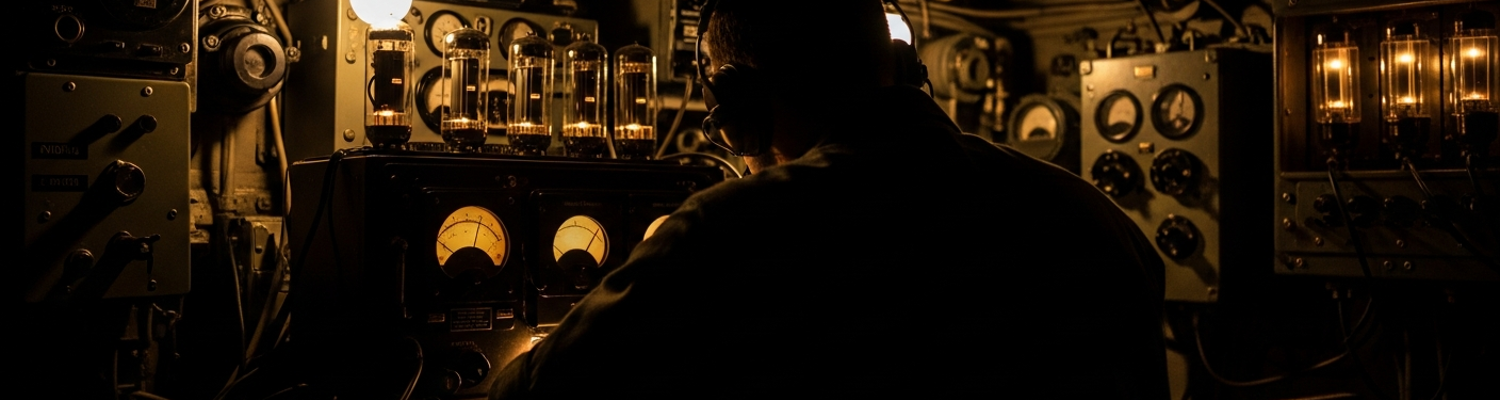
An ELINT specialist was a man entombed. On a four-piper destroyer, his “shack” was often a converted storeroom or a partitioned-off corner of the main radio room, a space barely large enough for a stool and the receiver. On a submarine, conditions were worse. The equipment was wedged into an alcove near the control room. These spaces were poorly ventilated, perpetually hot, and saturated with the smells of the ship. The faint, sweet scent of ozone from the high-voltage vacuum tubes in the National HRO receiver mingled with the ever-present odor of diesel fuel that permeated every surface. The air, heavy with humidity, caused paperwork to mildew and invited corrosion on the sensitive radio contacts. This environment was a constant, low-level assault on the senses, compounded by the unending vibration of the ship’s engines and the jarring shock of rough seas. All of it had to be endured for watch shifts that could last eight to twelve hours.
For hours on end, the radioman’s world was reduced to what came through his headphones: an unrelenting hiss and crackle of atmospheric static. His job was to sit in the dark, one hand glued to the large micrometer dial of the HRO, slowly sweeping through the high-frequency bands. It was a task that demanded intense, focused concentration against a backdrop of extreme monotony. The operator was listening for the faintest trace of a signal, a brief flutter of Katakana Morse code that might last only seconds before vanishing. The mental strain of this electronic vigil was severe. It created a sense of detachment, not just from the world outside, but from the very crew he served with. His shipmates were fighting the sea and maintaining the ship; he was fighting a war in the invisible electromagnetic spectrum, a battle no one else on board could see or understand.
Fatigue was a tactical reality. This combination of physical hardship and mental strain made errors inevitable. An operator, numb from hours of listening to static, could easily miss a weak signal burst. A hand cramped from constantly adjusting the tuning dial might fail to log a frequency with perfect accuracy. As exhaustion increases, perceptual sensitivity declines, and the brain begins to compensate by becoming more conservative, potentially dismissing a faint, unusual signal as mere noise. The operational isolation magnified this pressure. On a lone destroyer patrol in the South China Sea, the ELINT specialist was the only man of his kind for hundreds of miles. The intelligence he gathered was encrypted and transmitted into an electronic void, with no immediate feedback on its importance or acknowledgment of its receipt. During the Japanese signal burst of October 1940, the pressure intensified. Operators knew they were intercepting something significant, but they had no way of knowing if their frantic efforts were contributing to a larger picture. This lack of confirmation fed a sense of futility, where the operator could never be certain if he was a vital link in an intelligence chain or simply a man shouting into the static.
A fundamental flaw crippled the American electronic intelligence effort in the Pacific in 1940. U.S. Navy thinking, shaped by its own operational methods, was built on the belief that amassing a large fleet for an attack required extensive radio coordination, providing a built-in early warning system. The October 1940 signal bursts seemed to confirm this. Analysts correctly identified the traffic as a large-scale IJN exercise, but they filed the event under a flawed paradigm. They saw a fleet practicing for a conventional battle, not a force perfecting the art of radio deception for a surprise attack. The IJN, in stark contrast to American practice, was obsessively focused on communications security and the tactical use of radio silence.
The technical poverty of American ELINT units amplified this doctrinal error. While a network of shore-based high-frequency direction-finding (HFDF) stations was under construction, it was far from complete or precise. The stations at places like Cavite in the Philippines, Guam, and Samoa were often thousands of miles apart, making effective triangulation on a signal source a matter of rough guesswork. A bearing taken from a single station could produce a line of position hundreds of miles long, rendering the plot tactically useless. Shipboard DF equipment, typically a rudimentary loop antenna fitted to a destroyer or submarine, was even less accurate and highly susceptible to errors induced by the ship’s own metallic structure and the rolling of the vessel. This technical impotence meant that even when Japanese signals were intercepted, locating their point of origin was nearly impossible. Analysts were left to infer location from signal strength, a notoriously unreliable metric, creating a distorted and often incorrect picture of the Japanese fleet’s disposition.
The intelligence failures born from these doctrinal and technical weaknesses had a direct, corrosive impact on pre-war strategic assessments. The data gathered from the October 1940 intercepts and similar events was filtered through a fractured analytical system. The Navy’s three primary intelligence hubs operated as semi-independent fiefdoms. Lacking standardized protocols for traffic analysis, the interpretation of Japanese activity often depended on the local commander’s biases. Compounding this was the difficulty in reading the messages themselves; the JN-25 fleet code was updated on December 1, 1940, with a new codebook, temporarily setting back Allied cryptanalysis efforts. Even when parts of the code were readable, the constant changes required analysts to virtually start over, ensuring that by the time any real progress was made, the intelligence was often stale. The result was a stream of conflicting and ambiguous reports flowing to commanders like Admiral Thomas C. Hart of the Asiatic Fleet and to the Navy Department, fostering a dangerous sense of uncertainty and underestimation of Japanese capabilities.
The frustrations of 1940 and 1941 forced a slow, painful recognition that the entire command and intelligence structure was inadequate. The flow of information was sluggish and disjointed. An intercept log from a submarine on patrol had to be encrypted, transmitted, decrypted, analyzed, re-encrypted as part of a summary, and then sent up a long chain that extended from Manila to Hawaii and finally to Washington. A unified assessment of the October 1940 exercises was not formed until well after the Japanese fleet had already dispersed and fallen silent. This systemic lag, combined with the inconsistent analytical methods, made it clear that a drastic overhaul was needed. The hard lessons from these early intelligence gaps would eventually spur the development of improved command links and the creation of joint intelligence centers like FRUMEL in Australia, a direct response to the failures of the pre-war period.