
Strategic Importance of Dong Ha Combat Base
Radio operators at Dong Ha Tower frequently tracked inbound flights of C-130 transport aircraft on vector zero-niner-zero while the airspace remained saturated with rotary-wing traffic. The landing deck often sat foul under incoming 130-millimeter artillery fire. Pilots aborted their approaches.
A close review of operational logs indicates that by early 1968, Dong Ha Airfield handled a daily throughput of over three hundred tons of Class V ammunition and Class I rations. Positioned at coordinates 16.833 degrees North and 107.100 degrees East, the installation sat seven miles south of the Vietnamese Demilitarized Zone. The 3rd Marine Division relied entirely on this airstrip to feed its infantry battalions strung out along Route 9. This supply line required a constant stream of heavy transport aircraft to deliver pallets of 105-millimeter artillery shells and medical supplies. Heavy transport demand forced an unsustainable operational tempo.
Marine Air Support Squadron 2 operated the Direct Air Support Center on site. These controllers attempted to sequence incoming CH-46 Sea Knight helicopters alongside C-130 Hercules transport aircraft. Fixed-wing heavy lifters slammed down onto a 3,200-foot AM-2 aluminum matting runway designed exclusively for temporary expeditionary use. The constant friction of heavy landing gear degraded the locking mechanisms of the interlocking aluminum sections.
Metal planks snapped.
Archival evidence shows severe command friction between the Marine Corps aviation element and the Seventh Air Force headquarters in Saigon regarding the control of this specific airspace. Seventh Air Force commanders demanded centralized control of all fixed-wing sorties entering the Route Package 1 grid. They insisted on a single air tasking order generated by their tactical air control center. Marine officers at Dong Ha rejected this centralized scheduling model entirely. They viewed it as a bureaucratic infringement on their doctrine of an integrated Marine Air-Ground Task Force. Requiring Saigon to clear tactical air strikes delayed response times by up to forty-five minutes. Ground troops remained exposed to enemy assaults during these administrative delays.
Ground controllers at the airfield often ignored Air Force transit corridors to expedite their own organic close air support missions. Navy A-4 Skyhawks and Marine F-4 Phantoms frequently entered holding patterns at the exact same altitude as Air Force forward air controllers operating unarmored Cessna O-1 Bird Dogs. This created a highly congested airspace over the base where mid-air collision risks equaled the threat of enemy anti-aircraft fire. Radio frequencies jammed with overlapping transmissions from competing service branches. Radar screens filled with unidentified blips.
When examining the historical record of early 1968, the physical vulnerability of the installation drove daily aircraft attrition rates upward. North Vietnamese Army artillery units from the 324B Division entrenched 130-millimeter M-46 field guns and 122-millimeter rocket launchers immediately across the border. These batteries fired from concealed positions in the Co Roc mountains and along the northern edge of the Ben Hai River. Forward observers possessed direct line-of-sight to the Dong Ha runway from elevated terrain to the northwest. They timed their bombardments to coincide precisely with the arrival of heavy transport aircraft. Artillery crews waited for a C-130 to commit to its final glide slope before initiating a coordinate-based fire mission.
AN/MPQ-4A counter-battery radar systems at Dong Ha repeatedly failed to track the incoming trajectories. Mechanical degradation from fine laterite dust clogged the cooling fans of the radar units. Internal vacuum tubes overheated and short-circuited during active barrages. High-explosive shells detonated on the flight line.
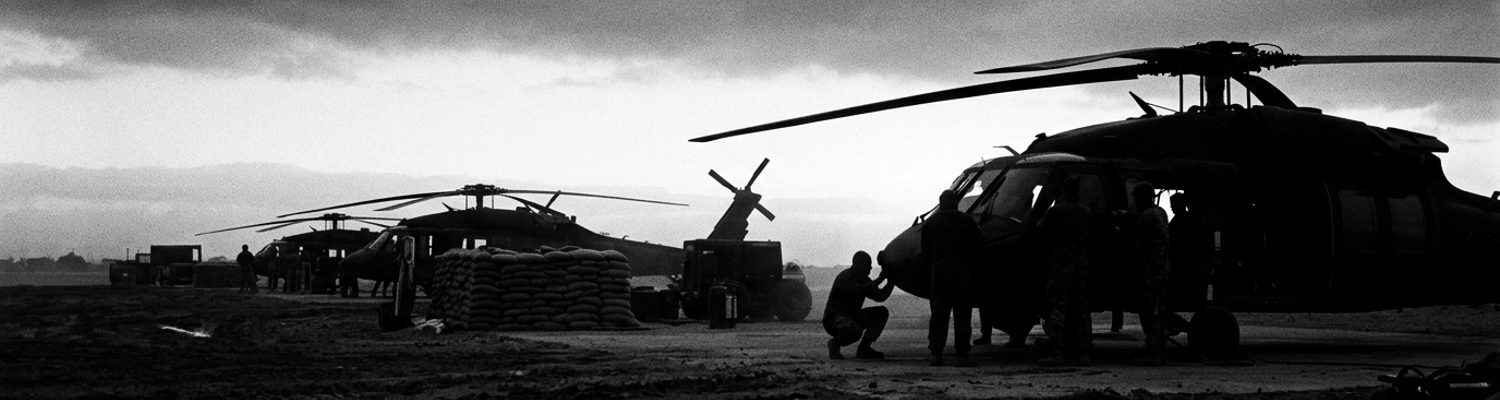
Shrapnel from the 130-millimeter rounds shredded the pressurized hydraulic lines and synthetic rubber tires of aircraft parked in the unprotected revetments. Maintenance crews from Marine Aircraft Group 36 worked in the open to patch punctured aviation fuel tanks with fast-curing epoxy while under active shelling. Fuel leaks mixed with the laterite dust. This created a highly flammable slurry across the taxiways. The air traffic control tower took multiple direct hits during the first week of February. Controllers abandoned the primary UHF radio consoles after fragmentation sheared the exterior antenna cables. They routed flight clearances through a backup PRC-25 man-pack radio operating on battery power from a subterranean bunker. Operators shouted coordinates over the concussive blasts of incoming artillery.
Doctrine Clash Between USAF and Marine Aviation
A close review of command directives from late 1968 reveals a severe institutional breakdown over airspace management. In September 1968, the USAF Seventh Air Force aggressively sought a unified command structure under its Single Manager doctrine. General William Momyer operated out of the Tactical Air Control Center at Tan Son Nhut Air Base in Saigon. From this distant headquarters, he mandated that every fixed-wing sortie across South Vietnam adhere to a single centralized Air Tasking Order. This daily master schedule dictated precise takeoff times, target coordinates, and ordnance loads for all strike and transport aircraft.
Officers in Saigon transmitted these complex schedules via encrypted AN/FGC-25 teletype networks routed over tropospheric scatter radio relays. The physical distance between the airbase in Saigon and the northern I Corps tactical zone spanned over four hundred miles. Signal degradation occurred constantly. High atmospheric humidity and frequent monsoon rain squalls disrupted the microwave transmissions. Punched paper tape readouts at receiving stations emerged garbled and unreadable.
Air Force doctrine insisted that consolidating control at the theater level prevented redundant bombing missions. Planners believed this system maximized the payload efficiency of F-105 Thunderchiefs launching from bases in Thailand. The Single Manager concept required all local ground commanders to submit target requests twenty-four hours in advance. Targeting officers at Tan Son Nhut needed this lead time to allocate appropriate munitions.
This centralized routing loop added hours to emergency strike execution times.
Archival evidence shows that the Marine Corps III Marine Amphibious Force fiercely resisted this centralization effort. Lieutenant General Robert Cushman argued that the Marine Air-Ground Task Force doctrine required immediate access to the 1st Marine Aircraft Wing. Infantry battalions pinned down by North Vietnamese Army crossfire near the Demilitarized Zone relied on rapid close air support to survive. Marine aviation officers operating the Direct Air Support Center at Dong Ha routed immediate strike requests straight to A-4E Skyhawk squadrons sitting on alert at Chu Lai and Da Nang.
Ground controllers utilized AN/MRC-108 communication suites mounted in the back of M151 quarter-ton trucks to talk directly with incoming pilots. The hardware integrated multiple Collins ARC-27 UHF transceivers and a 400-watt power amplifier to push signals through the dense jungle canopy. This localized architecture allowed a forward air controller on the ground to divert a flight of F-4B Phantoms mid-air. The controller could redirect them from a pre-planned interdiction target to drop 500-pound Mk 82 Snakeye retarded bombs on active enemy mortar pits just meters from friendly lines.
The Single Manager directive stripped the Dong Ha controllers of this exact diversion authority.
When examining the operational logs from September 1968, the implementation of the Single Manager system caused immediate mechanical and tactical friction over Route 9. Marine ground commanders refused to wait for the Tan Son Nhut headquarters to process and approve emergency air requests through the delayed teletype relay. They bypassed the Seventh Air Force completely. Using secure voice channels on PRC-77 man-pack radios equipped with KY-38 encryption units, forward observers called Marine attack squadrons directly.
Air Force radar operators at the tactical control facilities observed unauthorized Marine aircraft entering restricted strike zones already assigned to USAF fighter-bombers. F-100 Super Sabres diving on designated coordinates frequently pulled up violently to avoid colliding with Marine fixed-wing elements operating on conflicting localized instructions. The Direct Air Support Center at Dong Ha continued to assign stack altitudes and ingress vectors based solely on immediate infantry needs. They ignored the theater-wide Air Tasking Order generated in Saigon.
Radio channels overloaded as ground controllers shouted over each other to deconflict the airspace.
Seventh Air Force liaison officers embedded at the I Corps headquarters filed formal complaints. These documents cited specific grid coordinates where uncoordinated Marine ordnance drops endangered Air Force forward air controllers. The paperwork documented a September 14 incident at coordinates 16.790 North and 106.950 East. An unannounced Marine A-6 Intruder released a full payload of CBU-24 cluster munitions. The bomblet dispensers opened at two thousand feet. Fragmentation scattered directly through the established glide path of an Air Force RF-4C reconnaissance flight operating on a centralized Seventh Air Force clearance.
Air Strike Delays Along the Demilitarized Zone
Radio operators from India Company frequently transmitted requests for immediate fixed-wing suppression on vector zero-four-zero while receiving sustained 120-millimeter mortar fire from defilade. They authenticated their coordinates and reported their ammunition status as black on heavy ordnance.
A close review of operational logs from late 1968 indicates this exact type of transmission initiated a highly complex administrative sequence. Under the Single Manager system enforced by the Seventh Air Force, an emergency request for close air support originating near the Demilitarized Zone could no longer go straight to the 1st Marine Aircraft Wing at Da Nang. Ground commanders transmitted their coordinates via PRC-25 man-pack radios to the Direct Air Support Center at Dong Ha. Operators there transcribed the target data onto standardized paper forms.
Instead of scrambling A-4 Skyhawks sitting on alert five minutes away, local controllers typed the grid coordinates into an AN/FGC-25 teletype machine. This hardware punched a paper tape and transmitted the encrypted KW-7 cryptographic signal over a tropospheric scatter relay. The microwave beam traveled four hundred miles south to the Tactical Air Control Center at Tan Son Nhut Air Base in Saigon.
Centralized routing severed the tactical link between infantrymen and their organic aviation assets.
Archival evidence shows severe time lags accumulated inside the Saigon headquarters. Air Force targeting officers working inside the windowless facility reviewed the incoming paper tape readouts. They needed to determine if the requested strike conflicted with pre-planned bombing runs over Route Package 1. Manual cross-referencing against the daily Air Tasking Order printed on massive acetate plotting boards consumed valuable minutes. If a requested target fell within a restricted fire zone, a Seventh Air Force colonel had to authorize a diversion of airborne F-100 Super Sabres or F-4D Phantoms.
Approval orders then traveled back through the teletype network to a regional control center. From there, radio operators forwarded the clearance to an airborne forward air controller piloting an unarmored O-2 Skymaster. High humidity frequently jammed the mechanical punch mechanisms of the teletype machines.
When examining the historical record of engagements near the DMZ, these administrative loops generated lethal delays for ground units. III Marine Amphibious Force tactical commanders filed extensive after-action reports detailing the failure of the centralized system during active firefights. On October 14, elements of the 3rd Marine Division engaged a reinforced battalion of the North Vietnamese Army 320th Division near the combat base at Con Thien. Geographic coordinates for the ambush site were 16.903 degrees North and 106.911 degrees East.
NVA forces initiated contact using RPD light machine guns and B-40 rocket-propelled grenades fired from entrenched bunkers concealed by heavy elephant grass. Marine infantrymen immediately established a defensive perimeter. They dialed their radio frequencies to 49.80 megahertz and requested close air support through their battalion communications operator. Dong Ha logged the initial transmission at exactly 1412 hours.
Marine officers at the forward air control center possessed visual contact with two F-4B Phantoms orbiting in a holding pattern at fifteen thousand feet. Strict compliance with the Single Manager directive explicitly prohibited the controllers from dropping those specific aircraft onto the active ambush site without Saigon authorization. Their request entered the tropospheric scatter relay network. Atmospheric interference from a low-pressure system over the South China Sea degraded the microwave transmission almost immediately. Operators required three separate rebroadcasts before the Tan Son Nhut receivers produced a legible teletype punch tape.
TACC personnel took twenty-two minutes to process the target data and assign a flight of Air Force F-105 Thunderchiefs launching from Takhli Royal Thai Air Force Base.
Those assigned fighter-bombers were still sitting on the tarmac in Thailand.
III MAF commanders on the ground reported that NVA infantry utilized the delay to close within fifty meters of the Marine perimeter. Enemy troops actively employed hugging tactics to negate the effectiveness of any incoming air strikes. At 1538 hours, eighty-six minutes after the initial radio call, the F-105s arrived on station over Con Thien. Pilots in the Air Force formation carried 750-pound M117 general-purpose bombs fuzed for instantaneous detonation. The forward air controller orbiting above determined the proximity of friendly forces prevented the safe release of high-explosive unguided munitions. Targeting officers ordered the flight leader to abort the strike profile and return to base with a full ordnance load.
Field Modifications to UH1E Armed Helicopters
A close review of squadron maintenance logs from Marine Observation Squadron 2 reveals a direct mechanical response to the centralized targeting delays imposed by Saigon. Ground commanders operating along the Route 9 corridor could no longer depend on fixed-wing air support arriving before North Vietnamese infantry breached their perimeters. Marine aviation units at Dong Ha compensated by aggressively upgrading the organic firepower of their rotary-wing assets.
The standard factory armament on a Marine UH-1E Huey consisted of dual M60C 7.62mm machine guns mounted on external pylons. This configuration provided a combined rate of fire of barely one thousand rounds per minute. This volume proved highly inadequate against entrenched NVA 12.7mm anti-aircraft positions guarding the infiltration routes near coordinates 16.795 North and 106.711 East. Squadron armorers bypassed the naval supply chain entirely to acquire GAU-2B/A miniguns originally designated for Air Force gunships.
These electrically driven rotary weapons required 28-volt direct current power and fired four thousand rounds per minute. Marine logisticians bartered captured enemy weapons with Air Force supply sergeants at Da Nang to secure the restricted hardware.
The standard Huey airframe possessed no factory hardpoints capable of absorbing that specific recoil impulse.
Archival evidence shows that local maintenance chiefs initiated a complete redesign of the helicopter weapons interface without consulting Naval Air Systems Command engineers. Armorers scavenged heavy-gauge steel tubing from destroyed motor pool M35 cargo trucks to fabricate non-standard mounting brackets. They measured the dimensions of the external stores support assemblies and hand-cut the steel to match the load-bearing stress points of the fuselage. Mechanics wired the minigun control solenoids directly into the pilot cyclic control stick using salvaged communication cables ripped from wrecked avionics bays.
Ammunition feed chutes presented a severe mechanical challenge. The high cyclic rate of the GAU-2B/A required a continuous flow of linked 7.62mm cartridges to prevent catastrophic jamming during a firing pass. The standard electric feed motors struggled to pull heavy ammunition belts at high angles of attack. Crews stripped the rear troop compartments of their canvas seats and bolted massive aluminum ammunition bins directly to the floorboards. They routed flexible steel feed chutes out the side doors. Mechanics secured the tracks to the door frames with heavy-duty aircraft safety wire.
These modified hoppers held four thousand rounds of belted ammunition.
When examining the historical record of Marine Aircraft Group 36 operations, the physical execution of these airframe alterations violated standing aviation maintenance protocols (NAVAIR Instruction 4790.2). Structural welding occurred directly inside the open-air field maintenance bays at Dong Ha. This localized fabrication completely bypassed the slow formal logistics channels that required aircraft to be shipped back to depot-level facilities in Okinawa for major structural modifications.
Aviation mechanics utilized oxy-acetylene torches to fuse the improvised steel brackets onto the existing aluminum cross-tubes of the landing skids. The intense heat of the welding equipment frequently compromised the structural temper of the surrounding aviation-grade aluminum. Mechanics worked under camouflage netting amidst the constant threat of incoming 130-millimeter artillery fire from NVA batteries across the Ben Hai River. Fine laterite dust coated the welding seams. Crews had to repeatedly grind down and re-weld the joints to prevent slag inclusions. They reinforced the heat-weakened aluminum nodes by bolting on scrap titanium plating salvaged from the engine nacelles of downed F-4 Phantoms.
Base commanders intentionally ignored the non-compliant engineering reports.
The resulting hybrid gunships deployed immediately to escort CH-46 Sea Knight transports into contested landing zones near the Demilitarized Zone. During a July 1968 extraction mission at Landing Zone Robin, three of these field-modified UH-1Es engaged a heavy weapons company of the NVA 320th Division. The structural welds on the improvised mounts held firm under sustained firing runs. Pilots banked the aircraft at sharp sixty-degree angles. They channeled the minigun fire directly into the enemy tree lines at a slant range of three hundred meters.
Spent brass casings flooded the cabin floors. This frequently shorted out exposed radio wiring as the gunners maintained continuous suppression. The modified electrical feeds drew heavy amperage from the helicopter generators. Instrument panel warning lights flickered wildly during prolonged trigger pulls. High-frequency vibrations from the spinning barrels rattled the airframe so violently that instrument glass shattered in the cockpit.
Ammunition drums emptied in less than sixty seconds of continuous operation.
Documentation Shortages and Combat Photographer Challenges
A close review of logistics manifests from the 3rd Marine Division Photographic Section in August 1968 reveals a severe breakdown of photographic supply chains at Dong Ha. Combat cameramen operating out of the combat base at coordinates 16.833 degrees North and 107.100 degrees East carried standard-issue Leica M3 and Nikon F 35mm cameras. They shot thousands of frames of Kodak Tri-X Pan black-and-white film to record structural battle damage and infantry movements along the Route 9 corridor.
The chemical processing of these latent images required highly specific agents to convert exposed silver halides into visible metallic silver. Standard development protocols demanded Kodak D-76 developer powder, glacial acetic acid for the stop bath, and sodium thiosulfate to fix the negatives. Seventh Air Force cargo loadmasters at Da Nang Air Base classified these materials as non-essential cargo under the centralized theater supply system. They consistently stripped pallets of photographic chemicals from inbound C-130 Hercules flights. Planners in Saigon allocated that specific cargo weight exclusively for 105-millimeter howitzer shells and aviation-grade kerosene.
The chemical deficit halted all official photographic intelligence gathering.
Archival evidence shows Marine photographers accumulated hundreds of exposed film cassettes inside unventilated sandbagged bunkers near the airfield perimeter. Ambient temperatures routinely exceeded one hundred degrees Fahrenheit during the afternoon. This extreme heat rapidly degraded the latent images on the unprocessed acetate strips. Photographers needed to process the ASA 400 speed film before the heavy atmospheric humidity caused the gelatin emulsion layers to fuse permanently to the metal cassettes.
Without the factory-issued D-76 powder, chemical specialists attempted to stretch their remaining developer stock by diluting it at a ratio of one part chemical to four parts water. They mixed this weakened solution using heavily chlorinated water drawn from the base purification trailers. The high chlorine content reacted aggressively with the diluted hydroquinone developer compounds. Negatives emerged severely overdeveloped with massive grain structures.
When examining the historical record of Marine Aircraft Group 36, the necessity of documenting unauthorized airframe modifications forced combat cameramen to engineer unapproved darkroom solutions. Maintenance chiefs needed visual proof that their scavenged M35 cargo truck steel brackets successfully supported the Air Force GAU-2B/A miniguns on the UH-1E Huey landing skids. They required clear high-resolution prints of the specific weld seams to send to III Marine Amphibious Force headquarters.
Photographers built improvised darkrooms inside subterranean culverts using layers of heavy rubberized ponchos to block incoming daylight. They scavenged ascorbic acid from expired medical supply kits. They mixed this with sodium carbonate and instant coffee grounds sourced from C-ration boxes to create a crude developing agent. The mixture registered a pH level capable of reducing the exposed silver halides into a visible image. Cameramen shot the modifications using slow 1/30th of a second shutter speeds to compensate for the dark conditions inside the maintenance hangars.
They agitated the stainless steel film tanks constantly to compensate for the weak chemical reaction.
The resulting negatives possessed heavy base fogging and extremely low contrast. Photographers pushed the film during the development phase by leaving the strips submerged in the coffee-based mixture for up to forty-five minutes. They lacked proper chemical fixers to halt the development process permanently. Cameramen washed the film in standing rainwater collected in empty 7.62mm ammunition tins to clear the remaining active agents. Personnel hung the wet cellulose strips to dry on communications wire strung between 130-millimeter artillery craters along the flight line.
Ground commanders examined the resulting eight-by-ten inch contact prints under red tactical flashlights. The grainy high-contrast images captured the exact structural load points where aviation mechanics had fused the scrap titanium plating onto the aluminum cross-tubes of the helicopters. Photographers documented the heavy-duty aircraft safety wire securing the flexible steel ammunition chutes to the Huey door frames. These physical prints provided the only structural documentation of the hybrid gunships.
Artillery Bombardment and Tactical Communications Failures
Radio operators at DASC Dong Ha frequently transmitted emergency alerts reporting incoming 130-millimeter barrages on the tactical air control center. They reported primary UHF arrays severed and secondary VHF channels saturated with white noise. Controllers aborted all holding patterns and authenticated their distress signals.
A close review of operational logs indicates these transmissions marked the beginning of a systematic degradation of the 3rd Marine Division command grid. North Vietnamese Army artillery regiments from the 324B Division positioned directly inside the Co Roc mountains executed coordinated fire missions targeting the exact coordinates of the Dong Ha communications bunkers. Gun crews operating M-46 130-millimeter towed field pieces utilized forward observers on elevated ridges to dial in the Marine base.
These batteries fired high-explosive fragmentation shells with delay fuzes designed to penetrate the sandbag and corrugated steel roofs of the command posts before detonating. The resulting blasts specifically targeted the dense clusters of AS-1729/VRC whip antennas protruding from the subterranean operations centers. Shrapnel sheared through heavy-grade coaxial cables.
Archival evidence shows the physical destruction of the communications infrastructure occurred rapidly during the second week of March 1968. Incoming artillery rounds detonated within fifteen meters of the Direct Air Support Center. The concussive force collapsed the primary trench lines housing the heavy copper trunk lines. Those specific wires connected the radar approach control directly to the ground-to-air transmitters. Jagged metallic fragments traveling at supersonic speeds shredded the unarmored external generator units powering the base.
Without direct current power, the high-wattage AN/MRC-108 communication suites mounted in the M151 quarter-ton trucks completely powered down. Marine technicians crawled through the mud to splice the severed wiring under active fire using basic electrical tape and wire strippers. They required a continuous hardware connection to maintain the 243.0 megahertz emergency guard frequency.
Fine laterite dust infiltrated the exposed copper splices.
When examining the historical record of this specific bombardment, the loss of hardware severed the tactical link between ground controllers and airborne assets. Emergency air requests originating from infantry units pinned down along Route 9 failed to reach the orbiting fixed-wing attack squadrons. Operators inside the partially collapsed Dong Ha bunkers reverted to battery-powered PRC-25 man-pack radios. They cranked the squelch knobs to maximum in an attempt to cut through the heavy electromagnetic interference.
The continuous artillery detonations ionized the air directly above the airfield. This created thick bands of static across the VHF spectrum. The internal components of these portable radios suffered severe micro-fractures from the concussive shockwaves bouncing off the concrete bunker walls. Internal vacuum tubes shattered inside the radio casings.
Marine forward air controllers screamed into their H-250 plastic handsets. The physical noise of 130-millimeter shells impacting the runway tarmac registered above one hundred and forty decibels. This concussive acoustic pressure physically blocked the human voice before it could even reach the radio microphones. Audio logs recorded by the 1st Marine Aircraft Wing during the barrage consist almost entirely of heavy static and the structural groan of buckling overhead beams.
Pilots flying A-4 Skyhawks in holding patterns at ten thousand feet received only broken bursts of static over their UHF frequencies. The lack of clear communication prevented ground controllers from relaying precise target coordinates or authenticating clearance codes. Airborne flight leaders refused to drop 500-pound Mk 82 ordnance without verified visual or audio confirmation from the ground. The attack aircraft burned through their holding fuel and returned to Da Nang with full payloads.