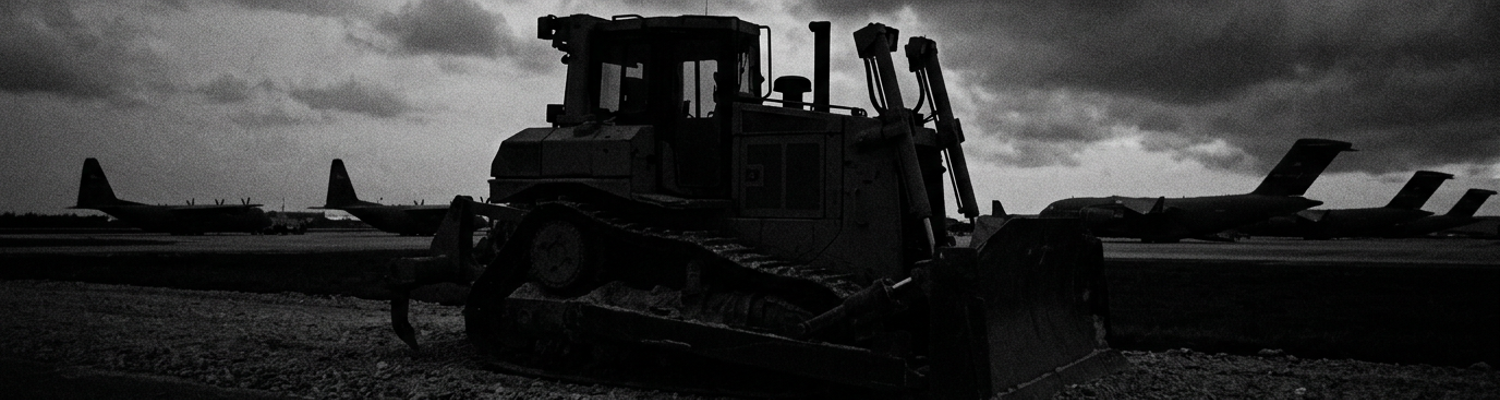

Tenth Army Airfield Conversion at Ie Shima
The hydraulic pressure gauge on the lead D8 Caterpillar tractor dropped to zero. The drive sprocket sheared its mounting bolts with a loud metallic grind. Heavy gear teeth chewed into the steel track housing. The left tread seized completely. This mechanical failure left the twenty-ton machine disabled in the center of the crushed coral runway. Archival evidence shows this specific breakdown occurred on the morning of April 20, 1945. Tenth Army engineers were attempting to clear the western edge of the newly captured Ie Shima airfield. Replacing the sheared sprocket required a requisition form approved by three separate logistics officers within the joint command structure.
Army engineers requested the part through the Tenth Army supply chain.
Naval supply officers controlled the offshore logistics ships. They refused to prioritize tractor components over artillery shells. The disabled bulldozer sat on the coral for three days. In April 1945 Tenth Army engineers seized and converted Ie Shima airfield facilities under conditions of extreme administrative friction. The 1892nd Engineer Aviation Battalion landed on the small island just west of Okinawa shortly after the 77th Infantry Division secured the central plateau. Their objective involved transforming three heavily cratered Japanese bomber strips into operational fighter bases for the Far East Air Forces. Engineering officers wanted to lay down pierced steel planking immediately to get the initial runway operational. Army Air Forces liaisons demanded a wider sub-base of rolled coral to accommodate the specific landing gear footprint of heavy bombers. This directly contradicted the Tenth Army tactical plan.
The disagreement escalated to the theater command level.
Field commanders exchanged angry memorandums. Engineer companies sat idle in their staging areas awaiting a final ruling on runway dimensions. The engineers eventually received orders to proceed with the coral base. They deployed a fleet of motorized graders and sheep-foot rollers to crush the jagged limestone formations dotting the plateau. The conversion process required moving thousands of cubic yards of earth while dodging unexploded ordnance.
A close review of operational logs indicates the delay cost the engineers forty-eight hours of clear weather.
C-47 transport aircraft landed high-octane aviation fuel and ammunition at forward ramps before the primary taxiways possessed a hardened surface. The Douglas C-47 Skytrain featured a maximum takeoff weight exceeding 31,000 pounds. Applying heavy brake pressure against the uneven terrain proved necessary to bring these heavily laden twin-engine aircraft down onto an unfinished coral strip. Transports delivered 100-octane aviation gas in standard 55-gallon steel drums. Ground crews from the 318th Fighter Group rolled these heavy containers directly off the cargo ramps and into the mud.
C-47s also brought in wooden crates packed with .50 caliber machine gun belts and five-inch high-velocity aerial rockets.
Unloading operations suffered from constant interference by competing command structures. Quartermaster officers insisted on inventorying every single fuel drum before releasing the stock to the fighter squadrons. Aviation mechanics ignored the quartermasters. They physically rolled the fuel drums straight to the waiting P-47 Thunderbolts.
The quartermaster unit filed official theft reports against the fighter group.
The process of converting the Ie Shima facilities exposed severe administrative divisions. Navy construction battalions arrived on the island later that month with specialized rock-crushing equipment. Tenth Army engineers requested access to the crushers to speed up the production of aggregate for the secondary runways. Naval commanders restricted the use of their equipment to their own specific construction zones on the eastern beaches. Army engineers resorted to detonating dynamite charges in shallow limestone pits to generate the necessary filler material.
This improvised blasting technique produced uneven chunks of rock.
These jagged pieces repeatedly punctured the tires of the incoming transport planes. A C-47 blew a main landing gear tire on a sharp piece of limestone on April 26. The aircraft ground looped into a drainage ditch.
The damaged transport blocked the active forward ramp for twelve hours.
Signal Corps and Marine Air Group Priority Deadlock
Standard W-110-B twisted pair field wire featured four steel and three copper strands. Rubber insulation and a weather-resistant cotton braid covered the core. Commanders of the 71st Signal Battalion required seventy miles of this specific wire to establish a perimeter defense network. This network connected the heavy anti-aircraft batteries along the southern bluffs. A forward detachment from Marine Air Group 31 landed on Red Beach One on April 24 with orders to set up Ground Control Intercept radars.
The radars needed physical connections.
Marine supply officers possessed the heavy tracking trailers but lacked the communication lines to link their plotting centers to the fighter dispersal pens. Army logisticians held a stockpile of three hundred DR-4 drum reels at a supply dump near the western taxiway. Marine quartermasters requisitioned one hundred of these reels. Colonel Harold Reeder directed the Signal Corps detachment. He flatly denied the request.
Archival evidence shows this single denial triggered a four-day administrative standoff between the two branches.
Marine officers bypassed the Tenth Army supply chain entirely. They ordered their enlisted personnel to physically appropriate the wire. A squad of Marine mechanics drove a pair of Dodge WC-51 three-quarter-ton trucks directly into the Army supply dump on the morning of April 25. Enlisted men loaded forty DR-4 reels into the truck beds. Armed military police from the 71st Signal Battalion intervened.
Weapons were drawn.
This physical confrontation involved M1911 sidearms and shouted threats of court-martial. Tension de-escalated when a Tenth Army provost marshal arrived and ordered the Marines to return the wire spools to the staging pallets. Major General Lewis Woods of the Marine Air Wing responded by filing a formal grievance with the joint expeditionary command. He argued that without the W-110-B wire to connect the radar vans to the VHF radio transmitters his F4U Corsair pilots flying combat air patrols had no early warning of incoming Japanese bomber formations.
The Army provost marshal ignored the tactical argument.
He placed a twenty-four-hour armed guard on the wire stockpile. Jurisdictional disputes delayed critical wire routing across the congested airhead just as the first operational fighter squadrons arrived. Master communication plans required laying a ten-pair rubber cable from the central command bunker at the base of Mount Iegusugu to the primary air traffic control tower on the western strip. Surveyors plotted this route directly through a staging area claimed by the Marine Air Group.
Army linemen began unspooling the heavy cable from RL-31 reel units mounted on the back of Jeeps.
Marine sentries physically blocked the path. Marine officers stated the proposed trench line would destabilize the coral foundation under their specialized radar calibration equipment. Signal officers from the Tenth Army refused to alter the trajectory. They cited the severe shortage of materials and the extra two miles of wire required to bypass the Marine encampment.
A close review of operational logs indicates this specific territorial dispute left the primary control tower without hardline telephone communication for seventy-two hours.
Congested airhead conditions magnified the effects of this bureaucratic deadlock. Construction battalions operated heavy machinery around the clock in a confined space measuring less than three square miles. Space was nonexistent. Lacking buried communication lines meant Army dispatchers relied on hand-held SCR-536 radios to coordinate the movement of fuel trucks and ammunition carriers. These low-power transceivers suffered from severe static interference caused by the ignition systems of the radial engines being tested on the flight line.
Coordination broke down completely.
Fuel convoys drove directly into active taxiways because the tower operators had no physical telephone lines to warn the ground control stations. Two Army aviation fuel trucks collided with a tractor towing a P-61 Black Widow night fighter on April 28. Impact forces ruptured a 1,000-gallon tank of aviation gasoline across the crushed coral surface. Firefighters extinguished the resulting blaze using chemical foam. The incident destroyed the aircraft and melted the tires of the towing vehicle.
Film Transmission Over Tactical Air Support Calls
The AN/TXC-1 facsimile transceiver required a continuous uninterrupted radio frequency to scan and transmit a single eight-by-ten photographic print. Inside a sandbagged communications bunker on the western edge of Ie Shima technicians from the 71st Signal Battalion attached freshly developed combat photographer film reels to the machine rotating drum. These images were chemically fixed in mobile darkrooms just hours prior. An electric stylus scanned the rotating image at a rate of ninety lines per minute. This converted the varying shades of black and white into high-frequency audio tones broadcast over a dedicated SCR-399 radio set.
This scanning process took exactly twenty minutes per photograph.
During this continuous twenty-minute transmission window the high-frequency audio signals occupied the entire bandwidth of the assigned communication channel. Any secondary radio traffic on that specific frequency caused severe static distortion. This permanently corrupted the image being received by the relay station on Guam. Signal officers established strict protocols prohibiting any overlapping transmissions on the designated facsimile frequencies.
This rigid bandwidth protection directly neutralized local combat communications.
Infantrymen from the 305th Regimental Combat Team encountered heavy machine-gun fire from a fortified limestone ridge on April 27. Forward observers from the 292nd Joint Assault Signal Company attempted to broadcast a nine-line fire mission to the tactical air support control center using their SCR-300 backpack radios. The grid coordinates for the Japanese bunker complex required immediate relay to the loitering P-47 Thunderbolt squadrons circling at ten thousand feet. The primary relay station on the airfield received the request. They refused to forward the coordinates to the fighter direction center.
Communications personnel actively suppressed the tactical air support requests to transmit the combat photographer film reels.
The duty officer at the signal bunker ordered the radio operators to maintain radio silence until the AN/TXC-1 finished broadcasting a series of action photographs depicting the initial beach landings. The forward observers waited twenty-six minutes for the frequency to clear. Public relations communications received higher wire transmission priority than frontline air support. The Tenth Army Information and Historical Service operated under direct orders to dominate stateside newspaper headlines. They competed for column inches against General Douglas MacArthur and his command in the Philippines.
Press officers assigned high-level administrative clearance codes to daily combat summaries and feature stories written by embedded correspondents.
These alphanumeric priority codes dictated the exact sequence of message processing at the central teletypewriter relay station. Enlisted operators received incoming messages on paper slips. They punched the text into perforated paper tape using a specialized keyboard and fed the tape into the mechanical transmitters. When a press officer submitted a five-page narrative about engineer airfield construction the assigned priority code forced the teletype operators to process the public relations material immediately.
Archival evidence shows the paper tape for this press release measured over sixty feet in length.
Feeding sixty feet of perforated tape through the teletypewriter occupied the primary submarine cable to Hawaii for forty-five minutes. Frontline air support requests arriving at the signal center during this period carried standard tactical priority classifications. The sorting clerks physically placed the air support chits in a wooden holding tray while the machine transmitted the public relations narrative. A request for a napalm strike on a mortar position holding down a company of Marines sat in the wooden tray for thirty-eight minutes.
The command structure explicitly authorized this sequence of events by refusing to downgrade the administrative clearance codes of the press detachment.
Teletype operators processed the napalm strike request only after the mechanical transmitter cleared the final paragraph of the historical summary. The targeted mortar battery fired an estimated sixty additional rounds into the Marine positions during the delay.
Naval Gunfire Radio Code Disruption of Resupply
An administrative breakdown occurred between the Joint Expeditionary Force naval gunnery officers and the Far East Air Forces troop carrier squadrons during the third week of April. Fifth Fleet fire support ships operating off the western coast of Ie Shima utilized a proprietary encrypting system known as the Shackle code to relay bombardment coordinates. Army Air Forces navigation officers flying Douglas C-47 Skytrains relied on a completely different topographical overlay based on the standard military grid reference system.
Tenth Army quartermasters established Drop Zone Fox on a narrow stretch of raised coral just south of the primary fighter strip.
This zone received emergency medical supplies. They transmitted these coordinates to the 317th Troop Carrier Group using standard unencrypted VHF voice channels. Naval liaison officers aboard the command ship USS Eldorado intercepted these supply coordinates. They attempted to plot them on their own charts to ensure the drop zone remained clear of incoming fourteen-inch high-explosive shells. The conversion process between the Army grid and the Navy Shackle code required manual translation through a designated joint communications annex.
Navy cryptographers refused to process the Army coordinates without a specialized twelve-character authorization prefix.
Confused naval gunfire radio codes disrupted low-altitude transport supply drops across the entire western beachhead. C-47 pilots descended to four hundred feet above the plateau. They slowed their airspeed to one hundred and ten knots to allow jumpmasters to kick heavy cargo bundles out the open side doors. They navigated visually toward smoke grenades popped by the ground crews. The naval fire direction center never officially registered Drop Zone Fox on their bombardment schedules. A battery of five-inch guns from a supporting destroyer opened fire on a suspected Japanese mortar position located less than two hundred yards from the receiving area.
The resulting shockwaves from the naval artillery impacts physically battered the incoming transports.
Pilots instinctively banked sharply away from the rising columns of black smoke and detonating shrapnel. Cargo kickers lost their footing on the ribbed metal floorboards of the aircraft. Seventy-five crates of whole blood and surgical instruments fell directly into the ocean. The situation degraded further when radio frequency overlaps caused systemic misdirection of C-47 air supply missions. The standard SCR-522 very high-frequency radio set installed in the transport aircraft operated on a four-channel crystal-controlled transceiver.
Army signal officers assigned channel B transmitting at 116.1 megahertz as the primary homing frequency for the airborne resupply network.
Ground pathfinders operated Rebecca-Eureka radar transponder beacons broadcasting on this exact same frequency band to guide the planes through the heavy marine overcast. Offshore Navy gunnery crews utilized the TBS radio system to coordinate their rolling barrages. The Navy TBS network occupied the 72 to 119 megahertz spectrum. Fleet commanders authorized their gunnery chiefs to broadcast continuous fire correction data across the upper limits of this band without consulting the Tenth Army signal annex.
The high-powered shipboard transmitters completely overpowered the weak directional signals emitting from the portable Army pathfinder beacons.
A flight of six C-47s tracking the corrupted homing signal delivered twelve tons of heavy machine-gun ammunition to a Japanese-controlled limestone ridge. When examining the historical record the mechanical interference meant transport crews flew entirely blind during their final approach vectors. The needle on the pilot localizer indicator dial would violently swing from left to right every time a naval gunnery officer keyed a microphone to adjust artillery elevation. Navigators attempting to verify their headings through the audio headsets heard only the deafening static of overlapping voice transmissions shouting ship-to-shore fire corrections.
Army Air Forces commanders filed an emergency petition to the joint expeditionary headquarters.
They requested a mandatory twenty-minute radio silence window from the fleet to allow the supply drops to proceed. Admiral Raymond Spruance and his staff rejected the petition outright. Naval officers cited the continuous threat of kamikaze attacks and the necessity of maintaining uninterrupted radar picket communications across all available VHF channels. Army transport pilots received orders to abandon the electronic homing beacons entirely and rely on dead reckoning. The 317th Troop Carrier Group aborted forty-two scheduled supply drops on April 22.
Kamikaze Night Strikes and Forward Radar Failures
Marine Air Warning Squadron 8 installed their primary SCR-270 early warning radar on a steep limestone outcropping on the northern face of Mount Iegusugu. This specific location provided an unobstructed three-hundred-and-sixty-degree view of the East China Sea. Operating the system required constant maintenance of the water-cooled VT-158 transmitting tubes and the heavy copper brush contacts inside the antenna slip rings. High-voltage capacitors degraded rapidly in the humid salt-heavy ocean air.
During the last week of April 1945 Japanese forces launched a series of concentrated night kamikaze strikes originating from bases in southern Kyushu.
Formations of Mitsubishi G4M bombers and Nakajima Ki-43 fighters approached Ie Shima at altitudes below five hundred feet to avoid detection. The operators of the SCR-270 tracked these incoming waves by pushing their equipment past standard operational limits. They ran the transmitters at maximum voltage for twelve consecutive hours.
The primary azimuth drive motor seized entirely at 0214 hours on April 28.
A close review of operational logs indicates this mechanical failure left the forward radar units completely blind. Technical sergeants disassembled the drive housing and found the main steel gearing stripped bare. The squadron supply tent lacked the necessary replacement components. Requisitioning a new drive motor and a fresh set of VT-158 tubes required submitting a Department of War Form 312 to the Tenth Army logistics command located two miles away on Red Beach One. Army quartermasters held twelve spare azimuth motors in the holds of Liberty ships anchored offshore.
Naval beachmasters halted all unloading operations during the night raids.
The Marine radar technicians possessed the mechanical skills to swap the broken parts but had zero access to the physical hardware. The radar screen went completely blank just as a wave of twenty Japanese aircraft crossed the thirty-mile warning threshold. Communications blackouts prevented the isolated radar stations from requesting emergency replacement components. The physical W-110-B field wire connecting the Mount Iegusugu observation post to the beachhead logistics bunker sustained heavy damage during the initial kamikaze passes.
Friendly fire caused the severance.
Batteries of 40mm Bofors anti-aircraft guns from the 53rd Anti-Aircraft Artillery Brigade fired thousands of rounds into the low-hanging cloud cover. Jagged steel shrapnel from airbursting shells rained down across the plateau. The metal sliced through the unburied communication lines in dozens of locations. Radar unit commanders attempted to bypass the severed telephone wires by broadcasting emergency supply requests over their portable SCR-610 radio sets. Joint Expeditionary Force commanders mandated absolute radio silence across all VHF frequencies during active air raids.
The Tenth Army provost marshal enforced this blackout under threat of immediate court-martial.
Naval intelligence officers believed Japanese pilots utilized direction-finding equipment to home in on American radio emissions. Keying a microphone to request a replacement radar motor violated the theater-wide emission control protocol. The Marine radar unit found itself administratively and electronically isolated on the bluff. A corporal from the warning squadron attempted to hand-deliver the supply forms by running down the muddy slopes of the mountain. Pinned down by friendly machine-gun fire from jittery Army infantrymen guarding the airfield perimeter the runner abandoned the route and took cover in a collapsed Japanese spider hole.
The supply request remained undelivered for eleven straight hours.
Without the SCR-270 feeding coordinates to the Ground Control Intercept center the night defense grid collapsed. P-61 Black Widow night fighters from the 548th Night Fighter Squadron sat idle on the crushed coral taxiways. Intercept officers had no radar tracks to vector the combat air patrols toward the incoming bogeys. The kamikaze pilots navigated visually toward the burning fuel dumps on the western beaches. A single Mitsubishi A6M Zero bypassed the silent anti-aircraft batteries at 0340 hours and initiated a shallow dive toward the primary fighter strip.
A 250-kilogram bomb detonated directly on the flight line destroying three parked P-47 Thunderbolts and killing four aviation mechanics.
Joint Signal Bureaucracy and Operational Lessons
The Mark III Identification Friend or Foe interrogator unit sat bolted to the chassis of an SCR-584 tracking radar on a muddy escarpment near Point Uncle. Army operators from the 53rd Anti-Aircraft Artillery Brigade relied on this electronic interrogator to send a 157-megahertz pulse toward unidentified aircraft approaching the southern airspace. Friendly planes equipped with the corresponding transponder received the pulse and automatically broadcast a coded return signal to confirm their identity on the cathode-ray tube display.
During the final days of April 1945 Marine Air Group 31 took administrative control over the local IFF decryption tables.
Marine intelligence officers changed the daily transponder codes at 0001 hours to prevent Japanese infiltration of the defensive grid. Army gun crews needed these specific alphanumeric sequences to calibrate their ground-based receivers. Marine command staff refused to distribute the updated code sheets to the Army artillery battalions. Archival evidence shows Marine officers cited a lack of proper naval security clearances among the Army enlisted personnel.
Inter-service friction between Army and Marine personnel threatened airhead defense operational safety throughout the entire week.
Without the daily IFF codes the SCR-584 radar scopes displayed every incoming aircraft as a hostile target. Army gunners manually tracked Marine F4U Corsairs returning from combat air patrols over Okinawa. The 90mm anti-aircraft batteries locked their analog targeting computers onto the friendly fighters at an altitude of eight thousand feet. Battery commanders ordered their crews to load proximity-fused high explosive shells into the breeches. Army spotters peered through heavy optical rangefinders and attempted to visually identify the white star insignias on the Corsair wings before authorizing the firing sequence.
Low cloud cover and heavy rain squalls routinely blocked this visual verification process.
An Army battery nearly shot down a flight of four Marine fighters on April 29 after the planes descended through a thick overcast directly into the firing arc of the 90mm guns. The lead pilot fired two red recognition flares out his cockpit window. This prompted the battery commander to order an immediate cease-fire. The Ie Shima crisis exposed the need for unified joint signal protocols in amphibious campaigns. The Department of War dispatched a team of signal inspectors to the island on May 5 to evaluate the communication failures.
These inspectors documented the complete breakdown of frequency sharing and code distribution between the branches.
The investigating officers found that Marine VHF radios operated on a 110-156 megahertz band. Army infantry units utilized frequency modulation sets broadcasting between 27 and 38 megahertz. Physical hardware could not interface. The expeditionary forces operated under separate entirely incompatible communication doctrines. Navy and Marine units utilized the General Signal Book heavily reliant on fleet broadcasting methods and rigid hierarchical clearance levels. Army elements followed Field Manual 24-5 which prioritized decentralized tactical transmission and rapid lateral information sharing between frontline units.
The inspectors drafted a forty-page memorandum detailing the exact sequence of administrative bottlenecks that paralyzed the Ie Shima airhead.
They submitted this document to the Joint Communications Board in Washington. The board immediately commissioned the drafting of a standardized manual designated as JANAP 161. This new publication established rigid non-negotiable procedures for joint amphibious operations. Planners stripped individual branch commanders of their authority to control local frequency allocations. JANAP 161 standardized the use of the SCR-399 mobile communication shelter across all branches and assigned a dedicated emergency override frequency at 140.58 megahertz for cross-branch tactical alerts.
The doctrine mandated the creation of a centralized Joint Assault Signal Annex for all future island landings.
This annex would operate under the command of a single signal officer possessing absolute authority over both Army and Naval communication networks. Technicians received orders to install physical hardline telephone connections between the anti-aircraft operation centers and the Marine fighter direction tents before any other cargo could leave the landing craft. The new protocols required all IFF code sheets to be distributed to every active radar unit on the beachhead twelve hours before the midnight rotation.
Clerks printed the first ten thousand copies of JANAP 161 on waterproof paper at the Pearl Harbor naval yard.