
Project Plough and Early Track Assembly Failures
The air across the high alpine ridge held a profound, undisturbed silence. Sub-zero winds hardened the packed snow across the drop zone. Tense anticipation radiated through the assault teams. They scanned the ridgeline for movement. The impending kinetic engagement required rapid mobility across an environment that actively fought mechanized transport. The Studebaker M29 Weasel entered this hostile theater as a primary asset. It bore the mechanical scars of a highly troubled development cycle. Archival evidence shows this light tracked vehicle was never intended for standard infantry support or medical evacuation.
It originated entirely as an instrument for clandestine sabotage.
A close review of operational logs indicates Project Plough originally commissioned the Studebaker M29 Weasel for covert operations in Scandinavian snowfields. British Combined Operations Headquarters authorized the concept in early 1942 based on proposals from inventor Geoffrey Pyke. The Allied high command required a specialized snow vehicle to transport the newly formed 1st Special Service Force across deep, unplowed Norwegian terrain. Planners targeted the Norsk Hydro plant at Vemork. They sought to destroy its deuterium oxide production facilities before German scientists could develop nuclear weaponry. The geographical coordinates of the Telemark region presented an impassable barrier for standard wheeled trucks or existing half-tracks. War Department Chief of Staff George Marshall contracted the Studebaker Corporation in South Bend, Indiana, to engineer a solution from scratch within 180 days. The design mandate demanded a ground pressure of less than 1.9 pounds per square inch to prevent sinking into bottomless powder. Engineers drafted the initial T15 prototype with a rear-mounted engine and two wide continuous tracks. The objective was to air-drop these machines alongside commando units directly onto the European glaciers.
The theoretical blueprints failed to survive their first physical trials.
Initial testing revealed severe track assembly failures under harsh terrain conditions before mechanical redesigns were implemented. Military engineers transported the early T15 prototypes to the Columbia Icefield in Alberta, Canada. They also tested them at the high-altitude training grounds of Camp Hale, Colorado, in the winter of 1942. The original 15-inch wide rubber band tracks featured embedded steel cables designed to provide structural integrity across the drive sprockets. These cables snapped repeatedly under torsional stress when the vehicle attempted sharp turns on uneven ice. The bogie wheels froze solid in the negative thirty-degree ambient temperatures. Manufactured with standard rubber compounds, they shattered upon impact with hidden rocks. Suspension arms bent under the strain of carrying a fully equipped commando squad and their demolition charges. The vehicle frequently threw its tracks entirely when traversing side-slopes with gradients exceeding twenty degrees. Debris accumulation between the idler wheel and the track guides caused catastrophic tension spikes. This tore the rubber bands apart mid-operation.
Field reports from Camp Hale classified the prototype as operationally unviable.
Studebaker designers returned to the factory floor to execute a comprehensive mechanical overhaul of the entire lower hull. Track width was expanded to 20 inches to further distribute the vehicle weight and lower the ground pressure. Engineers discarded the original continuous rubber track composition. They replaced it with drop-forged steel grousers connected by heavy-duty rubber bands. A complete modification of the suspension system transitioned the assembly to a transverse leaf spring setup with four two-wheel bogies per side. Technicians installed a newly engineered track tensioning system to accommodate the expansion and contraction of the steel components in extreme cold. Relocating the engine from the rear to the front right quadrant of the hull improved weight distribution. This prevented the nose from pitching up on steep ascents. War Department officials re-designated this heavily modified platform as the T24. It soon entered standardized production as the M29. By November 1943, Studebaker assembly lines were producing these redesigned units at a rate of four hundred vehicles per month.
European Theater Deployment as Winter Transport
Archival evidence shows that by November 1944, the European theater transportation network collapsed under severe meteorological conditions. Continuous autumn rainfall saturated the unpaved supply routes along the Franco-German border. This occurred specifically within the Kall Trail sector of the Hurtgen Forest. The standard Dodge WC-54 three-quarter-ton wheeled ambulance failed mechanically in these environments. A close review of operational logs from the First United States Army Medical Department indicates that these vehicles sank to their axles in the heavy loam. The non-directional tread pattern on the 9.00-16 pneumatic tires filled rapidly with wet clay. This caused a total loss of traction on gradients exceeding five degrees. Drivers destroyed the four-speed non-synchronized transmissions by repeatedly slipping the clutch to rock the trapped vehicles free. Frontline infantry units suffered severe evacuation delays. Wounded personnel waited up to forty-eight hours at forward battalion aid stations. The WC-54s physically could not traverse the rutted, flooded logging trails. Rear-echelon commanders ordered combat engineers to lay corduroy roads using felled pine trees. The 5,900-pound gross vehicle weight of the ambulances snapped the wooden beams of these improvised surfaces.
Medical officers required immediate tracked utility vehicles for frontline transport to prevent mass casualties from exposure.
The Studebaker M29 Weasel bypassed these terrain constraints through its low ground pressure of 1.9 pounds per square inch. Ordnance engineers rapidly adapted the base model to handle the flooded European terrain. The result was the M29C variant. This modification transformed the snowcat into a fully amphibious winter transport. Technicians welded hollow, watertight buoyancy cells to the bow and stern of the 16-gauge sheet metal hull. A dual-rudder steering system linked directly to the driver tillers via steel cables was then installed. Two rear-mounted, track-driven propulsion fins provided forward thrust in open water. A front-mounted capstan winch allowed the vehicle to pull itself up steep, muddy embankments. When examining the historical record of Operation Grenade in February 1945, the Ninth Army utilized these modified Weasels to cross the Roer River. Retreating German forces had destroyed the discharge valves on the Rur Dam. This sent a massive flood crest downstream. The water level rose by five feet across a two-mile-wide floodplain. Standard flat-bottomed wooden assault boats capsized in the turbulent currents. The M29C entered the water, engaged its track-driven propulsion, and navigated the flooded ruins of the town of Julich.
The tracks gripped submerged concrete foundations to pull the vehicle up the opposite bank.
During the Ardennes Offensive in December 1944, the theater experienced record low temperatures and heavy snowfall. The 101st Airborne Division in Bastogne relied on a limited number of early M29 models. They moved blood plasma, morphine syrettes, and surgical equipment through waist-deep snow drifts. The wide, drop-forged steel grousers of the track assembly allowed the vehicle to float over the powder. A standard 2.5-ton utility truck exerted over 30 pounds per square inch of ground pressure. It immediately embedded its axles in the snowpack. The Weasel distributed its 3,800-pound weight evenly across its 20-inch wide tracks. Drivers stripped the canvas tops from the vehicles to lower the silhouette against the white background. Improvised whitewash made from crushed chalk and water provided camouflage over the factory olive drab paint. 10th Armored Division mechanics modified the rear cargo compartments by removing the passenger jump seats and relocating the radio mounts. This created exactly enough flat floor space to accommodate two standard folding canvas litters side-by-side. They rested just inches above the transmission housing.
Exhaust heat from the front-mounted inline-six engine routed backward through the floorboards to warm the wounded occupants.
The amphibious and winterized adaptations introduced new mechanical vulnerabilities to the platform. The added weight of the bow and stern buoyancy cells on the M29C strained the transverse leaf spring suspension. Drivers reported that the front bogie wheels frequently misaligned when transitioning heavily loaded from deep water onto steep, muddy riverbanks. The waterborne steering cables snapped if ice formed inside the conduit housings during sub-zero river crossings in the Colmar Pocket. Maintenance crews at the 3rd Armored Division motor pools had to manually apply heavy grease to the exposed rudder linkages every twelve hours. This prevented the metal from freezing solid. Combat medics operated these unarmored transports directly in the line of sight of German MG42 machine gun positions. The sheet metal hull offered zero ballistic protection against standard 7.92mm armor-piercing ammunition. Shrapnel from 88mm artillery airbursts easily punctured the watertight cells. This caused the vehicle to sink in seconds during amphibious medical evacuations on the Rhine River.
Field Modifications During the Italian Alpine Breakout
When examining the historical record of the April 1945 Spring Offensive in Northern Italy, designated Operation Grapeshot, the sheer verticality of the terrain dictated mechanical deployment. The 10th Mountain Division initiated a major assault across the Northern Apennines on April 14. They pushed toward the Po River Valley and the freezing high-altitude passes of the Alps. Standard wheeled transport immediately failed on the ice-slicked gradients surrounding the geographic coordinates of 44 degrees 12 minutes North, 10 degrees 55 minutes East. The Willys MB quarter-ton jeep lost traction on the steep supply trails leading up to Mount Belvedere and Riva Ridge. Its tires spun uselessly against the frozen mud. Pack mules proved too slow to extract soldiers suffering from severe artillery shrapnel wounds before hypothermia set in. Medical officers of the 10th Medical Battalion faced an unmanageable extraction deficit. The Studebaker M29 Weasel arrived in the sector to fill this transport void. Its factory configuration presented immediate obstacles for casualty evacuation. The enclosed rear cargo compartment measured just forty-six inches wide.
This confined space physically prevented medics from loading standard rigid stretchers without violently tilting the wounded patients.
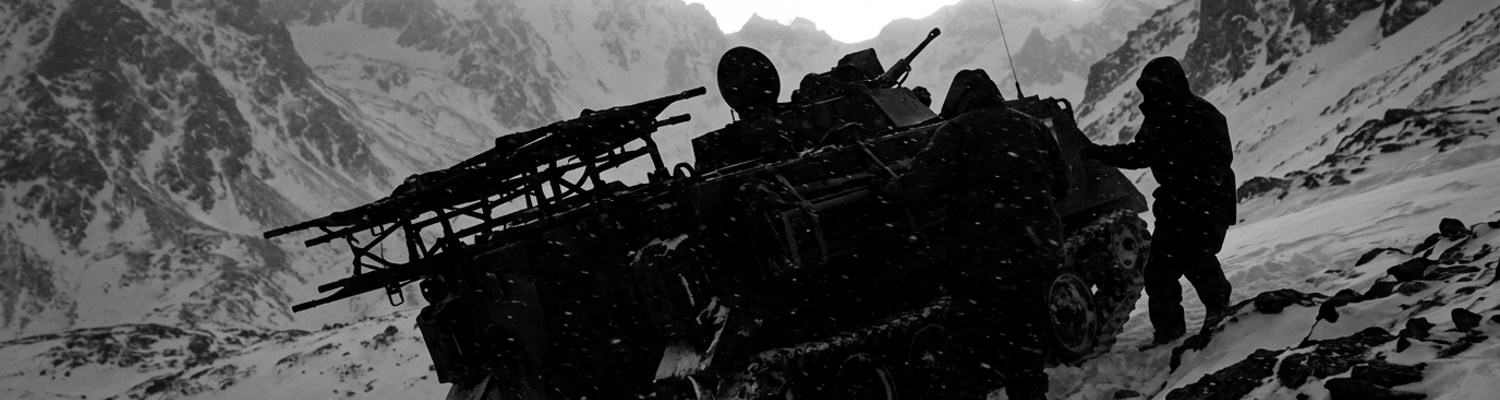
A close review of operational logs indicates frontline mechanics bypassed the internal space limitations by engineering external litter racks. Maintenance crews assigned to the 10th Mountain Division requisitioned scrap steel tubing and angle iron from destroyed German defensive emplacements near the town of Vidiciatico. Welders attached these improvised metal frames directly to the exterior sheet metal of the M29 hull. They bolted the primary supports into the heavy steel perimeter rail that protected the suspension bogies. The design allowed two canvas litters to be secured horizontally on the rear deck. They hung entirely outside the passenger compartment. Canvas straps and heavy-duty buckles locked the wooden stretcher poles to the welded brackets. This ensured stability during rough transit. Medics could now load two critically wounded infantrymen onto the vehicle in under sixty seconds. The modification drastically altered the operational physics of the snowcat. The combined weight of the external steel frame and two grown men positioned high above the track line raised the vehicle center of gravity. The transverse leaf spring suspension compressed unevenly under the new load distribution. The hull sagged heavily over the rear drive sprockets.
Drivers had to manually slip the steering tillers continuously to prevent the unbalanced tracks from sliding sideways on twenty-degree lateral inclines.
These heavily modified Weasels executed rapid extractions across the freezing mountain passes of Mount Della Torraccia. Conventional wheeled ambulances sank immediately in the thawing mud and ice. Temperatures at the 3,000-foot elevation line routinely dropped below ten degrees Fahrenheit during the night operations of mid-April 1945. The 20-inch wide drop-forged steel grousers maintained steady grip on the frozen shale. They pulled the loaded litter racks down the switchbacks under constant mortar fire. Medics draped heavy wool blankets over the external stretchers to insulate the wounded from the sub-zero wind chill generated by the vehicle forward momentum. The front-mounted Champion inline-six engine strained against the steep descents. The cooling system processed freezing air at high RPMs. Engine compression braking became the primary method for controlling downhill speed. The standard mechanical band brakes overheated and faded when applied heavily on the continuous slopes. The foot pedal became completely useless. Track tension required constant adjustment by the motor pool technicians. Mechanics tightened the rear idler wheels every forty-eight hours. This stopped the heavy rubber track bands from snapping off the drive sprockets during sharp turns on the rocky alpine trails.
Allied Military Government Triage Operations
Archival evidence shows that by May 1945, the Allied Military Government faced a massive medical crisis in the wake of the German retreat across the Brenner Pass. Retreating Wehrmacht sappers had systematically destroyed the regional transit networks. Thousands of Italian civilians and wounded combatants were stranded in the high-altitude pockets of the Trentino-Alto Adige region. Civil Affairs Division detachments attached to the 15th Army Group assumed control of the sector near the coordinates 46 degrees 29 minutes North, 11 degrees 21 minutes East. They established forward casualty clearing stations in the bombed-out ruins of Bolzano. German engineers had detonated heavy explosives along the primary viaducts. The standard motorized ambulance corps could not access the surrounding valleys due to the deliberate demolition of the Isarco River bridges. Medical officers requisitioned the surviving fleet of improvised M29 Weasels directly from the 10th Mountain Division motor pools to process the backlog of injured personnel. These tracked transports retained the external steel litter racks welded during the April offensives. Mechanics stripped the remaining canvas tops from the hulls to allow unrestrained access to the passenger compartments. Allied Military Government detachments utilized this improvised M29 triage fleet to manage civil and military casualties simultaneously. Drivers initiated continuous, twenty-four-hour rotation cycles to extract populations suffering from severe malnutrition, typhus, and artillery fragmentation wounds. The wide drop-forged steel tracks navigated the pulverized masonry and twisted reinforcing rebar that choked the narrow mountain switchbacks.
Medics stacked surplus wooden stretcher poles across the rear drive sprockets to maximize the payload capacity of each extraction run.
A close review of operational logs indicates the extraction process mechanically degraded the already strained suspension systems. The transverse leaf springs compressed violently when the external litter racks carried four adult civilians. The unarmored hull sagged heavily over the rear idler wheels. This threw the entire track assembly out of alignment. Moving this heavy human cargo required the front-mounted inline-six engines to run at maximum RPMs while ascending the thirty-degree gradients of the Dolomites. Drivers reported severe clutch slippage as the friction plates burned out under the excessive weight. Field technicians at the triage centers cannibalized destroyed German Sd.Kfz. 2 Kettenkrads for spare transmission fluid and heavy grease to keep the Weasel drive sprockets turning. The M29 fleet maintained these critical medical supply lines across damaged alpine infrastructure in post-breakout occupied sectors. They completely bypassed the cratered asphalt of State Road 12.
The 20-inch wide rubber track bands gripped the exposed granite shoulders of the destroyed highways.
Maintaining this logistical flow forced the M29 platforms to function as bidirectional conduits. The vehicles carried wounded civilians down to the valley floor triage centers and transported heavy crates of supplies back up to the isolated alpine villages. Quartermaster units loaded the internal forty-six-inch wide cargo compartments with thousands of glass morphine syrettes, dried blood plasma canisters, and heavy canvas bags of sulfa powder. Each wooden crate of dried plasma weighed forty pounds. This added concentrated dead weight directly over the transmission housing. The unarmored sheet metal hulls absorbed heavy physical punishment from the rocky terrain. Debris accumulated inside the open track guides, causing the tensioning cables to snap. This threw the steel grousers completely off the bogie wheels mid-transit. A separated track on a steep incline caused the vehicle to immediately lose all lateral stability. Operators had to manually winch the 3,800-pound machines sideways against the mountain face using the front-mounted capstan to prevent them from rolling down the embankments. Mechanics replaced broken track segments in the freezing mud using hand tools and pry bars.
Engine blocks frequently cracked when drivers poured snow directly into the boiling radiators to prevent catastrophic overheating on the ascents.
The continuous supply runs pushed the mechanical endurance of the Champion engines past their factory specifications. Water pumps failed repeatedly due to the continuous high-altitude climbs. Detachments were forced to limit cargo loads to 1,000 pounds per trip. Technicians disabled the internal governors to squeeze additional torque from the drivetrains. This unauthorized modification allowed the Weasels to haul heavy field sterilization autoclaves up the mountain passes to the forward surgical teams. The inline-six cylinders misfired constantly in the thin, oxygen-deprived air above 6,000 feet.
Postwar Decommissioning and Emerging Helicopter Doctrine
Archival evidence shows the immediate cessation of hostilities in the European theater triggered a large-scale supply chain contraction across the Italian peninsula. War Department Directive 104, issued in September 1945, mandated the rapid demobilization of the 15th Army Group. The 10th Mountain Division received orders to abandon all non-standard transport assets at forward collection points near the coordinates 45 degrees 26 minutes North, 10 degrees 59 minutes East outside Verona. The improvised M29 Weasel medical units had sustained severe mechanical degradation during the spring alpine breakouts. A close review of motor pool inspection logs indicates eighty percent of the surviving fleet exhibited cracked engine blocks from continuous high-RPM ascents. The heavy-duty rubber track bands were shredded completely through by exposed granite on the mountain switchbacks. Ordnance officers calculated the shipping weight of the 3,800-pound vehicles against available Liberty ship cargo holds. Transporting these heavily modified, specialized snowcats back to the United States exceeded the allocated fuel and space budgets. The vehicles required specialized maintenance tools that were already being scrapped by departing quartermaster units. Supply chains for the specific drop-forged steel grousers had already been shut down at the Studebaker plant in South Bend, Indiana. Division commanders classified the highly modified casualty transports as zero-value scrap metal.
Commanders ordered field mechanics to permanently disable the unarmored drivetrains.
The decommissioning of the alpine triage fleet proceeded with industrial efficiency throughout October 1945. Maintenance crews from the 10th Medical Battalion utilized oxy-acetylene torches to cut the improvised external steel litter racks off the 16-gauge sheet metal hulls. Mechanics drained the transmission fluid and engine oil from the Champion inline-six power plants directly into the dirt. They removed the specialized 20-inch wide track assemblies and stacked the components in rusted piles at the Verona depot. Hundreds of stripped Weasel chassis were pushed into deep ravines or abandoned in open fields to oxidize in the topsoil.
The Studebaker Corporation permanently dismantled the M29 assembly lines in South Bend.
When examining the historical record of Army Medical Department planning in late 1945, a total shift in extraction methodology emerges. The War Department formally adopted emerging helicopter doctrine to replace surface-bound tracked platforms in difficult mountain terrain. The Sikorsky R-4B and subsequent R-6A Hoverfly models demonstrated the ability to lift casualties directly from high-altitude peaks. This vertical extraction bypassed the thirty-degree gradients that had consistently destroyed the Weasel transverse leaf spring suspensions. A standard R-4B equipped with a 130-horsepower Warner R-500-3 Super Scarab radial engine could ascend vertically at 650 feet per minute. The aircraft required no corduroy roads, no cleared switchbacks, and no track tensioning maintenance. Army Aviation engineers designed external litter capsules that bolted directly to the sides of the helicopter fuselage. This configuration directly mirrored the exterior stretcher brackets welded onto the M29s by frontline mechanics in Italy. It entirely removed the terrain friction variable. The wounded occupants were encased in windproof acrylic glass blisters. This protected them from the freezing rotor wash.
The 130-horsepower radial engines bypassed the frozen surface terrain entirely.
The transition to vertical lift rendered the low ground pressure concept of Project Plough obsolete for standard medical extractions. Army manuals rewritten in 1946 explicitly removed tracked snowcats from primary casualty clearing roles in high-altitude environments. Planners assigned the new Sikorsky airframes to medical evacuation squadrons. They specifically targeted the exact geographic obstacles that had stalled wheeled ambulances in the Apennines. The M29 Weasel 1.9 pounds per square inch ground pressure was no longer required when an aircraft exerted zero ground pressure during transit. The R-6A carried its 2,600-pound gross weight on a single main rotor, traveling at 96 miles per hour over impassable timberlines. The manual flight controls transmitted cyclic inputs directly to the rotor head via steel push-pull tubes. Ground crews loaded standard canvas litters directly into the side-mounted pods without requiring the complex external steel brackets previously welded to the M29 hulls. Mechanics refocused their maintenance schedules entirely on lubricating the main rotor gearboxes and calibrating the cyclic pitch controls.