
Operation Iceberg was the largest amphibious assault of the Pacific War. Its objective was to seize Okinawa for use as the primary staging ground for the invasion of the Japanese home islands. Under Fleet Admiral Chester W. Nimitz, Admiral Raymond A. Spruance’s U.S. Fifth Fleet would execute the plan. The ground force, the U.S. Tenth Army, comprised over 183,000 soldiers and Marines commanded by Lieutenant General Simon Bolivar Buckner, Jr. The strategy was direct. Phase I involved seizing southern Okinawa, home to its population centers and vital airfields. Phase II would secure the island's northern third. To accomplish this, four divisions, the Army’s 7th and 96th Infantry Divisions of XXIV Corps and the 1st and 6th Marine Divisions of III Amphibious Corps, were slated to land abreast on L-Day, April 1, 1945. They would cut the island in two before turning south into the main Japanese defenses. A diversionary feint by the 2nd Marine Division off the southeastern Minatoga coast was meant to fix Japanese reserves in place. The entire operation hinged on the Hagushi beaches. The 82-day battle for the island would ultimately result in 49,151 American casualties, with approximately 12,500 killed or missing. The U.S. Navy alone suffered 4,907 sailors killed, more fatalities than either the Army or the Marine Corps ground forces they were supporting.
A close review of operational logs shows planners selected the long, wide stretch of Okinawa’s western coastline for its direct access to the Yontan and Kadena airfields. These were the primary objectives, seen as essential for establishing airpower for the next phase of the war. The beaches were divided into a color-coded and numbered series of landing zones. The III Amphibious Corps, with the 1st and 6th Marine Divisions, was assigned the northern Hagushi beaches, designated Red and Green, with Yontan airfield as their goal. To their south, the XXIV Corps, with the 7th and 96th Infantry Divisions, would land on beaches Blue, Yellow, Purple, and Orange, tasked with capturing Kadena Airfield. The bay's hydrography and the relatively flat terrain beyond the beaches offered the most promising path for a rapid inland advance. American planners, conditioned by the fighting on Iwo Jima and Peleliu, expected a bloodbath at the water’s edge. Intelligence estimated that between 8,000 and 10,000 Japanese soldiers were dug in to defend the Hagushi beachhead sectors. The pre-invasion bombardment was one of the heaviest of the war. Battleships, cruisers, and destroyers pounded the coastline alongside carrier aircraft. The first waves of the Tenth Army went ashore on April 1 prepared for a fight. They found nothing. By nightfall, more than 60,000 troops were ashore, having captured both Yontan and Kadena airfields within hours. The assault force had sliced clear across to the eastern shore, encountering almost no resistance.
Archival intelligence from early 1945 shows a fatal gap between perception and reality. British Admiralty weekly intelligence summaries provided generalized estimates of Japanese garrison strengths for the Nansei Shoto island chain. These reports, while comprehensive on naval matters, lacked granular detail on ground defenses, contributing to an Allied consensus that anticipated a conventional defense at the water line. The primary tool for closing this gap was American photographic reconnaissance. Sorties flown in the months before April 1945 produced an enormous volume of images. An intelligence mosaic assembled by the 10th Army’s G-2 Section from photographs taken during carrier raids on October 10, 1944, shows eight nautical miles of the Hagushi shoreline. This composite, prepared on November 20, 1944, alongside thousands of other vertical and oblique shots, formed the basis of the invasion plan. Photo interpreters scanned these images for fortifications, trench lines, and bunkers. While some positions were identified, the core of the Japanese strategy was missed. Analysts looked for familiar patterns of a beach defense, not the subtle signatures of a defense-in-depth designed to cede the beaches entirely. What appeared on film as innocuous terrain features, agricultural terraces, or traditional Okinawan tombs were, in fact, the camouflaged and hardened elements of a sophisticated, subterranean fortress. It was a failure not of collection, but of interpretation.
The physical reality waiting for the assault corps was a network of mutually supporting strongpoints, engineered to withstand naval bombardment and channel invaders into pre-registered kill zones. In sectors like Charlie-Red Beach, this system was particularly dense. The integrity of the Japanese pillboxes was grossly underestimated. Many were not simple field fortifications but were constructed of thick, steel-reinforced concrete, often integrated into the island’s natural coral and limestone ridges. Some defensive complexes were dug 20 meters deep with multiple subterranean levels. Thousands of lyre-shaped Okinawan tombs, built of heavy concrete, were co-opted and converted into machine-gun nests and observation posts. The tactical placement was the most important feature. Positions were sited not just for defense, but to provide interlocking fields of fire for five or six other positions. American planners, seeing only scattered defenses on their maps, had no conception of the integrated lethality of this system, which was designed to draw the Tenth Army inland and bleed it white long after the supposedly decisive landing was over.
The mission assigned to elements of the 1st Marine Division’s 1st Engineer Battalion on L-Day was deceptively simple. Their task was to land with the initial assault waves on the Red and Green beaches and immediately blast open lanes through any man-made obstacles. Planners expected a network of mines, timber posts, and concrete tetrahedrons at the high-tide mark. The engineers were the solution, tasked with creating multiple, wide-mouthed exits from the beach to allow the rapid forward deployment of Sherman tanks, artillery, and infantry. The entire operational tempo of the 1st Marine Division’s push inland depended on their speed and efficiency.
The obstacle was of an entirely different character than anticipated.
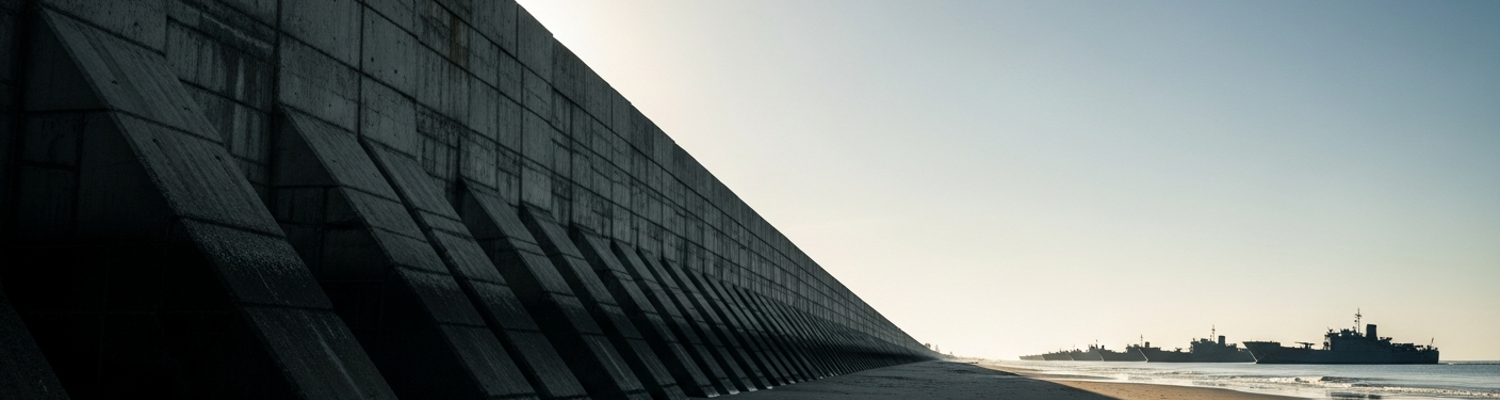
Instead of a barricade of smaller impediments, the engineers on Green Beach confronted a massive, continuous anti-tank ditch and an adjacent seawall. This formidable structure was far beyond the scale of a typical beach obstruction. It was a deep, reinforced-concrete trench, engineered not just to stop a tank but to swallow it. The standard-issue demolition charges the engineers carried ashore, primarily 20-pound tetrytol satchel charges, were woefully insufficient. These explosives were designed to shatter wooden posts or crater earthen barriers. Placed against the thick walls of the concrete ditch, their explosive force was inadequate, failing to create a ramp or fracture the structure in any meaningful way. The engineers were equipped to fight a different battle, one based on intelligence that had failed to grasp the true nature of the Japanese preparations. The infantry was now piling up behind them.
This failure of ordnance was compounded by a misallocation of specialized equipment. The operational plan had called for armored bulldozers, Caterpillar D-7s and D-8s sheathed in protective steel plates, to land alongside the engineers. These machines were the mechanical muscle of the breach teams. Records indicate a breakdown in the landing sequence. The armored bulldozers assigned to support the 1st Engineer Battalion were not available at the critical moment. Some were landed on the wrong beaches; others were held up in the transport area offshore by shifting priorities and the complexity of the landing. Denied their most important tools, the engineers were forced to attack the concrete ditch with hand tools and their inadequate explosives. All this happened while exposed to the sporadic but accurate mortar and sniper fire that began to sweep the beach. The delay created a severe traffic jam at the water’s edge, a bottleneck that trapped tanks and other vehicles in the soft sand, turning the theoretically secured beachhead into a congested and vulnerable target.
The command and control architecture designed to manage the Hagushi beachhead began to fracture almost immediately. The system was a dual-chain structure with Navy Beachmasters responsible for seaward approaches and Army and Marine Shore Party Commanders controlling the flow of men and materiel ashore. This entire apparatus was coordinated from the command post aboard the USS Eldorado (AGC-11), where Lieutenant General Buckner and his Tenth Army staff received their information. The system’s breakdown was one of friction. The primary conduits of information, the SCR-300 and SCR-536 radios, proved unreliable. Signals were frequently lost to saltwater damage, physical destruction of antennas, and the chaos of thousands of men and vehicles. Runners dispatched with physical messages often never reached their destination. As a result, command teams on the beach lost situational awareness beyond their immediate line of sight. They were deaf and blind to the unfolding crisis at the seawall, just as the generals on the Eldorado were deaf and blind to the paralysis gripping their beachmasters.
This communications breakdown created a vortex of conflicting information. A forensic examination of operational logs shows a pattern of contradictory reports flowing from the shoreline. From the perspective of the 1st Engineer Battalion teams pinned at the Green Beach seawall, the situation was an unambiguous disaster. They reported a complete failure to breach the primary anti-tank obstacle and were taking accurate, methodical fire. Their calls for armored bulldozers and explosive ordnance disposal specialists were either not getting through or were being drowned out. Simultaneously, reports from adjacent beach sectors, like Yellow and Blue, painted a picture of success. For the command staff on the Eldorado, miles offshore, these messages created a fatally flawed mosaic. The localized crisis reported by one small sector was interpreted as an anomaly, not the focal point of the enemy’s plan. Requests for heavy equipment were weighed against what appeared to be broad, successful advances elsewhere, delaying the reallocation of the D-8 bulldozers sitting available in the transport area.
The situation was no clearer for the offshore naval fire support group. Destroyers and Landing Craft Support (LCS) vessels were arrayed to deliver immediate, on-call fire missions. This system depended entirely on the eyes of Naval Gunfire Liaison Officers (NGLO) and Shore Fire Control Parties (SFCPs) embedded with the assault waves. These small teams were now trapped in the same bottleneck as the infantry, unable to see the source of the incoming Japanese fire. The Japanese Thirty-Second Army was not fighting on the beach; it was using a reverse-slope defense. Mortar and artillery positions were dug in on the far sides of the hills overlooking the beaches, shielded from direct naval observation. They were firing from concealed caves and camouflaged positions pre-registered on the beach exits with deadly accuracy. The SFCPs could only provide vague coordinates, requesting fire on a grid square they could not see. In response, destroyers like the USS Newcomb and cruisers like the USS St. Louis delivered massive, unobserved barrages, expending ammunition with little effect on the well-protected Japanese gunners. American naval power was immense but functionally blind, while the Japanese fire, though less voluminous, was lethally precise.
A close review of the Tenth Army’s operational plan for Operation Iceberg reveals a medical evacuation timeline that was precise, tiered, and entirely disconnected from events. The plan called for a phased deployment of medical assets. In the initial hours, casualties were to be handled by battalion aid stations on the beaches and then moved to designated transport ships waiting offshore. These transports were not floating hospitals; their sick bays were modest and not equipped for major surgery. The fully equipped, 800-bed hospital ships of the Haven and Comfort classes, along with specially augmented Landing Ships, Tank (LSTs) carrying surgical teams, were scheduled to arrive in the transport area later, on L+1 and L+2. This schedule was predicated on the assumption that the initial landing would be violent but swift, and that a secure beachhead would allow for an efficient transfer of the wounded. The intelligence failure that missed the Green Beach seawall also created a critical delay in the medical chain. The system was designed for a dispersed, predictable flow of wounded men, not for a sudden, concentrated deluge from a single, static kill zone.
The evacuation chain was broken at its first link.
The tactical failure of the 1st Engineer Battalion at the concrete anti-tank ditch immediately generated a mass casualty event the system could not absorb. Men from the engineer teams and the follow-on waves of the 1st and 7th Marines were pinned down in a geographic bowl, taking methodical fire from Japanese mortars positioned on reverse slopes. Corpsmen crawling to the wounded became casualties themselves. The constricted area, with no clear exit lanes, made it nearly impossible to move the injured even a few hundred yards back to the shoreline aid stations. Those who were moved arrived at stations that were quickly overwhelmed. The number of casualties arriving in a short span from this one sector exhausted supplies of plasma, morphine, and battle dressings. More critically, the LCVPs and other small craft designated to ferry wounded from the beach could not get close enough to the overwhelmed aid stations due to the chaos and vehicle congestion. Many that did found themselves circling offshore, waiting for a transport or LST that had space to accept them.
Every available vessel became a target.
This paralysis on the beach was compounded by the fight for survival at sea. The U.S. Fifth Fleet was under sustained assault from Japanese kamikaze aircraft. Suicide attacks had begun even before L-Day, and on April 1st, the skies were contested. This forced a terrible choice upon the captains of destroyers, transports, and the LSTs modified to serve as casualty receiving stations. To receive wounded from a smaller landing craft, a ship had to slow or stop, making it a perfect target for a diving Zero. Holding a position to take on a dozen litters from an LCVP meant risking the entire ship and the hundreds of sailors and patients already aboard. Casualty transfers were often delayed or aborted as ships maneuvered to evade air attack. The hospital ships themselves were not immune. Though protected by the Geneva Conventions and fully illuminated with massive red crosses, they were deliberately targeted. The USS Comfort would later be struck by a kamikaze off Okinawa on April 28, the pilot aiming directly for the red cross and crashing through three decks into the surgical ward, killing nurses, doctors, and patients. This constant threat strained all naval resources, diverting escort vessels from their screening duties to air defense and forcing every ship, including those tasked with medical care, to prioritize its own defense.
The failure to breach the Green Beach seawall on L-Day sent a shockwave through the operational timeline. Planners for the Tenth Army had projected the bifurcation of Okinawa would take between ten and fifteen days. A close review of XXIV Corps logs shows this schedule was rendered irrelevant within hours. The bottleneck at the anti-tank ditch delayed the deployment of essential armor and artillery for the better part of two days. This pause in momentum had a cascading effect. Instead of a swift advance south against a disorganized enemy, the lead elements of the 7th and 96th Infantry Divisions were stalled. This allowed General Mitsuru Ushijima’s Thirty-Second Army precious time to consolidate its forces within the heavily fortified Shuri Defensive Zone. The advance, when it finally began, met a prepared and waiting enemy. The fight for the Kakazu Ridge, which should have been a follow-on engagement, became a brutal battle of attrition that characterized the rest of the campaign. What was meant to be a 45-day operation ballooned into an 82-day ordeal.
The immediate engineering problem demanded a rapid evolution in demolition tactics. After-action reports from the 1st Engineer Battalion confirm the standard-issue tetrytol satchel charges were ineffective. In response, ordnance teams began improvising under fire. They moved away from simple contact charges and began creating shaped charges, using the principles of the Munroe effect to focus the explosive blast into a penetrating jet. This involved creating conical cavities in blocks of Composition C explosive and, in some cases, using scavenged metal to create liners. Techniques were developed to place multiple, coordinated charges to achieve a shearing effect. This tactical adaptation was paired with a harsh lesson in intelligence. Photo interpreters were subsequently retrained to identify the subtle signatures of a defense-in-depth. They learned to spot the tell-tale signs of reverse-slope positions, camouflaged tunnel entrances, and the integration of natural terrain into a cohesive defensive network.
The Hagushi bottleneck became a central case study in post-war instruction at the Army Engineer School and Naval War College. It demonstrated a catastrophic failure of combined arms integration at the point of contact. The inability of isolated engineer teams to breach the seawall without their assigned armored bulldozers led to a fundamental change in assault planning. Future doctrine would mandate the creation of dedicated, self-contained breaching teams in the initial wave, wedding armored bulldozers, flame-throwing tanks, and combat engineers into a single tactical unit with a singular objective: to open a lane at all costs. The communication breakdown also forced a doctrinal shift toward decentralized control, empowering on-scene commanders to direct supporting arms without waiting for approval from a distant command ship. These lessons directly informed the planning for Operation Downfall, the proposed invasion of the Japanese home islands. Planners for the landings on Kyushu projected a need for engineer support and specialized breaching equipment on a scale that dwarfed any previous operation, a direct reflection of the nightmare that unfolded on the sands of Green Beach.