
Strategic Geography of Chihjiang Airfield
Moving thousands of tons of high octane aviation fuel and heavy ordnance through the roadless terrain of western Hunan in the spring of 1945 presented a mathematical impossibility. When examining the historical record of the China Burma India theater, the sheer friction of distance dictated command decisions. Japanese forces launched an offensive toward Chihjiang Airfield in Hunan Province by April 1945. They aimed to neutralize the forward operating bases of the United States Fourteenth Air Force. The airfield sat at coordinates 27.4 degrees North and 109.7 degrees East. It occupied the edge of the Yuan River valley. This installation functioned as the primary staging ground for American bombers striking Japanese shipping lanes along the coast. Lieutenant General Ichiro Banzai directed the Japanese 20th Army to march westward from Baoqing. This force comprised the 116th and 47th Divisions. Their supply chain relied entirely on conscripted civilian labor. Pack animals carried standard rice rations and 6.5mm ammunition over unpaved mountain tracks.
Spring rains degraded these dirt paths into deep mud.
Draft animals died of exhaustion within the first week of the advance. Japanese quartermasters recorded daily caloric deficits among frontline infantry units before they engaged enemy forces. The invasion stalled on its own friction. Archival evidence shows complex integration between disparate military structures. US Army liaison teams coordinated defense plans with the Chinese 74th Corps along the Xuefeng Mountains. This mountain range formed a natural barrier east of Chihjiang. Sharp ridges exceeded 1,500 meters in elevation. Narrow defiles choked troop movements. American officers from the Chinese Combat Command embedded directly with the headquarters of the 74th Corps under General Shi Jue. Their primary function involved synchronizing ground movements with air supply schedules. Communication depended on heavy vacuum tube radios. The SCR-284 sets required hand cranked generators to operate.
Signal corps technicians reported high humidity short circuited the radio sets.
This severed contact between forward infantry battalions and rear artillery batteries. American liaisons resorted to running physical copper wires across active combat zones. The defensive strategy bypassed static trench warfare. Joint commands favored an elastic defense in depth. Chinese infantry units yielded the lower valleys. They fortified the high ground surrounding the Wugang and Dongkou passes. Advancing Japanese columns stretched their failing supply lines through fifty miles of contested ravines. American cargo planes initiated a continuous airbridge. Curtiss C-46 Commandos flew from bases in Kunming. They dropped 75mm pack howitzer shells and small arms ammunition directly to the 74th Corps positions.
The logistics of these airdrops proved dangerous.
Cloud cover over the Xuefeng peaks dropped visibility to zero. Cargo pilots flew on instruments through narrow mountain corridors. They pushed twin engine aircraft to their operational ceilings to avoid granite faces. Crews discarded standard parachute drops for low level free fall deliveries. Quartermasters at Chihjiang worked 18 hour shifts. They manually loaded wooden crates of artillery fuses into unpressurized cabins. A single miscalculated load balance could send a C-46 into an irrecoverable stall. Ground level coordination relied heavily on translated topographical maps. These documents contained severe inaccuracies regarding elevation changes and river depths. US liaison officers cross referenced conflicting survey data in torrential rain. They calculated artillery trajectories using wet paper tables. Field telephones utilized heavy spools of copper wire. Infantrymen physically carried these spools up 40 degree inclines.
The Japanese 116th Division assaulted the primary defensive line at Longtan on April 24.
They encountered a fully supplied enemy. Continuous artillery fire rained down. Forward observers equipped with functioning communication lines directed the barrages. The Japanese assault units possessed only the light mortar rounds they had carried on their backs for three weeks. The 74th Corps expended four thousand artillery shells in a single 48 hour period.
Ridge Fortifications and Terrain Defenses
A close review of operational logs from late April 1945 indicates Chinese 74th Corps troops constructed fortified anti tank positions along mud choked mountain ridges. General Shi Jue deployed the 51st and 57th Divisions along a 40 kilometer front. This sector spanned the Wugang and Dongkou passes. They anchored their defense near coordinates 27.2 degrees North and 110.5 degrees East. The soil composition in western Hunan consists largely of dense laterite clay. This specific geological profile retains maximum water volume. When subjected to continuous spring downpours, the dirt transformed into a heavy viscous sludge. It jammed standard folding entrenching tools.
Infantrymen dug gun pits using heavy iron mattocks and bare hands.
Engineering battalions lacked motorized transport. They could not move structural timber or reinforced concrete up the 45 degree inclines. Supply columns of conscripted laborers physically dragged 400 pound steel beams through waist deep mud. They reinforced the forward slopes with wet sandbags. Officers recorded that constructing a single protective bunker for a heavy machine gun required 72 hours of uninterrupted manual labor. Rainfall routinely collapsed these freshly dug earthen walls before the imported Portland cement could cure. Defenders prepared kill zones to halt advancing Japanese armor. The Japanese 116th Division attempted to force their way through the narrow defiles along the Shaoyang highway. They received support from attached independent armored squadrons operating Type 94 tankettes and Type 97 Chi Ha medium tanks.
American liaison officers mapped out precise overlapping fields of fire.
They targeted choke points where the traversable road narrowed to less than fifteen meters. Chinese artillery commanders positioned M3 37mm anti tank guns on elevated defilade platforms. They carved these positions directly into the rock faces overlooking the valleys. Siting these weapons required disassembling the 900 pound artillery pieces at the base of the mountain. Infantry squads carried the barrels, carriages, and optical sights up the ridges via rope pulleys. They spent weeks clearing brush from the reverse slopes to ensure unobstructed lines of sight for the optical rangefinders. Gun crews bolted the reassembled cannons directly into the granite. This prevented recoil mechanisms from tearing the wooden platforms apart.
The geometry of these engagement areas left the Japanese columns with zero evasive options.
Forward observers plotted pre registered artillery coordinates along every tight curve of the mountain tracks. Infantry squads equipped with M1A1 Bazookas hid in camouflaged spider holes. They dug these pits directly adjacent to the expected path of the treads. High atmospheric moisture severely degraded the dry cell batteries required to electrically ignite the bazooka rockets. Chinese quartermasters issued strict orders to keep the firing mechanisms wrapped in oiled rags until the exact moment of engagement. The lead elements of the Japanese armored thrust reached the Dongkou pass on May 4. They struck a concentrated network of buried M1A1 anti tank mines. The resulting detonations severed the tracks and road wheels of the lead Type 97 tanks.
This blocked the single lane of advance.
Trailing vehicles became trapped inside the pre measured coordinate boxes. Forward observers cranked their field telephones. They transmitted firing solutions to the 75mm pack howitzer batteries located three miles behind the ridge line. American supplied 37mm armor piercing rounds cleanly penetrated the 25mm riveted steel hulls of the stationary Japanese targets at a range of 400 yards.
Monsoon Inundation of Forward Airstrips
Supplying an industrialized defense grid through the unpaved terrain of western Hunan during the spring monsoon presented a severe mechanical failure rate. Meteorological stations recorded fourteen inches of rainfall between May 2 and May 6. This sustained low pressure system dumped unprecedented volumes of water directly onto the Chihjiang sector. Torrential monsoon rains inundated the forward dirt landing strips. Six inches of standing water submerged the 4,000 foot primary operating runways. The soil composition across the airfield perimeter consisted of highly porous laterite clay. It instantly lost all load bearing capacity when saturated. Engineering battalions had previously laid thousands of square feet of Pierced Steel Planking over the runway surfaces. They intended this metal grid to support the weight of incoming cargo planes.
The continuous rainfall liquefied the subsoil beneath the steel.
A fully loaded Curtiss C-46 Commando weighed over 45,000 pounds on approach. As these twin engine transports touched down, their main landing gear drove the steel matting deep into the mud. The aircraft wheels sank down to the brake calipers. Base commanders ordered the immediate suspension of all outbound bomber flights. They needed to preserve the degrading runway integrity for incoming supply drops. Dozens of transport planes from the 1st Combat Cargo Squadron became permanently stranded at the ends of the runways. Ground crews waded through knee deep sludge. They attempted to service the Pratt & Whitney R-2800 radial engines. High atmospheric moisture penetrated the unsealed distributor housings. It short circuited the ignition harnesses.
Mechanics stripped spark plugs and dried them manually over open kerosene stoves.
Aviation fuel consumption idled at zero. The grounded planes sank deeper into the runway apron. Archival evidence shows the failure of the airbridge forced American liaison officers to reroute all incoming ordnance. They shifted logistics through the Hunan Guizhou highway. This unpaved artery served as the sole terrestrial link between the supply depots at Guiyang and the frontline artillery batteries. Continuous precipitation turned these ground supply routes into impassable quagmires. Conventional motor transport completely halted. The highway navigated 15 degree inclines along the Yuan River valley near coordinates 27.3 degrees North and 109.9 degrees East. Convoys of GMC CCKW two and a half ton trucks belonging to the Chinese Services of Supply attempted to traverse the mountain passes.
The viscous mud packed tightly into the wheel wells and locked the drum brakes.
Drivers engaged the six wheel drive transfer cases. They applied maximum engine RPM to force the vehicles forward. Maintenance logs from the 373rd Quartermaster Truck Company detail the exact mechanical failures resulting from this strain. The resulting torque snapped the rear drive axles. It shattered the differential housings. The truck convoys churned the road surface into deep ruts. Liquid clay splashed up into the engine compartments and coated the radiator fins. Coolant temperatures spiked past 220 degrees Fahrenheit. The six cylinder engines seized from thermal expansion within three miles of leaving the staging areas. Quartermaster units abandoned eighty four loaded cargo trucks along a single two mile stretch of mountain road on May 12.
Command decisions rapidly shifted away from wheeled transport.
The vehicle attrition rate exceeded ninety percent. US Army supply officers ordered local laborers to manually offload 120 pound crates of 75mm howitzer shells from the disabled trucks. They transferred them to wooden handcarts. The wooden wheels of these carts immediately sank into the same ruts that had trapped the motorized convoys. The specific gravity of the saturated clay created a vacuum effect around any object submerged in it. Draft horses and mules broke their legs attempting to pull loads out of the heavy mud. Officers calculated that moving one ton of ammunition fifty miles through the flooded passes required an expenditure of calories that outpaced the daily combat requirements of the frontline infantry. The complete failure of both the dirt airstrips and the motorized supply columns isolated the defending Chinese 74th Corps. Division commanders issued orders restricting howitzer batteries to five rounds per day.
Fourteenth Air Force River Resupply Operations
A close review of operational logs indicates the complete degradation of terrestrial transport forced United States Army Air Forces logistics officers to entirely restructure their delivery vectors. By the third week of May 1945, forward Chinese infantry battalions defending the Wugang sector had completely exhausted their stockpiles of M70 armor piercing solid shot. Quartermasters at Kunming received urgent requests to resupply the M1 57mm anti tank guns positioned along the mountain defiles. Standard Curtiss C-46 Commandos could no longer utilize the flooded Chihjiang airstrips. Base commanders authorized the immediate deployment of Consolidated PBY Catalinas to bridge this specific supply gap. These twin engine amphibious aircraft featured a highly specialized chine hulled design.
Sharp hydrodynamic ridges ran along the lower fuselage.
These chines functioned to deflect heavy water spray away from the twin Pratt & Whitney R-1830 radial engines mounted above the wing. Logistics crews stripped the defensive fifty caliber machine guns from the waist blisters of six available Catalinas. This maximized internal payload capacity. Ground personnel manually loaded heavy wooden crates containing the 57mm munitions directly into the bare aluminum compartments. Each individual crate contained four complete rounds. They weighed exactly sixty five pounds. Archival evidence shows loading these munitions required precise weight distribution calculations. Flight engineers maintained the center of gravity within a strict four inch tolerance. They strapped the boxes against the primary load bearing bulkheads using heavy canvas webbing.
The aircrews initiated flights eastward toward the Xuefeng Mountains under a low overcast ceiling.
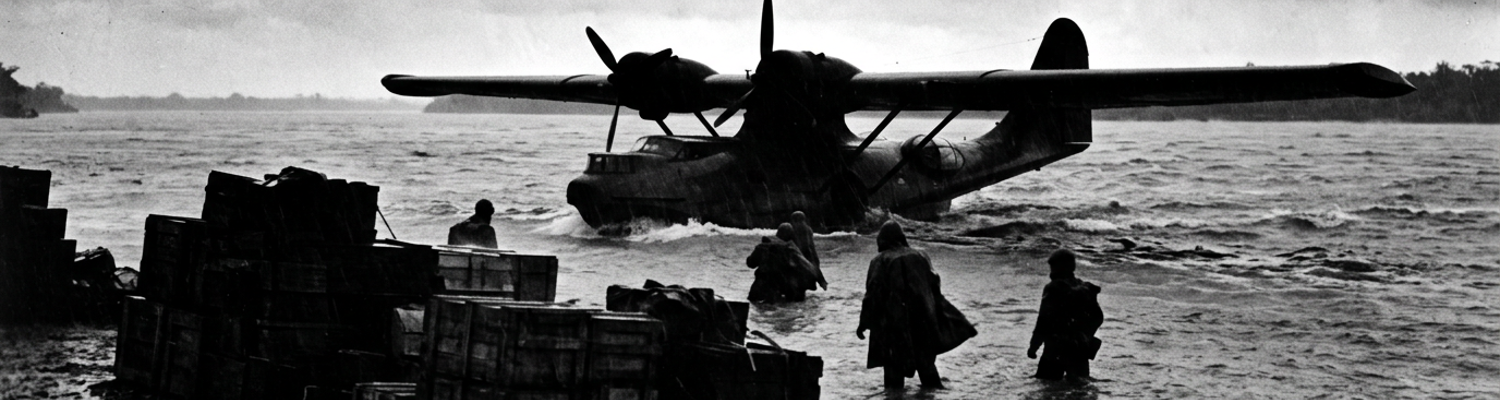
To bypass the completely submerged landing fields at Chihjiang, pilots executed emergency water landings directly on the surface of the Yuan River. This waterway snaked through the valley near coordinates 27.4 degrees North and 109.7 degrees East. Sustained monsoon rains had swollen the riverbanks. Surface current velocity accelerated past nine knots. Uprooted pine trees and dense clumps of riverbed mud churned through the landing zones. Navigators stood in the astrodome scanning the murky water for submerged rocks. Pilots dropped the aircraft flaps to reduce their approach speed to eighty miles per hour. The heavy flying boats slammed into the turbulent river surface with enough force to shear the aluminum rivets securing the forward hull plates.
Maintaining position in the fast moving river demanded constant throttle adjustments.
Pilots kept both engines running at low RPM to counteract the downstream drift. The chine hulled design effectively broke the suction of the water during the initial touchdown. The aircraft remained highly unstable while idling in the heavy currents. Flight engineers immediately activated the auxiliary bilge pumps. They ejected river water leaking through the stressed fuselage seams. The Fourteenth Air Force lacked dedicated dock facilities along the steep riverbanks. Chinese ground crews requisitioned flat bottomed wooden sampans. They manually rowed out to the idling hydroplanes. Aircrews opened the side blister windows. They physically handed the 65 pound crates of 57mm anti tank shells down to the men balancing in the small boats.
The intense river current frequently smashed the wooden sampans directly against the metal hulls.
Four consecutive impacts dented the portside stabilizing float of a PBY-5A beyond repair. The transfer process exposed aircrews and local laborers to high risks of drowning in the muddy water. Men slipped on the wet aluminum catwalks. They dropped crates of munitions directly into the river. Hand cranked winches proved useless due to the erratic vertical motion of the aircraft bobbing in the swells. A sampan reached its maximum load capacity of twenty crates. The rowers navigated back to the muddy embankment. Infantrymen stood in waist deep water to receive the boxes. They hoisted them onto their shoulders to begin the steep climb up the ravine towards the artillery positions. Prolonged exposure to the river spray saturated the ignition harnesses of the Catalinas. Mechanics manually wiped down the distributor caps with dry rags before the pilots could apply takeoff power. The port engine of aircraft serial number 44-33879 ingested a floating tree branch during its departure run on May 18.
Hydroplaning Chine Fractures and Submerged Debris
A close review of operational logs from late May 1945 reveals the immediate mechanical failure of the emergency hydroplane resupply chain. Fourteenth Air Force quartermasters overloaded Consolidated PBY-5A Catalinas far beyond their designated maximum takeoff weight of 35,420 pounds. Ground crews packed the internal fuselage compartments with unboxed 57mm anti tank shells. This pushed the center of gravity to the absolute aft limit. The excess mass forced pilots to increase their final approach speeds to ninety five miles per hour. This prevented an aerodynamic stall before reaching the surface of the Yuan River. Sustained monsoon rains had washed heavy timber down from the Xuefeng peaks.
The primary landing zones filled with dense waterlogged debris.
Entire uprooted pine trees floated just inches beneath the muddy surface. They remained completely invisible to the aircrews descending through the low overcast cloud deck. Navigators standing in the forward observation blisters could only watch the water rapidly rushing past the nose. The physics of high speed hydrodynamic impact dictated the rapid destruction of the aircraft. Overloaded flying boats flared for touchdown. Their deepened draft caused the lower fuselage to displace significantly more water than standard operational parameters allowed. The sharp lateral ridges running along the bottom of the hull absorbed the brunt of the kinetic energy during the initial surface contact. These structural angles were designed to deflect spray away from the propellers. They were not engineered to withstand blunt force trauma.
On May 21, a PBY Catalina carrying three tons of ordnance struck a submerged thirty foot pine trunk.
The aircraft traveled at eighty five miles per hour. The collision instantly buckled the 0.040 inch Alclad aluminum skin panels on the port side. The shear force ripped through two primary load bearing bulkheads. It sheared hundreds of flush rivets along the chine line. Pressurized river water immediately forced its way through the fractured seams. It flooded the lower bilge compartments before the pilot could retard the throttles. Sudden asymmetric drag violently slewed the aircraft to the left. It nearly dipped the wingtip float into the nine knot current. A three foot gash along the primary step of the hull rendered the flying boat entirely unairworthy. Archival evidence shows these structural failures systematically dismantled the aerial bridge over a period of four days.
Standard field repair protocols required hoisting damaged amphibious aircraft out of the water.
Heavy shore based cranes were necessary to replace the compromised metal plating. The Fourteenth Air Force possessed no such heavy lifting equipment along the steep banks of the Yuan River. Flight engineers attempted to seal the fractured chines while standing in waist deep water. They applied zinc chromate putty and bolted scrap aluminum patches over the jagged tears. The cold river temperature and continuous rainfall prevented the chemical sealing compounds from curing. Water continued to bypass the makeshift patches. This inflow overwhelmed the 24 volt electric auxiliary bilge pumps located beneath the flight deck. Mechanics spent forty eight hours manually bailing water with steel buckets. They fought to keep the twin engine aircraft from sinking into the riverbed.
Base commanders grounded the remaining five Catalinas by May 25.
This administrative order permanently severed the delivery of armor piercing munitions to the Wugang sector. Chinese infantry units defending the forward mountain passes immediately felt the absence of the hydroplane deliveries. Battalion quartermasters emptied their final reserve crates. Forward observers stopped calling in fire missions against Japanese Type 97 medium tanks attempting to clear the landslides along the Shaoyang highway. Anti tank gun crews sat idle in their rock carved emplacements. They possessed fully functional M1 cannons with empty breeches. The 51st Division recorded a total inventory of twelve anti tank rounds across a thirty mile front.
Frontline Munition Depletion in Defensive Bunkers
A close review of operational logs from late May 1945 indicates the administrative order to ground the Consolidated PBY-5A Catalinas immediately severed the sole remaining delivery vector for heavy ordnance. Base commanders at Kunming officially halted the river resupply operations on May 25. Submerged pine trees had destroyed the structural chines of multiple flying boats on the Yuan River. Mechanics lacked the heavy shore cranes required to lift the flooded aircraft out of the nine knot current for hull repairs. They watched the aluminum fuselages slowly sink into the muddy riverbed. This specific mechanical bottleneck terminated the daily influx of M70 armor piercing solid shot. Quartermasters had previously relied entirely on these amphibious flights to bypass the flooded terrestrial highways.
Ground crews at the rear airbases locked the remaining 65 pound wooden crates back inside their concrete storage magazines.
Chinese transport officers stationed along the muddy riverbanks stood in torrential rain waiting for supply drops that never materialized. The sudden cessation of these specific water landings cut off the primary anti armor supply line to the forward infantry battalions. Fourteenth Air Force logistics officers reallocated the surviving hydroplanes to safer patrol routes far to the east. Archival evidence shows the collapse of the aerial supply chain directly compromised the defensive integrity of the frontline bunkers positioned along the Xuefeng mountain ridges. General Shi Jue had deployed the Chinese 51st and 57th Divisions to hold the narrow defiles overlooking the Shaoyang highway near coordinates 27.2 degrees North and 110.5 degrees East. Infantrymen had spent weeks carving reinforced gun pits directly into the granite and heavy clay of the forward slopes.
These emplacements sat at 45 degree inclines.
They were heavily reinforced with four hundred pound steel beams dragged up the muddy trails by conscripted laborers. Soldiers camouflaged the firing ports with wet brush and sandbags to conceal the positions from the valley floor. Inside these dark waterlogged bunkers, artillery crews operated American supplied M1 57mm anti tank guns. These 2,700 pound weapons required a completely unobstructed line of sight to engage the advancing armored columns of the Japanese 116th Division. The defensive geometry relied on overlapping fields of fire. They aimed to trap Type 97 Chi Ha medium tanks inside tight geographic choke points measuring less than fifteen meters across. Gun captains manually calibrated their optical sights for targets at a fixed range of four hundred yards.
The heavy cannons functioned flawlessly but possessed nothing to fire.
When examining the historical record of the Dongkou sector during the last week of May, the anti armor supply shortage dictated the total collapse of the engagement matrix. Battalion quartermasters conducted physical audits of the ridge fortifications. They discovered completely empty ammunition lockers inside the forward bunkers. The cessation of the Catalina flights meant no new M70 solid shot had reached the mountain passes in over one hundred and forty hours. Artillery commanders issued strict orders forbidding gun crews from firing their remaining shells at anything other than the lead vehicles of an armored thrust. Japanese combat engineers utilized this operational lull to manually clear the destroyed tankette chassis blocking the mountain tracks below.
As the roadbed opened, independent armored squadrons began advancing.
Their Type 97 tanks moved up the muddy switchbacks in low gear. Forward observers occupying spider holes along the reverse slopes tracked the enemy armor through their wet field glasses. They cranked their heavy field telephones to transmit grid coordinates up to the bunker networks. Artillery officers received the firing solutions and immediately rejected them due to the lack of munitions. The M1 cannons sat idle on their bolted wooden platforms. Japanese tank treads churned the mud less than five hundred yards away. Infantry squads abandoned the heavy anti tank guns. They prepared to engage the 25mm riveted steel hulls using standard issue fragmentation grenades and degraded dry cell bazooka rockets. The 51st Division logged a total theater inventory of seven armor piercing rounds.
Logistical Vulnerabilities in Mountain Engagements
When examining the historical record of the Fourteenth Air Force during late May 1945, the destruction of the aerial supply route along the Yuan River directly quantified the extreme hazards of improvised waterborne airlift. Logistics officers at Kunming had attempted to bypass flooded terrestrial highways by overloading Consolidated PBY-5A Catalinas with unboxed 57mm anti tank shells. Ground crews packed the internal fuselage compartments to their physical limits. They pushed the center of gravity to the absolute aft tolerance. This exceeded the designated maximum takeoff weight of 35,420 pounds. These twin engine amphibious aircraft descended through heavy cloud cover to execute emergency landings on the swollen river near coordinates 27.4 degrees North and 109.7 degrees East. The sustained spring monsoon accelerated surface currents past nine knots. It concealed heavy waterlogged debris just below the muddy water.
Pilots flared the flying boats at ninety five miles per hour to maintain aerodynamic lift.
As the bare aluminum hulls impacted the turbulent surface, the deepened draft forced the aircraft lateral chines to displace significantly more water than standard operational parameters allowed. Submerged thirty foot pine trunks violently struck the 0.040 inch Alclad skin panels on the port side. The resulting blunt force trauma tore through hundreds of flush rivets along the primary step of the hull. It fractured two load bearing bulkheads. Pressurized river water immediately forced its way through the jagged seams. It flooded the lower bilge compartments before the flight crew could retard the dual Pratt & Whitney R-1830 radial engines. Flight engineers activated 24 volt auxiliary electric pumps. The rapid inflow rate overwhelmed the mechanical drainage systems within seconds. Mechanics lacking heavy shore based cranes watched the flooded fuselages sink permanently into the dense clay riverbed.
A close review of operational logs from the Dongkou sector indicates these specific supply chain bottlenecks completely neutralized the numerical superiority of the defending Chinese infantry.
General Shi Jue commanded over twenty thousand combat ready troops within the 51st and 57th Divisions. They were positioned along the mountain defiles near coordinates 27.2 degrees North and 110.5 degrees East. These soldiers occupied heavily fortified trench networks and rock carved bunkers overlooking the Shaoyang highway. They possessed clear lines of sight to engage the advancing armored columns of the Japanese 116th Division. This defensive network relied entirely on American supplied M1 57mm anti tank guns to penetrate the 25mm riveted steel hulls of the enemy Type 97 Chi Ha medium tanks. Gun crews had spent weeks manually hauling the 2,700 pound artillery pieces up 45 degree inclines using rope pulleys and heavy iron mattocks. Thousands of entrenched riflemen provided zero tactical advantage against armored vehicles moving through the narrow choke points without the heavy ordnance required to stop them. Commanders calculated that the raw troop numbers stationed on the ridges mattered less than the exact number of brass casings sitting in the ammunition lockers.
Battalion quartermasters recorded a total theater inventory of zero armor piercing artillery shells across a thirty mile front by the morning of May 26.
Archival evidence shows the cessation of the Catalina flights forced a total collapse of the engagement protocols at the ground level. Fourteenth Air Force commanders grounded the surviving hydroplanes to prevent the complete loss of the squadron. This permanently severed the delivery of the 65 pound wooden crates containing M70 solid shot. Forward observers occupying camouflaged spider holes tracked the independent Japanese armored squadrons advancing up the muddy switchbacks in low gear. Japanese combat engineers utilized the operational lull to manually clear destroyed tankette chassis blocking the mountain tracks below. As the roadbed opened, the Type 97 tanks entered the pre measured kill zones. Chinese spotters transmitted precise grid coordinates through heavy field telephones to the bunker networks above. Artillery officers received these firing solutions and immediately discarded them. The heavy M1 cannons sat bolted to their wooden platforms with empty breeches while enemy tank treads churned the viscous mud less than five hundred yards away. Infantry squads abandoned the useless anti tank guns and prepared to attack the armored vehicles using degraded dry cell bazooka rockets and standard fragmentation grenades. A completely severed logistics chain rendered the fortified high ground tactically undefendable. The 51st Division logged seven remaining explosive projectiles for their entire defensive sector.