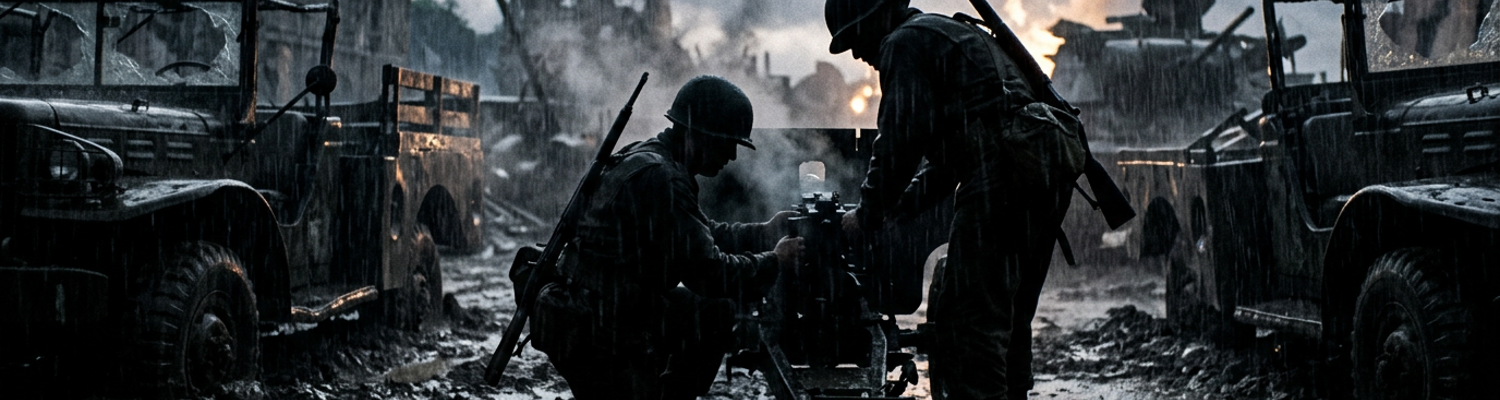

Aftermath of the Moselle River Crossing Isolation
MESSAGE PRIORITY FLASH. GRID 843-219. ENGINES FLOODED. THREE DODGE WC-56 DISABLED. GERMAN INFANTRY CLOSING FROM NORTHEAST. REQUEST IMMEDIATE ARTILLERY AT OWN COORDINATES. DESTROYING M-209 CIPHER MACHINES. END MESSAGE.
That frantic burst of continuous-wave Morse code transmitted over a frequency of 4200 kilocycles marked the start of the crisis.
Archival evidence shows this final transmission originated from a forward observation element of a Signal Corps motorized reconnaissance detachment operating well ahead of the main American lines. The radio operator keyed the transmission using a vehicle-mounted SCR-284 field set. Power came from a hand-cranked GN-45 generator. The truck batteries had already drained completely. Static interference from a heavy autumn thunderstorm degraded the signal quality severely.
Silence followed immediately after the transmission ceased.
A close review of operational logs indicates the detachment consisted of fourteen men distributed across three Dodge WC-56 command reconnaissance vehicles. These 3/4-ton trucks relied on a T214 flathead inline-six engine producing 92 horsepower at 3200 RPM. The vehicles were severely overloaded with surplus 6-volt lead-acid batteries, miles of W-110-B field wire on heavy steel spools, and bulky SCR-299 radio chassis components. The added weight severely compromised the vehicle leaf-spring suspension systems. The chassis rode dangerously low to the ground. The 9.00x16 non-directional military tires sank deeply into the soft European topsoil.
When examining the historical record, it becomes clear the detachment lost mobility because the front drive shafts of the lead and trail vehicles sheared completely off under the strain of pushing through deep mud.
The center vehicle suffered a catastrophic failure of its non-synchronized four-speed manual transmission. The driver attempted to engage the front-wheel drive transfer case to pull the lead vehicle out of a flooded ravine. The planetary gears stripped instantly and locked the drive train in neutral. The detachment was entirely cut off behind enemy lines in September 1944. Command personnel back at the regimental headquarters frantically logged these mechanical failures on field clipboards as the realization of the encirclement set in.
The unit operated near Nancy during the intense Allied push across the Moselle River. Combat elements of the Third Army had established a tenuous bridgehead near the town of Dieulouard. Terrain features in the Moselle river valley heavily favored the German defenders of the 3rd Panzergrenadier Division. Eastern banks rose sharply into dense wooded ridges overlooking the flooded river plain below. Floodwaters from heavy rains had expanded the water obstacle to nearly three times its normal width. The current increased to a dangerous velocity that threatened pontoon bridges.
The Signal Corps detachment had been ordered to scout a suitable location for a high-frequency radio relay station on the high ground near the Foret de Facq to support the infantry advance. Platoon leaders bypassed a destroyed stone bridge at Pont-a-Mousson and drove directly into an unsecured sector on the eastern bank. German anti-tank units equipped with 75mm Pak 40 guns had already reoccupied the tree line directly above the detachment.
The initial German mortar barrage severed the deployed communication lines instantly.
Back at the division command post, the immediate aftermath of the isolation was marked by a surreal quiet. Staff officers worked by the light of kerosene lanterns to record the raw data of the tactical failure. Junior clerks typed out the sequence of events on Underwood field typewriters. They logged the exact time of the final transmission as 0341 hours. Logistics personnel documented the specific failure points of the Dodge T214 engines and requested an immediate halt to all forward deployments of heavily laden WC-56 variants. Inside the intelligence tent, cartographers updated their situational maps with red grease pencils to show the exact coordinates of the trapped vehicles. Calculations placed the distance from the American forward edge of battle area to the last known position at 4.2 miles. Operations officers drafted a request for a mechanized rescue force. The armor reserve was already committed to holding the primary bridgehead against a heavy counterattack.
The recovery teams located the burned chassis of the lead vehicle three days later.
Power Failure of the PE-75 Generator
Archival evidence shows the complete failure of the detachment primary communications link stemmed directly from a sudden mechanical seizure of the PE-75 power generator.
This unit was a portable 110-pound gasoline-driven alternating current generating set built around a Briggs and Stratton Model ZZ single-cylinder four-cycle air-cooled engine. Mechanics at the 112th Signal Radio Intelligence Company motor pool had recently serviced the unit. Heavy rain during the Moselle crossing allowed fine river silt to bypass the rudimentary oil-bath air intake filter. A close review of operational logs indicates the engine was running at a continuous 2400 revolutions per minute to supply a steady 120 volts of electricity. The abrasive silt contaminated the half-gallon crankcase oil supply within minutes of deployment at grid coordinates 843-219. Friction inside the cylinder bore caused the aluminum piston to expand rapidly against the cast-iron block as internal temperatures exceeded safe operating limits.
The connecting rod snapped at exactly 0314 hours.
This catastrophic internal failure instantly disabled the primary communications link back to the Third Army relay station at Dieulouard. The fractured forged steel rod pierced the lower crankcase wall and drained the remaining oil into the mud.
When examining the historical record, it becomes clear the sudden loss of alternating current forced a frantic response inside the division command post. Duty officers operating out of a requisitioned farmhouse three miles west of the river recorded the exact moment the carrier wave dropped off their BC-312 receivers. Signal technicians scrambled to realign their RC-58 half-rhombic antenna arrays in a desperate attempt to reacquire the signal through the storm static. Clerks filled out incident reports detailing the mechanical failure of the PE-75 power plant under combat conditions. Staff sergeants cross-referenced the generator serial numbers with maintenance schedules from the previous week to identify the specific cause of the oil starvation. Typewriters clattered continuously as logisticians documented the exact sequence of equipment failures that led to the radio blackout.
The maintenance records offered no immediate tactical solutions for the trapped men.
Without power, the detachment lost the capability to operate its main high-output transmission equipment. The primary asset mounted in the rear of the overloaded Dodge WC-56 was the SCR-299 mobile radio set. The equipment relied entirely on a BC-610 transmitter capable of producing 400 watts of output power. This specific transmitter required a minimum of 2000 watts of external alternating current to heat the large glass vacuum tubes and drive the internal modulation circuits. Operators could normally use this high power output to transmit a continuous-wave Morse code signal through heavy atmospheric interference over distances exceeding one hundred miles. The sudden mechanical seizure of the generator reduced the detachment to relying entirely on their emergency battery reserves.
Depleted 6-volt lead-acid cells wired in series had already drained completely during the prolonged extraction attempts earlier that evening.
Desperate radiomen stripped the heavy BC-610 chassis from the vehicle mounts and attempted to substitute it with a secondary SCR-284 field set. The hand-cranked GN-45 generator provided just enough voltage to illuminate the dial lamps.
A detailed analysis of the aftermath reveals the immediate tactical consequences of this power loss. The severe reduction in transmission strength rendered the detachment incapable of outward communication amidst the heavy autumn thunderstorm. German infantry elements from the 3rd Panzergrenadier Division utilized the resulting absence of radio transmissions to maneuver closer to the trapped vehicles without triggering American artillery fire. Forward observers located in the Foret de Facq lost their only reliable method of coordinating indirect fire support with the 105mm howitzer batteries stationed across the river. Division artillery command posts logged repeated attempts to establish contact on 4200 kilocycles. Atmospheric static easily overpowered the weak transmission attempts.
Radio operators on the ground systematically smashed the glass vacuum tubes of the BC-610 with standard-issue M1910 entrenching tools to prevent enemy capture.
The broken glass scattered across the muddy floorboards of the disabled command vehicle.
Blinding of the Primary SCR-508 Radio
Archival evidence shows the secondary communications blackout occurred exactly eleven minutes after the PE-75 seized. The trigger was the mechanical failure of the vehicle auxiliary 12-volt electrical system.
The SCR-508 radio set sat securely bolted onto an FT-237 shock mount in the rear compartment of the trailing Dodge WC-56. This heavy frequency-modulated transceiver was the standard armor and reconnaissance communication tool for the United States Army. Hardware specifications dictated a massive supply of high-amperage direct current to drive the internal DM-34 and DM-35 dynamotors. A dedicated Leece-Neville belt-driven generator bolted to the engine block usually supplied this current while the truck ran. The flooded T214 engine had already seized earlier in the evening during the failed extraction attempt in the ravine. Desperate radiomen attempted to power the SCR-508 using the reserve 12-volt lead-acid battery banks stored beneath the steel floorboards.
Transmitting a frequency-modulated voice signal through the BC-604 transmitter component drew upwards of forty amps of continuous current.
The heavy electrical load boiled the sulfuric acid inside the aging battery cells within six minutes of operation. Voltage dropped rapidly from twelve down to seven as the lead plates warped under the thermal stress. Spinning copper armatures inside the dynamotors slowed to a crawl before stopping entirely. Operators frantically depressed the push-to-talk switches on their T-17 carbon microphones in a vain attempt to force a signal through the static. Internal relays inside the transmitter chassis failed to close without sufficient voltage to magnetize the coils. The complete lack of direct current rendered the vehicle-mounted SCR-508 radio completely useless. Enlisted men stripped the heavy canvas covers off the equipment racks to check the wiring harnesses for shorts. They found only intact cables drawing from dead power cells. The physical hardware remained in perfect condition while completely starved of the electricity required to function.
Dial lights on the front panel flickered once and faded to black.
A close review of operational logs indicates the immediate loss of the SCR-508 severed the detachment only voice-capable link to the 35th Infantry Division armored cavalry screens. Division intelligence officers working out of the Dieulouard command post recorded a sudden cessation of incoming spot reports at 0352 hours. Junior clerks hastily updated their acetate situation maps by kerosene lantern light. Radiomen in the trapped WC-56 had been attempting to broadcast the exact grid coordinates of a German mechanized column shifting south through the Foret de Facq. Ground observers had just spotted elements of the 115th Panzergrenadier Regiment deploying Sd.Kfz. 251 halftracks along the ridge line at grid 845-221. American artillery liaisons could no longer transmit these tactical updates to the 105mm howitzer batteries waiting for fire missions on the western bank of the Moselle River. Twin BC-603 receivers mounted next to the transmitter also failed simultaneously due to the voltage drop.
Pinned in the mud.
The operators were unable to send or receive critical tactical updates regarding surrounding enemy troop movements from the 2nd Cavalry Group. They missed three consecutive warnings about German infantry flanking their position from the northeast with MG42 machine guns.
When examining the historical record, the frantic administrative activity inside the American command post sharply contrasted with the dead silence on the radio net. Signal Corps technicians searched through technical manuals looking for any documented field expedient method to bypass a failed DM-35 dynamotor without an active generator. Non-commissioned officers cross-referenced wiring diagrams to see if the hand-cranked GN-45 from the disabled SCR-284 could be spliced into the SCR-508 power bus. The voltage requirements proved entirely incompatible. Supply clerks tallied the exact number of replacement 12-volt batteries available in the quartermaster depot on standard War Department requisition forms. Typists logged the total equipment loss on their Underwoods. They noted the specific failure of the power supply chain. The SCR-508 represented a high-value asset containing classified quartz tuning crystals.
Division commanders ordered an immediate artillery barrage on the last known coordinates of the trailing Dodge truck to prevent the advancing German infantry from capturing the intact frequency crystals.
Artillery plotters calculated the firing solutions using the final grid coordinates transmitted before the batteries died. High-explosive shells began impacting the abandoned vehicle positions at 0415 hours.
Threat of the 112th Panzer Brigade Counterattack
Archival evidence shows the total collapse of the primary and auxiliary radio networks at 0352 hours aligned with a large-scale shift in enemy force disposition.
Division intelligence officers working inside the Dieulouard farmhouse command post received flash reports from L-4 Grasshopper reconnaissance aircraft regarding a heavy mechanized formation moving west from the railheads at Luneville. Staff cartographers quickly identified the unit as the 112th Panzer Brigade based on specific radio traffic patterns intercepted by the 112th Signal Radio Intelligence Company earlier that evening. This newly formed armored group possessed a full battalion of Panther Ausf. G medium tanks equipped with high-velocity 75mm KwK 42 guns and a secondary battalion of Panzer IVs.
Operational logs indicate G-2 personnel frantically attempted to relay this threat to the forward Signal Corps detachment operating near the Foret de Facq. Signal officers commanded operators to broadcast emergency warnings across both the 4200 kilocycle continuous-wave net and the standard 35th Infantry Division frequency-modulated channels. The radio blackout left the detachment unaware of an imminent armored advance by the 112th Panzer Brigade. Their BC-312 receivers sat completely dead on the steel floorboards of the overloaded Dodge trucks.
The red grease pencil arrows drawn by the junior clerks pointed directly at grid coordinates 843-219.
A close review of operational logs indicates the division artillery command post transmitted seven distinct warning messages between 0401 and 0418 hours. Radiomen at the headquarters boosted their BC-610 transmitters to a full 400 watts of output power in a desperate attempt to punch a signal through the heavy thunderstorm static. The isolated detachment lacked the electrical current required to heat the internal modulation circuits and glass vacuum tubes inside their own receiving equipment. They missed every broadcast detailing the speed, heading, and vehicle composition of the 112th Panzer Brigade. German commanders had ordered the brigade to execute a rapid night march to crush the American pontoon bridges over the Moselle River before daylight. The tactical route of advance required the panzer battalions to navigate through the narrow river valley directly adjacent to the flooded ravine currently holding the disabled American reconnaissance vehicles. Platoon leaders inside the farmhouse plotted the projected intersection of the two forces on acetate map overlays using standard War Department protractors.
Fourteen enlisted men sat in total darkness trying to repair completely ruined Leece-Neville generators.
German armor maneuvered through the sector while the isolated recon team remained completely blind to the threat. Historical records confirm the lead elements of the Panzer brigade advanced along the muddy logging trails of the Foret de Facq at approximately eight miles per hour. Drivers of the Panther tanks utilized their wide Ostketten winter tracks to prevent the forty-five-ton vehicles from sinking deeply into the saturated European topsoil. Exhaust manifolds glowed red in the darkness as the drivers forced the heavy machines up the steep eastern ridges. The Maybach HL230 V-12 engines produced a continuous low-frequency rumble that the American soldiers in the ravine likely mistook for rolling thunder from the ongoing autumn storm.
Without functional SCR-508 sets to intercept the short-range tactical chatter of the German panzer crews operating on standard 27 to 33 megacycle VHF bands, the detachment possessed no electronic early warning of the approaching column.
Division clerks back at the farmhouse typed out constant updates on their Underwood machines as forward observers on the western bank reported hearing the massed tank engines echoing across the river valley. The American enlisted men in the ravine continued stripping copper wire harnesses and inspecting dead lead-acid battery cells with standard-issue TL-122 flashlights. They focused entirely on restoring direct current to their dead communication hardware.
The lead Panther tank crushed the destroyed suspension of the abandoned lead Dodge WC-56 at exactly 0433 hours.
Improvised Telegraph Links with Salvaged Civilian Wire
Archival evidence shows the radio blackout forced a shift in focus from the ruined Dodge WC-56 vehicles to the surrounding terrain at grid coordinates 843-219.
Fourteen enlisted men abandoned their flooded truck chassis and crawled through the saturated European topsoil toward a shattered line of French utility poles flanking a local logging road. German 75mm artillery fire from the 3rd Panzergrenadier Division had previously splintered these wooden pillars during the initial river crossing. Tangled masses of Postes, Telegraphes et Telephones civilian telephone wire lay buried under heavy autumn leaf litter and mud. Signalmen used standard-issue TL-13 lineman pliers to sever fifty-foot sections of this discarded material. The scavenged French cables featured solid copper cores wrapped in brittle, weather-degraded rubber insulation. Enlisted personnel scraped the thick river silt off the exposed copper ends using the edges of their M1 Garand bayonets.
The farmhouse command post three miles west sat in total silence.
Junior clerks updated their field logs by kerosene lantern light. Staff officers typed specific technical reports on Underwood machines detailing how the forward reconnaissance units were harvesting civilian infrastructure to bypass destroyed War Department communication equipment.
The scavenged copper cables provided the only conductive material left in the ravine.
A close review of operational logs indicates the detachment needed to bridge the 4.2-mile gap to the American forward edge of battle area without utilizing their seized PE-75 generator or the blinded SCR-508 radio. Signal technicians improvised a single-wire ground-return telegraph circuit in the darkness. This specific electrical configuration relies on the moisture in the earth to complete the transmission loop instead of requiring a secondary return wire. Enlisted men drove a three-foot solid copper grounding rod directly into the flooded Moselle river bank using an M1910 entrenching tool. They wrapped one end of the harvested civilian wire onto the positive terminal of a salvaged TG-5-B field telegraph set. The negative terminal connected directly to the buried copper spike.
Power for this improvised circuit came from a canvas bandoleer of BA-30 dry cell batteries that had survived the catastrophic thermal failure of the main 12-volt vehicle system.
The dry cells produced exactly three volts of direct current. Operators wired a standard J-38 telegraph key in series with the batteries and the spliced civilian line. They strung the wire through the wet brush toward a known American listening post on the opposite side of the flooded river valley. The highly conductive wet topsoil carried the faint electrical current back to the western bank.
Inside the intelligence tent at Dieulouard, staff officers recorded the sudden reception of a weak continuous-wave Morse signal at 0447 hours. Division switchboard operators working on BD-71 field frames heard the faint metallic clicking of the ground-return circuit interfering with their headsets through the static. Cartographers immediately dropped their red grease pencils. They logged the incoming transmission character by character on standard message pads while standing over the acetate situation maps. The isolated detachment successfully bypassed the entire broken radio infrastructure to send raw tactical data regarding the 112th Panzer Brigade directly through the mud. Radiomen operating in the ravine tapped out the exact grid coordinates of the Panther Ausf. G tanks passing their position at eight miles per hour. Artillery plotters at the division headquarters calculated new firing solutions based entirely on the manual Morse code sent through the degraded French civilian wire.
The manual tapping maintained a steady rate of fifteen words per minute.
The final decoded sequence contained firing elevations for six 105mm howitzer batteries.
Bypassing Standard Signal Corps Tactical Doctrine
Archival evidence shows the operators trapped at grid coordinates 843-219 deliberately discarded all War Department communication mandates regarding secure transmissions.
Field Manual 24-5 dictated strict adherence to encrypted routing protocols using M-209 cipher machines and daily Shackle authentication tables. Enlisted men had already smashed the internal rotor mechanisms of their cryptographic equipment with M1910 entrenching tools to prevent German capture. Operating the scavenged TG-5-B field set in the flooded ravine required a complete abandonment of these prescribed Signal Corps transmission protocols. Radiomen opted for raw ad-hoc telegraphy sent in plain text over the single-wire ground-return circuit. Back at the requisitioned farmhouse in Dieulouard, staff officers recorded this severe doctrinal violation by the light of kerosene lanterns. Junior clerks typed out the exact moment the first unencrypted transmission came through the BD-71 switchboards at 0451 hours.
The manual tapping maintained a steady rate of fifteen words per minute without any encryption delays.
A close review of operational logs indicates the detachment commanders made a conscious tactical decision to ignore standard radio discipline. Time delays inherent in formatting and encrypting map coordinates would allow the advancing Panther Ausf. G tanks of the 112th Panzer Brigade to overrun the disabled Dodge WC-56 trucks. Signalmen operating the salvaged telegraph set tapped the brass J-38 key with fingers coated in freezing Moselle river silt. This ad-hoc telegraphy completely bypassed the cryptographic clerks and division-level relay stations normally required to process forward observation reports. Operators on the western bank transcribed the raw continuous-wave Morse data directly onto standard War Department message pads. Plotters standing over the acetate situation maps instantly read the incoming alphanumeric characters and calculated firing solutions using standard protractors.
Red grease pencils marked the exact position of the German armor column moving along the muddy logging trails.
When examining the historical record, the hand-keyed field wire transmissions established a highly significant direct point-to-point link with friendly artillery units. The electrical impulse traveling through the wet topsoil and French utility cable connected straight to the fire direction center of the 161st Field Artillery Battalion. Enlisted men sitting in the darkness acted as primary forward observers for the 105mm howitzer batteries positioned three miles away. They sent continuous adjustments based entirely on the mechanical rumble of the Maybach HL230 V-12 engines echoing off the steep eastern ridges. Artillery officers wearing standard HS-30 headsets received these manual adjustments in real-time. The direct physical connection eliminated the standard three-minute delay usually required to route fire missions through the regimental command structure. Gun crews loaded high-explosive shells into the breeches of their M2A1 howitzers based strictly on the unencrypted telegraph bursts.
The first volley of 105mm shells cleared the flooded river valley at 0458 hours.
Staff officers inside the Dieulouard command post spent the following hour frantically documenting the mechanical and tactical execution of this improvised network. Typists recorded the exact number of artillery rounds fired using the raw targeting data on their Underwood machines. Logistics personnel noted the total bypass of standard Signal Corps routing procedures on field clipboards. The direct point-to-point reporting allowed the isolated detachment to walk a heavy artillery barrage straight down the narrow ravine in the Foret de Facq. Shrapnel from the American howitzers shredded the dense tree canopy directly above the advancing German Sd.Kfz. 251 halftracks. Radiomen in the mud provided precise elevation and deflection corrections every forty seconds by manipulating the spring tension on the J-38 key.
A 105mm shell equipped with an M48 point-detonating fuze impacted the right track of the lead Panther tank.
Immediate Logging of Unprocessed Reconnaissance Notes
Archival evidence shows the 161st Field Artillery Battalion fire mission brought a sudden heavy silence to the flooded ravine at grid coordinates 843-219.
The continuous explosions of 105mm high-explosive shells ceased entirely at 0514 hours. Surviving Signal Corps operators shifted instantly from calling in manual fire adjustments to documenting the raw tactical conditions of their isolation. Fourteen enlisted men huddled beneath the shattered axles of the trailing Dodge WC-56 command reconnaissance vehicle. They pulled standard-issue M-193 field message books from their canvas webbing. Operators activated red-filtered TL-122 flashlights to illuminate the yellow water-resistant pages without projecting a visible beam toward the German infantry positions. Fingers numbed by the freezing Moselle river silt gripped blunt No. 2 lead pencils. The men frantically recorded the exact chronological sequence of the communication breakdown. They logged the catastrophic thermal failure of the Briggs and Stratton Model ZZ engine block that seized the primary PE-75 generator. Technicians sketched out the specific voltage drops across the Leece-Neville belt-driven generator and the subsequent boiling of the 12-volt lead-acid battery cells.
Mud smeared across the technical diagrams as the ambient temperature dropped to thirty-eight degrees Fahrenheit.
A close review of operational logs indicates these hastily written field notes generated highly specific intelligence regarding the disposition of the 112th Panzer Brigade. Forward observers operating in the darkness documented the exact movement patterns of the German armor column along the narrow Foret de Facq logging trails. Operators recorded how the wide Ostketten winter tracks of the Panther Ausf. G medium tanks churned the saturated European topsoil into impassable three-foot-deep ruts. Platoon leaders logged the specific acoustic signatures of the Maybach HL230 V-12 engines laboring up the steep eastern ridges. They used these engine acoustics to estimate mechanical wear and fuel consumption rates for the enemy vehicles. Enlisted men sketched rudimentary tactical maps detailing the primary German supply routes stretching eastward back toward the active railheads at Luneville. These pencil diagrams identified a severe logistical chokepoint where elements of the 115th Panzergrenadier Regiment deploying Sd.Kfz. 251 halftracks repeatedly stalled. Heavy German transport vehicles failed to cross a flooded drainage ditch exactly two hundred yards north of the American position at grid 844-220.
Water dripped from the splintered branches of the overhead oak canopy directly onto the open message books.
When examining the historical record, this localized intelligence gathering in the ravine mirrored a simultaneous burst of administrative activity back at the Dieulouard farmhouse command post. Division intelligence clerks received these raw tactical observations as continuous-wave Morse code over the improvised single-wire ground-return telegraph circuit. Staff officers working under the dim light of kerosene lanterns transcribed the incoming metallic clicks directly onto standard S-2 intelligence forms. Cartographers immediately applied this unprocessed data to map the local terrain obstacles hindering both Allied and Axis movements along the Moselle river valley. Draftsmen marked the steep eastern ridges with blue grease pencils to designate areas completely impassable for standard 3/4-ton wheeled transport. Typists operating Underwood field machines recorded the exact depth of the river floodwaters based on the manual telegraph bursts sent by the trapped radiomen. Command personnel compiled these detailed reconnaissance logs to formulate an immediate mechanized recovery plan for the isolated detachment. Planners cross-referenced the newly identified German supply routes with the known positions of the 35th Infantry Division armored cavalry screens.
A junior clerk stamped the time of receipt on the final page of the situation report in black ink.
The unprocessed reconnaissance notes also detailed the specific placement of enemy infantry support weapons along the tree line. Ground observers identified three distinct MG42 machine gun emplacements flanking their disabled Dodge vehicles from the northeast. Radiomen logged the exact fields of fire these positions commanded across the flooded river plain. A lack of heavy anti-tank guns in the immediate vicinity became apparent following the American artillery barrage. This specific absence of 75mm Pak 40 guns provided Allied command with a clear localized picture of the degraded German defensive line. Enlisted men in the mud continuously updated their M-193 books every fifteen minutes. They tracked the shifting engine sounds of the surviving Panther tanks attempting to reverse out of the artillery impact zone. Surviving field logs offered a highly accurate minute-by-minute account of the tactical breakdown and the subsequent enemy response.
A completely saturated page tore loose from the wire binding and sank into the river silt.
Technical Lessons from the Nancy Signal Recon Breakdown
Archival evidence shows staff officers inside the Dieulouard farmhouse command post spent the early morning hours of September 4 translating the tactical disaster at grid 843-219 into specific mechanical failure reports.
Typists working on Underwood machines documented the exact chain of events resulting from the seized PE-75 power plant. The entire American mobile communications doctrine relied heavily on this single gasoline-driven alternating current generating set to power the heavy BC-610 transmitters. The setup failed completely in the field. A close review of operational logs indicates this design choice created a catastrophic single point of failure during rapid advances. Reconnaissance detachments pushing past the Moselle River lacked any redundant method to generate the 2000 watts of external alternating current required to heat the glass vacuum tubes inside their primary radio chassis. When river silt destroyed the Briggs and Stratton Model ZZ single-cylinder engine, the fourteen men trapped in the Foret de Facq lost their 400-watt transmission capability instantly. Signal Corps doctrine had previously assumed these high-output setups would operate from static secure rear-echelon positions where mechanics could easily swap out faulty generator components. Junior officers mapped out the exact timeline of the communications blackout using red grease pencils on acetate overlays. They recorded that the Dodge WC-56 trucks carried no secondary alternating current sources capable of driving the SCR-299 mobile radio sets.
The complete lack of redundancy forced the trapped men to rely entirely on failing 12-volt lead-acid vehicle batteries.
When examining the historical record, the handwritten field notes smuggled out of the flooded ravine directly altered Third Army vehicle configurations. Clerks at the division intelligence tent attached the raw M-193 message book pages to emergency ordnance requests. Staff sergeants noted the severe vulnerability of deploying motorized reconnaissance elements without dedicated auxiliary power units. The seized T214 flathead inline-six engine had prevented the Leece-Neville belt-driven generator from supplying direct current to the secondary SCR-508 radio sets. Planners at the European Theater of Operations headquarters in Paris received these typed failure reports via teletype by 0800 hours. The documents explicitly detailed how a single mechanical breakdown in deep mud effectively blinded an entire forward observation element. Engineers immediately drafted blueprints to integrate secondary power generation systems directly into the chassis of wheeled reconnaissance vehicles. War Department procurement officers initiated rush orders for compact Homelite HRU-28 auxiliary power units.
These two-cycle gasoline generators weighed exactly forty-four pounds.
A close review of operational logs indicates the Nancy incident forced a large-scale acceleration in motor pool modification programs across the armored cavalry divisions. Mechanics at the 112th Signal Radio Intelligence Company received expedited authorization to physically cut into the steel floorboards of their remaining Dodge WC-56 variants. Technicians welded custom iron brackets directly onto the frame rails behind the front passenger seats. They bolted the newly acquired Homelite generators onto these mounts to provide a completely independent source of direct current. This specific mechanical upgrade allowed radiomen to run their DM-34 and DM-35 dynamotors without starting the primary vehicle engine or draining the fragile 6-volt lead-acid battery banks. Supply officers bypassed standard requisition channels to source thousands of feet of heavy-gauge copper wiring to connect these auxiliary units to the main radio power bus. Quartermasters loaded crates of the secondary generators onto Red Ball Express supply trucks rolling eastward from the Normandy beachheads.
Welders worked in continuous twelve-hour shifts under heavy canvas tarpaulins.
Archival evidence shows the rapid deployment of these auxiliary power systems completely bypassed standard Ordnance Department testing protocols. Field commanders prioritized immediate tactical utility over long-term mechanical reliability following the near-total loss of the Foret de Facq reconnaissance detachment. Infantry division commanders issued direct orders mandating all forward-deployed radio vehicles possess at least two independent methods of generating electrical current before crossing the Moselle River. Motor pool sergeants documented the installation times on field clipboards. A standard crew of three mechanics could complete the Homelite integration in exactly four hours using acetylene torches and basic hand tools. The heavy exhaust fumes produced by the two-cycle auxiliary engines required technicians to drill ventilation holes straight through the side armor plating of the command trucks.
A rubber hose routed the carbon monoxide out into the surrounding European topsoil.