
Marine Corps Air Operations 1965
The radio call was flat. Technical. A Marine aviator, low on fuel, could not find his target through the jungle canopy. He needed to divert to Da Nang, now. That single, mundane transmission captured the entire problem of the air war in 1965.
The initial deployment of the 9th Marine Expeditionary Brigade to South Vietnam in March 1965 was, by design, a limited security mission for the Da Nang Air Base. This was essential for the Rolling Thunder bombing campaign. That narrow focus did not last. Archival evidence shows that by April, the mission had expanded, pulling Marine aviation into the fight. On April 10, 1965, fifteen F-4B Phantom IIs from Marine Fighter Attack Squadron 531 (VMFA-531), the “Gray Ghosts,” landed at Da Nang. They were the first land-based Marine jets in the country. Their arrival marked a fundamental shift. Initially tasked with radar-guided bombing missions, their role rapidly evolved to include close air support for Marine, Army, and South Vietnamese ground units. This created immediate doctrinal friction. The Marine Corps’ entire operational structure was built on the concept of a tightly integrated air-ground task force. In Vietnam, air assets were often controlled by the U.S. Air Force, leading to operational disconnects. The 1st Marine Aircraft Wing established an advanced headquarters at Da Nang in May, attempting to assert control over its assets, which were now spread across enclaves at Da Nang, Chu Lai, and Phu Bai.
The geography of I Corps, the Marines' primary area of operations, was a formidable opponent. The Annamite Range and the Central Highlands are defined by steep, rugged mountains cloaked in dense, multi-layered jungle, carved by narrow valleys and subject to punishing monsoon seasons. This terrain severely hampered air operations. From the cockpit of a high-speed jet, identifying camouflaged enemy positions or segments of the Ho Chi Minh Trail was nearly impossible. The thick jungle canopy could absorb the blast and fragmentation of bombs, rendering attacks ineffective unless they were perfectly placed. The region’s weather was a constant factor. Low cloud ceilings and torrential rain grounded aircraft for days and made low-level attack runs a perilous exercise in instrument flying. Areas like the A Shau Valley became infamous killing zones where the terrain gave every advantage to entrenched defenders. These environmental factors placed an enormous strain on reconnaissance and targeting, frequently forcing pilots to rely on often-inaccurate intelligence or to drop ordnance “in the blind” on suspected enemy locations.
At the center of these operations was the McDonnell Douglas F-4B Phantom II. It was a twin-engine, all-weather fighter-bomber capable of speeds over Mach 2 and able to carry up to 18,000 pounds of weapons. The Marines in 1965 flew the F-4B variant, a navalized version without an internal cannon. It relied on a combination of AIM-7 Sparrow and AIM-9 Sidewinder missiles for air-to-air engagements and a wide array of bombs, rockets, and napalm for ground attack. The aircraft’s two General Electric J79 engines provided immense thrust but also produced a thick, tell-tale trail of black smoke, making the Phantom easily visible for miles. Developed as a high-altitude fleet defense interceptor, it was not optimized for the low-and-slow close air support mission demanded in the Central Highlands. Its high speed became a liability when trying to visually identify targets in broken terrain. Its wide turning radius made it less nimble than its predecessor, the A-4 Skyhawk. Early in the deployment, the F-4's high landing speed and long takeoff roll presented issues for the expeditionary airfields being rapidly constructed, such as the aluminum-planked Short Airfield for Tactical Support (SATS) at Chu Lai. The F-4 was a complex machine that demanded a heavy maintenance footprint, and early models were plagued by issues like leaking wing fuel tanks, creating a logistical burden that dictated the pace of air operations.
Ordnance Dud Rate Epidemic
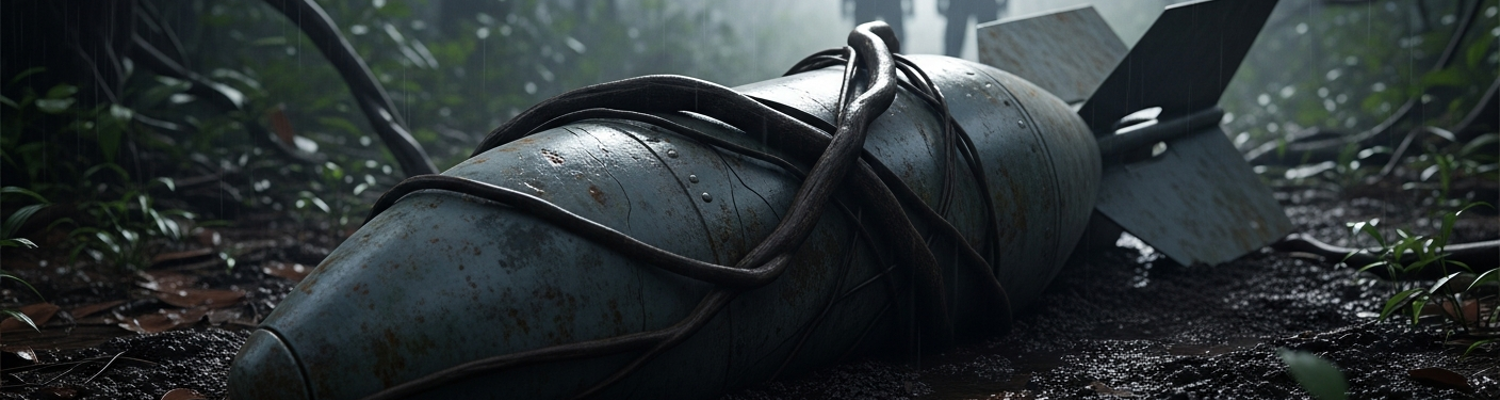
A close review of operational logs from 1965 reveals a deeply problematic trend that dogged air operations over the Annamite Range. American air-dropped ordnance was failing at an alarming rate. The workhorse Mk 80 series of general-purpose bombs, particularly the 500-pound Mk 82, exhibited a high dud rate that complicated bomb damage assessment and required dangerous re-strike missions on targets that should have been neutralized. The primary culprit was often the M904 mechanical nose fuze. This fuze, a complex clockwork device, was armed by a small propeller on the bomb’s nose that spun in the slipstream after release. A set number of rotations were required to arm the internal striker mechanism, a process that could be set for delays between two and eighteen seconds. In the low-level attack runs demanded by the jungle terrain, bombs often struck the ground or the dense triple-canopy foliage before the arming sequence was complete. The thick vegetation could also shear the vane off entirely or cushion the impact, preventing the striker from initiating the explosive train. The result was a high-explosive bomb successfully delivered to the target area but failing its terminal function.
A systemic issue.
The problem compounded with the introduction of Cluster Bomb Units. A single CBU-24 canister would open in mid-air, dispersing over 600 small, spherical bomblets. The BLU-26. The Guava bomb. Each of these submunitions was its own tiny explosive device, designed to saturate a wide area against un-reveted supply depots and troop concentrations. The arming mechanism for each BLU-26 was centrifugal; as the bomblet fell, flutes on its casing would cause it to spin, and this rotation would force internal components to arm the impact fuze. A confluence of factors led to catastrophic failure rates. Post-conflict analyses suggest dud rates between 10% and 30%. Bomblets dropped from too low an altitude failed to achieve the necessary rotational speed to arm. Others, encountering the thick jungle canopy, would have their descent and spin interrupted, becoming snagged in branches and vines. Many that reached the ground landed in soft mud or water, which cushioned the impact sufficiently to prevent the fuze from functioning. For every CBU-24 dropped, dozens or even hundreds of these small, lethal bomblets could be left scattered and dormant, effectively creating an unplanned minefield.
The environment itself was a constant corrosive agent. The operational theater of 1965 was defined by extreme heat and punishing humidity, particularly during the monsoon season which could dump over 100 inches of rain. Ammunition was often stored in open-air depots or under temporary cover, such as at the sprawling Bien Hoa and Da Nang air bases, where it was exposed to the moisture-laden air. This humidity could penetrate fuze mechanisms, causing corrosion on delicate parts and degrading the chemical stability of the explosive train’s primary elements. For ordnance that relied on electrical fuzing, moisture created pathways for short circuits. The packaging designed to protect the munitions could fail, allowing dampness to compromise the weapon before it was ever loaded onto an F-4’s pylon. The cumulative effect was that bombs and bomblets, already mechanically sensitive, were being sent into combat in a degraded state, predisposing them to failure long before they began their fall through the humid jungle air.
Logistical Fuzing Inconsistencies
An examination of ordnance supply manifests from 1965 and 1966 reveals a sprawling, overburdened system that contributed to the failure of munitions in the field. The journey of a single M904 nose fuze from a factory in the United States to an F-4 Phantom on the flight line at Da Nang was a long one. Fuzes were produced by multiple contractors with slight variations in quality control, packed, and then shipped by sea. During this transit, crates were subjected to constant vibration, temperature swings, and the salt air of the Pacific. Upon arrival in South Vietnam’s congested ports, such as Da Nang or Cam Ranh Bay, they entered a logistical bottleneck. Vast quantities of supplies were being pushed into the country to support the rapid troop buildup, overwhelming the undeveloped port and storage infrastructure. Crates of sensitive fuzes could sit on docks for extended periods or be roughly handled during transfer to depots, introducing unseen shock damage. The system was designed to push sheer tonnage forward, with little capacity for detailed, component-level inspection once it arrived in-country.
These supply chain failures manifested in the bomb’s final, critical seconds. The M904 fuze was a mechanical device, armed by a small vane on the bomb’s nose that spun in the slipstream. This spinning action would retract a detonator-slider from a misaligned “safe” position to an “armed” position, lining it up with a firing pin. Upon impact, the firing pin would strike the detonator, initiating the explosive train. A fuze that experienced rough handling or exposure to moisture during its long journey could have microscopic damage. A slightly bent arming vane, internal corrosion from humidity, or simple manufacturing defects could increase friction within the gear train that regulated the arming sequence. This meant the fuze might not fully arm in the allotted time during its fall. Similarly, the impact firing mechanism itself could be compromised. For the BLU-26 bomblets dispensed by Cluster Bomb Units, the failure rate was even more pronounced. Each tiny bomblet was armed by centrifugal force. A small dent from being jostled in a supply crate, or a bomblet’s spin being slowed by contact with jungle foliage, could prevent it from reaching the required rotational velocity to arm. The result was a high-explosive device that simply hit the ground inert. A dud.
Maintaining the integrity of ordnance in the field presented a separate set of challenges. Ammunition Supply Points at major bases like Da Nang, Chu Lai, and Bien Hoa were often sprawling, open-air affairs. Pallets of bombs and crates of fuzes were stored on the ground or in rudimentary revetments, often covered only by tarps. They were directly exposed to South Vietnam’s climate. Extreme heat, intense solar radiation, and a monsoon season that brought torrential rain and near-constant 90-100% humidity. Moisture infiltrated the imperfect seals of fuze casings, causing galvanic corrosion on the dissimilar metals of the delicate internal clockwork of an M904 fuze. It degraded the chemical stability of the primary explosive compounds in the detonators. For the few fuzes that relied on electrical circuits, the moisture created pathways for shorts, draining batteries or preventing a current from reaching the detonator. The daily temperature cycle, hot days followed by cooler nights, caused the metal and explosive components to expand and contract at different rates, further stressing seals and mechanical tolerances. A fuze sitting in a Da Nang ammo dump for weeks was, in effect, being slowly disabled by the environment before it was ever loaded for a mission.
Flawed Reconnaissance Intelligence
An analysis of after-action reports and operational logs from 1965 exposes the dysfunction at the heart of the American air campaign over the Annamite Range. The intelligence process was fractured. At the tip of the spear were the aerial reconnaissance platforms, primarily the Vought RF-8A Crusader flown by Marine Composite Reconnaissance Squadron 1 (VMCJ-1). These jets were tasked with flying deep into contested airspace to photograph potential segments of the Ho Chi Minh Trail, supply depots, and troop concentrations. The RF-8A was fast, but its photographic technology was a relic of a previous era. It relied on conventional wet-film cameras ill-suited for the mission. To get usable imagery of targets hidden under the dense triple-canopy jungle, pilots had to fly perilously low and slow, making them highly vulnerable to anti-aircraft artillery. Even when a pilot successfully captured images and returned to Da Nang, the intelligence cycle had only just begun. The film canisters had to be physically unloaded, transported to a lab, developed, and then painstakingly analyzed by photo interpreters. This entire process could consume hours, sometimes days.
The enemy did not wait for film to dry.
The deficiencies in aerial reconnaissance placed a greater burden on ground intelligence, a mission that proved to be exceptionally difficult. The Annamite Range is an unforgiving environment of sharp ridges and deep, jungle-choked valleys. Into this landscape, small, specialized units were inserted to find the enemy. Marine Force Reconnaissance platoons, operating in six-to-eight-man teams, were tasked with conducting deep reconnaissance to locate North Vietnamese Army (NVA) units and observe the trail network. These patrols, along with Army Special Forces teams and their associated Civilian Irregular Defense Group (CIDG) personnel, were the primary source of human intelligence from the border regions. Examination of their operational records shows a pattern of extreme risk for minimal reward. A core mission for these teams was to remain unseen, but the terrain and the sheer number of enemy forces made this almost impossible. Patrols were frequently detected within days, or even hours, of their insertion, leading to vicious firefights where they were badly outnumbered. A December 1965 engagement involving a combined Special Forces and Force Recon patrol from Ba To resulted in the deaths of three Marines and a Green Beret sergeant. The Ho Chi Minh Trail was not a single highway but a vast, constantly shifting web of paths, truck parks, and waystations, making it impossible for small teams on the ground to map its full extent. The intelligence they could gather was a tiny snapshot of a massive, dynamic logistical system.
The final failure occurred in the fusion and dissemination of this flawed intelligence. Data from a blurry RF-8A photograph, a garbled radio intercept, or a hasty report from a compromised Force Recon team would be sent up the chain to intelligence centers in Da Nang or Saigon. There, analysts working with often-inaccurate maps attempted to translate this fragmentary information into a concrete target for an air strike. The result passed down to the F-4B squadrons was frequently a set of geographic coordinates that were, at best, an approximation and, at worst, completely outdated. The time lag between intelligence collection and the arrival of a strike package was the central problem. A truck convoy spotted on a trail section at dawn would be miles away by the time F-4s arrived that afternoon. Post-strike bomb damage assessment photographs often revealed nothing more than craters in an empty stretch of jungle. This systemic imprecision led directly to the practice of “blind bombing,” saturating a grid square with ordnance in the hope of hitting something of value. Operational archives show that pilots were routinely tasked to strike targets that had already been hit, while more significant military installations, like enemy airfields, initially remained off-limits due to political restrictions.
Unintended Strike Zone Hazards
The systemic flaws in intelligence gathering and ordnance reliability converged into a perilous operational pattern. Mission logs show that Marine All-Weather Fighter Attack Squadrons, specifically those flying the Grumman A-6 Intruder like VMA(AW)-225, were frequently tasked with striking targets under conditions where visual confirmation was an impossibility. The Intruder was a purpose-built all-weather attack aircraft, equipped with a sophisticated Norden AN/APQ-92 search radar and a separate AN/APG-46 tracking radar, feeding data to a Digital Integrated Attack and Navigation Equipment (DIANE) computer. This system allowed a two-man crew, a pilot and a bombardier/navigator, to theoretically place ordnance on a target at night or in heavy monsoon rains without ever seeing it. The system was only as good as the coordinates it was fed. When a Force Recon patrol’s position was misplotted or an RF-8A’s imagery was misinterpreted, an A-6 crew from Da Nang could follow their DIANE guidance with perfect procedural execution and still drop a full payload of Mk 82 bombs miles from the intended enemy position. The all-weather capability that made squadrons like VMA(AW)-225 so valuable became a mechanism for generating misplaced strikes, as there was no last-second visual correction possible from the cockpit.
These targeting errors had direct consequences on the ground. An error of a few hundred meters, a simple transposition of digits in a grid coordinate, was the difference between a suspected North Vietnamese Army truck park and a civilian hamlet. The operational tempo demanded strikes be executed quickly based on perishable intelligence. The result was that strings of high-explosive bombs or canisters of napalm were sometimes dropped directly onto undefended villages or into active rice paddies where farmers were working. The destructive power of an F-4 Phantom’s payload meant that a single off-target sortie could obliterate a small community. These were not deliberate attacks on civilians; they were the inevitable outcome of a high-speed air war waged with imprecise information over difficult terrain. An after-action report might note the target was “not observed” or that “secondary explosions were not seen,” a sterile assessment for a strike that had actually impacted a non-combat area. These incidents created a deep-seated terror in the rural population of I Corps and presented a propaganda victory for enemy forces.
Every misplaced bomb created a new, persistent threat. The high dud rates of American ordnance meant that when a strike missed its target and landed in a civilian area, it often created an undeclared and lethal minefield. Since 1975, unexploded ordnance has killed more than 40,000 people and injured 60,000 more in Vietnam. A 500-pound Mk 82 bomb that failed to detonate due to its M904 fuze arming improperly could bury itself ten feet deep in the mud of a rice paddy, its presence completely unknown until a farmer’s plow struck it a decade later. The danger from Cluster Bomb Units was even more widespread. A single CBU-24 dropped off-target could scatter hundreds of BLU-26 bomblets across acres of farmland, forest, and village paths. With dud rates estimated as high as 30%, dozens of these small, spherical submunitions would be left armed and waiting. Children, attracted by their baseball-like shape, were frequent victims. Because these hazards were created by accident in areas with no official military designation, they were not mapped or marked, leaving civilians to discover them through fatal trial and error for generations. An estimated 800,000 tons of unexploded ordnance remain scattered across Vietnam, a direct legacy of strikes that went awry.
EOD Team Operational Nightmare
An analysis of after-action reports from Explosive Ordnance Disposal teams in I Corps during the 1965-1966 period reveals a logistical system completely overwhelmed by the scale of the UXO problem. EOD was not a proactive force. It was a reactive one, dispatched in small, two-to-three-man teams only after a dud was reported by a ground unit or spotted by aerial reconnaissance. The first failure point was transportation. With helicopters in high demand for combat assaults, medevac, and resupply, EOD teams were a low priority. They often waited for hours or days for available airlift. A team from the 3rd or 9th EOD detachments at Da Nang might receive a call for a hung 500-pound bomb in a remote valley, but getting there required navigating a command structure that prioritized active engagements over cleanup operations. This delay gave enemy forces ample time to observe the UXO, rig it with secondary anti-personnel devices, and prepare ambushes for the eventual arrival of the clearance team.
The bomb was still waiting.
The terrain itself was a weapon. The Annamite Range is a landscape of steep, jungle-covered ridges rising to over 8,000 feet, cut by ravines and blanketed in triple-canopy forest. For an EOD team inserted by helicopter, the work began with a physically draining movement through this environment. During the monsoon season, slopes became treacherous mudslides and visibility dropped to near zero. The ground was not sterile. These areas were often still contested or recently vacated by People's Army of Vietnam (PAVN) or Viet Cong units who were masters at fortifying their territory. Every footstep was a calculation against the threat of booby traps, which were designed to maim rather than kill to maximize their psychological impact and tie up friendly forces. EOD teams had to contend not only with the primary threat of the American-made UXO but also with secondary traps laid specifically for them. A common tactic was to rig a tripwire connected to a grenade or a “toe-popper,” a single rifle cartridge in a bamboo tube, near the dud bomb. Another was the bamboo whip, a spring-loaded pole with sharpened spikes that would swing across a trail when triggered. The initial approach to a dud bomb was a painstaking process of sweeping for and neutralizing secondary threats before the main task could even begin.
This hostile environment systematically degraded the specialized tools required for the job. EOD equipment was sensitive and ill-suited to the heat, constant moisture, and rough handling it endured. A team’s kit might include specialized wrenches for fuze removal, inerting chemicals, and demolition charges for controlled detonations. The persistent humidity caused corrosion on delicate metal tools and compromised the electrical firing systems used to initiate explosive charges. Blasting caps would fail, forcing teams to undertake dangerous manual procedures. The slow, methodical process of rendering a single bomb safe could take an entire day, from insertion to extraction. A review of unit logs shows an attritional pace that was impossible to sustain. On any given day, air operations could litter a single grid square with dozens or hundreds of new duds, particularly from cluster munitions. In contrast, a single EOD team, if it could get to the site and if its equipment worked, might clear one or two devices. The slow pace of clearance stood in stark contrast to the massive volume of ordnance being dropped, ensuring that the inventory of unexploded bombs across the Central Highlands grew larger with every passing day.