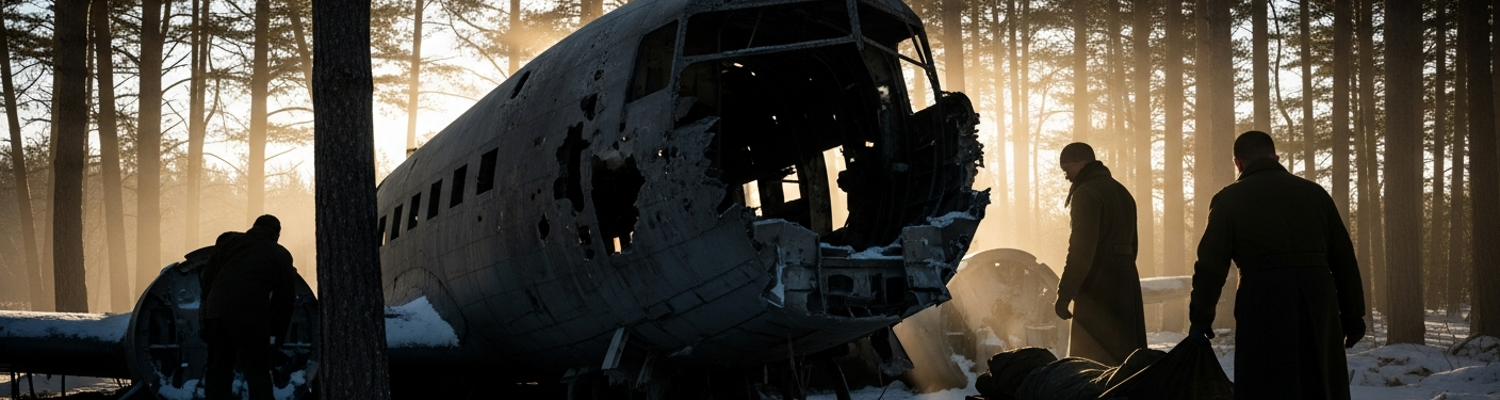

Chaotic Ardennes Night Drop
December 16, 1944. The German offensive erupting through the Ardennes achieved a level of strategic surprise that sent shockwaves through Allied command. Spearheaded by the 6th Panzer Army, the attack tore through thinly held American lines, creating a massive bulge in the front. A desperate race to contain the breach began. With seasoned German armor threatening to drive a wedge to the Meuse River, Allied High Command turned to its most mobile force: the airborne. The decision was made to commit the 82nd Airborne Division, then refitting from Operation Market Garden. They would not go by truck. The plan called for an emergency, high-risk parachute insertion behind the leading German spearheads. The objective for the 505th Parachute Infantry Regiment was simple: drop into the maelstrom, seize vital crossroads, and sow chaos behind the German advance long enough for conventional forces to establish a new defensive line.
It was a plan executed in the worst possible conditions.
Archival evidence from flight logs shows C-47 Skytrain transports taking off into a deteriorating winter sky. They flew into a nightmare of freezing fog, low cloud, and intermittent snow that made navigation nearly impossible. The intended drop zones, hastily selected from operational maps, were indistinguishable patches of dark forest and snow-covered fields. Unanticipated German anti-aircraft units added to the danger. Mobile flak batteries advancing with the Panzers opened up on the low-flying transports. After-action reports indicate pilots, blinded by weather and harried by ground fire, broke formation and dropped their paratroopers based on guesswork. Sticks of the 505th PIR, meant to land in a concentrated area, were instead scattered across hundreds of square kilometers of hostile terrain. Entire planeloads of men exited their aircraft miles from any recognizable landmark, their equipment scattered and their command structure instantly dissolved upon hitting the ground. The dispersion was not a partial failure; it was absolute.
The chaos in the air was mirrored by a unique crisis on the ground. The German breakthrough had not only shattered American lines but had also triggered a mass civilian exodus. The narrow, winding roads of the Ardennes became choked with refugees fleeing west. Their carts, farm animals, and overloaded vehicles created impenetrable blockades. For the thinly scattered paratroopers of the 505th, this civilian panic was as much of an obstacle as the German Army. Attempts to assemble into fighting units were hopelessly frustrated. Small groups of troopers would spend hours navigating around or through these terrified columns, only to be isolated once more. The flow of refugees complicated every tactical consideration, masking the sound of approaching German armor and providing cover for potential German infiltrators disguised as civilians.
This widespread dispersion, while a catastrophic failure of the operational plan, produced an entirely different outcome. Formal command of the 505th PIR was a fiction; battalions, companies, and even platoons ceased to exist as coherent entities. What emerged from the snowy forests was something else entirely. Dozens of small, isolated, leaderless groups of determined men. Troopers from different sticks, and sometimes different companies, banded together in ad-hoc squads and began to fight their own war. Armed with little more than their personal weapons and fierce initiative, these ghost platoons began to strike the German advance from all directions. They ambushed supply columns, attacked rear-echelon headquarters, and forced German combat units to peel off from the main advance to secure their own flanks. While the strategic objective of seizing specific crossroads was never achieved, the sheer chaos created by these scattered paratroopers had a significant disruptive effect, slowing the German timetable and creating a sense of paranoia within their ranks.
Immediate Isolated Defensive Positions
Operational logs indicate the designated drop zones were compromised before the first C-47 appeared. Pre-offensive German reconnaissance by units attached to the 6th Panzer Army had correctly identified the open agricultural plateaus near Werbomont and Trois-Ponts as likely airborne landing sites. Consequently, what appeared on Allied planning maps as ideal, clear terrain was, in fact, already bracketed by pre-sighted 88mm Flak guns and observed by forward patrols of SS Panzergrenadiers. The paratroopers of the 505th PIR descended directly into this prepared battlespace. One ad-hoc platoon, an amalgamation of troopers from Able and Charlie companies, landed astride a German supply depot hastily established in a forest clearing. Instead of a period of quiet assembly, their arrival was announced by the ripping canvas of their chutes snagging on parked Opel Blitz trucks and the immediate eruption of MP-40 and MG-42 machine gun fire. Weighted down by equipment and tangled in their harnesses, the first moments on the ground were a slaughter. The survivors were those who could cut themselves free and crawl into the frozen ditches bordering the woods, their primary weapons and equipment bags lost.
Command was a concept, not a function.
For a small contingent of approximately thirty-five men from the 2nd Battalion, including a lone captain from regimental headquarters, the original mission objective remained a tangible imperative. Their orders, memorized before takeoff, specified the seizure of the primary road junction just north of Trois-Ponts. This intersection controlled the flow of traffic west from the Salm River. This small band, armed with little more than M1 rifles, a single BAR, and a handful of Gammon bombs, moved through the dense, snow-laden forests toward their objective. The terrain itself was an enemy. The frozen ground made digging foxholes nearly impossible, forcing them to rely on the scant cover offered by fallen logs and shallow depressions. Upon reaching a ridge overlooking the junction, the situation became clear. The crossroads was already held by elements of Kampfgruppe Peiper, whose half-tracks and armored cars controlled the road, their engines a low, constant rumble in the frigid air. The paratroopers’ plan to lay a hasty ambush was rendered useless by the sheer volume and armor of the enemy force.
The attempt to contest the junction devolved instantly into a fight for survival. The BAR gunner, firing from a shallow fold in the earth, managed to send a single panicked burst into the canvas canopy of a passing truck before a torrent of retaliatory fire from multiple heavy machine guns tore apart his position. The sound of a German 81mm mortar finding the range, a hollow thump followed by the shriek of the incoming round, signaled the end of any offensive action. The Captain, recognizing the futility of the situation, ordered a withdrawal. This was not a coordinated tactical movement but a frantic scramble, man by man, back into the deeper woods. They left behind their dead and wounded. The engagement forced the German column to halt and deploy its infantry to sweep the woods, a minor delay bought at a high price. For this scattered group of the 505th, the battle was no longer about seizing crossroads; it was about surviving, their ammunition dwindling and the cold biting deeper than any wound.
Improvised Field Fortification Challenges
The first enemy was the earth itself. For the isolated pockets of the 505th Parachute Infantry Regiment, creating a defensive position was a losing battle against geology and physics. The standard issue M-1943 entrenching tool, a small folding shovel designed for softer ground, was almost completely ineffective against the frozen, rock-strewn soil of the Ardennes. Troopers reported the steel blades striking the ground with a dull clang, chipping away only slivers of icy dirt. The effort required to excavate even a shallow depression was enormous, leaving men exhausted and sweating in sub-zero temperatures, a dangerous combination that could lead to hypothermia. Veteran testimony reveals some men resorted to using their bayonets or helmets to scrape at the ground. Others attempted to use explosives to loosen the earth, a tactic that often drew immediate enemy fire. The result was not the regulation two-man foxhole, but a series of shallow holes that offered concealment from view but almost no meaningful protection from incoming fire.
These inadequate defenses were then subjected to a high volume of German artillery. The German attack was preceded and supported by a massive concentration of 1,900 guns and rocket launchers. For the paratroopers in their shallow pits, this translated into a continuous, terrifying bombardment. After-action reports consistently mention the unique effect of the Nebelwerfer rocket launchers, which American troops came to call Screaming Meemies for the shriek the rockets made in flight. While less precise than conventional artillery, the Nebelwerfer's ability to saturate a large area with a salvo of six 150mm high-explosive rockets in seconds had a profound demoralizing effect. A lethal phenomenon of the Ardennes forest added to the danger: the tree burst. Artillery shells configured with proximity fuzes or simply striking the dense canopy of 100-foot fir trees would detonate in the air, spraying a cone of shrapnel and wooden splinters downward. This rendered the paratroopers' shallow holes almost useless, as the attack came from above, turning what little cover they had into a trap.
The defensive struggle stretched from days into weeks, a protracted ordeal of attrition where cold and hunger became enemies equal to the German infantry. For the small, ad-hoc units of the 505th holding positions near Trois-Ponts from late December 1944 into January 1945, the fight became one of pure endurance. A soldier’s caloric needs in such conditions could exceed 5,000 calories a day, but most men were lucky to get half that. Their bodies consumed themselves to stay warm. Rations ran out, forcing troopers to eat snow for hydration. Ammunition was counted by the individual round, with fire discipline breaking down into a desperate hoarding of bullets for point-blank encounters. The constant exposure led to thousands of non-battle casualties. Trench foot, a condition where the flesh of the foot dies from prolonged exposure to cold and moisture, became rampant. Unit logs from the period (NARA Record Group 407) document a steady erosion of combat power not from direct enemy action, but from the simple, grinding effects of existing in the frozen forest. When relief finally arrived, many survivors were physically broken, having lost significant body weight and suffering from the long-term effects of severe frostbite and exhaustion.
Denied Heavy Equipment Support
The pleas for dedicated engineering assets began almost immediately. A review of operational logs from XVIII Airborne Corps, commanded by Major General Matthew B. Ridgway, shows a pattern of urgent requests for combat engineer support originating from the battered airborne units. General James Gavin of the 82nd Airborne, whose troopers were trying to hold a line west of the Salm River, repeatedly signaled for pioneer companies and their equipment. The requests were specific. They needed assault bridges to counter-maneuver across the region’s many rivers and, most importantly, heavy machinery to fortify their positions against the weight of German armor and artillery.
The requests were systematically ignored.
Archival evidence from First Army’s G-4 (supply) section reveals a command philosophy at odds with the situation on the ground. Heavy engineering equipment, particularly entire combat engineer battalions like the 291st, were held as a strategic reserve for the anticipated Allied counter-attack. The priority was maintaining mobility for a future offensive. This meant keeping engineer assets ready to construct bridges forward for an armored push, not digging trenches for a desperate defense. Supply manifests show convoys of Caterpillar D7 bulldozers, LeTourneau earthmovers, and truck-mounted augers belonging to units like the 1128th Engineer Group being re-routed north, away from the airborne sector, to support potential bridging operations over the Meuse. This command friction was not born of malice, but of a doctrinal disconnect. From the detached perspective of Army headquarters, the paratroopers were a temporary plug in the line. The true decisive action would be a counter-punch, and all heavy assets had to be preserved for that moment. For the men on the line, this meant every request for a bulldozer was denied in favor of a theoretical future operation.
This lack of heavy digging machinery proved catastrophic. The ground in the Ardennes was frozen solid, a composite of rock and ice that rendered the standard-issue M-1943 entrenching tool almost useless. Modern analysis of frozen ground excavation shows that even with specialized frost buckets, the process is punishing for both machine and operator. For a paratrooper with a small folding shovel, it was a near impossibility. Troopers expended enormous amounts of energy and time attempting to hack shallow holes that offered concealment but no real protection from shrapnel or direct fire. The absence of heavy equipment like bulldozers, which could carve out company-sized defensive positions with interlocking fields of fire in a matter of hours, meant that defenses were never properly established. This had a direct and lethal correlation with casualty rates, particularly from artillery tree bursts. Lacking the ability to dig deep, covered foxholes, troopers were completely exposed to the rain of steel fragments from shells detonating in the forest canopy. The denial of this equipment forced lightly armed infantry to endure an armored assault without the prepared field fortifications that might have evened the odds.
Inter-Service Operational Priorities Conflict
A review of operational logs from the besieged 101st Airborne Division in Bastogne reveals a consistent, desperate plea. Beginning around December 23, 1944, once the crippling winter fog began to lift, the radio messages crackling from the encircled town to VIII Corps headquarters were not just for ammunition and medical supplies, but for fighter-bombers. The paratroopers of the 501st and 506th Parachute Infantry Regiments were using bazookas and 57mm anti-tank guns against the heavily armored Panthers and Tigers of the Panzer-Lehr-Division. From their shallow, frozen foxholes, they could physically see the German armor assembling for attacks. They needed Republic P-47 Thunderbolts to act as flying artillery, to drop 500-pound bombs and fire high-velocity rockets directly onto the tanks and assault guns maneuvering just hundreds of yards away. The ground-based forward air controllers, Army officers attached to the airborne units, transmitted the exact grid coordinates of these threats, pleading for immediate strikes on targets that threatened the complete collapse of their defensive perimeter.
These requests were routinely denied or redirected.
The disconnect was rooted in high-level doctrinal schisms codified years before the first shot was fired in the Ardennes. Army Field Manual FM 100-20, the governing document of the Army Air Forces, had established a clear hierarchy of missions. The first priority was to gain and maintain air superiority over the battlefield. The second, and most prized, was interdiction: the disruption of the enemy’s rear areas by attacking bridges, rail hubs, supply depots, and troop concentrations. Close air support, the direct assistance of ground troops in contact with the enemy, was a distant third. General Hoyt Vandenberg’s Ninth Air Force, which provided the air cover for this sector, was an institution built on the concept of strategic independence. Its commanders believed the war was best won by strangling the German army’s supply lines, not by becoming a reactive flying artillery service beholden to the minute-by-minute demands of ground commanders. On December 24, while the 101st was fighting for its life, the majority of IX Tactical Air Command’s P-47 sorties were dispatched not to the perimeter of Bastogne, but deep into Germany to strike at rail lines and bridges over the Rhine.
This doctrinal conflict was magnified by a cumbersome bureaucracy. A request for an air strike originating from a company commander in the 501st PIR first had to be relayed by radio to battalion headquarters. From there, it traveled to regiment, then to division headquarters in Bastogne. An Air Corps liaison officer at the division level would then have to approve the request and transmit it up to VIII Corps, who would then formally petition the IX Tactical Air Command. Each step introduced delays and the potential for denial based on competing priorities. A German tank column identified at 0900 might not have its coordinates approved for a strike mission until noon, by which point it had moved or already accomplished its objective. This system pitted the ego of the ground commander, who saw the tank in front of him, against the ego of the air commander, who saw the war on a map of Western Europe and jealously guarded his aircraft for missions he deemed more impactful.
Harsh Environmental Supply Shortages
The weather was a weapon. Meteorological data from December 1944 shows the Ardennes region was subjected to a punishing cycle of freezing rain, fog, sleet, and snow, with temperatures plummeting far below freezing. This was not merely an inconvenience; it was a primary tactical factor. For the scattered paratroopers of the 505th, many of whom had been dropped without their main equipment packs, the immediate result was a chronic and debilitating lack of basic survival gear. Veteran testimony consistently reveals that soldiers lacked overcoats, spare socks, and even single wool blankets in the face of one of the coldest European winters in 40 years. The freezing rain soaked their standard-issue uniforms, which then froze solid, turning clothing into a brittle cage that chafed skin raw and accelerated the onset of hypothermia. This constant, wet cold had a direct impact on combat effectiveness. The lubricating oil on M1 Garand rifles and Browning Automatic Rifles would congeal, causing actions to seize and rendering the weapons useless until they could be thawed, often over an open fire.
The terrain itself transformed. When the temperature rose just enough to induce a thaw, the frozen earth turned into a thick, viscous mud that clung to every surface. This mud added a significant physical burden to men already exhausted by combat and cold. Standard leather-soled combat boots became saturated, absorbing moisture and contributing to an epidemic of trench foot. The mud caked trousers, webbing, and weapons, adding pounds of dead weight and making movement a slow, torturous effort. An examination of after-action reports indicates that this mud could foul the feeding mechanisms of machine guns and make the simple act of inserting a fresh magazine into a rifle a deliberate, difficult process. For small units attempting to maneuver, the sucking sound of boots pulling free from the mire eliminated any chance of stealth. The physical effort required to advance a few hundred meters left squads depleted before they even made contact with the enemy.
The supply system itself was broken. A high-level belief that the war would be over before Christmas 1944 led to systemic failures in the quartermaster corps long before the German attack. Requisitions for winter clothing, from insulated boots to overcoats, were made too late and for insufficient quantities. What little supply existed in rear-area depots was often claimed by non-combat personnel. The paratroopers, fighting at the tip of the spear, were at the end of a long, fractured supply chain where priorities were constantly in flux. As the German offensive unfolded, available truck transport, including elements of the recently disbanded Red Ball Express, was tasked with moving fuel and ammunition for armored divisions or evacuating depots in the path of the advance. The specific needs of the isolated infantryman for something as simple as a pair of dry socks or white camouflage to blend in with the snow were a low priority. As a result, troopers were forced to improvise, using bedsheets from Belgian homes or pieces of their own parachutes for camouflage. This persistent failure of supply meant that American soldiers were fighting not just the German army, but a logistical battle against their own command’s lack of foresight, a battle measured in frostbite cases and frozen rifle bolts.
Physical Psychological Combat Exhaustion
Field medical reports and veteran testimony from the Ardennes reveal a force being consumed not just by enemy action, but by its own physiology. The physical exhaustion experienced by the paratroopers was a cascading failure of the human machine. Studies show that a soldier performing strenuous activity in extreme cold requires upwards of 5,000 calories per day to maintain energy balance. The men of the 82nd and 101st Airborne were lucky to get half that. The body, denied fuel, began to consume itself. Fat reserves disappeared first, then muscle mass. Soldiers lost dozens of pounds in a matter of weeks, a visible wasting away that directly impacted their ability to march, dig, and fight. Acute sleep deprivation compounded this caloric deficit. For weeks on end, no soldier could expect more than an hour or two of uninterrupted rest. Men learned to sleep standing up or in brief, hallucinatory snatches between artillery barrages. The result was a body and mind operating in a perpetual fog, where reaction times slowed, simple cognitive tasks became difficult, and the physical strength needed to shoulder a weapon simply evaporated.
The cold was a constant physical presence. The ceaseless shivering that defined existence in the Ardennes was the body’s desperate, final defense against hypothermia. It was an involuntary, violent muscular action designed to generate heat, but it burned through precious calories the men did not have. When the shivering stopped, it was a sign not of relief, but of the body giving up, a precursor to mental confusion, apathy, and death. The cold attacked equipment and flesh with equal disregard. Lubricants on rifles and machine guns turned to sludge, freezing actions solid. Bare skin exposed to metal, even for a moment, could be torn away. The most widespread affliction was trench foot, a condition where feet, submerged in a constant slurry of freezing mud and water inside leather boots, began to die. The flesh would become numb, then turn waxy white or blue before becoming necrotic. The non-battle casualties from cold injuries were immense, with some estimates suggesting that for every man wounded by the enemy, several more were evacuated for frostbite and trench foot.
The breaking point was not a single event. It was the culmination of weeks of physical decay, unrelenting cold, and the unique psychological pressures of the Ardennes battlefield. The term used at the time was combat exhaustion, a label that encompassed everything from acute anxiety to a complete catatonic breakdown. A soldier who had endured the physical wasting and the biting cold was then subjected to the distinct terror of the German offensive. He lived in a shallow, frozen hole, unable to dig deeper, while artillery shells fitted with proximity fuzes detonated in the treetops. He heard the metallic clank and engine roar of German armor that his own weapons could barely scratch. He witnessed friends killed or maimed, and knew that if he were wounded, he might freeze to death before a medic could reach him. Psychiatric evaluations from the period describe men exhibiting uncontrollable tremors, an inability to speak, or a vacant, thousand-yard stare. This was not cowardice; it was the logical and physiological end state of a nervous system pushed beyond its absolute limits.
Protracted Defensive Stand Impact
A review of operational logs from the 82nd and 101st Airborne Divisions reveals a brutal, repeating pattern of existence that defined the battle. For the isolated pockets of paratroopers holding ground from the Salm River to the outskirts of Bastogne, life became a relentless cycle of three tasks: digging, patrolling, and fighting. The physical act of digging was a study in futility against the frozen Belgian earth. Men hacked for hours with inadequate entrenching tools, expending huge amounts of energy to create shallow scrapes that offered little protection from the tree-bursting artillery. The moment the digging stopped, the patrolling began. Small groups of exhausted men were sent out into the snow-choked forests to find the enemy, probe for weaknesses, and provide a few precious minutes of warning before the next attack. These patrols almost always made contact, a frantic, close-range firefight that was often the patrol’s last act.
Then came the combat.
The German assaults were methodical and heavy, often led by armor that the paratroopers’ light anti-tank weapons could not reliably defeat. This cycle, dig, patrol, fight, repeat, was a machine for grinding men down. It offered no rest, with sleep measured in minutes, not hours. The constant stress and physical exertion in sub-zero temperatures, often on a fraction of required calories, led to a rapid degradation of combat effectiveness.
The promise of imminent relief was a fiction. While troopers on the front lines were told to hold on for a matter of days, archival evidence from Allied High Command shows a different calculation. The airborne divisions, particularly the 101st in Bastogne and the 82nd near St. Vith, were viewed not as units to be rescued, but as a strategic anvil against which the German advance would be broken. General Eisenhower and his staff made the command decision on December 17th to commit the SHAEF reserve, the two airborne divisions still refitting from Holland, as a stopgap measure. Their purpose was to seize crossroads and hold them at all costs, buying time for other armies to disengage and pivot for a coordinated counteroffensive. Records from Patton’s Third Army show its famous northward drive to Bastogne was not part of the original plan but a reaction born of the 101st’s unexpected tenacity. The paratroopers were, in effect, a sacrificial force, placed in the path of the German main effort with the full understanding that they would be surrounded and forced to fight with only the resources they carried. The relief, when it came, was weeks away from the initial deployment.
This protracted stand had deep and lasting strategic implications. The stubborn defense of isolated crossroads by ad-hoc groups of paratroopers completely wrecked the German operational timetable. The German plan, Wacht am Rhein, depended entirely on speed, with a goal of reaching the Meuse River within days. The stand of the 82nd Airborne around the Salm River and Trois-Ponts directly blunted the armored spearhead of the 6th Panzer Army, while the defense of Bastogne by the 101st denied the 5th Panzer Army the road network needed to supply its westward advance. This forced German commanders to divert powerful combat formations, like the Panzer-Lehr-Division, away from the main offensive axis to deal with these pockets of resistance. The battle became a siege, a contest of attrition that Germany could not afford. Every day the paratroopers held out, more Allied reinforcements moved into position. More German fuel and ammunition were expended against tactical objectives that were not the primary goal. The airborne divisions traded their own blood and endurance for time, consuming the last of Hitler’s offensive reserves.