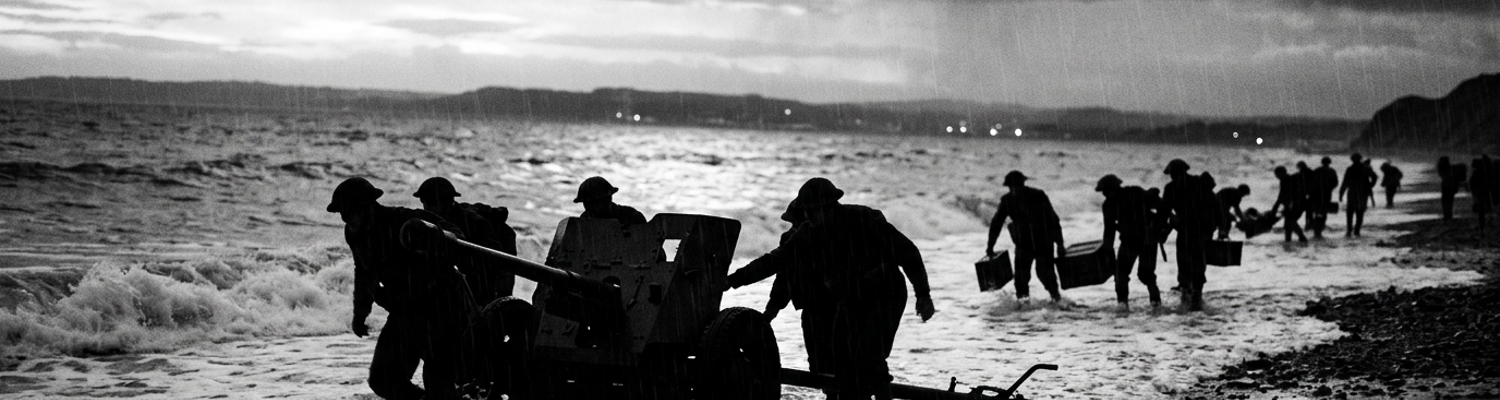

Matanikau Sandspit Perimeter Aftermath
Fifty-four men lay dead or wounded across less than two hundred yards of coral sand. This represented a forty-two percent casualty rate among the leading rifle platoons within forty-five minutes of contact. A close review of operational logs indicates that three of the four 37mm M3 anti-tank guns deployed to the shoreline were disabled or abandoned before mid-afternoon. At the western spit where the Matanikau River enters the ocean, the defensive line ceased to function as a coherent front. Marine riflemen pulled back on their bellies through wet, black volcanic sand. They left heavy equipment, field packs, and spent brass scattered across the surf break. Combat power disintegrated into isolated groups attempting to preserve their remaining ammunition.
Retreat was the only surviving order.
Archival evidence shows that elements of the 5th Marines collapsed back to the eastern bank of the Matanikau River estuary under continuous mortar harassment. Japanese Type 97 81mm smoothbore mortars and Type 89 50mm grenade dischargers had pre-sighted every yard of the open sandbar. These weapons were concealed in fortified log bunkers beneath the palm canopy west of Point Cruz. Platoon leaders from Companies B and C ordered their squads to bound backward in pairs. They used the low berm of the tidal spit for minimal cover against high-angle shrapnel. Shell fragments tore into the shallow brackish water. The metal sliced through canvas web gear and punctured rubberized medical bags. Forward observers lost communication when sound-powered telephone wires were severed by bursting rounds. Portable SCR-536 radio batteries shorted out after immersion in saltwater. Enemy crews walked their impact patterns systematically north along the sandspit to the river mouth. This pinned small groups of infantry against the river channel where the current ran four feet deep. Wounded men were hauled by their combat suspenders across the waist-deep estuary. Their blood washed out into the surf as high-explosive detonations threw columns of mud across the eastern tree line. Company commanders on the eastern bank could not establish coordinated defensive fires. Heavy machine guns had been left without tripods on the far shore.
High-angle explosive fire shredded the timber along the water line.
When examining the historical record, surviving gun crews manned improvised defensive positions along the beachhead immediately following the fighting withdrawal across the sandspit. The 37mm M3 anti-tank gun weighed 912 pounds on its wheeled carriage. It proved unmanageable once its pneumatic tires were shredded by shell fragments and the split trails sank into deep sand. Artillerymen from the 5th Marines weapons detachments abandoned two ruined carriages on the exposed flats. They dragged only the removable breechblocks, firing pins, and optical sights across the estuary to prevent enemy salvage. Once ashore on the eastern beach, these artillerymen took up positions inside washed-out drainage cuts. They sheltered behind fallen coconut trunks fifty yards back from the tide line. The men recovered abandoned M1903 Springfield bolt-action rifles, M1 Garands, and discarded boxes of .30-caliber ammunition from dead infantrymen to establish a stopgap firing line. Working without entrenching tools, the crews scraped shallow rifle pits using their steel helmets and bayonets. They oriented their fields of fire to interlock across the narrow river mouth. This intercepted any follow-up assault by Japanese infantry from the 124th Infantry Regiment. Loaders stacked spare 37mm canister rounds beside a solitary operational gun dug in beneath a palm log revetment. Its barrel was depressed directly toward the open tidal bar.
Two guns remained submerged in the tidal wash.
Intelligence Failures and Japanese Dispositions
Archival evidence shows that division staff planned the offensive across the river mouth using intelligence maps that were weeks out of date.
A close review of operational logs indicates that the 1st Marine Division D-2 intelligence section had repeatedly misidentified the Japanese garrison west of the river. Field reports circulating through the division command post at the Lunga perimeter categorized enemy forces between Point Cruz and Kokumbona as fragmented, demoralized naval construction personnel from the 11th and 13th Labor Units. Division staff assumed these Japanese troops lacked heavy weapons, cohesive leadership, and the will to mount a coordinated defense. The actual defenders dug into the palm groves were frontline combat veterans from the Imperial Japanese Army 124th Infantry Regiment. Colonel Akinosuke Oka commanded this unit. Specialized troops from the Maizuru 4th Special Naval Landing Force reinforced Oka. His riflemen had occupied the jungle ridgelines for days. These troops constructed mutually supporting log bunkers. They established interlocking fields of fire across the sandbar. The engineers built concealed revetments for 70mm Type 92 battalion guns. 5th Marines rifle companies walked directly into pre-registered kill zones manned by disciplined regular infantry.
Division headquarters had completely misjudged the enemy.
When examining the historical record, this intelligence failure stemmed directly from the naval crisis following the Battle of Savo Island on August 9. Rear Admiral Richmond Kelly Turner withdrew Task Force 62 amphibious transports from the coast within thirty hours of the disaster. He sailed south after three American heavy cruisers and one Australian cruiser were sunk in the sound. Vice Admiral Frank Jack Fletcher had already pulled his three aircraft carriers from the area. This removed all tactical air support. This sudden maritime retreat severed the Marine beachhead from naval gunfire assets, coastal surveillance, and maritime resupply. The transport ships departed with half of the division heavy equipment. This included vehicle-mounted communications gear, heavy artillery rounds, and aerial reconnaissance photography equipment. Division personnel possessed neither aerial cameras to survey enemy positions west of the Matanikau nor sound-ranging equipment to pinpoint hidden mortar batteries. Operating in complete isolation, the intelligence staff had to rely on interrogation notes from single captured prisoners and brief patrol sightings through heavy jungle canopy.
Without offshore naval gunfire to suppress the reverse slopes of Point Cruz, 5th Marines commanders dispatched infantry platoons and four-man anti-tank gun sections into an unmapped bottleneck. The M3 37mm anti-tank carriages lacked power-traverse capabilities. They were tethered to narrow coastal tracks by their heavy split trails. The crews could neither spot nor penetrate the reinforced coconut-log emplacements concealed within the tree line. Japanese gunners operating Type 97 81mm smoothbore mortars possessed surveyed firing data for every yard of the exposed sandspit. Marine forward observers lacked both the topographic maps and functional wire lines to call in counter-battery fire from the 11th Marines. Battalion dispatch logs show that Company B commanders requested immediate naval illumination and offshore bombardment three separate times during the afternoon. They received only the flat notification that no ships were present in the sound. The gun crews were left pinned on the tide line with seventy-two pounds of high-explosive canister shot. They fired blindly into camouflaged palm revetments that division intelligence insisted did not exist.
The naval withdrawal left the infantry completely blind.
Surveyed Kill Zones and Estuary Ambush
Zero yards of defilade existed on the exposed spit.
Archival evidence shows that forward rifle elements from 1st Battalion, 5th Marines crossed the sandbar directly into surveyed interlocking fields of fire. The Imperial Japanese Army 124th Infantry Regiment mapped these zones days earlier. Japanese gunners had driven trimmed bamboo aiming stakes into the mudflats along the river mouth. This established fixed traverse limits and exact range increments for their weapons. Three Type 92 7.7mm heavy machine guns fired 13.2-gram steel-jacketed rounds at five hundred shots per minute from reinforced coconut-log pillboxes near Point Cruz. They laid grazing fire eighteen inches above the wet coral sand. Battery crews operating Type 97 81mm smoothbore mortars dropped high-explosive rounds directly onto the waterline using primary data cards recorded during preliminary registration fires. Forward Marine squads from Companies B and C could neither dig into the fluid, waterlogged sediment nor advance past the plunging wall of shrapnel. Fragment patterns burst uniformly at ground level because the wet sand offered no absorption for proximity blast waves. Riflemen attempting to crawl westward found their field jackets shredded by fragments. Saltwater ruined their canvas ammunition bandoliers within minutes. Company dispatch runners attempting to sprint back toward the eastern shoreline fell under continuous sweeps of 7.7mm fire directed from camouflaged embrasures less than one hundred yards away.
The river crossing had been engineered into a pre-sighted kill zone.
A close review of operational logs indicates that the two-gun sections of 37mm M3 anti-tank guns deployed to support the crossing were trapped on the water edge without organic indirect fire support or adequate maneuver room. Attached from the 5th Marines weapons platoon, each four-man gun crew had to manhandle a 912-pound weapon mounted on an M1 carriage across deep, soft volcanic silt without mechanized prime movers. The physical limits of the terrain eliminated tactical movement. To the right lay ocean breakers rolling over sharp coral shelves. To the left stretched an impassable labyrinth of tangled mangrove roots and four-foot-deep stagnant pools. The detachment operated without attached 60mm light mortar teams or direct radio lines to the 11th Marines pack howitzer batteries. The gunners had no way to deploy smoke screen rounds or suppress Japanese machine-gun nests hidden behind deadfall timber. Gun captains ordered their crews to drop the split trails to engage the enemy pillboxes with direct fire. The steel spade plates sank eight inches into the mud. This froze the traversing mechanism. The 37mm tube was strictly an open line-of-sight weapon with a traverse arc of just sixty degrees. It could not pivot toward concealed mortar pits walking high-angle explosive shells across their flanks.
Gunners became static targets while fighting their own equipment.
When examining the historical record, physical failures compounded across both weapon mounts as the Japanese mortar pattern closed within fifteen yards. Shrapnel from an 81mm airburst peppered the shield plates. It shattered the M6 elbow optical gun sights and cut down both loaders. Without spare optics or maintenance kits, surviving crewmen attempted to aim through the open bore. They exposed their faces and torsos directly to 7.7mm grazing fire ricocheting off the bronze gun mantlets. The left pneumatic tire on gun number two burst under fragmentation hits. This dropped the axle into the tidewater and pitched the entire breech assembly thirty degrees to port. Ammunition bearers carrying wooden boxes of thirty-two-ounce high-explosive canister rounds were shot down in the shallows before reaching the guns. Saltwater contaminated the percussion primers on the 37mm brass cartridges. This produced misfires when breechblocks slammed shut against wet chamber walls. Marine officers on the scene recognized that the weapon systems could not displace forward across the channel or withdraw along the narrow sandspit under direct heavy machine-gun tracking. Crews pulled the firing pins. They uncoupled the removable breech mechanisms to drop them into the surf. The men left the twisted steel carriages half-submerged in the falling tide.
The tide submerged the steel frames by dusk.
Mechanical Degradation of M3 Gun Breeches
Archival evidence shows that weapon failures along the eastern riverbank mounted immediately after the withdrawal due to the mechanical sensitivity of the M3 carriage.
Designed for clean European road networks rather than wet coastal mud, the 37mm M3 gun relied on a horizontal sliding wedge breechblock. This component was engineered with machined tolerances under five thousandths of an inch. Weapons detachments dragged their 912-pound carriages through the waist-deep surf of the river mouth. Ocean swells submerged the breech rings. Heavy deposits of pulverized volcanic sand washed directly into the internal guide channels. This sand was composed of angular quartz and magnetite particles common to the Matanikau sandbar. Recoil buffer seals failed under the corrosive wash. Closing springs could not overcome the friction created by this abrasive slurry. The heavy steel wedge jammed along its traverse rails. It seized either partly open or completely fixed in battery. Extractors locked against their retaining cams. Sea salt formed a crust over the percussion firing pins within ninety minutes of exposure.
Brine and volcanic silt converted the precision breech mechanisms into solid blocks of seized metal.
A close review of operational logs indicates that the design of the horizontal sliding wedge left no internal clearance for foreign debris. Gun captains from the 5th Marines weapons platoon tried to force the breech levers shut by pounding the handles with steel helmets. The hardened alloy guideways scored against the receiver housing. This mechanical scoring created burrs that rendered the weapons incapable of chambering the 37x223mmR canister cartridges. Japanese forward observers across the river maintained sporadic mortar fire on the eastern timberline. Crews had to conduct repairs in cramped revetments forty yards behind the water. Platoon commanders faced a breakdown of direct-fire capability along the estuary perimeter. Battery sergeants ordered the complete breakdown of every surviving assembly before corrosion welded the high-carbon steel components together. Marine gunners knocked out the retaining pins. The men pulled the breechblock operating shafts. They unseated the extractor forks using flathead screwdrivers from their M10 roll-up maintenance packs.
Three operational guns on the eastern bank sat stripped to bare receiver rings under the palm trees.
When examining the historical record, Marine crews scrambled through the dusk to flush the abrasive grit from the disassembled components using severely rationed supplies. Rear Admiral Turner naval withdrawal had stranded the division without depot reserves of solvent. Gunners were left with only two-ounce tins of rifle bore cleaner and light preservative lubricating oil carried in their haversacks. Infantrymen donated canteen water to wash coastal silt from the slotted wedge tracks. Swabs of bore cleaner applied with cut-up cotton undershirts followed this to neutralize the acidic saltwater film. Gunners scraped black magnetite sand out of the blind firing-pin wells using bayonet tips and brass wire bore brushes. Chemical bore cleaner stripped the corrosive residue. Supplies ran completely dry before all three breechblocks were cleared. Loaders had to lubricate the sliding tracks with automotive grease scavenged from a stranded amphibian tractor. By nightfall, two guns were reassembled. Manual cycle times remained double the normal rate because sand grains still ground within the spring recesses.
The weapons platoon entered the night with thirty-six rounds of canister ammunition and two functional firing pins.
Field Radio Failures and Commutator Fouling
Archival evidence shows that tactical radio networks across the Matanikau sector collapsed completely within sixty minutes of the opening mortar barrage.
The primary voice transmitters deployed by 1st Battalion, 5th Marines failed due to direct mechanical contamination. These were predominantly SCR-284 receiver-transmitter units and portable SCR-131 sets. Ambient relative humidity along the river reached ninety-four percent by mid-afternoon. This saturated the canvas covers and seeped past rubber gasket seals into the dynamotor housings. This high moisture mixed instantly with airborne volcanic ash and pulverized coral sand whipped up by surf breakers and high-explosive detonations. Severe commutator fouling occurred in tactical radio sets due to high ambient humidity and fine sand particulate intrusion. Sand grains entered the open ventilation ports of the PE-103 dynamotors. They lodged directly between the carbon brushes and copper commutator segments. The armatures spun at over three thousand revolutions per minute to generate high-voltage plate current. The abrasive slurry scored deep radial grooves into the soft copper faces. Friction generated thermal buildup. This melted brush binders and deposited an insulating layer of vitrified silica across the electrical contacts. Transmitters suffered dielectric breakdown. Violent commutator flashovers occurred. Sudden armature short-circuits silenced battalion command nets.
The radios died where they stood.
When examining the historical record, field technicians from the 5th Marines signal detachment found themselves stripped of the basic materials required to restore electrical continuity. Repairmen unscrewed the cast-aluminum casing plates behind the shelter of sandy berms. They discovered commutator segments packed with a greasy paste of copper filings, sea salt, and black magnetite sand. Solvents to degrease the delicate armatures did not exist in forward medical kits or supply packs. Signalmen attempted to dress the gouged copper bars by hand using torn strips of automotive sandpaper and clean dental probes. Microscopic silica grains remained embedded within the mica insulation separating the segments. Hand-cranked GN-45 generators suffered identical breakdowns. Fine beach grit penetrated the unsealed reduction gearboxes. This stripped bronze teeth under the strain of two-man hand operation and locked the crank drives in place. Battalion signal officers reported that five of the six heavy radio sets assigned to the perimeter were entirely dead by 1600 hours. Forward units were unable to receive incoming division traffic.
No voice transmissions crossed the river estuary.
A close review of operational logs indicates that Company commanders relied on surviving wire lines and foot runners to relay urgent situation reports back to division headquarters. Captains from Companies B and C fell back on drum-mounted W-110-B twisted-pair copper-steel wire connected to battery-powered EE-8-A field telephones. Even this system proved highly fragile. Japanese mortar fragments and creeping artillery barrages cut the main coastal trunk line in eleven separate locations between the Matanikau sandspit and the division switchboard at the Lunga River perimeter four miles east. Linemen from the battalion wire section crawled forward on their bellies through drainage cuts under active sniper fire. They searched for severed ends in the mud. Splicing teams stripped wet insulation with pocketknives. They knotted the steel strands to maintain physical tension, twisted the bare copper wires together, and sealed the raw junctions using black friction tape. These hasty splices grounded out whenever rising brackish tide water submerged low-lying sections of the coastal trail. Hand-cranked magneto rings dropped from loud bells to faint clicks. Officers had to shout over static-filled receiver diaphragms to report coordinate shifts and heavy casualty counts.
The final operational link rested on the legs of teenage riflemen.
Battalion officers dispatched two-man teams of foot runners from the sandspit perimeter along the exposed coastal trail. They carried folded carbon-paper situation reports in their greaseproof utility pockets. These messengers had to sprint across four miles of open coconut groves and washed-out coral tracks. They dodged 7.7mm fire from Japanese snipers lashed into the upper fronds of palm trees. Three runners were hit and killed within four hundred yards of leaving the Company B command post. The surviving couriers took fifty-five minutes to reach Major General Alexander Vandegrift headquarters dugout beside the Lunga airstrip. They arrived physically collapsed from heat exhaustion and dehydration. Division operational journals document that the final emergency report reached division commanders three hours after the weapons had already been stripped and dumped into the Matanikau surf. This report detailed the abandonment of the 37mm anti-tank guns and thirty-six Marine casualties.
Lieutenant Colonel William Whaling received the runner dispatch at 1820 hours.
Reorganization of Forward Defensive Outposts
Archival evidence shows that by 1715 hours, company officers consolidated ninety-six surviving effectives from Companies B and C into six improvised defensive nodes along the eastern timberline.
Platoon boundaries vanished during the retreat across the sandspit. Senior non-commissioned officers gathered riflemen who had crawled back without helmets or field equipment. They paired them with intact heavy weapons squads positioned behind coastal deadfall. Each ad hoc rifle squad formed around a single functional Browning M1917A1 .30-caliber water-cooled machine gun or the lone operational 37mm M3 anti-tank gun stationed north of the coastal trail. Gunners stripped fabric ammunition belts from dead water-bearers to feed the two operable tripod-mounted weapons. Riflemen filled empty five-round stripper clips and eight-round en-bloc clips using loose .30-06 ball rounds recovered from flooded wooden supply crates.
Surviving corporals assumed command over mixed eighteen-man groups containing scouts, riflemen, and displaced artillerymen.
A close review of operational logs indicates that the defense anchored itself around two M1917A1 machine guns belonging to the battalion weapons company. These were positioned eighty yards south of the river mouth. Both weapons had sustained cracked water jackets and severed steam condensing tubes during the morning mortar barrages. Gun crews drained brackish water directly from nearby shell craters using discarded mess kits to prevent the barrels from warping under sustained cyclic operation. They poured the gritty liquid straight into the cooling jackets. Loaders used pocketknife blades to pry open damaged cartridge stops. They cleared jammed steel links from the feed blocks before feeding salvaged cloth belts. Riflemen from Company B scraped out two-man rifle pits five paces from the gun tripods. They oriented their M1 Garands to cover dead angles in the mangrove thickets. Squad leaders redistributed seventy-two fragmentation grenades among these perimeter nests. They instructed riflemen to hold fire until targets reached twenty yards.
When examining the historical record, Marine officers recognized that the Japanese 124th Infantry Regiment would exploit the falling tide to cross the river shallows under cover of pitch darkness. Lieutenant Colonel William Whaling and company commanders paced the eastern bank in the fading twilight. They drove split coconut logs and trimmed bamboo stakes into the mudflats forty yards out from the fighting holes. These markers functioned as mechanical traverse limits. Machine gunners rested their barrels against the notched stakes and tightened the brass traversing and elevating handwheels. They locked their fire onto fixed azimuths six inches above the wet sand. Heavy .30-caliber rounds could now sweep the riverbank on fixed grazing trajectories in total darkness without requiring visual acquisition or tracer ammunition that would reveal gun positions.
Officers locked the final protective lines directly across the sandbar.
Battalion dispatch logs indicate that officers deployed three interlocking listening posts fifty yards forward into the tidal marsh to detect preliminary Japanese infiltration. Two-man scout teams crawled through tangled mangrove roots into the black mud. They hauled sound-powered EE-8 telephone wire and unspooled it by hand through the underbrush. Observers secured salvaged ration cans filled with beach pebbles to tripwires strung across natural sand gaps. They designed crude noisemakers to register movement through the surf line. Strict command directives prohibited these forward outposts from firing their M1903 rifles or hurling grenades at passing Japanese reconnaissance squads. The scout pairs maintained contact through hand-cranked telephone handpieces or pre-arranged tugs on bare wire lines. This signaled gun captains to open direct canister fire the moment massed enemy infantry reached the surveyed marker stakes. Marine wire teams completed the final forward outpost fifty yards north of the river spit at 1945 hours.
The perimeter waited in absolute silence.
Emergency Maintenance Protocols
Archival evidence shows that ordnance armorers assigned to the 5th Marines weapons detachment initiated emergency modifications on factory equipment within two hours of establishing the eastern bank positions.
Standard issue M12 canvas muzzle boots and breech covers designed for the 37mm M3 gun possessed loose drawstrings and unsealed seams. These offered no barrier against airborne volcanic grit and salt spray blown off Ironbottom Sound. Fine magnetite particles bypassed these factory gaps. They settled into grease-packed traversing mechanisms and horizontal sliding breech guideways. Gunnery sergeants cut down waterproof rubberized poncho material salvaged from dead infantrymen. They used waxed sailcloth thread and copper wire to bind these synthetic skins directly over the weapon breeches. Field armorers stitched double-layered inner flaps over the exposed traversing handwheels and elevating screw threads. They sealed the raw canvas edges with boiled paraffin scraped from empty C-ration carton liners. Every remaining 37mm carriage along the coastal tree line received these hand-sewn shrouds. They were secured with braided telephone wire to prevent coastal winds from peeling the covers back during overnight tropical downpours.
Factory covers failed in the surf.
A close review of operational logs indicates that division ordnance maintenance ledgers compiled by 1st Marine Division staff documented severe deficits in replacement assemblies that crippled perimeter weapons. Supply manifests showed that transport ships had sailed away with ninety percent of the division depot maintenance packs. Front-line armorers were left with fewer than eight replacement firing pins and four extractor assemblies for every twelve deployed anti-tank guns. Firing pins broke continuously because brittle tool steel shattered under repeated dry-fires while crews desperately tested jammed actions in sandy revetments. Extractor assemblies sustained catastrophic stress when steel extractor forks attempted to yank swollen, brine-pitted 37mm cartridge casings out of unpolished gun chambers. Marine mechanics pulled ruined parts from two disabled guns dragged back from the sandspit. They ground scored extractor claws flat against pocket whetstones and filed salvaged truck bolts down to match the diameter of broken firing pins. These improvised pins lacked proper metallurgical tempering. They deformed after firing five rounds of high-explosive canister shot.
Replacement parts did not exist on the island.
When examining the historical record, ordnance reports recorded an absolute exhaustion of clean lubricant stocks across the entire perimeter by midnight on September 24. Standard Light Preservative Lubricating Oil and chemical bore cleaner had run out across all battalion supply dumps. Weapons personnel were left with zero authorized compounds to flush the acidic brine drying inside the mechanisms. Ordnance personnel confiscated five-gallon cans of heavy sixty-weight motor oil from damaged LVTs belonging to the 1st Amphibian Tractor Battalion. They strained the black sludge through discarded wool socks to filter out metal shavings. Armorers thinned this heavy automotive grease using white aviation gasoline drained from grounded Grumman F4F Wildcats at Henderson Field. This created a volatile liquid bath to scrub corrosion off sliding breech blocks. This improvised mixture evaporated within forty minutes under tropical heat. It left dry metal surfaces exposed to ninety percent relative humidity. Marine gunners resolved the friction problem by rubbing mineral oil drawn from medical corpsman burn kits onto the sliding guide rails. They rationed four ounces of medicinal oil per anti-tank carriage.
Battalion records cataloged forty-one completely dry weapon mechanisms at dawn.
Tactical Doctrine Revisions for Riverline Assaults
Archival evidence shows that by 2200 hours on September 24, division operations officers at the Lunga perimeter command post began drafting urgent tactical memorandums to halt blind riverline assaults.
Working by kerosene lantern inside damp sandbagged bunkers, staff officers from the 1st Marine Division D-3 section dissected the morning debacle along the Matanikau estuary. The typed memorandums condemned company and battalion commanders for committing the 912-pound M3 anti-tank guns to open terrain without prior physical reconnaissance of the opposite bank. Gun crews had been ordered directly onto the soft, tidal spit without preliminary forward scouting patrols verifying whether the Japanese positions west of the river had active defenses or empty trenches. No reconnaissance teams had waded the channel or mapped the dense coconut palm groves east of Point Cruz. The four-man gun detachments had rolled their carriages straight into the surveyed arcs of Imperial Japanese Army Type 92 heavy machine guns. Staff officers noted in carbon-copied field notes that pushing crew-served anti-tank artillery ahead of infantry scouts transformed direct-fire assets into static targets. The memos demanded an immediate ban on advancing anti-tank sections past the friendly front line until ground reconnaissance units visually identified Japanese automatic weapons bunkers, measured river ford depths, and plotted defilade routes through coastal sand.
Heavy anti-tank tubes belonged in defensive overwatch rather than the front ranks of an amphibious river charge.
A close review of operational logs indicates that the D-3 revisions completely overhauled how Marine infantry battalions organized flank security for heavy crew-served weapons during water crossings. Division directives prohibited 37mm gun sections from operating as self-securing tactical units. During the subsequent October offensive across the Matanikau, each individual gun carriage received an attached eight-man security fire team drawn from the parent infantry company. These dedicated riflemen carried M1 Garands, M1918A2 Browning Automatic Rifles, and crates of Mk II fragmentation grenades. Their solitary tactical mission was to suppress close-quarters jungle infiltration, eliminate snipers lashed into the upper palm trees, and secure physical flanks while the artillerymen concentrated entirely on operating the gun controls. Battalion commands also assigned four additional ammunition bearers per gun to handle physical carriage movement across soft sand. This ended the lethal practice of stripping gunners away from the breech mechanisms to manhandle split trails through tidal silt. Rifle company commanders had to sign off on specific perimeter defense plans for each gun pit before artillerymen unlimbered their weapons near the water.
Artillerymen could no longer be asked to fight as assault infantry while servicing jammed breeches.
When examining the historical record, the revised doctrine transformed the fire support architecture for subsequent riverline operations conducted by the 5th and 7th Marines between October 7 and October 9. Marine assaults no longer relied on anti-tank direct fire to break fortified river mouths. Combat plans mandated concentrated indirect mortar preparation before any infantry squad stepped onto the sandbar. Company commanders integrated Company D 81mm M1 mortars alongside platoon-level 60mm M2 mortars into unified fire batteries sited 300 yards behind the river eastern bank. Prior to crossing operations, these tubes expended hundreds of rounds of high-explosive and white phosphorus shells onto Japanese log bunkers on the reverse slopes of Point Cruz and along the river bluffs. Forward observers registered exact grid coordinates with 11th Marines pack howitzers. This created rolling artillery barrages that suppressed Japanese Type 97 mortars while rifle platoons advanced under an overhead screen of high-angle fragmentation. Anti-tank guns were held back in camouflaged revetments on the high ground. They were depressed to fire canister shot strictly across pre-designated defensive kill zones should enemy armor or counterattacking infantry attempt to re-enter the estuary. Battery officers logged two hundred rounds of 37mm canister ammunition stockpiled in dry rear revetments by October 6. The mandated doctrinal shift was complete.