
JANIS 71 Strategic Intelligence and North China Surveys
Steel keels of naval cargo ships ground against the shallow silt bar at the mouth of the Hai River, exposing the severe maritime bottleneck that paralyzed American operations across North China. Transports carrying heavy equipment for the III Amphibious Corps drew over twenty feet of water, making it impossible for fleet auxiliaries to navigate the shoals and reach the inland wharves. Marine commanders asked for additional shallow draft landing craft and lighters to unload their divisions, but Seventh Fleet staff officers held onto motorized barges for their own ship to shore communications. The Joint Intelligence Study Publishing Board compiled JANIS 71 in September 1945 to assess ports, transportation networks, and terrain in Hopeh and Shantung Provinces, providing military planners with detailed surveys of these difficult waters. Bureaucrats and hydrographers from competing service branches had rushed the production of the study during the final weeks of the war, leaving logistics officers to sort through conflicting charts and depth soundings. JANIS 71 detailed extensive damage to regional rail infrastructure and severe silting across Hai River delta anchorages, warning that deep draft transports would remain stranded in outer roadsteads fifteen miles offshore.
Offshore roadsteads forced barges to ferry essential cargo across fifteen miles of open water, struggling to move heavy equipment through the shallow river channel toward the wharves at Tangku. Marine working parties at the docks quickly discovered that landing their equipment on the quays solved only half of their operational crisis, because distributing supplies inland toward Tientsin and Peiping required an intact rail network. Rail lines across Hopeh Province lay in ruins after years of sabotage and neglect, with dynamited bridge spans, stripped rails, and derailed coal wagons blocking the tracks. Army transportation officers demanded sole authority over the repair of the regional lines, sparking bureaucratic resistance from Marine division commanders who refused to let outside staff officers control their direct tactical supply lines. Technicians combed through captured inventories and railway listings in JANIS 71 to locate serviceable locomotives and replacement steel, but administrative disputes between theater commands held up the release of heavy repair gear. Marine mechanics scavenged boiler parts and laid track by hand alongside local civilian crews, trading field rations for timber ties and spikes to keep single track supply runs moving forward.
Supply runs moving forward brought locomotives into ruined transit yards where American troops encountered dangerous illnesses in every rail depot. The intelligence publication warned planners of endemic health hazards throughout North China, explicitly citing high risks of epidemic typhus and cholera. Displaced populations crowded into unheated stations alongside burst water mains and open sewage trenches, creating breeding grounds for body lice and contaminated drinking water. Naval medical authorities wanted to establish strict quarantine perimeters around every railhead and port facility, but tactical commanders rejected the plan because isolating the stations would halt the distribution of food and coal to the cities. Medical corpsmen established makeshift sanitation posts along the tracks, spraying train crews and railroad workers with hand pumped DDT powder to kill lice before typhus could take hold in the ranks. Surgeons distributed water purification tablets and administered cholera inoculations under kerosene lamps in drafty maintenance sheds, battling administrative delays that held up medical shipments out at the offshore anchorages.
Offshore anchorages held crates of vaccine and DDT powder stacked on the rolling decks of naval transports alongside artillery shells and ration boxes. Marine beachmasters at Tangku clashed daily with Seventh Fleet cargo officers over unloading priorities, as naval officers focused on emptying holds rapidly while Marine officers demanded immediate delivery of medicine and track repair tools. Staff officers in Shanghai issued vague guidelines about joint logistics management, leaving field commanders to fight their own bureaucratic battles over fuel allocations, barge schedules, and crane time. Major General Keller Rockey directed his Marine staff to bypass standard naval offloading schedules, assigning armed Marine details to ride the lighters and enforce supply priorities directly at the shipboard cargo nets. Stevedores winched pallets of cholera vaccine and track spikes onto the landing craft and pushed off through the muddy river delta, delivering critical supplies to the waiting railhead at Tangku before winter froze the waterways.
The Port of Tangku Amphibious Supply Bottleneck
Waterways around the Tangku railhead required LSTs and motorized lighters to shoulder the burden of hauling pallets across choppy water, because a shallow bar at the mouth of the Hai River prevented deep draft transports from berthing directly at the port wharves. Heavy open sea swells slammed the landing craft against the iron plates of the cargo ships, forcing hazardous transshipment operations that repeatedly broke mooring lines and tipped supply nets into the sea. Naval transport captains refused to leave the deeper roadstead or risk their hulls in the shifting channel, which compelled the landing craft to make exhausting round trips across the sandbar with exposed decks. Crane operators lowered artillery pieces and ammunition boxes down into the bobbing landing craft, but sudden swells often dropped the smaller vessels out from under the loads and cracked hull timbers. Stevedores lashed drums of aviation gasoline and crates of dry rations directly to the wet steel decking, struggling to balance the weight before setting out toward the river delta. Coxswains steered each wallowing craft toward the river entrance at full engine power, trying to cross the shallow bar before the ebbing tide drained the navigable water beneath their keels.
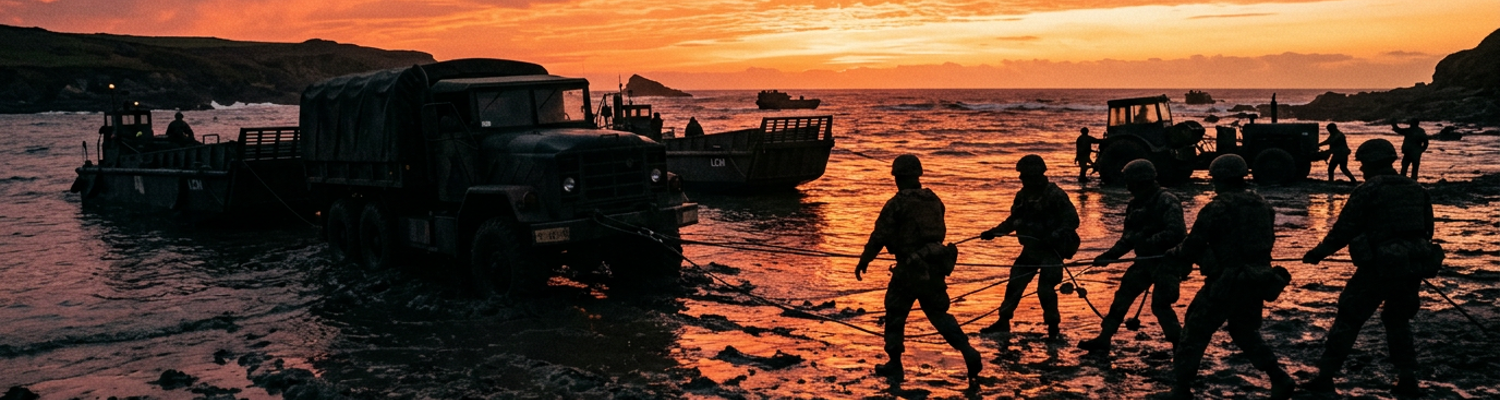
Keels scraping the silt laden tidal flats at Tangku frequently grounded amphibious craft and stranded heavy vehicular equipment during low tides as the river water rushed back out to sea. Blunt bow ramps dropped directly into deep grey mud, dumping six by six cargo trucks, jeeps, and bulldozers onto unstable ground that gave way beneath their tires. Drivers shifted into low gear and hammered their throttles, but the spinning wheels only churned the soft mud into liquid trenches that buried vehicle axles up to the frame rails. Naval beachmasters ordered stranded crews to abandon their stuck trucks so other landing craft could attempt to land, but Marine officers refused to leave their heavy vehicles behind to be drowned by the rising tide. Soldiers and sailors wrestled steel cables around vehicle tow hooks, hooking trucks together in long chains while tractor operators pulled with all their horsepower to drag the equipment onto dry soil. Tide water swamped dozens of waterlogged engines and brake assemblies before the heavy towing winches could drag the final vehicles clear of the mudbanks.
Mudbanks surrounding the pier facilities offered no pre arranged shore party staging areas for the quartermasters of the III Amphibious Corps arriving in late September 1945. American logistics planners had assumed that local Chinese municipal agencies would provide hundreds of dockworkers to unload the incoming vessels, but the docks stood empty and abandoned when the first troop ships arrived. Japanese garrison troops had surrendered administrative control of the waterfront without passing along operational harbor records, leaving warehouses locked and municipal cranes stripped of their electrical cables. Army liaison officers in Tientsin sent no instructions or harbor guides down to the river mouth, leaving Marine quartermasters to secure their own working space through direct confrontations with local officials. Landing craft continued to disgorge thousands of tons of rations, clothing, and small arms ammunition directly onto the narrow stone quays, piling pallets four tiers high until the waterfront became completely impassable.
Impassable waterfronts forced Marine infantrymen to lay down their rifles and pick up cargo hooks, taking over the physical labor of clearing the congested piers after divisional commanders halted tactical training to break the bottleneck. Working parties shoved handcarts through the narrow alleys between supply stacks, loading artillery rounds and winter parkas directly into open railway flatcars that stood waiting on the port spurs. Seventh Fleet beach officers argued with Marine company commanders over the control of the single functioning rail switch, as naval personnel attempted to divert empty freight cars for their own shipboard provisions. Armed Marine sentries took positions along the railroad switches, refusing to allow naval crews to touch the railcars until every pallet of infantry ammunition and medical supplies was loaded. Engineers finally fired the boilers on two captured switch engines, coupling the heavily loaded cars and pushing the supply train westward down the main line toward Tientsin.
Seventh Fleet Unloading Doctrine and Shore Party Breakdowns
Tientsin bound supply trains carried away the only organized shipments to leave the coast, because Seventh Fleet assault transports out in the Bohai Gulf strictly prioritized rapid sea turnaround over orderly cargo handling. Naval task group commanders feared autumn gales and underwater mines in the shallow roadstead, so ship captains ran their deck winches around the clock to empty their holds and clear the combat zone as fast as possible. Lighters and landing craft took on whatever crates came out of the cargo nets first, hauling thousands of tons of mixed, unsorted supplies directly onto the exposed mudbanks along the river mouth instead of staging them by category at proper berths. Sailors dumped heavy pallets of artillery shells right on top of medical gear and vehicle tires, turning the soft tidal flats into sprawling, unorganized dumps. Marine beachmasters waved signal flags and shouted through bullhorns to halt the landing of scrambled cargo, but naval coxswains dropped their ramps, pushed pallets into the silt, and throttled their engines back toward the outer fleet.
Fleet lighters deposited this scrambled cargo onto beaches where the infantrymen who were supposed to provide physical labor were already boarding troop trains for the interior. Marine shore parties were severely depleted because combat battalions were diverted inland to secure Tientsin and Peiping rather than managing dockheads. Major General Keller Rockey and his staff prioritized the tactical race to occupy regional hubs before communist forces could arrive, leaving only small detachments of pioneer troops and motor transport men to handle millions of pounds of incoming equipment with almost no mechanical help. Stretcher bearers, clerks, and cooks found themselves assigned to round the clock stevedore shifts, struggling to drag heavy crates across deep mud without enough tractors or functioning forklifts. Exhausted work details collapsed against supply piles after twelve hour shifts in the damp air, watching fresh flotillas of naval lighters deposit another layer of scrambled crates directly into the shoreline mud.
Mud across the open beaches turned into a waterlogged mess when rainwater began pooling in early October. Unsorted field rations, munitions, and cold weather clothing deteriorated rapidly under heavy autumn rains on the open beaches as cardboard cartons soaked through and broke open in the mud. Waxed ration boxes dissolved into wet pulp, exposing tins of meat and biscuits to salty dampness that ruined thousands of meals. Wool overcoats, blankets, and fleece lined parkas soaked up dirty runoff, doubling their weight and rotting along their seams before quartermasters could even log them into supply ledgers. Dampness seeped into wooden ammunition crates stacked alongside the rotting clothing, corroding brass shell casings and fouling delicate fuses that infantry units needed for defensive positions along the rail lines.
Rail line defensive positions required quartermasters to search through the waterlogged heaps with flashlights and crowbars, trying to salvage ruined uniforms and dry munitions before the approaching North China winter froze the mud solid. Navy cargo officers ignored requests to send waterproof canvas covers ashore, insisting that fleet doctrine required every transport to dump its remaining tonnage on the mudbanks before returning to open waters. Marine captains posted armed sentries along the water line to stop landing craft coxswains from dropping further mixed cargo, forcing naval crews to hold their craft in the surf until specific pallets could be sorted. Work gangs threw wooden planks across the mud to build makeshift walkways, rolling intact barrels of fuel to higher ground while abandoned winter coats sank deeper into the shoreline silt.
Command Authority Conflicts Between Wedemeyer and Rockey
Silt covered fuel drums rolled directly from those timber walkways into the cargo beds of idling six by six trucks as Marine drivers prepared to haul supplies inland under conflicting directives from rival headquarters. Lieutenant General Albert C. Wedemeyer of Army China Theater headquarters held strategic command over ground occupation tasks while Major General Keller E. Rockey remained in the naval chain of command. Wedemeyer directed III Amphibious Corps to prioritize Nationalist Chinese government stabilization and the repatriation of surrendered Japanese forces. This expansive mandate required Rockey to push his combat divisions far beyond the shoreline, dispatching regiments to secure the sprawling urban centers of Tientsin and Peiping while posting garrison troops along vital coal corridors. Naval task force commanders warned that scattering combat troops across hundreds of miles of Chinese territory created an indefensible logistical corridor that fleet transports could not protect.
Fleet transports required secure coastal enclaves, prompting admirals commanding the Seventh Fleet to pressure Marine units to limit inland logistical exposure. Naval planners insisted that the III Amphibious Corps should concentrate its battalions near the deep water ports of Tangku and Tsingtao, where fleet guns could cover their perimeter and maritime supply lines remained intact. Admiral Thomas C. Kinkaid and his staff argued that defending exposed railroad tracks deep in the interior was not a proper naval mission, especially when regional communist armies were cutting telegraph lines and blowing up bridges. Rockey was trapped between opposing service philosophies, as Army headquarters in Chungking evaluated success by how far American troops pushed inland to restore order, while naval headquarters in Shanghai evaluated success by how safely the fleet guarded its coastal footholds. Marine staff officers received sharply conflicting orders on the same day, forcing them to guess whether their cargo trucks should haul rations to coastal port garrisons or load ammunition onto trains bound for distant Peiping.
Trains bound for distant Peiping steamed out of the Tientsin yards carrying Marine security detachments and crates of rifle ammunition under direct orders from Wedemeyer. Army staff officers insisted that stabilizing regional governance required III Amphibious Corps to protect coal shipments from the Kailan mines and clear the tracks for Nationalist troop movements. These long distance railway patrols forced Rockey to establish isolated company outposts at water towers, bridges, and switching yards over a three hundred mile network. Seventh Fleet commanders protested this dispersal by refusing to assign naval beach parties or harbor craft to support the inland supply depots, arguing that naval assets could not be squandered on inland railroad defense. Marine rifle companies found themselves holding lonely railway stations with only a three day reserve of C rations, relying on civilian telegraph wires that sabotage squads frequently cut in the dark.
Telegraph wires cut in the dark forced Rockey to dispatch armed scout cars and radio equipped jeeps along the trackside dirt roads so those isolated station garrisons would not be cut off without emergency food or ammunition. Marine mechanics welded heavy steel plating onto open railroad flatcars and mounted air cooled machine guns, creating improvised armored trains to defend the tracks against guerrilla ambushes. Wedemeyer continued to issue urgent operational directives from Shanghai, demanding that Rockey disarm and repatriate hundreds of thousands of Japanese troops who were still concentrated in the interior cities. Seventh Fleet transport captains accepted the surrendered Japanese personnel at the coastal wharves, but naval officers refused to allocate truck tires, vehicle spare parts, or railway tools to the Marine quartermasters keeping the trains running. Marine work crews had to strip captured Japanese ordnance depots and forge their own replacement parts in local rail yards to maintain the locomotives hauling the occupation forces.
Peiping Mukden Railway Rehabilitation and Coal Convoy Operations
Locomotives hauling the occupation forces required machinists to bolt salvaged iron castings onto worn boilers so Marines could assume logistical control of the Peiping Mukden Railway to transport essential coal supplies from the Kailan Mining Administration pits at Tangshan. Millions of civilians and vital municipal utilities in Tientsin, Peiping, and Shanghai faced imminent collapse as freezing weather approached without adequate fuel reserves. Kailan coal powered city waterworks, municipal electric grids, and the fleet auxiliaries anchored off the coast, making regular train movements across eastern Hopeh Province a matter of strategic survival. Communist forces and local bandits constantly threatened the single track corridor, tearing up iron rails, dynamiting culverts, and firing at passing rolling stock from trackside villages. Major General Rockey ordered the 7th Marines to secure the right of way, establishing heavily fortified garrisons at switching yards, pump houses, and river bridges between Tangku and Chinwangtao. Unescorted freight trains quickly became favorite targets for guerrilla ambushes, as enemy snipers zeroed in on the exposed engine cabs to disable civilian drivers and halt the coal traffic.
Coal traffic required Marine quartermasters to improvise rolling stock by outfitting flatcars with sandbags, machine guns, and 37mm antitank guns to secure train crews. Work parties stacked double rows of burlap sandbags along the outer edges of low sided timber gondolas to build protective parapets against rifle bullets. Armorers mounted .30 caliber and water cooled .50 caliber machine guns on welded steel pedestals at the corners, while artillerymen lashed 37mm antitank guns to the wooden floorboards to blast trackside roadblocks and fortified ambush positions. Technicians coupled these armored battle wagons directly ahead of the steam engines and behind the tenders, shielding the locomotives and detonating primitive pressure mines before the heavier cars reached weakened ties. Riflemen from the 1st Marine Division stood guard behind the sandbags in biting wind, scanning railroad embankments and spraying automatic fire into roadside ditches whenever muzzle flashes appeared. Engineers laid heavy steel boilerplate over the locomotive cabs and tender boxes, protecting civilian firemen who otherwise refused to shovel coal into the fireboxes while traveling through contested territory.
Contested territory operations brought these reinforced engines into municipal yards where daily routines quickly bogged down in administrative friction. Administrative disputes between Marine officers and Chinese railway personnel frequently stalled locomotive maintenance and fuel distributions. Nationalist administrators insisted on retaining sovereign control over engine dispatching, ticket collections, and workshop repair bays, refusing to recognize American operational directives without clearance from distant transport ministries. Quartermasters from III Amphibious Corps discovered that local officials regularly siphoned high grade steaming coal away from frontline locomotives and diverted lubricated machine parts to commercial black markets. Marine mechanics tried to service damaged boilers themselves, but Chinese shop foremen locked tool cribs, hid technical diagrams, and ordered yard machinists to walk off the job. Trains loaded with thousands of tons of Kailan coal sat idle on siding tracks for days while officers argued in station offices over signed authorizations, coal rationing stamps, and roundhouse priority.
Roundhouse priority disputes ended when Marine guards broke through this administrative gridlock by taking direct physical control of the track switches and coal bunkers. Logistics officers placed armed sentries at every water tower, coaling trestle, and maintenance shop along the Peiping Mukden line, forcing local yard crews to fuel and service the locomotives on military schedules. Pioneer battalions laid emergency bypass tracks around sabotaged junctions and kept repair trains steaming immediately behind each coal convoy with replacement ties and fresh ballast. Convoys of up to forty coal cars moved north and south under constant armed escort, delivering over twenty thousand tons of Kailan fuel each week into Tientsin and the waiting coastal colliers at Chinwangtao. Long lines of hopper cars rolled into the central freight depots, where work gangs coupled them to switching engines for immediate routing across regional spurs. Shovel crews emptied the arriving hoppers directly into the boiler bunkers of municipal power stations, keeping the electrical generators spinning and water pumping through the freezing coastal plain.
Typhus Cholera and Environmental Hazards in Hopeh Province
Water pumping through cracked city mains immediately threatened occupation forces with lethal waterborne diseases, because raw sewage and agricultural runoff had thoroughly fouled municipal reservoirs throughout Hopeh Province. Widespread contamination of regional water supplies forced logistical sections to establish extensive chlorination and distillation plants along the riverbanks and railroad sidings. Marine engineers unpacked mobile purification units, but Seventh Fleet officers refused to release sufficient replacement filter chemicals and spare boiler tubes from naval cargo ships at Tangku. Navy doctors claimed that shore garrisons were wasting critical fleet chemical reserves on Chinese municipal waterworks instead of reserving them for naval vessels. Quartermasters from the 1st Marine Division worked around the naval supply blockades by commandeering industrial distillation tanks from abandoned Japanese breweries and running them with Kailan coal. Technicians tested water samples every hour, dosing millions of gallons of river water with heavy calcium hypochlorite solutions before tank trucks hauled the treated water to forward rifle companies along the rail corridors.
Rail corridors received these tank trucks unloading treated water directly into massive crowds of refugees who were suffering from epidemic typhus. Corps sanitation units conducted widespread DDT dusting operations across civilian and military marshaling points to suppress lice borne typhus vectors. Marine medical teams rigged gasoline powered blowers and hand cranked duster guns to blow ten percent DDT powder down the collars, sleeves, and waistbands of thousands of rail passengers every day. Army theater headquarters ordered the Marines to sanitize every civilian entering the Peiping and Tientsin rail terminals, but Seventh Fleet medical purveyors delayed shipments of insecticide refills to shore units. Navy administrators argued that Marine corpsmen were depleting theater chemical stockpiles without proper joint inventory vouchers. Medical officers ignored the administrative protests and seized drums of chemical powder directly from the coastal docks, dusting every train car, freight shed, and barracks building to halt the spread of typhus through the occupation zone.
Occupation zone barracks buildings and freight sheds offered very little shelter when Siberian gales swept across Hopeh Province in late October, driving temperatures far below freezing overnight. Rapid drops in autumn temperatures strained supply chains that lacked sufficient stocks of winter parkas and arctic lubricants. Marine riflemen posted along exposed railroad embankments stood guard in summer dungarees and light wool flannel shirts because assault transports had left heavier cold weather clothing sitting on wharves in the South Pacific. Seventh Fleet cargo managers refused to give priority space to winter gear shipments from supply bases in the Marianas, insisting that fleet fuel oil and ammunition occupied all available hold tonnage. Standard vehicle grease froze into stiff paste inside truck differentials, while engine oil congealed in the crankcases of patrol jeeps and weapon carriers. Mechanics stripped oil pans from stalled transport trucks to build wood fires underneath the engine blocks, warming the congealed fluid enough to crank the starter motors.
Starter motors whined and battery plates cracked across the frozen maintenance parks as drivers struggled to keep supply convoys rolling toward Peiping. Marine motor transport officers requested emergency allocations of sub zero oils and heavy parkas from Army depots in Shanghai, but Army quartermasters refused to issue supplies without written authorizations from Wedemeyer and his personal staff. Supply sergeants resolved the deadlock by trading Japanese swords and captured pistols to Army airfield personnel in exchange for surplus wool blankets, sheepskin flight coats, and hydraulic fluid. Machine shop crews blended aviation gasoline into regular transmission lubricants to prevent truck gears from locking up along the icy trackside dirt roads. Marine patrols wrapped their rifle receivers in burlap strips and smeared kerosene on breech blocks to keep their weapons firing during nighttime guerrilla attacks. Convoy commanders dispatched heavily loaded six by six trucks out into the blinding dust storms, delivering chlorinated water and medical crates to isolated garrisons along the frozen Peiping corridor.
Guerrilla Interdiction Along the Kailan Mining Rail Network
Corridor garrisons unloaded these crates under constant sniper fire as Eighth Route Army guerrilla units systematically demolished rail culverts, pulled track, and ambushed isolated Marine coal trains. Communist saboteurs struck primarily during nocturnal raids, using heavy crowbars and sledgehammers to pry up iron rails, loosen tie plates, and detonate black powder charges beneath stone culverts. Derailed coal trains blocked the single track for days at a time, leaving steam engines stranded in rural cuts while repair crews fought off automatic rifle fire from nearby villages. Guerrilla riflemen dug fighting positions into the frozen mud beside the roadbed, waiting for armored gondolas to pass before detonating buried artillery shells directly under the coal tenders. Marine guards fired back from behind their sandbag parapets, spraying ditch banks with water cooled machine guns and keeping the attackers from overrunning the disabled engines.
Disabled engines sat on the tracks while Marine tactical commanders operated under strict theater level rules of engagement that prohibited retaliatory offensive operations far from the rail embankments. Army theater staff officers in Shanghai insisted that American forces remain strictly neutral in the escalating civil war between Chinese Nationalists and Communists. Battalion officers repeatedly asked for permission to sweep trackside villages and hunt down the mortar crews that shelled their station compounds, but theater orders strictly confined American weapons to immediate defensive fire within a few hundred yards of the ballast line. Guerrilla bands exploited these political restrictions by setting up firing positions just beyond the designated boundary, lobbing mortar rounds into Marine outposts and melting back into the countryside without fear of counterattack. Patrol leaders had to watch armed partisan units withdraw in broad daylight across open terrain, unable to call in air strikes or pursue the raiders past the rail right of way.
Right of way restrictions left locomotives standing idle on siding tracks as interrupted rail schedules repeatedly cut off fuel deliveries to Tientsin and Peiping, threatening civilian power generation and provoking urban civil unrest. Coal stockpiles at municipal utility plants plummeted to critical levels within days of each rail break, forcing city engineers to shut down electric dynamos and ration drinking water across freezing metropolitan districts. Cold and hungry factory workers poured into the streets of Peiping to protest soaring black market fuel prices, clashing violently with Nationalist police and surrounding American administrative headquarters. Municipal hospitals lost heat as steam pipes went cold, while water pumping stations across Tientsin ceased operating whenever sabotaged tracks halted the hopper cars at rural sidings. Major General Rockey responded by stripping rear echelon units of riflemen and doubling the armed guards on every outbound work train, ordering his engineers to weld heavier armor plates over the locomotive cabs and clear the tracks at gunpoint.
III Amphibious Corps Quartermaster Overhaul and Resolution
Tracks cleared at gunpoint allowed trains to reach regional terminals where organizational confusion continued to choke the supply lines. Supply officers had scattered ammunition, replacement tires, and field medical kits across disconnected warehouse buildings throughout the city, leaving depot clerks unable to locate critical equipment when forward garrisons came under mortar attack. Communication breakdowns between combat regiments and supply echelons meant that empty freight cars frequently sat on sidings while rifle companies fifty miles away ran short of drinking water and rifle ammunition. Major General Rockey consolidated corps logistical operations, establishing centralized depot storage and rail movement control headquarters in Tientsin. Marine quartermasters took over the massive former Japanese warehouse complexes near the central railway junction, assigning dedicated sheds for rations, vehicle parts, and communications wire. Train dispatchers and corps logistics officers worked side by side inside the new movement control center, plotting every railcar journey on wall sized track diagrams and matching engine schedules directly to depot loading docks.
Depot loading docks remained empty because dispatchers inside the movement control center soon discovered that incoming trains arrived half empty from the coast. Seventh Fleet transport captains continued to rush their deck winches, dumping mixed crates of tank ammunition, canned meat, and office desks onto the muddy waterfront so their ships could weigh anchor and return to open water. Coastal mudbanks filled with waterlogged containers that blocked the railway sidings, preventing trains from loading essential winter gear. Logistical liaisons instituted standardized manifest verification at Tangku to halt uncoordinated cargo dumping by Seventh Fleet ships. Marine inspectors climbed aboard arriving fleet lighters with clipboards and tally sheets, refusing to let naval working parties drop their ramps until every crate matched an authorized bill of lading. Navy deck officers protested the delays and accused the Marines of obstructing naval turnaround doctrine, but the inspectors held their ground until cargo handlers sorted crates into designated staging bays according to corps priority tags.
Corps priority tags tied to each pallet directed cargo handlers to shift the sorted crates from the wet docks to covered freight platforms where organized labor was desperately needed. Marine quartermasters resolved the chronic waterfront manpower shortage by hiring thousands of unemployed Chinese dockers and displaced railway workers to form organized civilian labor battalions. Logisticians issued daily grain rations, heavy quilted coats, and reliable cash wages to each worker, securing the cooperation of local union leaders who had previously refused to assist Nationalist or naval authorities. Labor squads worked under the supervision of Marine noncommissioned officers, operating hand winches, pushing heavy carts across timber gangways, and restacking cargo to clear the jammed pier aprons. Shovel crews cleared snow and coal dust from the rail switches, while repair teams patched leaky boxcar roofs with tar paper to protect flour sacks and medical boxes from rain and winter moisture.
Winter moisture could not penetrate the boxcar roofs covered in fresh tar paper, keeping the dry provisions intact as train crews coupled long lines of freight cars to armored locomotives for scheduled departures into the interior. Regulated rail convoys and organized civilian labor battalions stabilized the flow of critical rations and coal across North China by early 1946. Marine sentries manned water cooled machine guns mounted inside sandbagged gondola cars, while scout engines steamed ahead of every convoy to detect torn tracks and detonated culverts before heavy freight trains could derail. Trains departed on rigid timetables coordinated with the Tientsin movement control center, delivering thousands of tons of Kailan coal directly to municipal power plants and distributing field rations to isolated garrison outposts along the rail corridor. Locomotive whistles echoed across the freezing plains of Hopeh Province as coal fired boilers kept city lights burning, civilian water pumps running, and American occupation regiments fed and fueled through the coldest months of the deployment.