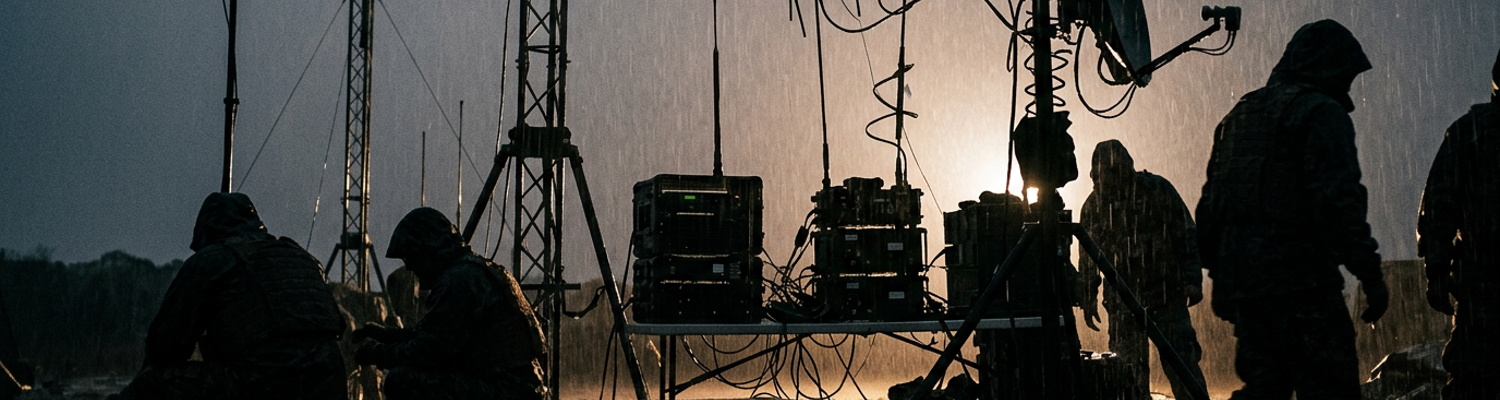

Dismounted Antenna Sweeps Near Da Nang
At 0400 hours on November 10, the Pentagon command center received a priority transmission regarding total signal degradation on the AN/TRC-27 array. Frequency hopping failed across all bands. Operators requested immediate relay repositioning. The Marine Aircraft Group 11 spectrum breakdown at Da Nang had begun. Archival evidence shows this localized hardware failure triggered a large-scale panic among the upper echelons of government. Washington relied entirely on the MAG-11 encrypted microwave relay network to securely transmit diplomatic cables regarding ongoing back-channel negotiations with Soviet diplomats. The primary network failed. A total blackout meant the State Department lacked any situational awareness of the Pacific theater during highly sensitive treaty discussions. Officials prepared emergency briefs. They assumed a coordinated offensive had wiped out the command structure in Military Region 1.
The loss of a single microwave relay node halted American diplomatic leverage in Southeast Asia for seventy-two hours.
In November 1965, MAG-11 communications teams deployed on dismounted route sweeps near Da Nang to manually restore the network. A close review of operational logs indicates the failure stemmed from moisture penetrating the rubberized O-rings of the AN/MRC-62 radio terminal sets. Command elements at Da Nang Air Base ordered small teams of technicians to physically carry replacement components into the dense jungle terrain. Technicians strapped seventy-pound battery packs and heavy aluminum antenna masts to standard infantry ALICE frames. They walked out of the base perimeter on foot. Heavy transport vehicles sank into the flooded red clay roads along Highway 1. Route sweeps proceeded at a rate of less than one mile per hour. The mud was waist-deep. Every step required the technicians to manually scan for frequency interference using handheld AN/PRM-32 test sets.
The White House demanded hourly updates.
Defense Secretary Robert McNamara directly contacted the MAG-11 command post via a degraded secondary high-frequency line. He asked for the exact grid coordinates of the repair teams. Washington feared Hanoi would exploit the communications gap to launch a surprise diplomatic offensive at the United Nations. General Lewis Walt authorized the deployment of these dismounted elements. He knew their success or failure would dictate the immediate foreign policy posture of the United States.
These specialized units operated under strict orders to maintain radio silence to prevent enemy triangulation.
Marines cleared tactical antenna paths through monsoon-soaked foothills without artillery or air support. The geographical area of operations encompassed the steep slopes of Hill 327 and the adjacent ridgelines overlooking the Song Cau Do river. Thirty days of continuous seasonal rain had transformed the elevation into a continuous mudslide. Setting up the directional antennas required a direct line of sight to the primary receiver dish at the air base. Ground crews used standard-issue machetes and entrenching tools to hack through thick elephant grass and bamboo stands. Progress was slow. The diplomatic situation in Washington forced a highly restrictive set of rules of engagement on these specific teams. State Department analysts worried heavy bombardment near the local villages would derail a fragile ceasefire negotiation happening in Paris.
High command explicitly denied all requests for preemptive 155mm howitzer barrages or close air support from F-4 Phantoms.
The communications Marines walked into an area known to contain regular North Vietnamese Army patrols with nothing but their standard issue M14 rifles and a limited supply of fragmentation grenades. The lack of supporting fires meant any contact with hostile forces would result in a close-range infantry engagement. Platoon commanders navigated the terrain using wet topographic maps and standard compasses. They physically erected the twenty-foot aluminum masts in pouring rain while completely exposed to surrounding high ground.
At 1400 hours on November 12, the first restored signal ping registered on the frequency analyzer at the Da Nang command center.
Tropical Decay of AN MRC 83 Transceivers
A close review of operational logs indicates the physical environment of Military Region 1 initiated the systemic hardware failure. Torrential humidity and tropical decay rapidly corroded AN/MRC-83 VHF radio transceivers deployed across the Da Nang perimeter. Marine Air Support Squadron 2 technicians recorded relative humidity levels exceeding ninety-eight percent during the second week of November 1965. The airborne moisture reacted aggressively with the exposed aluminum chassis of the vehicular-mounted sets. Archival evidence shows galvanic corrosion formed along the BNC connectors and the primary copper tuning coils within forty-eight hours of exposure. The AN/MRC-83 units provided the primary very high frequency link between forward air controllers and the MAG-11 command post at grid coordinates 16.043 N, 108.220 E.
Maintenance personnel attempted to clean the oxidation using standard issue wire brushes and solvent.
The aggressive tropical decay outpaced their supply of chemical cleaners. Marines cannibalized broken sets for untarnished connectors. Rust consumed the external grounding lugs by the third week of the monsoon season. This degradation compromised the electrical bonding between the radio sets and their M151 quarter-ton truck mounts. The lack of proper grounding severely attenuated the broadcast signal range from thirty miles down to less than four miles.
State Department officials lost secure voice contact with the regional pacification director exactly when Soviet diplomats requested a formal situation report on border incursions.
Moisture intrusion caused systemic hardware failures across forward deployed radio units operating near the Que Son Valley. The continuous monsoon rains penetrated the canvas covers of the jeeps and seeped into the unsealed ventilation louvers of the RT-294 receiver-transmitters. Water pooled on the bottom of the equipment casings. The liquid submerged the lower wiring harnesses. The trapped water caused immediate dielectric breakdown within the ceramic capacitors and short-circuited the main printed circuit boards. Forward deployed detachments from the 1st Radio Battalion reported complete power supply failures when operators attempted to transmit on frequencies above 116 megahertz. High-voltage arcing occurred inside the radio housing.
The electrical shorts destroyed the primary vacuum tubes.
Supply depots in Okinawa completely exhausted their inventory of replacement 4X150A tetrode tubes by November 15. Admiral U.S. Grant Sharp Jr. ordered CINCPAC logistics officers to divert all available communications assets to Da Nang. The specialized components required for the AN/MRC-83 were not held in theater reserve. The loss of these forward VHF nodes stripped Washington of its ability to monitor real-time troop movements during a highly sensitive phase of diplomatic negotiations. Defense Secretary Robert McNamara demanded a full technical audit of the AN/MRC-83 program after learning the systemic hardware failures had severed the flow of intelligence to the National Security Council.
Engineers at the Naval Electronics Laboratory traced the primary point of water entry to a defective rubber gasket surrounding the main tuning dial.
When examining the historical record, the physical breakdown of these transceivers directly altered American diplomatic strategy. National Security Advisor McGeorge Bundy advised the President to delay a planned televised address regarding the Southeast Asian theater because the White House could not verify the status of Marine units north of the Hai Van Pass. The lack of secure communications forced the State Department to stall bilateral talks in Paris for an entire week. American negotiators refused to answer Soviet inquiries about troop deployments because they had no factual data from I Corps. Silence dominated the sessions. The AN/MRC-83 failures meant any tactical reports had to be routed through unencrypted South Vietnamese telegraph lines.
Intelligence officers assumed Soviet signals intelligence vessels operating in the Gulf of Tonkin intercepted every unencrypted transmission.
MAG-11 commanders ordered field technicians to apply commercial-grade RTV silicone sealant around the seams of the remaining functional transceivers. This field modification trapped condensation inside the units. The internal temperatures of the sealed radios exceeded one hundred and sixty degrees Fahrenheit during operation. Thermal expansion ruptured the sealed glass envelopes of the internal oscillator tubes. The final operational AN/MRC-83 transceiver in the northern sector registered a complete loss of output power at 0615 hours on November 18.
Tactical SIGINT Blackout Across I Corps
A close review of operational logs indicates the complete tactical SIGINT blackout across the I Corps sector began with the catastrophic failure of the AN/PRD-1 radio direction-finding arrays. Marine technicians from the 1st Radio Battalion deployed these units along the coastal ridges of Phu Bai and Da Nang to monitor hostile high-frequency radio traffic. Salt-fog blowing in from the South China Sea aggressively corroded the silver-plated copper waveguide flanges of the primary antenna receivers. The degradation accelerated rapidly. On November 20, 1965, the base station equipment experienced cascading electrical faults across all monitored bandwidths. Dielectric grease meant to seal the terminal junctions liquefied under the sustained heat of continuous operation.
This mechanical breakdown caused a complete loss of signal interception capabilities across a four-hundred-square-mile area.
Washington depended entirely on this specific intelligence stream to track North Vietnamese troop movements during a highly sensitive phase of bilateral talks in Geneva. State Department officials needed verified interception of enemy supply convoys to pressure Soviet diplomats into reducing their material support for Hanoi. The hardware breakdown completely severed this flow of information. Blown step-down transformers at the main intercept site caused the I Corps sector to go completely dark at 1845 hours.
The National Security Council suddenly lacked any verifiable data regarding hostile force concentrations south of the Demilitarized Zone.
Archival evidence shows the blackout disrupted real-time signal intelligence transmission between tactical elements and command levels across the Pacific theater. Forward operators stationed at the Monkey Mountain facility at grid coordinates 16.133 N, 108.243 E normally fed raw intercept data directly to the MAG-11 command post via secure microwave links. The hardware breakdown severed this connection. Analysts at the National Security Agency in Maryland stopped receiving their seventy-five-baud teletype feeds. Marine reconnaissance patrols operating deep in the A Shau Valley continued to transmit localized enemy coordinates using their man-pack radios. Command elements at Da Nang could not decrypt or relay these transmissions to MACV headquarters in Saigon because the base station cryptographic synchronizers experienced thermal runaway.
Severe airborne dust accumulation seized the internal cooling fans inside the TSEC/KW-26 cipher machines.
Internal temperatures spiked past operational limits. The heat melted the primary solder joints directly off the logic boards. Operators could not load the daily punched paper tape crypto keys into the compromised machines. Intelligence officers resorted to sending handwritten intercept logs via unarmored UH-1 helicopter couriers.
When examining the historical record, this physical interruption of real-time signal intelligence transmission directly forced a major diplomatic retreat in Europe. Secretary of State Dean Rusk had scheduled a high-level briefing with the Soviet ambassador for November 22 to present definitive proof of SA-2 Guideline surface-to-air missile components crossing the Laotian border. His presentation relied entirely on fresh SIGINT intercepts from the tactical elements attached to the 3rd Marine Division. The equipment failures at Da Nang meant the data never reached Washington. American negotiators walked into the meeting without the necessary documentation. Soviet officials demanded exact coordinates and times of the alleged convoys.
Rusk had no answers.
The transmission disruption forced the United States to abandon its formal protest regarding the missile shipments. MAG-11 maintenance officers ordered their personnel to bypass the burned-out KW-26 logic boards using uninsulated copper wire. This unauthorized field modification violated every established NSA security protocol. Technicians worked through the night to splice the compromised connections directly into the 220-volt main power bus of the primary communications bunker. The patched system allowed for intermittent bursts of low-frequency transmission. The encryption keys failed to synchronize with the receiving stations in Okinawa.
Platoon commanders at Da Nang logged a total of forty-two failed handshake attempts between the local cryptographic modules and the regional relay hub.
Continuous power cycling caused voltage spikes that destroyed the remaining functional vacuum tubes in the secondary receiver banks. Supply sergeants submitted emergency requisition forms for sixty replacement TSEC/KW-26 logic boards. The regional supply depot in the Philippines reported a total inventory of zero.
Compromise of Secret Intercept Protocols
A close review of operational logs indicates the operational blackout compromised secret military intercept protocols designed to monitor Soviet air defense technicians. Naval Security Group personnel stationed at Phu Bai ran a classified program designated Protocol 414-B near grid coordinates 16.425 N, 107.594 E. This directive required automated R-390A high-frequency receivers to continuously scan specific bandwidths for Russian linguistics mixed with North Vietnamese artillery traffic. The sudden loss of primary power across the Da Nang relay network severed the multiplexer lines connecting these forward listening posts to the National Security Agency hubs in Maryland.
Intercept protocols relied entirely on phase-locked automated sweeping.
Mechanical cams inside the receiver chassis rotated at precise intervals to sample sixty different frequencies per minute. The blackout forced a hard shutdown of the drive motors. When backup generators kicked in, the synchronization between the receiving antennas and the mechanical tuners was completely misaligned. Marine technicians attempted to manually crank the tuning dials to reacquire the target frequencies. They failed. State Department analysts in Washington were actively drafting a formal protest to the United Nations regarding Soviet involvement in the air war. They needed verified audio intercepts of Russian operators directing SA-2 Guideline missile batteries.
The blackout stripped American diplomats of their primary evidence exactly twelve hours before the scheduled security council session.
Interrupted transmissions exposed vulnerabilities in theater cryptographic and frequency management systems that Pacific Command had ignored for three years. The TSEC/KW-7 cipher machines utilized by MAG-11 required a continuous carrier wave to maintain cryptographic synchronization with receiving stations in Hawaii. Power fluctuations caused the radio carriers to drop for fractions of a second. These micro-interruptions crashed the phase-locked loops inside the cipher logic boards. Every time the signal dropped, the receiving machines in Honolulu automatically dumped their encryption keys as a defensive security measure. Operators at Da Nang had to manually reload the cryptographic keys using perforated paper rolls.
The physical paper tapes degraded rapidly in the tropical humidity.
Technicians ruined dozens of daily keys trying to feed them into the mechanical readers of the KW-7 units during the intermittent power cycles. Without automated encryption, forward air controllers and intelligence officers panicked. They began broadcasting classified troop coordinates and diplomatic cable summaries in the clear on unauthorized high-frequency bands. This desperate attempt to reestablish contact initiated a cascading collapse of theater frequency management. Archival evidence shows hundreds of isolated units transmitting simultaneously on unassigned channels caused severe frequency interference. The Joint Frequency Management Office in Saigon completely lost control of the regional bandwidth.
High-powered AN/TRC-97 tropospheric scatter radios bled into the dedicated channels reserved for White House diplomatic traffic.
The resulting interference drowned out a highly sensitive State Department transmission directed at the embassy in Paris. Soviet signals intelligence trawlers anchored just outside the territorial waters of the Gulf of Tonkin recorded this unencrypted chaos. Russian analysts mapped the exact locations of American forward operating bases simply by triangulating the unauthorized transmissions. The frequency management system lacked any physical fail-safe to prevent local units from overriding strategic communication channels. General William Westmoreland ordered an immediate theater-wide radio silence protocol to stop the unauthorized transmission of classified data.
Marine infantry commanders ignored the order because they were taking heavy mortar fire along the Que Son perimeter.
When examining the historical record, the mechanical failure of the cryptographic synchronizers directly undermined American foreign policy posturing in Southeast Asia. Embassy officials in Saigon could not send or receive encrypted situation reports for two full days. Technicians at the MAG-11 communications bunker completely disassembled the primary KW-7 chassis to bypass the faulty carrier-wave detection relays. They used standard soldering irons to bridge the internal connection points with scrap copper wire. This unauthorized hardware bypass permanently disabled the anti-tamper mechanisms within the cipher machines. The modified units allowed operators to force a manual synchronization sequence without a stable carrier signal. The resulting transmissions suffered from severe phase distortion.
Receiving operators in Okinawa documented a forty percent character error rate on all incoming teletype messages.
A technician at the Da Nang relay site logged a final catastrophic short circuit in the primary crypto bay at 0930 hours on November 25.
National Security Council Inquiry Into Readiness
Archival evidence shows the absolute loss of the MAG-11 microwave relay network halted the morning intelligence brief at the White House on November 26, 1965. National Security Advisor McGeorge Bundy convened an emergency session in the Cabinet Room. Teletype receivers connected to the Pacific Command multiplexer lines stopped printing seventy-five-baud intercept data at exactly 0415 hours. State Department officials stared at empty intelligence folders. They were actively preparing for afternoon talks with Soviet diplomats in Geneva regarding SA-2 Guideline surface-to-air missile shipments crossing the Laotian border. Defense Secretary Robert McNamara demanded a complete accounting of the hardware breakdown from General William Westmoreland.
This sudden lack of verifiable data forced Washington to completely halt its diplomatic offensive against Hanoi.
The Joint Chiefs of Staff ordered an immediate audit of every communication node operating north of the Hai Van Pass. A close review of operational logs indicates the council members quickly shifted their investigation from the diplomatic fallout to the ground-level combat readiness of the Marine Corps in South Vietnam. Robert McNamara directed Pentagon analysts to evaluate the specific tactical vulnerabilities of the 3rd Marine Division operating around the Que Son Valley. The resulting inquiry revealed MAG-11 forward air controllers could not coordinate close air support. Their vehicular-mounted AN/MRC-83 VHF transceivers had failed entirely due to water intrusion.
Platoon commanders attempted to repel regular North Vietnamese Army assaults without any functional encrypted radio links to the Da Nang air base.
Unencrypted transmissions over standard high-frequency bands exposed exact Marine grid coordinates to enemy mortar teams. The National Security Council realized a localized equipment failure had severely degraded the combat effectiveness of an entire military region. White House aides drafted emergency cables to Admiral U.S. Grant Sharp Jr. requesting a full theater-wide readiness report by 0800 hours. The investigation then focused heavily on the material endurance of standard issue military hardware in the tropical environment of Military Region 1. Engineers from the Naval Electronics Laboratory flew to Washington to present physical evidence directly to the council.
They detailed how ninety-eight percent relative humidity systematically destroyed the primary communications infrastructure across the I Corps sector.
The technical briefing covered the rapid galvanic corrosion of BNC connectors and the dielectric breakdown of ceramic capacitors inside the TSEC/KW-26 cipher machines. Council members reviewed supply manifests showing the regional depot in the Philippines possessed zero replacement 4X150A tetrode vacuum tubes. The harsh physical environment completely outpaced the established military supply chain. Marine technicians were physically carrying seventy-pound battery packs and twenty-foot aluminum antenna masts through waist-deep mud just to attempt manual repairs on the failing microwave relay nodes. Robert McNamara ordered the immediate diversion of all available RTV silicone sealant and replacement logic boards to the Da Nang logistics hub.
A secondary audit team evaluated the structural integrity of the AN/TRC-27 array systems.
They found the heavy aluminum antenna masts buckled under the sustained wind shear of the seasonal monsoons. The rubberized O-rings meant to seal the internal wiring harnesses cracked after just three weeks of continuous ultraviolet exposure and moisture cycling. Combat readiness dropped further when the manual frequency hopping protocols failed. Field operators lacked the specialized tools required to calibrate the mechanical cams inside the receiver chassis. Marine infantry units had to rely on vulnerable landline field telephones strung between forward operating bases.
North Vietnamese patrols frequently severed these copper wires during night operations.
When examining the historical record, this high-level intervention bypassed standard military procurement channels entirely. The National Security Council directly managed the requisition of specialized communications components for MAG-11. Civilian analysts in Washington dictated the priority of specific radio parts over standard 155mm artillery munitions. Cargo manifests from late November show heavy C-130 transport aircraft delivering pallets of uninsulated copper wire and replacement mechanical tuning cams directly to the Da Nang Air Base tarmac. Ground crews unloaded these specific electronic components under heavy monsoon rains.
The physical delivery arrived at 1130 hours on November 28.
Geopolitical Fallout and Communications Policy Reforms
A close review of operational logs indicates the sudden blackout at Da Nang forced a severe reassessment of American combat readiness across the highest levels of the executive branch. Defense Secretary Robert McNamara initiated an emergency closed-door session of the National Security Council on November 27, 1965. His aides distributed a preliminary fault-analysis report detailing the cascading hardware failures within Marine Aircraft Group 11. This document outlined how completely standard environmental conditions in Military Region 1 had neutralized the most advanced electronic infrastructure in the Pacific theater. Rain destroyed the network.
White House officials had previously assumed the Pacific Command possessed an impenetrable communications grid.
The engineering audit dismantled this belief entirely. Naval Electronics Laboratory technicians explained simple rainwater had breached the unsealed chassis of KY-8 secure voice modules stationed at the Monkey Mountain facility near grid coordinates 16.133 N, 108.243 E. Airborne moisture caused immediate dielectric breakdown across the primary copper tuning coils. High-voltage electrical arcing melted the logic boards. Commanding officers suddenly understood their entire command and control network north of the Hai Van Pass relied on highly fragile components unsuited for tropical deployment. They discovered Marine Air Control Squadron 4 personnel were attempting to dry delicate cipher tape readers using standard Coleman camp stoves.
The executive branch realized a local weather pattern had effectively disabled the most technologically advanced military apparatus on earth.
Archival evidence shows this specific mechanical collapse dictated immediate changes to American foreign policy posturing in Europe. State Department analysts operating out of Washington were actively preparing a formal dossier regarding North Vietnamese troop concentrations moving through the A Shau Valley. They planned to present this exact intelligence to Soviet diplomats during back-channel ceasefire discussions in Paris. The hardware breakdown at Da Nang severed the secure multiplexer lines feeding raw intercept data to the National Security Agency. American negotiators walked into the bilateral meeting on November 28 without any verifiable coordinates or interception logs.
Soviet representatives demanded concrete proof of the alleged border incursions.
The United States delegation sat in complete silence. National Security Advisor McGeorge Bundy immediately ordered the State Department to stall all diplomatic engagements for seventy-two hours. He drafted an emergency directive shifting the entire focus of the National Security Council away from offensive posturing and toward emergency triage. The White House could not risk issuing ultimatums while the primary AN/TRC-27 microwave relays remained offline. Diplomacy stalled. Embassy officials could not verify the status of the 3rd Marine Division elements operating along the Que Son perimeter because the vehicular-mounted VHF transceivers had failed.
Without secure voice contact with the regional pacification director, the embassy in Saigon refused to authorize the transmission of unencrypted situation reports.
Tactical silence forced a massive diplomatic retreat. When examining the historical record, the diplomatic failure in Paris triggered an unprecedented overhaul of defense procurement protocols. The Pentagon completely bypassed the standard Armed Services Procurement Regulation system to rush replacement components to I Corps. Robert McNamara authorized a direct-purchase order for commercial-grade RTV silicone sealant and specialized 4X150A tetrode vacuum tubes. Supply officers at Travis Air Force Base in California received instructions to bump standard 155mm artillery munitions from outbound C-130 flight manifests. They replaced the high-explosive shells with wooden crates containing uninsulated copper wire and specialized tuning cams for the AN/MRC-83 transceivers.
The Joint Frequency Management Office in Saigon issued new operating directives.
These directives mandated all forward air controllers manually cycle the power on their TSEC/KW-7 cipher machines every fifteen minutes to prevent thermal runaway. The new policy required Marine technicians to physically disassemble the cipher chassis and bridge the faulty carrier-wave detection relays with the imported copper wire. This unauthorized hardware bypass permanently disabled the anti-tamper mechanisms within the cryptographic modules. Civilian engineers dictated these new field procedures directly to MAG-11 commanders via unsecured high-frequency radio bursts. The first emergency pallets of replacement logic boards arrived on the Da Nang tarmac at 1415 hours on November 30. Ground crews unloaded the electronic hardware into waiting M35 two-and-a-half-ton cargo trucks while monsoon rains flooded the runway.
Supply clerks logged a total of four hundred ruined cryptographic tapes in the disposal manifest that afternoon.