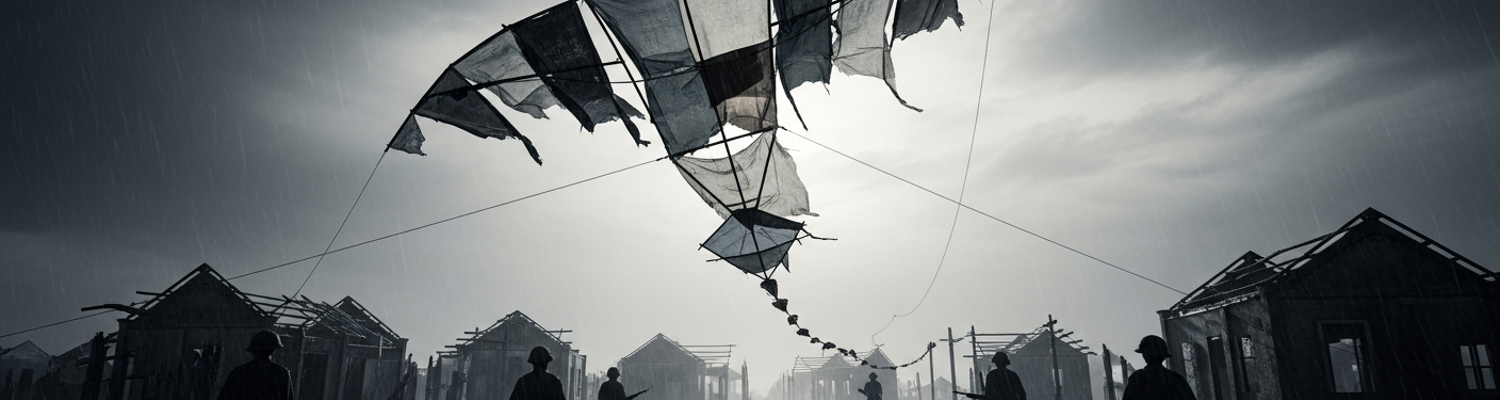

A close review of operational logs for the 25th Infantry Division shows Company A, 2nd Battalion, 35th Infantry Regiment, holding a perimeter on the volatile fringes of Saigon. The date was January 31, 1968. The Tet holiday truce was a fiction. For the men of “Cacti Blue,” the war was about to shift from jungle patrols to a desperate defense in a maze of urban decay. Their position was a hastily fortified collection of buildings and sandbagged emplacements on the edge of a district that blended seamlessly into the capital. The terrain was a nightmare of two-story shophouses, walled compounds, and narrow alleys choked with refuse. It was an environment that defeated conventional ground-level observation and offered near-perfect concealment to an infiltrating enemy.
The attack came without warning. It was a coordinated storm of mortar fire and ground assaults that erupted from the city's fabric. Viet Cong and NVA units, having moved into position under the cover of holiday celebrations, struck with precision. The fighting was immediate and total. American units accustomed to jungle warfare dynamics were forced to adapt instantly to a three-dimensional battlespace where threats could emerge from any window, rooftop, or sewer grate. The distinction between combatant and civilian evaporated in the chaos. The primary objective for Company A was simple. Hold the line. Secure the sector. Prevent a deeper penetration toward the city center.
They were fighting in a labyrinth. Fields of fire were often less than fifty meters, broken by blind corners and the skeletal remains of destroyed structures. An enemy RPG team could occupy the second floor of a blasted-out building, completely invisible to soldiers in foxholes just a street's width away. Survival depended on seeing the enemy before they could strike.
Company A possessed a unique asset for this purpose. It was a field-expedient device known as the Tethered Aerial Reconnaissance Camera, or TARC. There were no factory-built drones or dedicated reconnaissance aircraft at the company level. The TARC was a product of necessity, fabricated by the unit’s signal and maintenance sections. The apparatus consisted of a surplus neoprene weather balloon, a modified K-20 aerial camera salvaged from a derelict aircraft, and a winch assembly stripped from a disabled M151 utility truck. The camera, housed in a welded steel pod, sent a live, black-and-white video feed down a thick bundle of wires to a ground control station. Hoisted several hundred feet in the air, it provided Company A’s command post a god's-eye view of the surrounding terrain. It was their only consistent overwatch of a key infiltration route running through a series of drainage ditches just beyond the western perimeter.
The system was a constant battle against mechanical failure. The Vietnamese humidity caused persistent electrical shorts. The neoprene balloon grew brittle under the relentless cycle of tropical heat and monsoon downpours, requiring constant patching. The winch mechanism, never designed for such a load, suffered from extreme wear. On February 3rd, 1968, during a period of heavy, wind-driven rain, the primary gear inside the winch assembly stripped its teeth. The sudden loss of tension sent the main tether whipping, snapping a secondary anchor cable weakened by rust. The balloon and its heavy camera pod did not fall completely. It dropped over one hundred feet before the damaged main cable snagged, leaving the entire assembly dangling at a much lower altitude. It was now directly in the line of sight of the opposing treeline.
The crippled observation platform became an immediate target. Within minutes of its partial collapse, a Viet Cong machine gun team opened fire from a concealed position approximately 800 meters away. The weapon was likely a 12.7mm DShK. The initial bursts were high, but the gunners quickly walked the rounds onto the target. The steel camera pod, resistant to small arms, was not proofed against heavy machine gun fire. Rounds hammered the housing, puncturing it and severing internal wiring. The final sequence of fire struck the camera lens directly, shattering the optics. The video feed terminated. The TARC was gone. Company A was blind.
The destruction of the TARC was only the first failure. The second occurred less than six hours later. The company's primary communication link to battalion headquarters was a vehicle-mounted AN/VRC-12 radio system installed in the command post bunker. This system was the lifeline, connecting the company to artillery fire-direction centers at Củ Chi. At approximately 0215 hours on February 4th, a barrage of 82mm mortar rounds walked across the company’s position. One round achieved a direct hit on the command post. The blast shredded the sandbagged structure and obliterated the AN/VRC-12. The explosion also ignited a cache of spare batteries for the unit's man-portable AN/PRC-25 radios, which were being recharged nearby.
The company was deafened. Command fell back on the squad-level AN/PRC-25s, the workhorse infantry radios. These radios, however, were never intended for long-range communication back to a rear echelon headquarters. Their effectiveness depended on line-of-sight, a condition made impossible by the dense urban terrain and jungle. The torrential monsoon rains degraded the signal further. One by one, the surviving radios began to fail. Handsets shorted out in the deluge. Batteries that were not destroyed in the explosion quickly lost power with no way to recharge or replace them. Within three hours of the mortar strike, every radio in Company A was silent. They were cut off from battalion, from adjacent units, and from any external support.
This electronic isolation had dire tactical consequences. The most significant was the inability to request any form of fire support. A company in the field relied on an open line to the 1st Battalion, 8th Artillery, or the 2nd Battalion, 77th Artillery, and their 105mm howitzers. A single call could bring down high explosives on an enemy position. Without a radio, there was no way to talk to the fire-direction center. No way to request illumination rounds. No way to call for helicopter gunships or medical evacuation. Company A possessed no means to send the pre-arranged code words that would trigger a response from quick-reaction forces. They were alone.
Blind and mute. Enemy forces could now maneuver against them with near impunity, knowing the company could not coordinate a defense or call for artillery to break up an assault. Situational awareness was absolute zero. Platoon leaders had no information beyond what their own men could see and hear. To pass messages, the company reverted to using runners. This was a primitive and dangerous method in a war defined by technology. A soldier carrying a message had to physically run from one foxhole to another, exposed to sniper fire. This reality created immense psychological pressure on the command structure. Every decision was made with the knowledge that there would be no help. The Viet Cong forces arrayed against them noticed the silence and began to test the wire.
The dual failure of surveillance and communication created an absolute intelligence vacuum. Doctrinal field manuals from the period (such as FM 7-10) show an infantry company’s security posture was based on observation and communication. With both gone, the unit was fighting with antiquated senses in a modern war. The inability to see the enemy translated directly into an inability to predict their actions. Archival analyses of NVA urban tactics during Tet highlight a preference for maneuver and surprise. Without the high-angle view of the TARC, it was impossible to identify flanking maneuvers being staged just out of sight. A VC squad could move through back alleys, interconnected buildings, or even the extensive network of storm drains, emerging suddenly on a platoon’s flank or in its rear.
The company was defenseless against standoff weapons. An 82mm mortar team could set up their weapon in a courtyard several hundred meters away and drop rounds with precision, guided by a forward observer the company had no way of spotting. The mortar team itself remained hidden from direct observation and immune to counterattack by direct-fire weapons. The only effective response, counter-battery fire from artillery, was unavailable. The unit could be systematically dismantled by an enemy it could not see and could not strike back against. Every action became exponentially more hazardous. Resupplying ammunition to a position under fire was a life-or-death gamble. Casualty patterns in similar urban engagements show a high percentage of losses were incurred when troops were forced to move in the open without adequate intelligence.
The decision to attempt a solution was not born of a formal order. It came from necessity. A handful of junior NCOs and specialists from the company’s maintenance and signals sections gathered in the remains of the command post. They presented the company commander with a desperate proposal: fabricate a new aerial observation device from the wreckage of their own position. The risk was considerable. It would divert skilled soldiers from the defensive perimeter when every rifle was needed. The resulting apparatus would be a fragile, unpredictable contraption. The alternative was to remain blind and await destruction. The commander gave his assent.
It was an exercise in battlefield salvage. The original TARC was destroyed. The team needed a new lifting body and a new optical system. The primary structure for the new device was a large box kite. Its frame was constructed from lengths of thin aluminum salvaged from the support struts of a destroyed radio antenna and the floor panels of a wrecked M151. For the kite’s surface, the men stitched together three rubberized ponchos, waterproofing the seams with axle grease from a disabled truck. The choice of an optic was more challenging. The K-20 camera was a ruin. Instead, the team recovered the gunner’s primary periscope sight from a derelict M48 Patton tank that had been disabled by a mine weeks earlier just outside the perimeter. This telescopic sight, with its x8 magnification, was a heavy, complex piece of equipment. The final component was the tether. The men painstakingly unspooled and braided together hundreds of feet of WD-1 communications wire, creating a thick, unreliable line.
The engineering challenges were formidable. The first was weight. The M48 gunner's sight was a dense assembly of steel and glass. The poncho-and-aluminum kite frame was barely capable of lifting its own mass, let alone the heavy optic. The first two launch attempts in the gusting wind failed, the kite frame cracking under the strain. The solution involved stripping the sight of its heavy outer steel housing, leaving only the core optical tube, and reinforcing the kite’s central spar with bamboo cut from a nearby thicket. The second issue was control. There was no video feed. The plan was for a soldier to lie flat on the ground, directly underneath the kite, and peer up into the eyepiece of the dangling sight. This made the operator completely exposed. The kite was wildly unstable in the monsoon weather, causing the image in the sight to jerk and spin. It offered only fleeting, disorienting glimpses of the surrounding terrain. There was no way to aim the device; it flew where the wind dictated.
The first operational deployment of the improvised kite-periscope was nearly a failure. A three-man team carried the device into a small, exposed clearing. The monsoon winds were a violent, gusting torrent. As two soldiers struggled to control the braided communications-wire tether, a third, the operator, lay on his back in the mud. His task was to hold the heavy optical tube and attempt to sight through the eyepiece. The kite bucked and plunged, spinning the periscope in wild arcs. The view was a chaotic montage of sky, mud, and shattered buildings. The physical strain and disorienting view meant no single soldier could maintain the watch for more than a few minutes. The first hour yielded no actionable intelligence.
The key was the development of a stabilization and aiming method. It was a rapid, iterative process of field engineering under fire. The team first attached stabilizing tails to the kite, using long strips of fabric torn from sandbags and weighted with spent cartridges. This dampened the bucking but did not allow them to aim the device. The decisive modification was the addition of two secondary guide lines, also made from braided WD-1 wire, attached to the lower corners of the kite frame. This turned the apparatus into a three-man operation. One soldier controlled the main tether for altitude. Two others, positioned several yards apart, used the guide lines to pull against the wind, steering the kite left and right. The exposed operator, still on his back, could now receive verbal commands from a fourth soldier, an officer or NCO, who used binoculars to direct the kite team toward a specific point of interest.
This re-engineered system provided Company A with its first real-time tactical intelligence since the TARC’s destruction. The view was shaky and narrow, but it was controllable. The team could now systematically scan the battlefield. The commander could direct the kite to loiter over a specific sector. He could order the operator to focus on the second-story windows of a shophouse. The process was slow. The officer would identify a target building, the three-man kite team would maneuver the device, and the operator would scan the structure, reporting everything he could see. The intelligence was granular and immediate. A flicker of movement. The shape of a helmet. The glint of a weapon’s barrel.
Specific operational logs from February 5th demonstrate the direct impact. At approximately 1400 hours, the kite team was directed to observe a small, walled-off pagoda located about 600 meters from the company’s eastern flank. The structure was presumed empty. After several minutes of holding the kite steady, the periscope operator reported seeing three individuals in black pajamas assembling a heavy tube and baseplate inside the pagoda’s walled courtyard. The description matched that of an 82mm mortar team. The position was completely concealed from any ground-level observation post. Based on this direct sighting, the company commander rerouted a two-man M72 LAW team to a forward position with a direct line of fire into the courtyard’s gate. Minutes later, when a Viet Cong soldier opened the gate to observe the American lines, the LAW team fired. The mortar was neutralized before it could fire a single round. Later that afternoon, a scan of a dense treeline to the west revealed a concentration of approximately a dozen enemy soldiers, their presence given away only by the faint wisps of smoke from their cigarettes. This information allowed the commander to shift the primary sector of fire for an M60 machine gun team to cover that specific area, creating a pre-planned ambush for any force attempting to advance from that position.