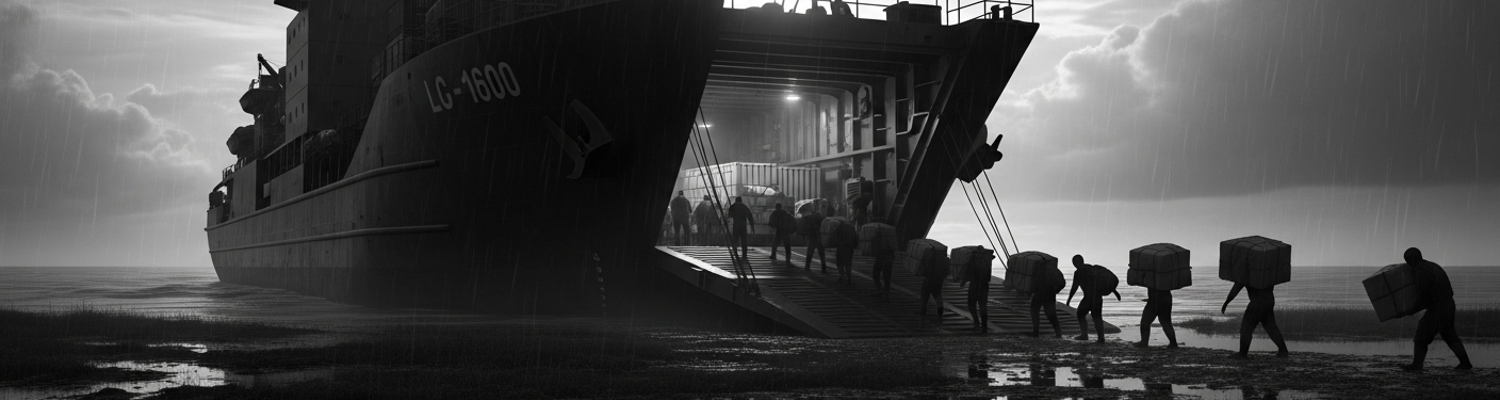

The purpose of the Landing Craft Utility 1600-class was direct. It was built to move heavy equipment and vehicles from the well decks of amphibious assault ships onto an undeveloped shore. Its existence was a matter of brutal geometry. Planners needed a vessel to bridge the gap between a ship’s hull and a solid beachhead, a workhorse designed not for combat but to deliver the tools of combat. The core mission was vehicle transport, a logistical function with a direct lineage to the Landing Craft, Tank of the Second World War. The concept was simple. Drive an M60 tank or a column of trucks onto the craft, sail to the shore, drop the bow ramp, and drive them off. This was not a vessel of finesse. It was a rugged, steel displacement craft, a floating garage intended to haul the machinery of war.
Its operational doctrine was shaped by the Cold War. Planners envisioned large-scale, ship-to-shore movements, likely on the coastlines of Europe or Asia. The LCU was a component in a chain of supply designed to build up combat power after initial assault waves had cleared a beach. They were not first-wave assets. Instead, they were scheduled to arrive once a beach was secure enough to begin the massive effort of landing heavy armor, artillery, and supply trucks. A key design feature facilitating this was the ability for multiple LCUs to connect bow-to-stern, forming a temporary pier from a larger ship to the beach, allowing for a continuous flow of vehicles.
A review of the vessel’s general specifications reveals a machine built for capacity over speed. The LCU-1610 variant measured approximately 135 feet in length with a beam just under 30 feet. Power came from a pair of Detroit 12V-71 Diesel engines, giving the craft a sustained 680 horsepower. This propulsion package could push the fully loaded vessel at a maximum of 11 knots. It was slow. But it could carry a significant load: up to 180 tons of cargo, or 400 combat-equipped troops. This translated into a practical capacity of three M60 tanks. Unlike smaller landing craft, the LCU-1600 was built for sustained, independent operations. With a range of 1,200 nautical miles at an economical 8 knots and berthing for its 10-person crew, it could function as a self-sufficient shuttle for up to ten days.
This was a flat-bottomed boat.
That design choice was essential for beaching, but it came with a trade-off. The craft required a draft of about nine feet when fully loaded, limiting the beaches it could access and making it less versatile than the air-cushioned landing craft that would follow. Its bow and stern ramps were its most important features, simple mechanical systems designed for one purpose: the rapid loading and unloading of rolling stock. The entire open cargo deck, measuring around 2,500 square feet, was dedicated to this function. Armament was purely defensive, typically two or four machine guns. The primary operational environments envisioned were the predictable littorals of a major conventional conflict.
Deployment to the Philippines for Operation Enduring Freedom beginning in 2002 thrust the aging craft into an environment for which it was never intended. The Sulu Archipelago is a labyrinth of volcanic islands, shallow seas, and unpredictable hydrography. The vessel was now tasked with penetrating a complex island chain defined by hazards that tested the limits of its design. A review of operational logs from this period indicates a constant struggle against the environment itself. The LCU’s flat-bottomed hull, requiring a draft of up to nine feet when loaded, was a liability in these waters. The region is characterized by thousands of square kilometers of uncharted coral reefs. For LCU crews, these formations represented a constant, unmapped threat. Groundings were a persistent danger, with coral heads capable of puncturing the steel hull or damaging the exposed propeller shafts and rudders. The waters were often murky with sediment runoff from island river systems, making visual navigation of these hazards nearly impossible.
This unforgiving terrain was the backdrop for a mission defined by a punishing operational tempo.
The core mission in the Philippines was supporting the Joint Special Operations Task Force-Philippines (JSOTF-P), a small contingent of U.S. forces advising and assisting the Armed Forces of the Philippines against terrorist groups like Abu Sayyaf. This was not a mission of large-scale landings but of sustained, low-intensity presence. JSOTF-P personnel were distributed across numerous small, remote outposts on islands like Basilan and Jolo. The LCU-1600 became their lifeline. The craft were engaged in continuous resupply runs, shuttling everything from ammunition and food to construction materials for reinforcing local clinics. A typical mission involved a multi-day voyage from a logistics hub like Zamboanga City to a series of isolated jungle outposts, each requiring a difficult beaching. The doctrine of a single, massive landing was replaced by a routine of constant movement. The demand was unending, forcing the vessels and their crews to operate on a cycle that far exceeded the intensity envisioned by their original designers.
The mechanical strain of this new role quickly became apparent. Post-operational reports from units assigned to JSOTF-P reveal a pattern of recurring system failures directly attributable to the unique combination of the environment and the mission. The propulsion systems were a primary point of failure. The twin Detroit 12V-71 diesel engines, while reliable in open-water transits, were not optimized for the constant low-speed maneuvering and frequent cycling required for navigating reef-strewn waters. Engine cooling systems, designed for cleaner deep-water operations, were frequently clogged with sand, silt, and marine vegetation, leading to persistent overheating issues. Propellers and drive shafts suffered repeated damage from underwater collisions. More distinct to this theater, however, was the stress placed upon the bow ramp. Designed for a limited number of cycles during a specific amphibious operation, the LCU’s ramp was now being raised and lowered multiple times a day. This led to accelerated wear on the hydraulic winch systems and mechanical linkages. Case studies show that hinge bushings would seize from a combination of corrosion and grit, causing the ramp to operate loudly, unevenly, or fail entirely. These failures were not just maintenance inconveniences. They were mission-critical.
The relentless operational tempo in the Philippine archipelago pushed the Vietnam-era LCU-1600s past their breaking points. A close review of maintenance logs from Assault Craft Unit 1 (ACU-1) and Naval Beach Unit 7, which supported JSOTF-P, reveals a vessel fighting a losing war against its own obsolescence. The propulsion system was the first to show its age. The twin Detroit 12V-71 two-stroke diesel engines were a 1960s design, ill-suited for the unique strains of the mission. This operational profile led to chronic overheating. The engine’s cooling systems were routinely choked with sand and silt from the shallow littorals around Zamboanga. Clogged heat exchangers and water pumps became a constant source of maintenance headaches, often leading to engine shutdown at the worst possible moments, such as during a delicate beaching.
This was a war of attrition fought in maintenance bays and on the steel decks of the landing craft.
The impact of continuous heavy usage was documented in a spike in demands for spare parts that the Navy’s supply system struggled to meet. A Department of Defense report from the era noted that equipment used in high-tempo combat environments could experience two to eight times the wear of peacetime usage. For the LCU-1600s, this translated into a constant state of disrepair. Crews from ACU-1 became masters of improvisation. Maintenance records show a pattern of cannibalization, where parts were stripped from one already-damaged LCU to keep another one operational. This practice, while keeping the mission afloat, created a fleet of non-operational hulls that were increasingly difficult to return to service. The constant vibration from the engines and pounding from the waves caused fatigue cracks in the hull and superstructure.
No system was more emblematic of the LCU-1600's mechanical struggles than its bow and stern ramps. These massive steel structures were the vessel’s entire reason for being, but their actuating mechanisms were not designed for the frequency of use demanded in the Philippines. Instead of a few cycles per major operation, crews were dropping and raising ramps multiple times a day to offload single pallets of water. The primary point of failure was the ramp’s hinge bushing system. Located outside the main hull and constantly exposed to the elements, the original bronze bushings required regular greasing. This was impossible to do while underway. The combination of saltwater spray, sand, and the lack of lubrication created a grinding paste that caused the massive steel hinge pins to seize. Operational after-action reports frequently mention ramps that were noisy, operated unevenly, or failed to lower or raise completely, delaying the delivery of supplies to isolated special operations teams. The hydraulic winch and cable systems that lifted the several-ton ramp also suffered, with cables fraying from corrosion and constant stress.
The LCU-1600’s deployment into the Sulu Archipelago subjected it to a threat environment its designers had never conceived. The craft was built for administrative landings, not for navigating contested littorals under fire. A close review of operational logs from ACU-1 detachments supporting JSOTF-P reveals a rapid and necessary evolution driven by hostile action. Abu Sayyaf Group (ASG) fighters, familiar with the maze-like channels between islands like Basilan and Jolo, frequently initiated attacks from concealed positions ashore. These were harassing fires from small arms, aimed at the LCU’s most vulnerable points as it navigated predictable routes. The vessel’s original construction offered almost no ballistic protection. The unarmored steel wheelhouse, the exposed crew-served weapons positions, and the open deck left the crew dangerously exposed.
This was an untenable situation.
In response, crews began a campaign of ad-hoc armoring. There was no formal upgrade package from the Navy. Instead, sailors and embarked Seabees used whatever materials they could acquire. Scavenged steel plates of various thicknesses were welded onto the exterior of the pilothouse, providing a crude but essential layer of protection for the craftmaster and navigator. Sandbags were stacked into makeshift walls around the .50 caliber machine gun tubs. In some documented cases, Kevlar blankets were hung inside crew spaces to catch spall. This was a process of reactive adaptation. After a transit through a particularly dangerous channel resulted in bullet impacts on the superstructure, a maintenance period in Zamboanga would see another steel plate added. The armoring was ugly, heavy, and unbalanced, placing further strain on the aging vessel, but it was deemed necessary.
The challenge of coordinating with dispersed special operations teams necessitated an overhaul of the LCU’s communications architecture. The craft’s standard equipment, primarily marine-band VHF and HF radios, was inadequate for the mission. JSOTF-P units operated with advanced, encrypted tactical radios, such as SINCGARS. An LCU crew using standard marine radios could not securely communicate with a Special Forces team ashore to confirm a landing zone was clear or to coordinate an emergency medical evacuation. To bridge this gap, LCU crews, often with the help of JSOTF-P communication specialists, began integrating SOF radio systems directly into their platforms. This involved running new wiring, fabricating mounting brackets, and tapping into the LCU’s limited electrical power. It was common to see man-portable AN/PRC-117 radios installed in racks within the LCU’s pilothouse, transforming the landing craft into a networked node.
Urgency drove every modification. The ad-hoc armor and enhanced radios were not part of a planned modernization program but were desperate measures taken to keep supply lines open. The small, isolated outposts of U.S. and Philippine forces depended entirely on the LCUs. These were not bulk resupply runs; they were lifeline missions carrying specific items. A single run might be tasked with delivering a specific type of 40mm grenade, IV bags for a wounded operator, or a replacement satellite radio antenna. The failure of a single mission could have dire consequences. The threat of ambush was constant. The risk of adding unbalanced weight with improvised armor or overloading the vessel’s electrical systems was weighed against the greater risk of mission failure.
The ad-hoc modifications forced upon the LCU-1600s represented a fundamental violation of their design principles. Naval architecture is a science of balance, weight, and buoyancy. The addition of scavenged steel plates and sandbags pushed the craft into a permanently overloaded and unbalanced state. A review of technical specifications shows an LCU-1600 has a designed maximum displacement of approximately 375 tons when fully loaded. The haphazardly welded steel plates and stacked sandbags added several tons of unplanned weight. This raised the vessel’s center of gravity, a factor in stability, making it more susceptible to heavy rolling. The increased weight also meant the craft sat lower in the water, increasing its draft beyond the 9-foot maximum for which it was rated. This was not a temporary cargo load; it was a permanent alteration. The operational tempo demanded by JSOTF-P meant there was no time to remove the armor between missions.
The vessel was now fighting against its own structure.
This constant state of overload, combined with the punishing rhythm of daily missions, initiated a rapid series of structural and mechanical failures. A ship’s hull is designed to flex with the waves, but the additional, poorly distributed weight created stress concentrations the original designers never anticipated. Post-mission inspections from ACU-1 consistently noted the appearance of fatigue cracks in the hull plating and superstructure, especially around the new, field-welded armor plates. These cracks were symptoms of a deeper problem. The propulsion system suffered just as severely. The twin Detroit 12V-71 diesel engines now had to propel a heavier vessel. This resulted in chronically higher engine temperatures and increased fuel consumption. The strain was most evident in the drive train; engine mounts fractured from the constant vibration, and propeller shafts experienced accelerated wear.
Every component was pushed past its engineered lifespan.
The consequences of these systemic failures were stark. The primary result was a dramatic decline in the operational availability of the LCU fleet. A craft that is constantly breaking down cannot deliver supplies. Maintenance logs from the period show a fleet caught in a vicious cycle: the intense operational demand caused accelerated wear, which led to more frequent breakdowns. This, in turn, placed even greater strain on the few remaining operational craft. Securing spare parts for the Vietnam-era vessels in a remote theater became a logistical nightmare. Reports from ACU-1 crews describe widespread cannibalization, creating a fleet of hollowed-out hulls that were nearly impossible to return to service. This state of disrepair posed a direct threat. A propulsion failure in the Basilan Strait could leave a craft drifting into hostile territory. A ramp failure on a beach could prevent the offload of vital medical supplies. The LCU-1600 was being systematically consumed by the very mission it was tasked to support.
A review of operational logs from ACU-1 reveals a direct, mechanical link between the failing LCU-1600s and severe ammunition shortages at remote outposts. In the FOBs of Basilan and Jolo, a firefight could burn through a shocking amount of ammunition. The small Special Forces and Philippine Marine units relied completely on the LCUs for resupply. An urgent request for 5.56mm rounds or 40mm grenades would be sent, and a pallet would be loaded onto an LCU in Zamboanga. But the mission's success then depended entirely on a 1960s-era engine. Multiple after-action reports document missions aborted due to one of the twin Detroit 12V-71 diesel engines overheating. Clogged heat exchangers, fouled by silty water, were a common culprit. In other instances, a loaded LCU would make it to the beaching site only for the bow ramp’s hydraulic winch to fail, leaving tons of needed munitions sitting yards from the shore, inaccessible. For the troops counting their magazines, the result was the same. The promised resupply was not coming.
The shortages were not limited to ammunition.
The impact on medical readiness was more acute. A Special Forces medic is trained to perform life-saving procedures in austere conditions, but their effectiveness is bound by the supplies they have on hand. The unreliability of the LCU supply chain meant that stocks of IV bags, blood plasma, and antibiotics were dangerously unpredictable. A single ambush could generate multiple casualties with complex trauma, rapidly depleting a team’s entire medical kit. Medics on the ground reported making agonizing decisions, forced to ration supplies based on a patient’s chances of survival until a theoretical MEDEVAC could arrive. A limited supply of saline solution might be triaged, given to one wounded soldier while another went without. These choices were a direct consequence of a logistics vessel failing to complete its route.
This all occurred within the context of escalating insurgent violence. Abu Sayyaf Group fighters were not a static force; they were actively adapting to JSOTF-P and Armed Forces of the Philippines operations. Their knowledge of the local waterways allowed them to stage ambushes with increasing frequency, often targeting the predictable resupply routes. An LCU mission was often launched in direct response to a unit being in contact. A mechanical breakdown was not just a delay; it was an active threat multiplier. An LCU dead in the water with a failed engine or stuck on a beach with a jammed ramp was a vulnerable target, and its failure left the frontline troops it was meant to support dangerously exposed.
A review of fleet readiness reports from the mid-2000s reveals the inevitable outcome of deploying the LCU-1600 fleet into the Southern Philippines. The chronic mechanical failures and the structural fatigue from ad-hoc armor created a logistical death spiral. The craft were becoming unsustainable. For every operational hour, they required an exponentially increasing number of maintenance hours, a burden that forward-deployed units like ACU-1 could not bear. The decision to phase out the LCU-1600 from its central role in supporting JSOTF-P was not a singular command, but a gradual recognition of its unsuitability. As availability rates plummeted, JSOTF-P began to rely on a wider array of assets, including helicopters and larger high-speed vessels. The LCU-1600s were not formally retired from the theater overnight. They were simply run into the ground.
The fleet was eating itself alive.
The experience in the Sulu Archipelago provided a series of stark, unavoidable lessons for naval and army logisticians. The first lesson was that in complex littoral environments, simple shallow draft was insufficient. Future craft required propulsion and steering systems protected from the kind of debris and coral that had crippled the LCU-1600’s exposed propellers and rudders. The second lesson was that survivability could not be an afterthought. The improvised steel plates on the LCUs were a testament to crew ingenuity but an indictment of a design that offered zero ballistic protection. Future logistical craft would need integrated armor incorporated from the keel up. A third lesson concerned network integration. The struggle to bolt SOF-specific radios onto the LCU-1600 highlighted the need for future platforms to be born with modern, secure, and adaptable C4ISR suites.
The ghost of the LCU-1600’s failures directly shaped its successors. The Navy’s replacement, the LCU-1700 class, is a direct response to the problems encountered in the Philippines. The contract for the new craft was awarded in 2018. The LCU-1700 features modern, reliable CAT C18 diesel engines, a significant upgrade over the failure-prone Detroit 12V-71s. Its propulsion system is further protected by Kort nozzles, offering some shielding against debris. While its speed of 11 knots is comparable to the older craft, its systems are designed for greater reliability and lower maintenance costs. The U.S. Army, drawing similar lessons, initiated the Maneuver Support Vessel (Light) or MSV(L) program. This craft represents an even more radical departure, featuring a novel tribow monohull for stability, a laden draft of only four feet, and triple waterjet propulsion, making it highly resistant to the exact sort of propeller and rudder damage that plagued the LCU-1600s. With a laden speed of over 20 knots, the MSV(L) is designed to move critical assets, like a single M1 Abrams tank, with speed and access to the shallowest of beaches, directly addressing the last-mile logistical failures of a previous generation.