Full Calendar
THIS DAY IN U.S. MILITARY HISTORY • DECEMBER 1 1950 U.S. Army Korean War

Task Force Faith Mounts Desperate Breakout at Chosin Reservoir

Trapped along the frozen eastern shore of the reservoir, American infantrymen launched a fierce fighting withdrawal through massed Chinese roadblocks.
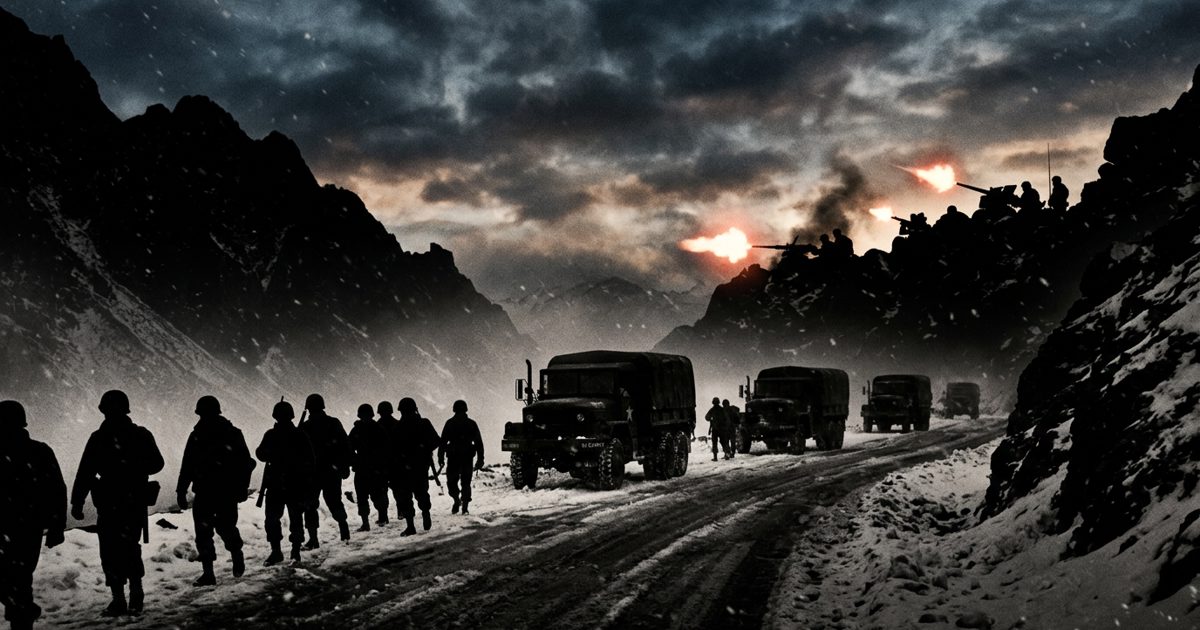
Task Force Faith Mounts Desperate Breakout at Chosin Reservoir

Soldiers of the 31st Regimental Combat Team woke to sub-zero temperatures on the eastern shoreline of North Korea reservoir. Lieutenant Colonel Don C. Faith Jr. assumed command of the isolated perimeter after Colonel Allan MacLean suffered mortal wounds in prior fighting. Surrounded by veteran divisions of the Chinese People's Volunteer Army, Faith ordered the demolition of all heavy artillery and non-essential gear to load more than six hundred wounded comrades into unarmored transport trucks. The column gathered on the snowbound dirt roadway to attempt an eight-mile dash southward toward Marine positions at Hagaru-ri.

Chinese infantry entrenched on the ridgelines overlooking the roadway opened fire with heavy machine guns and mortars as soon as the American convoy began moving. Faith repeatedly charged forward into bullet-swept snowdrifts to rally pinned soldiers and direct suppressive fire against concealed bunkers. Friendly aircraft flying close air support accidentally dropped napalm near the front of the column, causing temporary panic and scattered ranks. Faith rallied his men despite the chaos, organizing infantry squads to assault dug-in enemy positions along the slopes of Hill 1221.

Survivors fought their way past several enemy barriers until a blown bridge and a fortified roadblock halted the lead vehicles near the southern edge of the reservoir. Faith personally charged the final roadblock while hurling hand grenades and firing his sidearm until enemy rifle bullets mortally wounded him. The convoy disintegrated under relentless night attacks, forcing ambulatory soldiers to abandon disabled trucks and cross the treacherous surface ice on foot. Nearly one thousand wounded and frostbitten men reached Marine lines at Hagaru-ri during the night, preserving critical strength for the subsequent breakout to the sea.

CHRONOLOGICAL RECORD

December 1 Across U.S. Military History

8 Verified Events
1779 Continental Army Landmark Event • American Revolutionary War

Continental Army Occupies Winter Quarters at Morristown

General George Washington led the Continental Army into winter cantonment at Jockey Hollow near Morristown, New Jersey. Troops cleared heavily wooded hillsides to construct twelve hundred log cabins to shelter ten thousand soldiers. The encampment endured twenty-eight blizzards and extreme cold during the harshest recorded winter of the eighteenth century.

1842 U.S. Navy Landmark Event • Antebellum Era

Executions Aboard USS Somers Spark Naval Reform

Commander Alexander Slidell Mackenzie ordered Midshipman Philip Spencer, Boatswain Samuel Cromwell, and Seaman Elisha Small hanged from the yardarm of the training brig USS Somers at sea. Mackenzie accused the trio of organizing a mutinous plot to seize the warship for piracy. The executions sparked widespread public controversy and drove the establishment of the United States Naval Academy in 1845.

1918 U.S. Army Landmark Event • World War I

Third Army Crosses Border into Germany

Soldiers of the United States Third Army crossed the Moselle River frontier from Luxembourg into Germany to initiate the Allied occupation of the Rhineland. Major General Joseph T. Dickman directed three corps to secure key transit corridors and administrative centers. American forces advanced methodically toward the Rhine River to establish headquarters at Koblenz.

1921 U.S. Navy • Interwar Era

Navy Airship C-7 Flies First Helium Mission

Navy pilot Lieutenant Commander Ralph F. Wood steered the non-rigid blimp C-7 from Hampton Roads, Virginia, to Bolling Field in Washington, D.C. The historic flight proved the operational viability of non-flammable helium as a safe lifting gas for military lighter-than-air vessels. The demonstration prompted the Navy to adopt helium across its expanding airship fleet.

1941 U.S. Army Air Forces Landmark Event • World War II

Civil Air Patrol Established for Homeland Defense

Director Fiorello La Guardia signed Administrative Order 9 to establish the Civil Air Patrol under the federal Office of Civilian Defense. The agency organized private civilian aircraft and volunteer pilots into an auxiliary arm to protect coastal shipping and patrol border airspace. Thousands of civilian airmen mobilized within weeks following the attack on Pearl Harbor.

1942 U.S. Navy • World War II

Heavy Cruiser USS Northampton Sinks off Guadalcanal

Crewmen abandoned the damaged heavy cruiser USS Northampton in Ironbottom Sound several hours after Japanese torpedoes struck her port side during the night engagement off Tassafaronga. The warship succumbed to flooding and rolled over shortly after three in the morning. American destroyers rescued seven hundred seventy-three officers and enlisted men from the dark waters.

1944 U.S. Army • World War II

22nd Infantry Regiment Repels Counterattack at Grosshau

Infantrymen of the 22nd Infantry Regiment, 4th Infantry Division, defended captured ground in the village of Grosshau during the bitter Battle of the Hurtgen Forest. Mortar squads poured rapid defensive fire into advancing German infantry formations attempting to retake the crossroads. Heavy artillery support and determined riflemen broke the counterattack, securing the approach to the Roer River plain.

1969 Joint Service Landmark Event • Vietnam War

Selective Service Holds First Draft Lottery Since 1942

Officials at Selective Service National Headquarters in Washington, D.C., conducted a televised random lottery to establish conscription order for 1970 military service. Representative Alexander Pirnie drew the first capsule, which contained the date September 14. The lottery determined the call sequence for hundreds of thousands of draft-eligible men born between 1944 and 1950.

MEDAL OF HONOR ACTION 1966

Staff Sergeant Edward Kaneshiro Clears Enemy Trenches in Kim Son Valley

Staff Sergeant Edward N. Kaneshiro led his infantry squad near the village of Phu Huu 2 in South Vietnam's Kim Son Valley. His unit, assigned to the 1st Squadron, 9th Cavalry Regiment, scouted open ground east of the hamlet. Concealed North Vietnamese troops ambushed two sister squads in the village center with heavy machine gun fire from a fortified trench. The initial barrage killed the platoon leader and pinned down the surviving soldiers in exposed terrain.

Kaneshiro realized his comrades faced destruction and advanced alone toward the hostile trench without waiting for orders. He crawled to the parapet and dropped a grenade through the aperture of the primary bunker, killing the enemy machine gunner. Jumping into the ditch with his rifle and remaining grenades, Kaneshiro cleared thirty-five meters of trench line by eliminating multiple enemy positions. His solo charge silenced the resistance, allowing his platoon to extract the wounded and safely withdraw.