Full Calendar
THIS DAY IN U.S. MILITARY HISTORY • NOVEMBER 30 1864 U.S. Army Civil War

Union Earthworks Hold Firm at the Battle of Franklin

Major General John Schofield repulses eighteen Confederate frontal assaults outside Nashville.
Union Earthworks Hold Firm at the Battle of Franklin

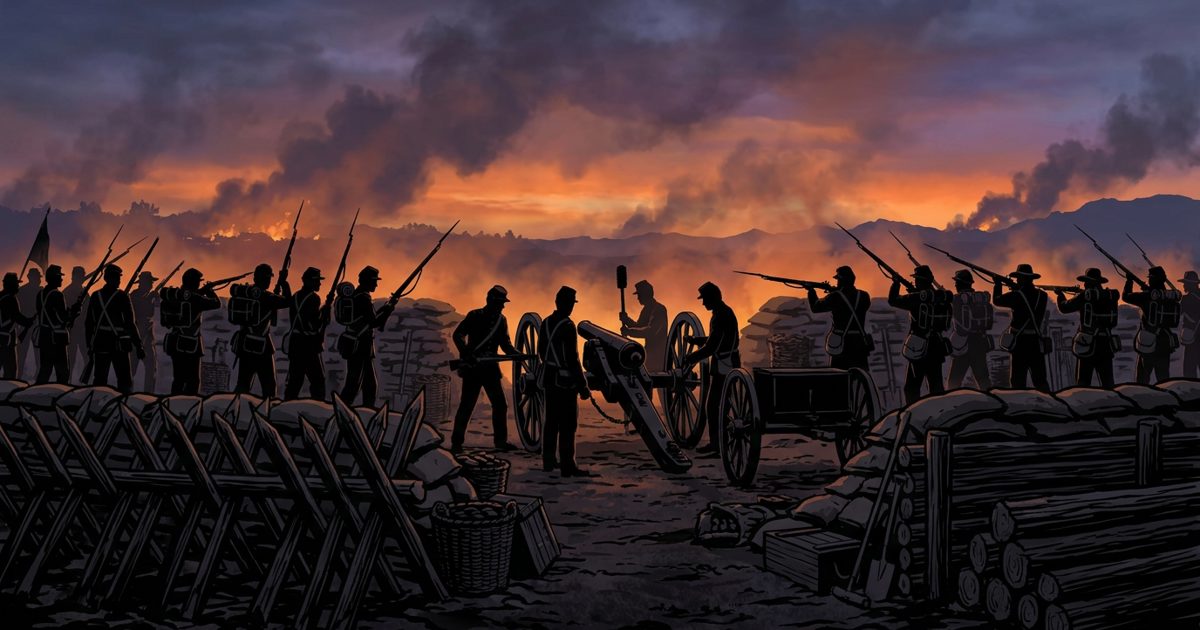
Union soldiers entrenched across the southern edge of Franklin, Tennessee, early on November 30, 1864, after marching through the night from Spring Hill. Major General John Schofield positioned twenty-seven thousand Union troops from the Army of the Ohio and the Army of the Cumberland in a tight crescent anchored on the Harpeth River. Brigadier General Jacob Cox supervised the rapid construction of deep breastworks, revetments, and outer abatis surrounding the Carter farmstead. Schofield needed several hours of daylight for his engineers to repair two damaged bridges across the river so his artillery trains and supply wagons could safely withdraw toward Nashville.

Lieutenant General John Bell Hood deployed twenty thousand Confederate infantrymen across two miles of open fields at four in the afternoon without waiting for his artillery. Rebel divisions advanced with fixed bayonets in parade-ground alignment, crashing directly into isolated forward outposts held by two Federal brigades. The fleeing Union skirmishers temporarily masked the defensive fire of the main line, allowing Confederate divisions under Major General Patrick Cleburne and Major General John C. Brown to momentarily puncture the Union center at the Carter House. Colonel Emerson Opdycke immediately led his reserve brigade in a ferocious countercharge, plugging the gap and trapping the attackers in crossfires of point-blank musket volleys and double-canister artillery blasts.

Darkness brought no respite as Confederate brigades launched eighteen distinct charges into the entrenched Union perimeter before midnight. Repeating rifles carried by Federal infantry swept the approaches, stacking casualties along the exterior ditches and destroying the offensive capability of the Army of Tennessee. Hood lost over six thousand soldiers, including fourteen general officers killed, wounded, or captured, with Cleburne among the six dead generals on the field. Schofield withdrew his intact corps across the repaired Harpeth River bridges before dawn, marching unimpeded into the fortifications of Nashville.

CHRONOLOGICAL RECORD

November 30 Across U.S. Military History

8 Verified Events
1782 Continental Army Landmark Event • American Revolutionary War

Preliminary Peace Articles Signed in Paris

Commissioners John Adams, Benjamin Franklin, John Jay, and Henry Laurens signed preliminary articles of peace with British representative Richard Oswald in Paris on November 30, 1782. Great Britain formally recognized the independence of the United States and agreed to withdraw all royal land and naval forces. The agreement established American territorial boundaries extending westward to the Mississippi River.

1864 U.S. Army • Civil War

Union Assault Repulsed at Honey Hill

Brigadier General John Hatch led five thousand Federal troops, including the 54th and 55th Massachusetts infantries, against fortified Confederate positions at Honey Hill, South Carolina, on November 30, 1864. Entrenched rebel artillery pinned the attacking columns across swampy terrain, inflicting heavy casualties. First Lieutenant Orson Bennett of the 102nd U.S. Colored Infantry earned the Medal of Honor for recovering abandoned artillery.

1886 U.S. Coast Guard • Gilded Age

Revenue Cutter Rush Intercepts Contraband Steamer

Captain Calvin Hooper commanded the revenue cutter Richard Rush during an interception of the transpacific steamer Rio de Janeiro off San Francisco on November 30, 1886. Armed boarding officers seized three hundred fifty pounds of smuggled opium hidden near the stern. This operation marked the first recorded at-sea narcotics interdiction conducted by the United States Revenue Cutter Service.

1942 U.S. Navy Landmark Event • World War II

Task Force 67 Intercepts Japanese Destroyers

Rear Admiral Carleton Wright led five cruisers and four destroyers into Ironbottom Sound off Guadalcanal on November 30, 1942. American gunfire destroyed the destroyer Takanami, but Japanese warships launched Type 93 Long Lance torpedoes that sank heavy cruiser USS Northampton and crippled three other cruisers. Rigorous damage control efforts enabled the surviving American warships to reach port for extensive repairs.

1950 U.S. Army • Korean War

Combat Engineers Burn Colors at Kunu-ri

Soldiers of the 2nd Engineer Combat Battalion defended the rear of the retreating 2nd Infantry Division near Kunu-ri, North Korea, on November 30, 1950. Chinese forces encircled the withdrawal route, subjecting the column to heavy machine gun ambushes. Battalion commander Lieutenant Colonel Alarich Zacherle ordered all heavy equipment destroyed and burned the unit colors to prevent their capture.

1972 U.S. Armed Forces • Vietnam War

Troop Ceiling Halts Public Withdrawal Announcements

Defense officials announced on November 30, 1972, that routine public briefings detailing troop withdrawals from South Vietnam would cease. American military personnel in the country had declined to twenty-seven thousand, down from a peak of over five hundred forty thousand soldiers and Marines in 1969. The remaining forces focused primarily on air operations and advisory support as peace negotiations continued.

1981 U.S. Armed Forces Landmark Event • Cold War

Nuclear Weapons Reduction Talks Open in Geneva

Delegates from the United States and the Soviet Union convened in Geneva on November 30, 1981, to open negotiations on reducing intermediate-range nuclear forces in Europe. Ambassador Paul Nitze led the American defense and diplomatic team, seeking the elimination of Soviet SS-20 missiles in exchange for halting planned Pershing II deployments. These foundational discussions established the framework for the landmark 1987 treaty.

1995 U.S. Armed Forces Landmark Event • Post-Cold War

Department of Defense Concludes Desert Storm Operations

Defense Department authorities officially closed the Southwest Asia Cease-Fire Campaign on November 30, 1995, terminating operational service eligibility for Operation Desert Storm. American forces had maintained no-fly zones and naval monitoring in the Persian Gulf for over four years following the liberation of Kuwait. Service members who deployed during this period completed the final recognized campaign phase of the Gulf War.

MILITARY AVIATION 1951

Major George Davis Downs Four Aircraft in MiG Alley

Major George Andrew Davis Jr. led eight F-86 Sabre jet fighters of the 334th Fighter-Interceptor Squadron over northwestern Korea on November 30, 1951. His flight spotted nine Chinese Tupolev Tu-2 bombers escorted by sixteen La-11 piston fighters and twenty-four MiG-15 jets heading toward Taehwa-do Island. Davis dove his Sabre directly through the fighter screen from ten thousand feet. Heavy machine gun fire from his aircraft shattered the bomber formation, destroying two Tupolevs and sending a third spiraling into the Yellow Sea.

Escort fighters swarmed Davis as he pulled out of his dive, but he reversed controls and engaged an attacking MiG-15. Davis destroyed the enemy jet with a direct deflection burst, scattering the remaining hostile fighters and saving a damaged wingman. Hostilities on this single patrol yielded four confirmed victories, making Davis the fifth American jet ace of the Korean War. Air Force planners noted that this decisive air battle permanently halted Chinese daylight bombing raids along the Yalu.