CHRONOLOGICAL RECORD
December 19 Across U.S. Military History
9 Verified Events
1776
Continental Army
Landmark Event
• American Revolutionary War
Thomas Paine Releases The American Crisis Pamphlet
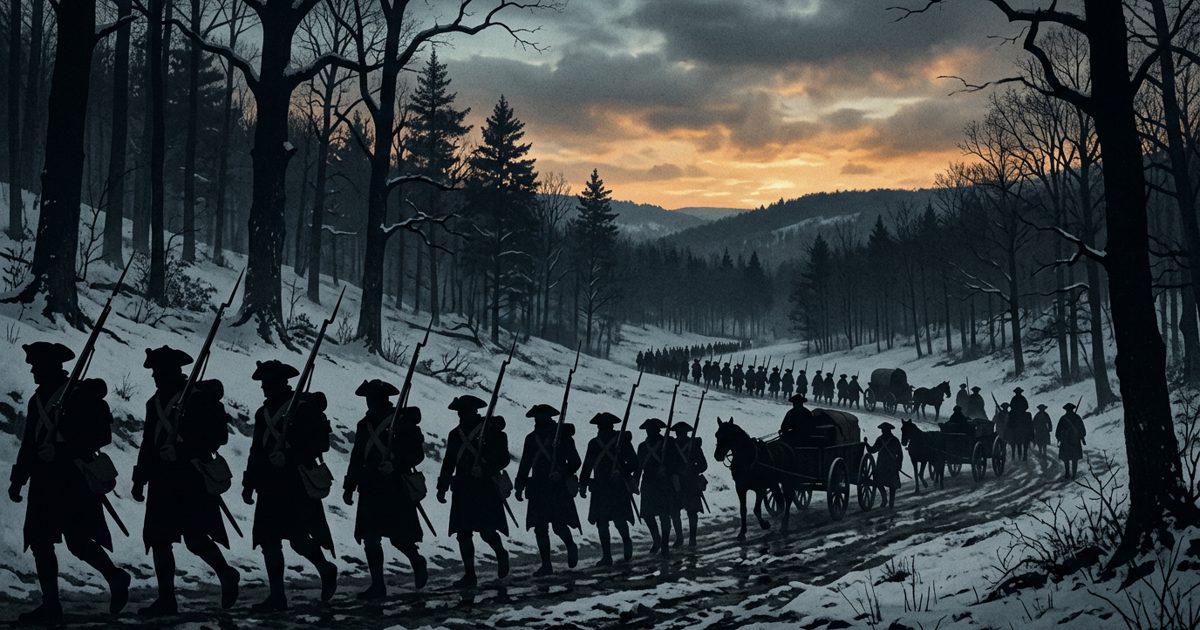
Author Thomas Paine published the first issue of The American Crisis in Philadelphia to bolster colonial morale during the Continental Army retreat across New Jersey. General George Washington recognized the persuasive power of the text and ordered officers to read it aloud to every regiment. The stirring prose revitalized dispirited soldiers days before their surprise crossing of the Delaware River.
1813
U.S. Army
• War of 1812
British Night Attack Captures Fort Niagara
Colonel John Murray led British regular infantry across the frozen Niagara River to capture Fort Niagara in a surprise nighttime bayonet assault. Assaulting forces penetrated an open gate, killing eighty American defenders and capturing more than three hundred prisoners. The defeat cost the United States its primary fortress and artillery depot along the northern New York border.
1864
U.S. Army
• American Civil War
Union Cavalry Strikes Altamaha River Railroad Bridge
Colonel Smith D. Atkins led a Union cavalry brigade against Confederate fortifications protecting the Doctortown railroad trestle over the Altamaha River in Georgia. Troopers dismantled outlying tracks and destroyed wooden trestle sections while under heavy fire from entrenched state militia batteries. Confederate artillery prevented the capture of the main span, preserving an evacuation rail line toward Savannah.
1899
U.S. Army
• Philippine-American War
Major General Henry Ware Lawton Falls at San Mateo
Major General Henry Ware Lawton fell mortally wounded by sniper fire while directing troops at the Battle of San Mateo in the Philippines. Lawton was walking along the front lines in rain gear when struck, making him the highest-ranking American officer killed during the war. His troops subsequently rallied, crossed the Marikina River, and drove the opposing forces from the town.
1944
U.S. Navy
Landmark Event
• World War II
Submarine USS Redfish Sinks Carrier Unryu
Commander Louis D. McGregor guided the submarine USS Redfish to intercept and sink the Japanese aircraft carrier Unryu in the East China Sea. Torpedo hits ignited volatile aviation fuel and thirty rocket-propelled Ohka suicide aircraft stored in the lower hangar bay. The resulting detonations obliterated the carrier, marking the final fleet carrier sunk by an American submarine in World War II.
1944
U.S. Army
Landmark Event
• World War II
Task Force Desobry Blocks German Panzers at Noville
Major William Desobry led a reinforced armor team and paratroopers from the 101st Airborne Division to defend the crossroads village of Noville, Belgium. American tank destroyers and infantry engaged the advancing 2nd Panzer Division through thick fog, destroying more than thirty enemy tanks. The stubborn holding action delayed the German advance toward Bastogne, securing vital hours for Allied lines to form.
1960
U.S. Navy
• Cold War
Deadly Fire Engulfs Supercarrier USS Constellation
Fuel spilled from a punctured diesel tank ignited a catastrophic blaze aboard the unfinished supercarrier USS Constellation at the Brooklyn Navy Yard. Flames rapidly spread through wooden scaffolding across multiple hangar decks, trapping hundreds of civilian workers. The disaster killed fifty workers and injured one hundred fifty others, delaying the warship's completion by several months.
1972
U.S. Air Force
Landmark Event
• Vietnam War
Air Force Expands Operation Linebacker II Bombing Missions
Bombers from Strategic Air Command pounded rail yards, warehouses, and thermal power facilities across North Vietnam on the second night of Operation Linebacker II. Crews flying B-52 Stratofortresses dropped thousands of tons of ordnance through heavy concentrations of surface-to-air missiles. The precision strikes disrupted North Vietnamese logistics and pressed Hanoi back into negotiations.
1972
U.S. Navy
Landmark Event
• Space Exploration / Cold War
USS Ticonderoga Recovers Returning Apollo 17 Crew
Divers and flight deck crew aboard the aircraft carrier USS Ticonderoga retrieved the Apollo 17 command module after splashdown in the South Pacific Ocean. Sailors hoisted astronauts Eugene Cernan, Ronald Evans, and Harrison Schmitt safely aboard the carrier within an hour of landing. The naval recovery marked the official completion of the United States Apollo lunar landing program.