Full Calendar
THIS DAY IN U.S. MILITARY HISTORY • NOVEMBER 15 1942 U.S. Navy World War II

USS Washington Crushes Japanese Battleship Kirishima off Guadalcanal

Rear Admiral Willis Lee navigates midnight waters off Savo Island to break Japan's naval offensive.
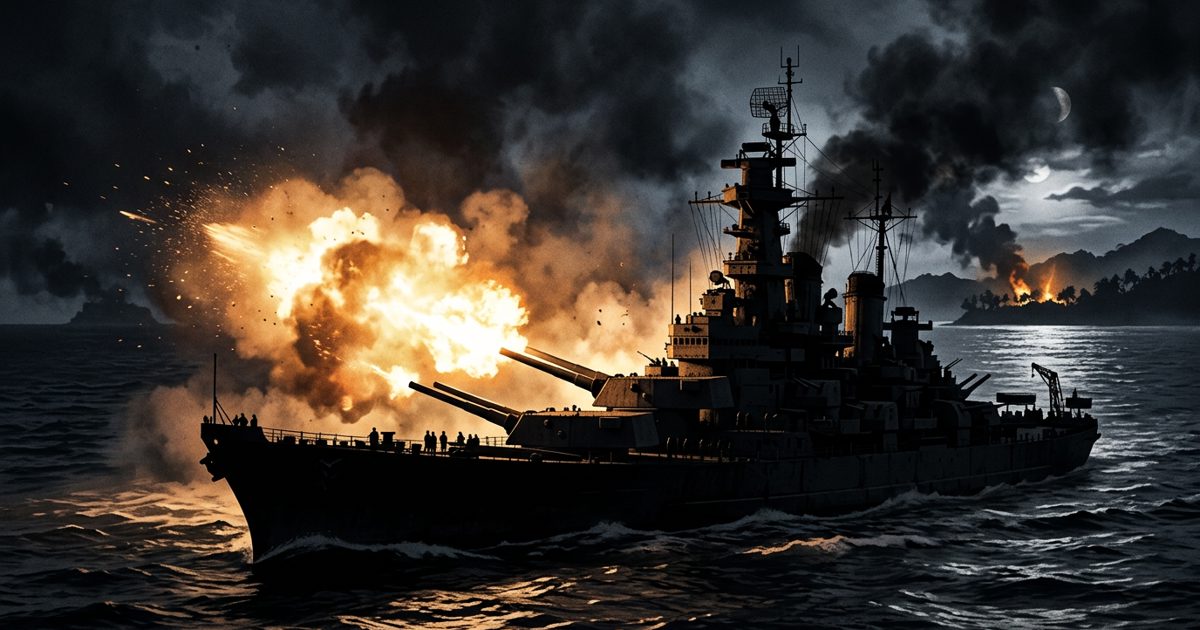
USS Washington Crushes Japanese Battleship Kirishima off Guadalcanal

Radar screens aboard the battleship USS Washington illuminated enemy surface contacts shortly after midnight near Savo Island. Rear Admiral Willis A. Lee commanded Task Force 64 as Japanese warships under Vice Admiral Nobutake Kondo advanced into Ironbottom Sound to bombard American positions at Henderson Field. Heavy gunfire erupted rapidly across the black water, quickly crippling several accompanying American destroyers and leaving battleship USS South Dakota exposed under enemy searchlights. South Dakota took twenty-seven damaging hits as Japanese gunners concentrated their fire, leaving Washington completely undetected in the blind darkness.

Gunnery officers aboard Washington utilized their advanced SG radar systems to lock directly onto the Japanese battleship Kirishima at a range of only 8,400 yards. Main battery turrets swung smoothly toward the target, unleashing nine massive 16-inch guns in rapid succession alongside concentrated 5-inch secondary barrages. Washington hurled seventy-five armor-piercing heavy shells and over one hundred secondary rounds across seven intense minutes, ripping through Kirishima's steering compartments and superstructure. Devastating explosions tore open the Japanese capital ship, causing severe flooding below the waterline that forced the crew to scuttle the burning vessel just hours later.

Task Force 64 secured operational control of the sea surrounding Guadalcanal following the midnight clash. Willis Lee turned his surviving battleship south to draw enemy pursuit away from the battered South Dakota and damaged destroyers. Transport convoys carrying critical Japanese Army reinforcements scattered under repeated air strikes the following morning, permanently extinguishing Tokyo's capability to mount large-scale naval counteroffensives in the southern Solomons.

CHRONOLOGICAL RECORD

November 15 Across U.S. Military History

8 Verified Events
1777 Continental Army Landmark Event • American Revolutionary War

Continental Congress Approves Articles of Confederation

Delegates gathered in York, Pennsylvania, formally approved the Articles of Confederation to establish America's first national constitution. The framework provided a legal structure for the Continental Army under General George Washington while maintaining sovereign authority among the individual thirteen states.

1777 Continental Army • American Revolutionary War

Defenders Evacuate Battered Fort Mifflin

Major Simeon Thayer withdrew his surviving garrison of Continental soldiers across the Delaware River after enduring the heaviest British naval bombardment of the war. Troops left the American colors flying over burning ramparts, successfully delaying Royal Navy supply ships headed to Philadelphia.

1864 U.S. Army Landmark Event • American Civil War

Sherman Launches Famous March to the Sea

Major General William Tecumseh Sherman led 62,000 Union troops out of Atlanta, Georgia, severing communications with Washington to embark on a campaign toward Savannah. Soldiers operated under orders to live off the land, wreck rail lines, and systematically dismantle Confederate war infrastructure.

1942 U.S. Army Air Forces • World War II

First Women Pilots Enter USAAF Flight Training

Trainees reported to the Houston Municipal Airport in Texas to form Class 43-W-1 of the Women's Flying Training Detachment. Pioneer aviator Jacqueline Cochran organized the unit to qualify female pilots for domestic military aircraft ferrying and target towing assignments across the United States.

1951 U.S. Army • Korean War

Private Mack Jordan Earns Medal of Honor

Private First Class Mack A. Jordan provided heroic covering fire near Kumsong, Korea, allowing his trapped squad from the 21st Infantry Regiment to withdraw and reorganize. Jordan destroyed an enemy machine gun bunker and fought relentlessly despite suffering fatal wounds from enemy demolition charges.

1960 U.S. Navy Landmark Event • Cold War

USS George Washington Deploys on First Deterrent Patrol

USS George Washington departed Charleston, South Carolina, carrying sixteen armed Polaris A-1 ballistic missiles. Commander James Osborn led the Blue crew on a sixty-six-day continuous submerged operational patrol, inaugurating the sea-based leg of the American nuclear triad.

1967 U.S. Air Force • Cold War

Major Michael Adams Killed in X-15 Flight

Major Michael J. Adams reached an altitude of 266,000 feet in an X-15 rocket plane before electrical malfunctions caused a hypersonic spin during atmospheric reentry. Aerodynamic stress fractured the research aircraft at 62,000 feet, marking the only fatal crash of the X-15 flight test program.

1969 U.S. Navy • Cold War

Attack Submarine USS Gato Collides with Soviet K-19

USS Gato collided with Soviet ballistic missile submarine K-19 while operating submerged at a depth of two hundred feet in the Barents Sea. The collision damaged the Soviet vessel's forward sonar dome and torpedo caps, though both submarines survived and returned to port under their own power.

NAVAL WARFARE 1960

Inaugural Polaris Strategic Deterrent Patrol of USS George Washington

Commander James B. Osborn guided the fleet ballistic missile submarine USS George Washington away from Naval Weapons Station Charleston, South Carolina, on November 15, 1960. The vessel carried sixteen Polaris A-1 solid-fueled ballistic missiles armed with nuclear warheads. Shipbuilders constructed the pioneer submarine by inserting a 130-foot missile bay into a modified Skipjack-class attack hull at Groton, Connecticut. The maiden deployment proved that nuclear submarines could remain submerged for months while providing an undetectable deterrent patrol.

Sailors maintained total radio silence as the submarine cruised submerged across the North Atlantic for sixty-six consecutive days. Advanced inertial navigation consoles provided precise missile targeting data without requiring the submarine to surface for celestial sightings. George Washington concluded its voyage in January 1961 at New London, Connecticut, establishing the continuous sea-based deterrent patrol of the American nuclear triad.