Full Calendar
THIS DAY IN U.S. MILITARY HISTORY • NOVEMBER 19 1967 U.S. Army Vietnam War

Paratroopers Assault Hill 875 at Dak To

Soldiers from the 173rd Airborne Brigade launch an assault against entrenched North Vietnamese forces in the Central Highlands.
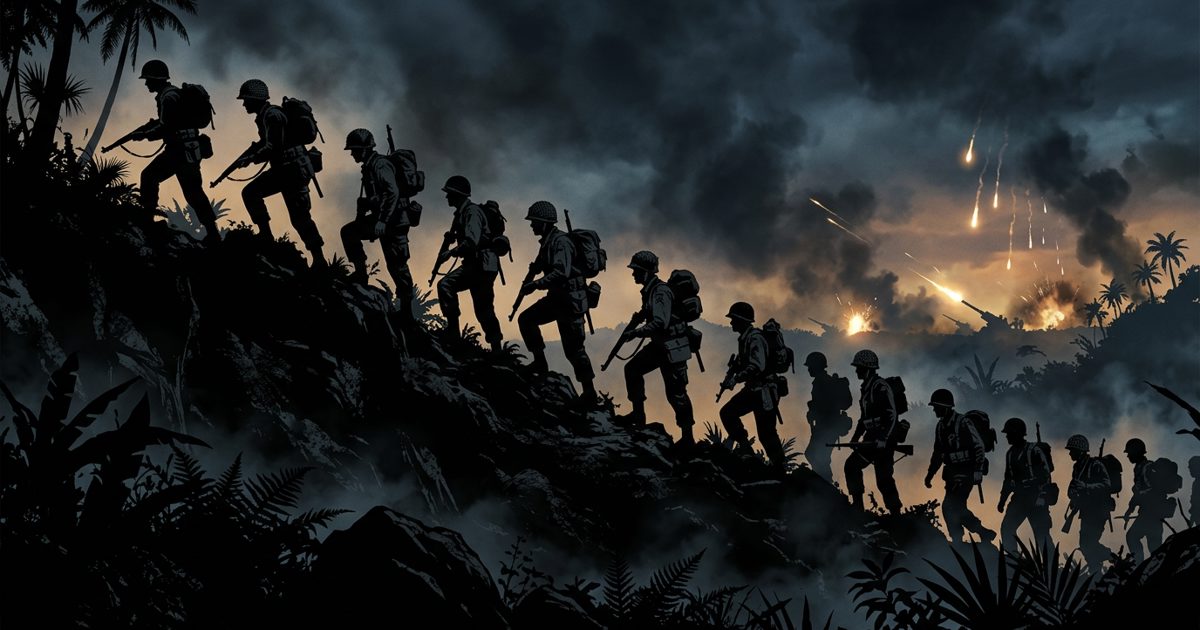
Paratroopers Assault Hill 875 at Dak To

Paratroopers of the 2nd Battalion, 503rd Infantry, 173rd Airborne Brigade moved out to assault Hill 875 near Dak To. American commanders anticipated light enemy contact, but two battalions of the North Vietnamese Army 174th Regiment held fortified bunkers along the ridge. Company A climbed the steep western slope under covering fire from artillery and air strikes. Hidden machine gunners opened fire from camouflaged bunkers as the lead platoons approached within two hundred meters of the crest. This ambush halted the advance and trapped the company, forcing the battalion to call in reinforcements.

Reinforcements from Company C rushed up the ridge to link with the pinned paratroopers, but enemy fighters encircled the hillside and cut supply lines. Mortar barrages pounded the American perimeter while anti-aircraft fire drove off medical evacuation helicopters. Army Chaplain Charles Joseph Watters ran outside the defensive lines without a weapon to carry wounded paratroopers to safety. Watters repeatedly braved intense gunfire until an errant bomb struck the battalion aid station, killing him and dozens of wounded men. His actions earned the Medal of Honor as surviving soldiers dug shallow trenches to endure the night.

Darkness brought repeated enemy charges that the battered paratroopers repelled with close-range rifle fire and artillery support. Surviving soldiers held the ridge for fifty hours until the 4th Battalion breached the encirclement to deliver fresh ammunition and water. Paratroopers captured the crest on November 23 after four days of fighting that claimed 107 American lives on the hill. Army leaders subsequently revised air-support coordination procedures and tactical reconnaissance doctrine throughout the Central Highlands.

CHRONOLOGICAL RECORD

November 19 Across U.S. Military History

8 Verified Events
1775 Continental Army • American Revolutionary War

First Siege of Ninety Six Begins

Militiamen under Major Andrew Williamson fortified a makeshift stockade at Savage's Old Fields in backcountry South Carolina on November 19, 1775. Loyalist forces surrounding the position initiated the first major southern land clash of the Revolutionary War. Both sides exchanged sustained rifle fire for three days before agreeing to a temporary truce.

1813 U.S. Navy • War of 1812

Frigate Essex Annexes Pacific Island Base

Captain David Porter landed sailors and Marines from the frigate USS Essex on Nuku Hiva in the Marquesas Islands on November 19, 1813. Porter claimed the territory for the United States and erected Fort Madison to repair commerce-raiding warships. His outpost served as the first U.S. naval installation established in the Pacific Ocean.

1863 U.S. Army Landmark Event • American Civil War

Lincoln Delivers the Gettysburg Address

President Abraham Lincoln spoke at the dedication of Soldiers' National Cemetery in Gettysburg, Pennsylvania, on November 19, 1863. Lincoln delivered a concise 272-word address honoring the fallen soldiers of the Army of the Potomac who died repelling the Confederate invasion. His speech defined the Civil War as a battle for national unity and human equality.

1917 U.S. Navy • World War I

Destroyer USS Chauncey Lost off Gibraltar

Destroyer USS Chauncey collided in darkness with the British merchant ship SS Rose while escorting an Allied convoy off Gibraltar on November 19, 1917. Chauncey sank within minutes, resulting in the loss of twenty-one American naval personnel, including commanding officer Lieutenant Commander Walter E. Reno. Allied escorts recovered surviving sailors to continue transit across the submarine-threatened Mediterranean.

1942 U.S. Marine Corps • World War II

Captain Joe Foss Concludes Historic Guadalcanal Victory Run

Captain Joseph J. Foss completed his initial combat deployment over Guadalcanal by shooting down his twenty-third Japanese aircraft on November 19, 1942. Serving as executive officer of Marine Fighting Squadron 121, Foss directed flights of the Cactus Air Force from Henderson Field through six weeks of intense air combat. Severe malaria forced his medical evacuation that day before he returned to match the wartime record of twenty-six aerial victories and receive the Medal of Honor.

1943 U.S. Navy Landmark Event • World War II

Task Force 50 Strikes Gilbert Islands

Aircraft from Task Force 50 launched heavy air strikes against Japanese positions on Tarawa, Makin, and Nauru on November 19, 1943. Naval aviators bombed coastal artillery and airfield infrastructure to neutralize enemy defenses on the eve of Operation Galvanic. These preparatory strikes degraded Japanese air power hours before amphibious forces landed on the beaches.

1944 U.S. Army • World War II

Staff Sergeant Ruben Rivers Holds the Line

Staff Sergeant Ruben Rivers of the all-Black 761st Tank Battalion engaged German antitank guns near Bourgaltroff, France, on November 19, 1944. Rivers refused medical evacuation for earlier wounds and opened fire from his tank to protect his retreating company until enemy shells killed him. His courageous stand earned him a posthumous Medal of Honor.

1969 U.S. Navy Landmark Event • Cold War

Navy Astronauts Complete Second Moon Landing

Astronauts Charles Conrad Jr. and Alan L. Bean landed the Apollo 12 lunar module Intrepid in the Ocean of Storms on November 19, 1969. Both active-duty Navy commanders achieved a pinpoint touchdown within walking distance of the robotic Surveyor 3 probe. Their lunar excursion retrieved spacecraft instruments and collected seventy-five pounds of rock samples for scientific study.

MEDAL OF HONOR ACTION 1943

Captain John Philip Cromwell Safeguards Pacific War Secrets

Captain John Philip Cromwell boarded the submarine USS Sculpin as commander of a wolfpack targeting Japanese shipping near Truk. Cromwell carried full knowledge of top-secret Ultra codebreaking and the tactical plans for the imminent invasion of the Gilbert Islands. Enemy depth charges from the destroyer Yamagumo severely damaged Sculpin on November 19, 1943, jamming its depth gauge and breaching the hull. Commander Fred Connaway ordered the submarine to surface so the crew could abandon ship under gunfire.

Crewmen scrambled into the sea, but Cromwell knew enemy interrogation and drugs could force him to disclose the invasion plans. He deliberately stayed inside the control room as the scuttled submarine sank beneath the waves. Japanese captors took forty-two survivors prisoner without uncovering the classified naval offensive. Cromwell received the Medal of Honor posthumously for giving his life to protect Pacific Fleet intelligence.